
This lesson guides you through the mandatory lighting equipment on your vehicle and the strict regulations for using it under various Austrian traffic conditions. Mastering these rules is essential for both your theory exam and real-world safety, helping you see and be seen at all times.

Lesson content overview
Proper use of your vehicle's lighting system is fundamental to safe driving in Austria. It enables you to clearly see the road ahead and ensures that your vehicle is visible to other road users, significantly reducing the risk of accidents. This comprehensive guide covers the legal requirements and practical application of all vehicle lights under the Austrian Traffic Regulations (StVO), empowering you to make informed decisions in diverse driving conditions.
Vehicle lighting systems are crucial for both active illumination and passive conspicuity. Active illumination refers to the lights that help you see the road, such as headlights, allowing you to detect hazards, read road signs, and anticipate changes in the environment. Passive conspicuity, on the other hand, ensures that your vehicle is seen by others, preventing collisions by making your presence clear, especially in low light or adverse weather conditions.
Misunderstanding or improper use of lighting can lead to dangerous situations, including temporary blindness for oncoming drivers, delayed reactions, and a higher risk of collisions. Adhering to the Austrian StVO regarding lighting is not just a legal obligation but a cornerstone of defensive driving, promoting predictable traffic flow and enhancing overall road safety for everyone.
Modern vehicles are equipped with a range of lighting systems, each designed for a specific purpose. Knowing what each light does and when to use it is essential for safe and legal operation.
Daytime Running Lights (DRL) are a reduced-intensity lighting system designed to make your vehicle more noticeable to other road users during daylight hours. They activate automatically when the engine is running and are distinct from your main headlights. Their primary function is to enhance your vehicle's conspicuity, especially in challenging daylight conditions such as glare from the sun, light rain, or when driving through shaded areas.
The Austrian Traffic Regulations (StVO § 44) stipulate that DRL must be on whenever the engine runs, except when the vehicle is parked or being used off-road. It is a common misunderstanding that DRL can replace dipped beams at night or in heavily reduced visibility; they cannot, as they do not provide sufficient forward illumination for the driver. DRL are purely supplementary for being seen, not for seeing.
Dipped beam headlights, also known as low beams, are the standard setting for illuminating the road ahead without dazzling oncoming traffic. They project a low-intensity, wide-angle light that focuses on the road surface directly in front of and to the sides of your vehicle. This beam pattern is carefully designed to provide adequate visibility while minimizing glare for other drivers.
According to StVO § 44, dipped beams are mandatory between sunset and sunrise, in tunnels, during heavy rain, snowfall, or fog, and at any other time when visibility is reduced. While not strictly required during daytime in good visibility, using dipped beams can still offer an added layer of conspicuity. It's crucial to switch to dipped beams when entering a tunnel, even during the day, to ensure clear visibility for all road users within the tunnel environment.
Main beam headlights, often called high beams, provide maximum forward illumination. They emit a high-intensity, narrow-angle beam designed to light up the road for a significant distance ahead. This extended visual range is invaluable for detecting obstacles and hazards early, particularly on unlit rural roads at night.
However, the powerful light of high beams can temporarily blind other drivers. Therefore, their use is strictly regulated by StVO § 44. You must switch off your main beams (dim to dipped beams) when approaching oncoming vehicles within a distance that could cause glare, typically around 200 metres. Similarly, high beams must be dimmed when following another vehicle at a close distance to avoid dazzling the driver ahead through their mirrors. Main beams are prohibited in well-lit urban areas or when visibility is already sufficient with dipped beams.
Front fog lights are specially designed to improve visibility in challenging atmospheric conditions such as dense fog, heavy rain, or thick snowfall. Positioned low on the vehicle, they emit a wide, shallow beam of light that aims towards the road surface. This design helps to cut under the reflective water droplets or snow particles in the air, reducing backscatter and enhancing the contrast of the road, rather than reflecting light back into the driver's eyes.
StVO § 44 mandates that front fog lights may only be used when visibility is significantly reduced below 100 metres due to fog, heavy rain, or snow. They must always be used in conjunction with dipped beams. Using front fog lights in clear conditions is not only unnecessary but can also distract other drivers and is subject to fines.
Rear fog lights are powerful red lights located at the rear of the vehicle, significantly brighter than standard tail lights. Their purpose is to dramatically increase your vehicle's visibility to drivers behind you in extremely low-visibility conditions.
Similar to front fog lights, rear fog lights are strictly regulated by StVO § 30. They may only be activated when visibility drops below 100 metres due to fog, heavy rain, or snow. It is crucial to switch them off as soon as visibility improves, as their intensity can be dazzling and distracting to following drivers in clear conditions. They should never be confused with or used as brake lights.
Turn signals, also known as indicator lights, are flashing amber lights located at the front, sides, and rear of your vehicle. They are your primary means of communicating your intended change of direction or lane to other road users. This clear communication is vital for maintaining predictable traffic flow and preventing collisions.
According to StVO § 21, turn signals must be activated at least 5 seconds before the intended manoeuvre. This provides ample warning to surrounding traffic, allowing them to anticipate your actions and adjust their speed or position accordingly. It is equally important to deactivate the turn signal once the manoeuvre is completed (StVO § 21, § 22) to avoid confusing other drivers. Leaving a signal on indefinitely can mislead others about your future intentions.
Brake lights are red lights located at the rear of your vehicle that illuminate when you press the brake pedal. Their critical function is to alert following drivers that you are decelerating or stopping. This immediate visual cue gives drivers behind you precious time to react, slow down, and maintain a safe following distance, significantly reducing the risk of rear-end collisions.
StVO § 30 requires brake lights to illuminate instantly when the brakes are applied and to remain on until the vehicle is stationary. Ensuring your brake lights are always functional is a vital part of your vehicle's safety check. They must not be used for any other purpose, such as signalling a turn or as hazard warnings.
Hazard warning lights involve the simultaneous flashing of all turn signals (front, side, and rear). They are used to indicate that your vehicle is stationary and poses a potential danger or obstruction to other traffic, or when you are experiencing an emergency.
As per StVO § 30, hazard warning lights must be activated when your vehicle is stopped on the road due to a breakdown, an accident, or any other situation that presents a danger to other traffic. For instance, if you have to stop unexpectedly on a motorway shoulder due to a mechanical issue, activating your hazard lights is essential to warn approaching vehicles. They must be deactivated once normal movement resumes or the hazard is removed. It is incorrect and potentially dangerous to use hazard lights while the vehicle is moving, as this can mislead other drivers about your vehicle's status.
The Austrian Traffic Regulations (StVO) provide clear guidelines for the mandatory and permissible use of various lighting systems. Adhering to these rules is non-negotiable for all drivers.
According to StVO § 44, all vehicles must use Daytime Running Lights (DRL) whenever the engine is running and the vehicle is in motion on public roads. This rule applies regardless of the time of day or prevailing weather conditions, unless the vehicle is parked or operating off-road. This continuous use significantly enhances vehicle visibility during daylight, making cars more noticeable to pedestrians, cyclists, and other drivers.
Dipped beams are the default headlights for poor visibility. StVO § 44 mandates their use:
Main beams offer superior illumination but require careful management. StVO § 44 specifies that you may only use main beams:
Both front and rear fog lights have specific activation criteria under Austrian law. StVO § 44 and § 30 state that:
Timely and correct use of turn signals is a fundamental aspect of communicating your intentions. StVO § 21 requires:
Brake lights are crucial safety features. StVO § 30 dictates that:
Hazard warning lights are reserved for specific emergency situations. According to StVO § 30:
The correct use of your vehicle's lighting system is highly dependent on the prevailing environmental conditions and the type of road you are driving on. Proactive adjustment of your lights is a hallmark of a responsible driver.
When driving in areas with pedestrians, cyclists, or motorcyclists, particular care must be taken with your lighting:
Understanding common mistakes related to vehicle lighting can help you avoid penalties and, more importantly, prevent accidents.
High Beam Misuse in Urban Areas:
Failure to Dim High Beams for Oncoming Traffic:
Using Fog Lights in Clear Conditions:
Late Activation of Turn Signals:
Leaving Hazard Lights On While Moving:
Relying Solely on Daytime Running Lights in Poor Weather or at Night:
Regular inspection of your vehicle's lighting system is a critical aspect of vehicle maintenance and road safety. Before every journey, especially longer ones or those in challenging conditions, quickly check that all your lights are operational:
Promptly replace any broken bulbs or repair malfunctioning wiring. A properly maintained lighting system is a non-negotiable requirement for safe and legal driving in Austria.
This lesson covers Austrian vehicle lighting regulations under StVO, explaining that DRL enhance daytime conspicuity but cannot replace dipped beams for night driving or poor visibility. Dipped beams are mandatory in darkness, tunnels, and adverse weather, while high beams provide maximum illumination on unlit roads but must be dimmed when approaching traffic. Fog lights are restricted to visibility below 100 metres and must be used with dipped beams; rear fog lights must be switched off once conditions improve. Turn signals require activation 5 seconds before manoeuvres and deactivation after, while hazard lights are reserved exclusively for stationary emergencies. Mastering these rules is essential for both the Austrian Category B theory exam and safe real-world driving.
A short set of high-value points that capture the most important learning from this lesson.
DRL (Daytime Running Lights) are for being seen only and cannot replace dipped beams at night or in poor visibility
Dipped beams are mandatory between sunset and sunrise, in all tunnels regardless of external light, and during any reduced visibility
High beams must be dimmed to dipped beams when oncoming traffic is within approximately 200 metres
Fog lights (front and rear) are permitted only when visibility drops below 100 metres due to fog, heavy rain, or snow
Turn signals must be activated at least 5 seconds before any manoeuvre and deactivated once completed
Explore all units and lessons included in this driving theory course.
StVO §44 mandates DRL whenever the engine runs on public roads, except when parked or off-road
Front fog lights must always be used together with dipped beams; rear fog lights must be switched off once visibility improves above 100 metres
High beams are prohibited in tunnels and well-lit urban areas; on motorways, dimming distance extends to approximately 300 metres at higher speeds
Hazard warning lights are for stationary emergencies only and must never be used while the vehicle is moving
StVO §21 requires turn signals at least 5 seconds before any lateral movement; failing to deactivate them is equally a violation under §21 and §22
Relying solely on DRL at night or in poor weather, which provides insufficient illumination for the driver
Forgetting to dim high beams when approaching oncoming vehicles within 200 metres, causing dangerous glare
Using fog lights in clear conditions, which can dazzle other drivers and lead to fines
Activating turn signals too late (less than 5 seconds) before turning or changing lanes
Leaving hazard lights on while driving, which confuses other road users about your vehicle status
Lesson content overview
A short set of high-value points that capture the most important learning from this lesson.
DRL (Daytime Running Lights) are for being seen only and cannot replace dipped beams at night or in poor visibility
Dipped beams are mandatory between sunset and sunrise, in all tunnels regardless of external light, and during any reduced visibility
High beams must be dimmed to dipped beams when oncoming traffic is within approximately 200 metres
Fog lights (front and rear) are permitted only when visibility drops below 100 metres due to fog, heavy rain, or snow
Turn signals must be activated at least 5 seconds before any manoeuvre and deactivated once completed
Explore all units and lessons included in this driving theory course.
StVO §44 mandates DRL whenever the engine runs on public roads, except when parked or off-road
Front fog lights must always be used together with dipped beams; rear fog lights must be switched off once visibility improves above 100 metres
High beams are prohibited in tunnels and well-lit urban areas; on motorways, dimming distance extends to approximately 300 metres at higher speeds
Hazard warning lights are for stationary emergencies only and must never be used while the vehicle is moving
StVO §21 requires turn signals at least 5 seconds before any lateral movement; failing to deactivate them is equally a violation under §21 and §22
Relying solely on DRL at night or in poor weather, which provides insufficient illumination for the driver
Forgetting to dim high beams when approaching oncoming vehicles within 200 metres, causing dangerous glare
Using fog lights in clear conditions, which can dazzle other drivers and lead to fines
Activating turn signals too late (less than 5 seconds) before turning or changing lanes
Leaving hazard lights on while driving, which confuses other road users about your vehicle status
Explore search topics learners often look for when studying Lighting Systems, Headlights, and Visibility. These topics reflect common questions about road rules, driving situations, safety guidance, and lesson level theory preparation for learners in Austria.
Browse additional driving theory lessons that cover connected traffic rules, road signs, and common driving situations related to this topic. Improve your understanding of how different rules interact across everyday traffic scenarios.
Understand the specific Austrian regulations for using dipped beams, high beams, front fog lights, and rear fog lights. Learn how to ensure visibility and be seen in challenging weather and low-light conditions according to the StVO.
This lesson equips drivers with the knowledge to handle a range of adverse weather conditions safely. It explains the risks of hydroplaning in heavy rain, reduced visibility in fog, and loss of traction on snow and ice, including the hidden danger of black ice. The content provides practical strategies for speed adaptation, correct use of lighting, and maintaining vehicle control, as well as specific considerations for night driving.
This lesson addresses the critical skill of adapting driving behavior to conditions of reduced visibility, such as fog, heavy rain, snow, or darkness. It explains the principle of driving only as fast as you can see, ensuring your stopping distance is within your visibility range. The content covers the correct use of headlights and fog lights and emphasizes why speed reduction is essential for maintaining safety when your ability to perceive hazards is compromised.
This lesson covers the various lighting and reflector systems required on heavy goods vehicles in Austria. It explains the function and legal requirements for headlights, taillights, brake lights, indicators, and reflective markings. Ensuring all lighting systems are operational is essential for visibility and communicating intentions to other road users.

This lesson focuses on strategies for riding safely in conditions of poor visibility, such as rain, fog, and low sun glare. It explains how to use lights effectively, increase following distances, and moderate speed to maintain control. The content also addresses braking techniques on wet surfaces to prevent skidding and hydroplaning.

This lesson focuses on adapting driving techniques for hazardous weather conditions. It details the legal requirements for winter tires and the proper use of snow chains in Austria. Additionally, it covers safe driving practices in low visibility conditions like fog, such as reducing speed and using appropriate lights.

Adverse weather demands a significant adjustment in driving technique. This lesson explains the dangers of aquaplaning in heavy rain, the need for drastically reduced speed in fog, and how to anticipate and correct for the effects of strong crosswinds on a high-sided vehicle. It reinforces the importance of increasing following distances and using appropriate lighting to see and be seen.

This lesson details the mandatory lighting and reflector requirements for Category AM vehicles in Austria. It explains the functions of different light settings, including daytime running lights, and their importance for being seen. Additionally, it covers the legal standards for protective helmets, a critical component of rider safety.
This lesson examines how adverse weather directly affects motorcycle safety. It explains how water on the road reduces tyre grip, increasing braking distances and the risk of aquaplaning. Strategies for riding in fog, dealing with reduced visibility from road spray, and identifying potential ice patches are covered to help riders manage weather-related risks.
Master the correct use of turn signals, brake lights, and hazard warning lights as per Austrian traffic law. Learn how to effectively communicate your intentions to other road users and ensure safety during manoeuvres.
This lesson focuses on clear communication with other road users through the correct use of signals. It covers the proper operation of turn indicators, including the importance of cancelling them after a maneuver, and the use of brake lights. Additionally, it reviews standard hand signals for turning and stopping, which serve as a vital backup or supplementary communication tool.
This lesson explains the operation and meaning of traffic light signals in Austria, including the standard red, yellow, and green phases, as well as flashing signals and arrows. It also covers other priority control devices, such as stop signs and yield signs, which are used to manage right-of-way at intersections. Understanding the hierarchy between these signals and signs is crucial for navigating junctions safely and in compliance with the law.
This lesson covers the various lighting and reflector systems required on heavy goods vehicles in Austria. It explains the function and legal requirements for headlights, taillights, brake lights, indicators, and reflective markings. Ensuring all lighting systems are operational is essential for visibility and communicating intentions to other road users.
This lesson focuses on the interpretation of traffic lights and road surface markings that guide riders through intersections. It covers the meaning of each traffic light phase, the rules for amber lights, and the significance of various lane lines and stop lines. Properly understanding these signals is essential for maintaining traffic flow and ensuring safety at junctions.
This lesson focuses on warning signs, which are designed to alert drivers to potential hazards ahead. Learners will explore the meanings of signs indicating sharp curves, changes in road surface, potential animal crossings, and upcoming construction zones. The content explains how the characteristic triangular shape and symbols convey specific dangers, enabling drivers to anticipate conditions and adjust their speed and attention accordingly.
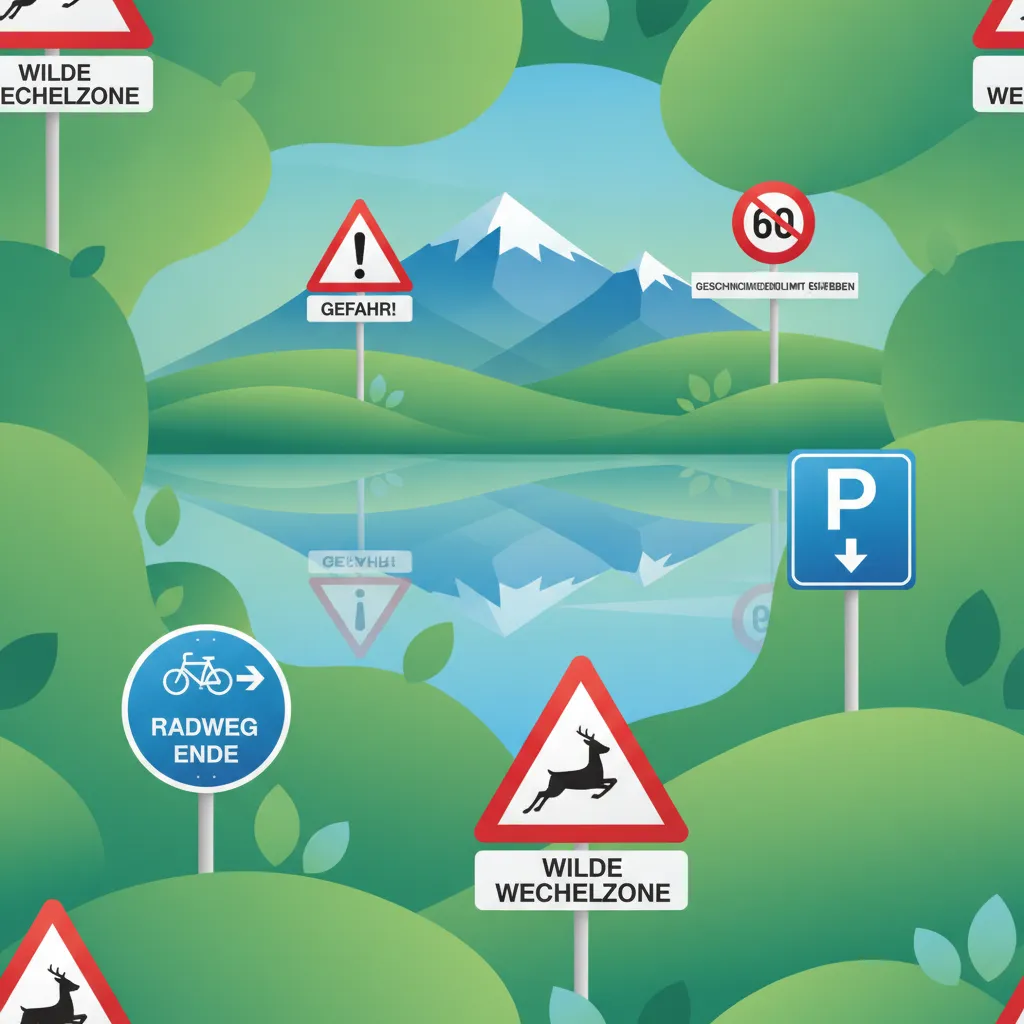
This lesson categorizes and explains the different types of Austrian road signs, including warning, regulatory, and informational signs. It details how the shape and color of a sign indicate its function, such as communicating speed limits, prohibitions, or mandatory actions. Understanding this visual system is fundamental for making correct and safe decisions while riding.
This lesson addresses the specific challenges of interacting with larger vehicles like buses and trams in an urban environment. It explains how to signal intentions clearly and predictably to avoid conflicts in shared spaces. Key topics include safely crossing tram tracks and maintaining awareness around public transport stops.
This lesson provides a step-by-step guide for safely managing a vehicle breakdown on the road. It covers the correct procedure for pulling over to a safe location, activating hazard lights, and wearing a high-visibility vest. Learners will understand the legal requirement and correct placement of the warning triangle to alert oncoming traffic, as well as the necessary information to provide when contacting roadside assistance services.
This lesson details the various types of road markings and their significance for guiding traffic and ensuring safety. Learners will understand the rules associated with solid versus broken lane lines, the instructions provided by directional arrows painted on the road, and the purpose of stop lines and pedestrian crossing markings. The content emphasizes how these markings work in conjunction with signs to regulate traffic flow and define legal lane usage.
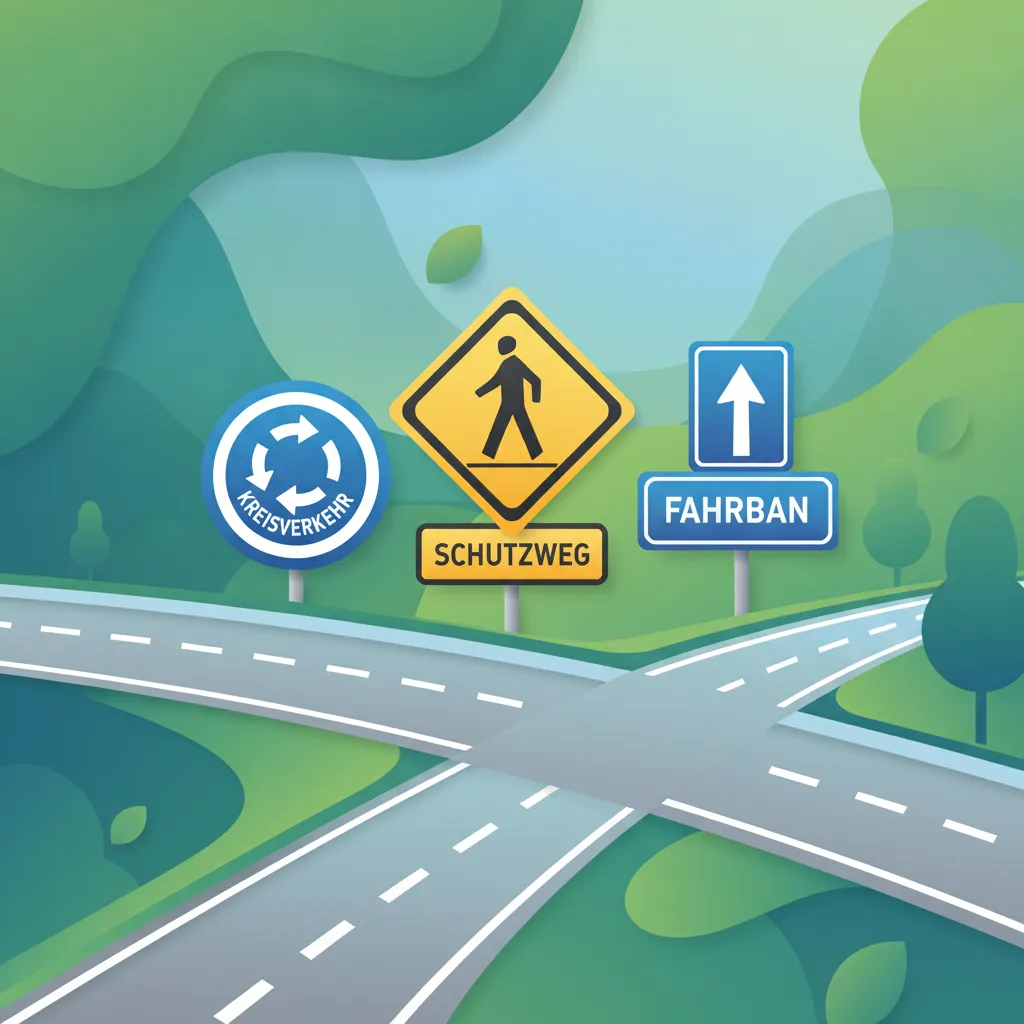
This lesson covers the specific regulations associated with special Austrian road signs and areas. It details the rules for 'Schutzweg' (protected pedestrian crossings), 'Kreisverkehr' (roundabouts), and the distinction between 'Fahrbahn' (road) and 'Fahrstreifen' (lane). Understanding these specific contexts is essential for safe navigation in urban and suburban environments.
Find clear answers to common questions learners have about Lighting Systems, Headlights, and Visibility. Learn how the lesson is structured, which driving theory objectives it supports, and how it fits into the overall learning path of units and curriculum progression in Austria. These explanations help you understand key concepts, lesson flow, and exam focused study goals.
You may only use front fog lights if visibility is severely restricted due to rain, snow, or fog. Rear fog lights are strictly reserved for situations where visibility is extremely low, as they can cause significant glare for drivers behind you.
No, DRLs are not a substitute for low-beam headlights. You must switch to your low-beam headlights at dusk, in tunnels, or whenever visibility is poor, as DRLs often do not illuminate the road surface or activate your rear tail lights.
Generally, no. You should only use high beams on unlit roads where there is no oncoming traffic and no risk of dazzling other drivers or pedestrians. In built-up areas with street lighting, high beams are typically unnecessary and prohibited.
If your primary lighting fails, it is considered a significant safety hazard. You must pull over safely at the earliest opportunity, use your hazard warning lights, and arrange for repairs; you should not continue driving at night or in low visibility with broken lights.
Refine your study plan by searching for specific Austrian driving theory practice sets. Pinpoint questions related to particular road rules, signs, or challenge levels, and begin practicing immediately to reinforce your knowledge and excel in your official exam with confidence. Get started with focused revision today.