
This lesson explores the physics of stopping a heavy goods vehicle, a crucial skill for both your theory exam and professional safety. You will learn to factor in weight, speed, and road conditions to determine the total stopping distance required for C and CE category vehicles in Austria.

Lesson content overview
Understanding how much distance a heavy vehicle requires to come to a complete stop is a fundamental skill for every professional driver in the Austrian Driving License Theory Course for Heavy Goods Vehicles. This lesson provides a comprehensive guide to calculating total stopping distance (TSD), detailing the critical factors that influence it, from driver reaction to road conditions and vehicle specifics. Mastery of these principles is not only essential for passing your theory exam but, more importantly, for ensuring safety on the road, especially when navigating Austria's challenging alpine routes.
The total stopping distance (TSD) represents the entire distance a vehicle travels from the moment a driver perceives a hazard until the vehicle is completely stationary. For heavy goods vehicles (HGVs) and articulated combinations, this distance can be significantly longer than for passenger cars due to their greater mass and inertia. Accurate assessment of TSD is paramount for maintaining safe following distances, planning overtakes, and reacting effectively to unexpected traffic situations.
Total stopping distance is a critical safety metric that combines both human reaction time and the physical dynamics of braking. It is the sum of two distinct phases: the perception-reaction distance and the actual braking distance. Overestimating a heavy vehicle's stopping capabilities can lead to hazardous situations, particularly at higher speeds, on steep grades, or in adverse weather conditions.
To fully grasp total stopping distance, it's essential to understand its two primary components:
The combination of these two distances dictates the safe operating parameters for heavy vehicles and forms the basis of many traffic regulations, including those concerning minimum following distances.
Numerous variables interact to determine the total stopping distance of a heavy vehicle. Understanding each of these factors and how they impact TSD is crucial for safe driving.
Perception-Reaction Time (PRT) is the interval between a driver identifying a hazard and physically initiating the brake application. While often assumed to be constant, PRT is highly variable and significantly impacts total stopping distance. For professional heavy vehicle drivers, an optimal PRT under normal conditions is typically approximated at 0.75 seconds. However, this can extend considerably under less ideal circumstances.
Factors such as driver fatigue, distraction, poor visibility (e.g., fog, heavy rain, darkness), and the complexity of the hazard can increase PRT to 1.00–1.50 seconds or even more. This seemingly small increase in time translates into a substantial increase in perception-reaction distance, especially at higher speeds.
The distance covered during the perception-reaction phase is directly proportional to the vehicle's speed and the driver's reaction time. It can be calculated using the formula:
Perception-Reaction Distance = Speed (m/s) × Perception-Reaction Time (s)
For example, a heavy vehicle traveling at 80 km/h (which is approximately 22.22 meters per second) will cover:
This initial distance is traveled before any braking force even begins to slow the vehicle down, highlighting why a low PRT and a focus on alertness are so vital for heavy vehicle operators.
Braking distance is the physical distance the vehicle travels from the moment the brake pedal is pressed until it comes to a complete stop. Unlike perception-reaction distance, which is largely human-dependent, braking distance is primarily governed by the laws of physics and the capabilities of the vehicle and road surface. The kinetic energy of the moving vehicle must be dissipated through friction.
The fundamental formula for braking distance is:
BD = (v²) / (2·a)
Where:
v is the initial speed of the vehicle in meters per second (m/s).a is the deceleration rate in meters per second squared (m/s²).A higher initial speed or a lower deceleration rate will result in a longer braking distance.
The deceleration rate (a) is heavily influenced by the available friction between the tyres and the road surface, which is expressed by the deceleration coefficient (or friction coefficient, μ). This coefficient is a ratio of the maximum achievable deceleration to gravitational acceleration (g ≈ 9.81 m/s²), so a = μ · g.
The braking distance formula can thus be expressed as:
BD = (v²) / (2·μ·g)
The μ value varies significantly depending on the road surface and environmental conditions:
g (excellent grip).g (moderate grip).g (very poor grip).Even a small reduction in μ can drastically increase braking distance, emphasizing the need for speed adaptation, especially for heavy vehicles, as required by Austrian traffic law (StVO § 46).
One of the most critical relationships in braking physics is that braking distance is directly proportional to the square of the vehicle's speed. This means if you double your speed, your braking distance will not just double, but quadruple. If you triple your speed, braking distance increases ninefold.
This quadratic relationship is due to kinetic energy (½·m·v²). A vehicle traveling at 100 km/h has four times the kinetic energy of the same vehicle at 50 km/h, requiring four times the distance to dissipate that energy through braking. This principle underscores why speed limits and appropriate speed adaptation are paramount for heavy vehicles, which carry immense kinetic energy due to their mass.
While the basic braking distance formula often highlights speed, vehicle mass is an inherent factor through kinetic energy (½·m·v²). A heavier vehicle possesses more kinetic energy at the same speed, requiring more force over a longer distance to stop. However, modern heavy vehicles are designed with powerful braking systems capable of handling their maximum permissible mass.
The critical factor related to mass during braking is the load-transfer effect. When a vehicle brakes, inertial forces cause a dynamic shift of weight from the rear axles towards the front axles. This phenomenon significantly alters the load on each axle, which in turn affects the effective braking force.
During heavy braking, the front axles of a heavy truck or combination experience increased load, while the rear axles (especially on trailers) become lighter. This dynamic load transfer can lead to:
Proper load distribution is therefore essential. Austrian Road Traffic Regulations (RVR § 23) strictly mandate that vehicles must be loaded within permissible axle loads. An improperly loaded vehicle, even if its total weight is within limits, can suffer from adverse load transfer, increasing braking distance and compromising stability. Load securing (Ladungssicherung) also plays a role in preventing cargo from shifting, which could exacerbate load transfer effects.
The incline or decline of the road, known as the gradient (θ), has a significant impact on braking distance. Gravity plays an additional role, either assisting or resisting deceleration.
To account for gradient, a modification factor is applied to the braking distance formula. For downhill grades, the BD adjustment factor is approximately 1 / (1 - (sinθ / μ)), making the braking distance longer. On steep alpine descents, this effect is particularly pronounced, making early anticipation and the use of auxiliary braking systems mandatory.
The condition of the road surface and the quality of the tyres are paramount to achieving effective braking. The friction coefficient (μ), which dictates the maximum achievable deceleration, is directly affected by these elements:
μ and increasing BD. Standing water can lead to hydroplaning, where tyres lose contact with the road entirely.μ, making braking distances two to three times longer than on dry roads. Specialized winter tyres and snow chains are essential in these conditions.μ due to displacement of the surface material.μ, especially on wet roads. Properly inflated and maintained tyres are crucial.Austrian traffic law (StVO § 46) explicitly requires drivers to adjust their speed to road conditions. For heavy vehicles, this often means significant speed reductions when roads are wet, snowy, or icy.
Modern heavy vehicles are equipped with sophisticated braking systems designed to handle immense loads and speeds. Understanding how these systems work and when to use them is crucial for effective braking and managing total stopping distance.
The service brake (Betriebsbremse) is the primary braking system, typically air-pressured drum or disc brakes on all wheels. These brakes are responsible for the vehicle's normal deceleration and stopping. Their effectiveness depends on:
To prevent service brake overheating and extend their lifespan, heavy vehicles utilize auxiliary braking systems. These are particularly important for managing speed and stopping distance on long downhill gradients, common on Austrian alpine roads.
On descents greater than 5% on Austrian alpine roads, the mandatory use of engine braking or retarder systems is specified in Austrian traffic guidelines. This is crucial for maintaining control and preventing brake fade.
Austrian traffic laws and guidelines provide the legal framework for safe driving, implicitly and explicitly addressing the factors that influence total stopping distance for heavy vehicles. Adhering to these regulations is critical for both safety and legal compliance.
The Austrian StVO § 4 (1) mandates that "Drivers must maintain a safe distance that allows safe stopping." This regulation applies continuously, at all speeds, and under all road conditions. It directly relates to the total stopping distance, as the safe following distance should at least equal the TSD required for the prevailing conditions.
This rule inherently requires drivers to consider their vehicle's specific TSD, factoring in speed, load, road surface, and their own reaction time. Failing to maintain a safe following distance (tailgating) is a common violation and a significant cause of rear-end collisions, particularly involving heavy vehicles which have longer stopping distances.
Austrian StVO § 46 (2) states that "Speed limits must be observed, and vehicle speed must be adjusted to road, traffic, and weather conditions." This is a fundamental principle directly impacting TSD. When conditions are adverse (e.g., wet roads, snow, ice, fog, heavy traffic, steep gradients), drivers must reduce their speed to ensure they can stop safely within the visible distance and available grip.
For heavy vehicles, even a slight reduction in grip (e.g., wet roads) or an increase in PRT (e.g., fog) necessitates a substantial reduction in speed to keep TSD within safe limits. This ensures that the vehicle can decelerate effectively and avoid collisions.
The Austrian Federal Alpine Roads Directive specifically addresses the challenges of driving heavy vehicles on mountainous terrain. It mandates that "On alpine roads with grades >5%, engine brake or retarders must be used for speed control."
This regulation is in place to prevent service brake overheating and ensure that drivers can maintain vehicle control and adequate braking capability over long descents. Over-reliance on service brakes can lead to total brake fade, a catastrophic loss of braking power that significantly extends TSD and can result in runaway vehicles.
Austrian Road Traffic Regulations (RVR) § 23 stipulates that "Vehicle must be loaded within permissible axle loads; overload beyond limits is prohibited." This regulation is critical for braking performance. Exceeding axle load limits, particularly on rear axles, can negatively impact braking efficiency due to inadequate weight distribution and the load-transfer effect.
Proper load securing (Ladungssicherung) is also vital. Unsecured cargo can shift during braking, dramatically altering the vehicle's centre of gravity, leading to instability, reduced braking effectiveness, and potentially longer stopping distances or loss of control.
Understanding the theoretical aspects of braking distance is only half the battle. Professional drivers must also internalize these principles and apply them consistently in real-world driving scenarios.
Several common misunderstandings or dangerous practices can significantly compromise safety regarding heavy vehicle braking:
Safe driving means constantly adapting your driving behavior to the prevailing conditions.
μ) and often visibility (increasing PRT). Drivers must slow down, increase following distances, and be prepared for significantly longer stopping distances.When driving a heavy vehicle in fog or darkness, reduced visibility not only increases your perception-reaction time but also shortens the distance you can see ahead. This requires a significant reduction in speed to ensure your total stopping distance does not exceed your visible range.
Let's consider a few practical scenarios to apply these concepts:
Scenario: Driving a fully loaded HGV on a dry motorway at 90 km/h.
μ of 0.7 g.
Scenario: Descending a 6% downhill grade on a wet alpine road at 60 km/h with an articulated combination.
μ reduced to 0.5 g.
Mastering the calculation and understanding of heavy vehicle braking distance is a cornerstone of safe and responsible driving in the Austrian Driving License Theory Course for Heavy Goods Vehicles. The Total Stopping Distance (TSD) is a crucial metric, comprising both the driver's Perception-Reaction Distance and the vehicle's Braking Distance (BD).
Perception-Reaction Time (PRT), typically 0.75-1.5 seconds for professional drivers, can significantly extend under adverse conditions like fatigue, distraction, or poor visibility, directly increasing the distance traveled before braking begins. Braking Distance (BD) is governed by the square of the vehicle's speed and the deceleration coefficient (μ), which represents the friction between tyres and road. This μ varies dramatically with road conditions (e.g., dry, wet, icy surfaces), demanding constant speed adaptation.
Crucially, heavy vehicle mass means higher kinetic energy, requiring more braking effort. The load-transfer effect shifts weight to the front axles during braking, potentially reducing rear brake effectiveness and necessitating careful load distribution. Gradient influence also plays a major role; downhill grades significantly increase BD, while uphill grades reduce it. For this reason, Austrian regulations mandate the use of engine braking and retarders on alpine descents (grades >5%) to prevent service brake overheating and maintain control.
Adherence to Austrian traffic laws, such as StVO § 4 (safe following distance) and StVO § 46 (speed adaptation to conditions), is not merely a legal obligation but a practical application of TSD principles. By accurately assessing TSD based on speed, load, road conditions, gradient, and driver state, heavy vehicle operators can maintain safe following distances, plan maneuvers effectively, and prevent collisions, ensuring safety for themselves and all other road users.
This lesson covers the physics and practical calculations of total stopping distance (TSD) for heavy vehicles, comprising perception-reaction distance and braking distance. Key factors include driver reaction time (typically 0.75-1.5 seconds), vehicle speed (with braking distance proportional to speed squared), road surface friction coefficients (varying from ~0.8g on dry roads to ~0.2g on ice), and vehicle mass affecting kinetic energy. The load-transfer effect during braking shifts weight forward, impacting brake balance. Austrian regulations mandate safe following distances (StVO § 4), speed adaptation to conditions (StVO § 46), and mandatory use of engine braking or retarders on alpine descents exceeding 5% gradient (RVR § 23).
A short set of high-value points that capture the most important learning from this lesson.
Total stopping distance (TSD) is the sum of perception-reaction distance and braking distance, both of which must be calculated for heavy vehicles.
Braking distance increases with the square of speed, meaning doubling your speed quadruples the distance needed to stop.
Road surface conditions drastically affect the friction coefficient (μ): dry asphalt (~0.7-0.8g), wet roads (~0.5g), and snow/ice (~0.2-0.3g).
During braking, weight transfers forward from rear to front axles, reducing rear brake effectiveness and requiring proper load distribution.
On Austrian alpine roads with grades exceeding 5%, engine braking or retarders must be used to prevent service brake overheating.
Explore all units and lessons included in this driving theory course.
Formula: TSD = (Speed × PRT) + (v² / 2μg), where PRT for professional drivers is typically 0.75-1.5 seconds.
The friction coefficient (μ) varies dramatically: wet roads cut grip by ~35%, ice by up to 70% compared to dry conditions.
Load transfer during braking shifts weight to front axles, making rear axle brakes less effective if cargo is improperly distributed.
StVO § 4 requires drivers to maintain following distances at least equal to their calculated TSD for prevailing conditions.
Service brakes alone cannot safely manage extended downhill braking; engine braking and retarders are mandatory on steep alpine descents.
Assuming reaction time stays constant at 0.75 seconds regardless of fatigue, distraction, or poor visibility conditions.
Failing to account for the speed-mass relationship, underestimating how much kinetic energy a fully loaded vehicle carries.
Ignoring gradient effects on downhill grades, where gravity adds to the braking workload and increases stopping distance.
Over-relying on service brakes during long descents, leading to brake fade and potentially catastrophic loss of braking power.
Misjudging stopping distances on wet or icy roads by applying dry-surface braking expectations to slippery conditions.
Lesson content overview
A short set of high-value points that capture the most important learning from this lesson.
Total stopping distance (TSD) is the sum of perception-reaction distance and braking distance, both of which must be calculated for heavy vehicles.
Braking distance increases with the square of speed, meaning doubling your speed quadruples the distance needed to stop.
Road surface conditions drastically affect the friction coefficient (μ): dry asphalt (~0.7-0.8g), wet roads (~0.5g), and snow/ice (~0.2-0.3g).
During braking, weight transfers forward from rear to front axles, reducing rear brake effectiveness and requiring proper load distribution.
On Austrian alpine roads with grades exceeding 5%, engine braking or retarders must be used to prevent service brake overheating.
Explore all units and lessons included in this driving theory course.
Formula: TSD = (Speed × PRT) + (v² / 2μg), where PRT for professional drivers is typically 0.75-1.5 seconds.
The friction coefficient (μ) varies dramatically: wet roads cut grip by ~35%, ice by up to 70% compared to dry conditions.
Load transfer during braking shifts weight to front axles, making rear axle brakes less effective if cargo is improperly distributed.
StVO § 4 requires drivers to maintain following distances at least equal to their calculated TSD for prevailing conditions.
Service brakes alone cannot safely manage extended downhill braking; engine braking and retarders are mandatory on steep alpine descents.
Assuming reaction time stays constant at 0.75 seconds regardless of fatigue, distraction, or poor visibility conditions.
Failing to account for the speed-mass relationship, underestimating how much kinetic energy a fully loaded vehicle carries.
Ignoring gradient effects on downhill grades, where gravity adds to the braking workload and increases stopping distance.
Over-relying on service brakes during long descents, leading to brake fade and potentially catastrophic loss of braking power.
Misjudging stopping distances on wet or icy roads by applying dry-surface braking expectations to slippery conditions.
Explore search topics learners often look for when studying Calculating Braking Distance for Heavy Vehicles. These topics reflect common questions about road rules, driving situations, safety guidance, and lesson level theory preparation for learners in Austria.
Browse additional driving theory lessons that cover connected traffic rules, road signs, and common driving situations related to this topic. Improve your understanding of how different rules interact across everyday traffic scenarios.
Understand the key elements that determine stopping distance for heavy vehicles, including speed, load, and road conditions. Essential theory for safe driving and Austrian C category exam preparation.

This lesson covers the proper techniques for performing an emergency braking manoeuvre in a heavy vehicle. It explains how to apply maximum braking force without losing control, especially in vehicles equipped with an Anti-lock Braking System (ABS). The lesson also discusses how hard braking can affect cargo and the importance of proper load securing.
This lesson teaches correct braking techniques, including the coordinated use of front and rear brakes for maximum efficiency. It explains how to calculate total stopping distance based on speed, perception time, and reaction time. The content also covers adjustments needed for braking on wet or slippery surfaces to avoid loss of control.
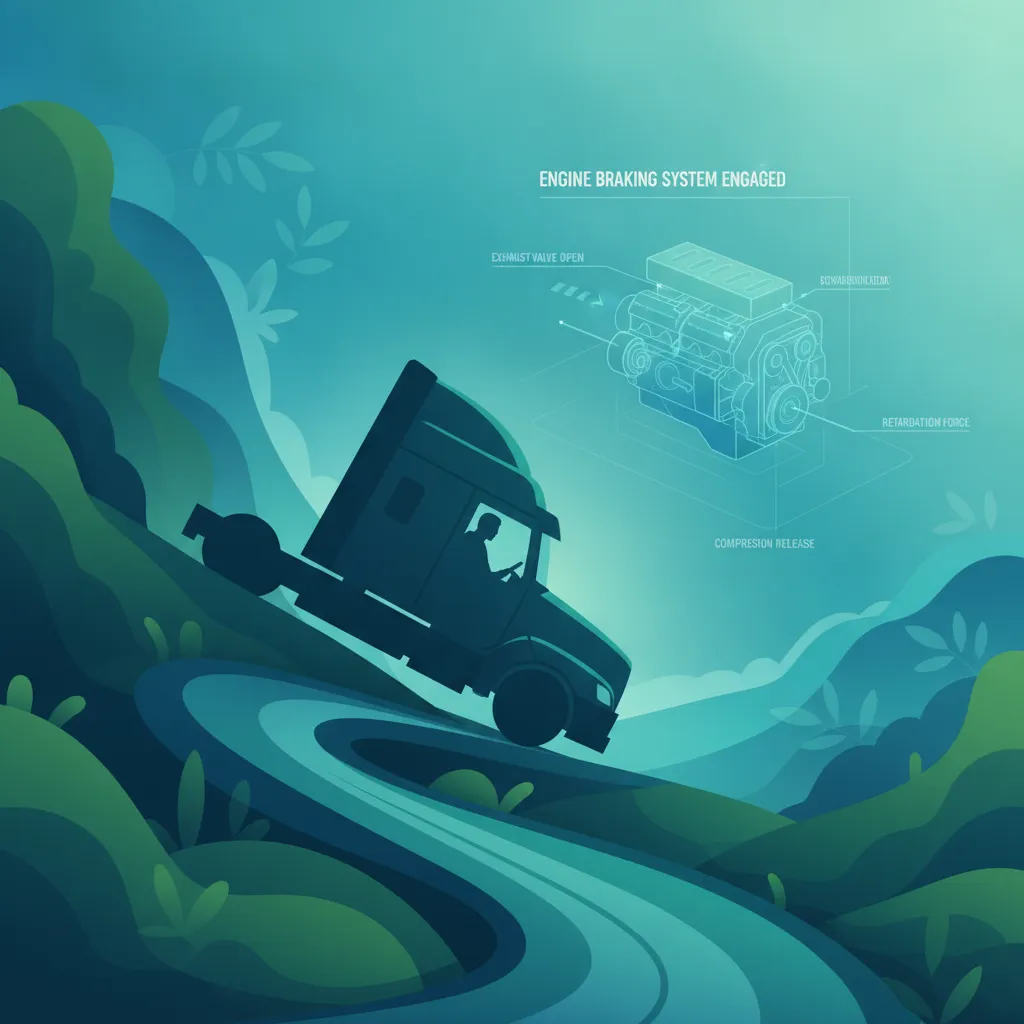
This lesson introduces auxiliary braking systems, such as engine brakes and retarders, which are designed to help control vehicle speed without using the service brakes. It explains how these systems function to slow the vehicle, especially on long downhill gradients. Using them effectively reduces service brake wear and prevents overheating.
This lesson provides critical techniques for managing vehicle speed on the steep, long gradients found on Alpine roads. It emphasizes selecting the correct gear before the descent and using auxiliary braking systems to maintain a safe, controlled speed. These practices are essential to prevent service brake overheating and potential failure (brake fade).
This lesson outlines the standardized procedure for handling a vehicle breakdown safely. It covers pulling over to a safe location, activating hazard lights, deploying the warning triangle, and wearing a high-visibility vest. It also explains when and how to contact roadside assistance or emergency services.

This lesson details the general traffic rules applicable to heavy goods vehicles on Austrian roads, highlighting differences from passenger car regulations. It covers key topics such as right-of-way at intersections, specific rules for overtaking, maintaining proper lane discipline, and adhering to designated speed limits. Understanding these rules is critical for safe integration into mixed traffic.

This lesson focuses on the legal restrictions concerning a heavy vehicle's dimensions, including maximum height, width, and length. It teaches drivers how to interpret road signs and supplemental plates that indicate these limits. This knowledge is crucial for route planning, especially when navigating under bridges, through tunnels, and on restricted roads.
This lesson covers the specific weight restrictions that apply to sensitive infrastructure like Alpine passes and bridges throughout Austria. It explains how to identify these limits through road signage and incorporate them into route planning. Adhering to these restrictions is vital for preventing structural damage and ensuring safety in challenging terrain.

This lesson details the regulations for heavy goods vehicles on Austria's high-speed road network. It covers the specific speed limits, rules on lane usage (e.g., when overtaking is permitted), and procedures for entering and exiting the motorway. Adherence to these rules is crucial for safety in a fast-paced environment.
This lesson breaks down the concept of total stopping distance into its two key components: reaction distance and braking distance. Learners will understand how factors like vehicle speed, driver perception-reaction time, and road surface conditions (e.g., wet or icy) dramatically influence how long it takes to bring a vehicle to a complete stop. This knowledge is crucial for making safe speed choices and maintaining an adequate buffer for hazard avoidance.
Learn about legal requirements in Austria regarding safe following distances and speed adaptation for heavy vehicles. Crucial driving theory for maintaining safety on all road types.

This lesson explains the importance of maintaining a safe following distance to prevent rear-end collisions. It introduces practical methods for judging a safe gap, such as the widely-used 'two-second rule,' and clarifies how this distance needs to be increased in adverse weather or poor visibility. The content emphasizes that an adequate buffer zone provides the necessary time and space to react and brake safely if the vehicle in front stops suddenly.
This lesson details the general traffic rules applicable to heavy goods vehicles on Austrian roads, highlighting differences from passenger car regulations. It covers key topics such as right-of-way at intersections, specific rules for overtaking, maintaining proper lane discipline, and adhering to designated speed limits. Understanding these rules is critical for safe integration into mixed traffic.
This lesson focuses on the legal restrictions concerning a heavy vehicle's dimensions, including maximum height, width, and length. It teaches drivers how to interpret road signs and supplemental plates that indicate these limits. This knowledge is crucial for route planning, especially when navigating under bridges, through tunnels, and on restricted roads.

This lesson consolidates the legal restrictions on the maximum dimensions and weight for different vehicle combinations in Austria. It covers how to read signs indicating these limits and the importance of compliance for route planning. Adhering to these regulations is essential for legal operation and avoiding fines.
This lesson details the regulations for heavy goods vehicles on Austria's high-speed road network. It covers the specific speed limits, rules on lane usage (e.g., when overtaking is permitted), and procedures for entering and exiting the motorway. Adherence to these rules is crucial for safety in a fast-paced environment.

This lesson details the specific regulations and best practices for driving in areas with high pedestrian activity, such as bus stops and school zones. It explains the driver's obligation to stop for school buses with flashing lights and to yield to public buses pulling out from a stop. The content emphasizes the requirement to significantly reduce speed in marked school zones to ensure the safety of children.
This lesson outlines the standardized procedure for handling a vehicle breakdown safely. It covers pulling over to a safe location, activating hazard lights, deploying the warning triangle, and wearing a high-visibility vest. It also explains when and how to contact roadside assistance or emergency services.

This lesson covers the various lighting and reflector systems required on heavy goods vehicles in Austria. It explains the function and legal requirements for headlights, taillights, brake lights, indicators, and reflective markings. Ensuring all lighting systems are operational is essential for visibility and communicating intentions to other road users.
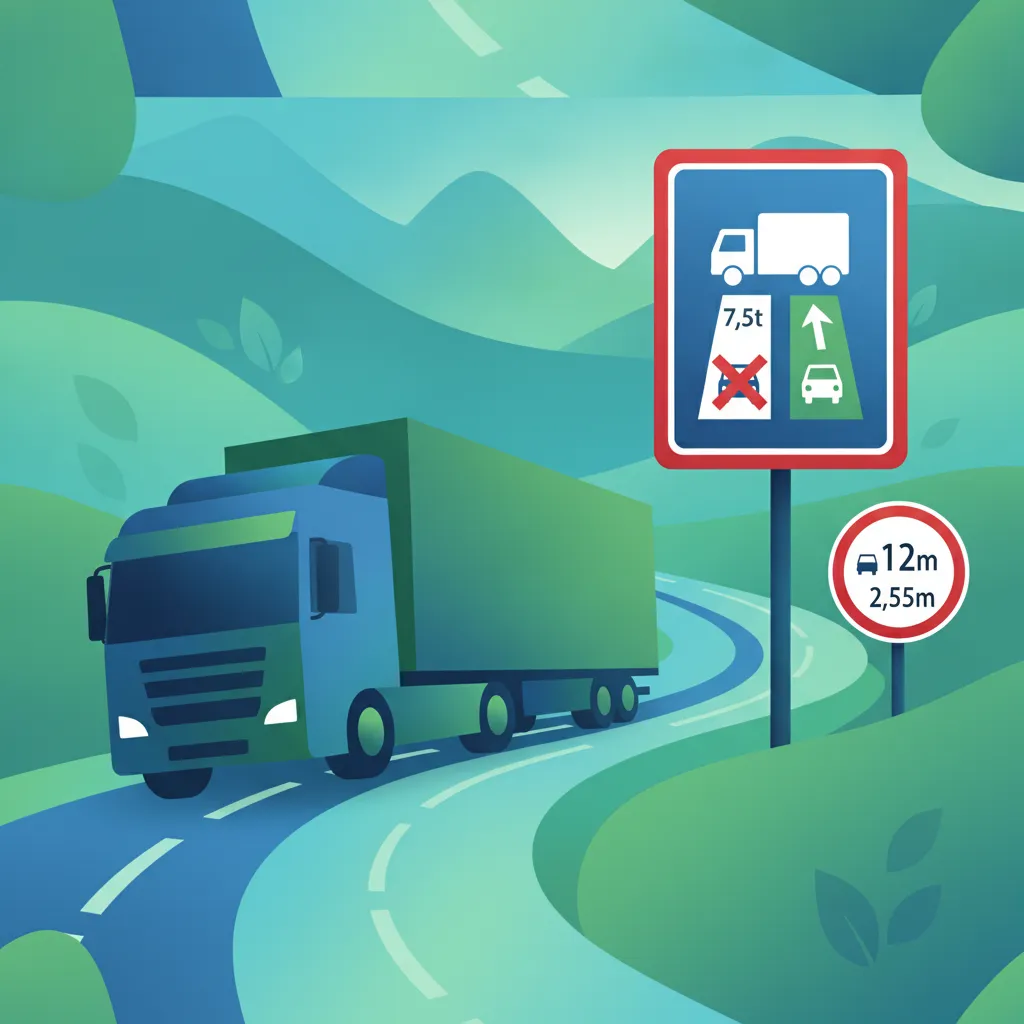
This lesson focuses on the specific Austrian road signs and supplemental plates that apply to heavy goods vehicles. It explains how to interpret signage indicating weight limits, height and width restrictions, lane usage rules, and other critical regulatory information. Correctly understanding these signs is essential for legal compliance and safe navigation on Austria's roads.
This lesson breaks down the concept of total stopping distance into its two key components: reaction distance and braking distance. Learners will understand how factors like vehicle speed, driver perception-reaction time, and road surface conditions (e.g., wet or icy) dramatically influence how long it takes to bring a vehicle to a complete stop. This knowledge is crucial for making safe speed choices and maintaining an adequate buffer for hazard avoidance.
Find clear answers to common questions learners have about Calculating Braking Distance for Heavy Vehicles. Learn how the lesson is structured, which driving theory objectives it supports, and how it fits into the overall learning path of units and curriculum progression in Austria. These explanations help you understand key concepts, lesson flow, and exam focused study goals.
Heavy vehicles have much greater mass, which increases kinetic energy and places higher demands on the braking system. Even with advanced braking technology, the physical laws of motion dictate that a heavier vehicle requires more distance to dissipate that energy during a stop.
On slippery or wet road surfaces, the coefficient of friction is reduced, meaning the tires have less grip. In your theory exam, you must account for these conditions by significantly increasing your following distance, as the braking distance can easily double or triple compared to dry conditions.
Generally, yes. A fully loaded vehicle has more mass, which requires more force to stop. However, some modern electronic braking systems (EBS) are designed to adjust brake pressure based on the load, though they still cannot overcome the basic laws of physics regarding momentum.
Total stopping distance is the sum of reaction distance and braking distance. Even before you hit the brakes, the vehicle travels a certain distance while you process a hazard. In the exam, always assume a standard reaction time before the braking phase begins.
Refine your study plan by searching for specific Austrian driving theory practice sets. Pinpoint questions related to particular road rules, signs, or challenge levels, and begin practicing immediately to reinforce your knowledge and excel in your official exam with confidence. Get started with focused revision today.