
This lesson explores the physics of heavy vehicle steering, specifically focusing on how your truck or combination's dimensions dictate the space needed for turns. You will learn to manage off-tracking and lane discipline, ensuring you can navigate urban and rural intersections safely without endangering other road users. Mastering these concepts is essential for both your theory examination and your future professional driving career in Germany.

Lesson content overview
Navigating a heavy vehicle or a vehicle combination requires a precise understanding of how the vehicle occupies space, especially during turns. Unlike smaller passenger cars, trucks, buses, and articulated vehicles have unique spatial requirements that, if not properly managed, can lead to dangerous situations, traffic obstructions, or even collisions. This lesson delves into the fundamental concepts of turning radius (Wendekreis), swept path (Schleppkurve), and the critical importance of lane discipline (Fahrspurdisziplin) for safe and efficient heavy vehicle operation in Germany and beyond.
The objective is to equip you with the knowledge needed to accurately assess the space required for turns, plan your maneuvers effectively, and maintain correct lane positioning to ensure safety for yourself and all other road users. Mastery of these concepts is not only crucial for passing your German heavy vehicle driving theory examination (C1, C1E, C, CE) but also for your daily professional driving practice.
Turning radius, swept path, and lane discipline are interconnected principles that govern how a heavy vehicle moves through a curve or intersection. They are essential for understanding vehicle geometry, predicting its movement, and making informed decisions while driving.
These concepts are deeply rooted in the physics of vehicle geometry and the legal framework of traffic laws, such as the German Road Traffic Regulations (Straßenverkehrsordnung – StVO). They are indispensable for planning every maneuver, particularly for vehicles with long wheelbases, multiple axles, or trailers, as these configurations significantly amplify the challenges posed by turning.
The turning radius is a foundational measurement that indicates how tightly a vehicle can turn. For heavy vehicles, this value is significantly larger than for passenger cars, directly impacting route planning and maneuver execution.
The distance from the center of the theoretical turning circle to the central axis of the vehicle when the steering is at its maximum lock.
When a vehicle turns, its wheels trace different paths. We distinguish between:
The practical implication of a large turning radius is that heavy vehicles require considerably more space to negotiate curves and intersections. A truck with a turning radius of, for example, 11 metres (as per manufacturer specifications) needs an intersection or road curvature that can accommodate this minimum radius to turn safely without leaving its designated lane or colliding with objects. Misjudging this can lead to the vehicle's body or load extending beyond the intended path, creating a hazardous situation.
It is a common misunderstanding to assume that the vehicle's entire body will follow the same tight radius as the steering wheel indicates for the front wheels. This ignores the significant impact of the swept path, especially due to off-tracking of the rear axles, which we will discuss next.
While the turning radius describes the path of the vehicle's central point, the swept path provides a much more comprehensive and practical understanding of the total space a heavy vehicle occupies during a turn. This concept is vital for preventing collisions and ensuring smooth traffic flow.
The total lateral and longitudinal area covered by all parts of a vehicle, including its outer edges and any load, from the beginning to the end of a turning maneuver. It explicitly accounts for the off-tracking of rear axles and trailers.
The swept path is not merely a circular path; it is an irregular area that widens as the vehicle turns. Its width is influenced by several factors, including the vehicle's wheelbase, overall length, the number of axles, and especially the presence of trailers or semi-trailers.
Key components of the swept path include:
The practical meaning of the swept path is that it serves as a visual guide for maneuver planning. Drivers must always envision this area to ensure there is sufficient clearance not only for the front of the vehicle but for all its parts throughout the entire turning process. For example, during a sharp right turn, the rear of a long truck or combination will swing considerably to the left (outward) from the front's path, and its inner rear wheels will track significantly closer to the curb. This requires the driver to position the vehicle appropriately to prevent the rear from colliding with traffic signs, parked vehicles, or pedestrians.
Legally, drivers are obligated to ensure that their vehicle's swept path does not interfere with other road users' paths or encroach on adjacent lanes. Failure to do so can lead to dangerous situations and legal penalties under the StVO.
Off-tracking is a specific phenomenon inherent to vehicles with multiple axles, and it is a primary contributor to the increased swept path of heavy vehicles, particularly those with trailers.
The tendency of the rear wheels of a vehicle to follow a path inside the turning circle of the front wheels during a turn. This effect is more pronounced with longer wheelbases and significantly amplified in articulated vehicle combinations (trucks with trailers/semi-trailers).
The physics behind off-tracking is relatively straightforward: when the front wheels turn, they initiate a new direction. Due to the fixed distance between the axles (wheelbase) and the pivot point, the rear wheels must pivot around a different center, causing them to "cut the corner" relative to the front wheels.
Practical Implications of Off-Tracking: The most significant consequence of off-tracking is the requirement for more lateral space. To prevent the rear of the vehicle or trailer from colliding with curbs, road furniture, or other vehicles, the driver must initiate turns wider than might seem intuitive. This often means temporarily encroaching on the opposite side of the road or an adjacent lane before turning, a maneuver that requires careful judgment and communication with other road users.
For example, a typical semi-trailer (Sattelzug) may off-track by up to 1.5 metres (or even more for very long combinations) in a tight 90-degree turn. This means that if the tractor unit's front wheels are 1 metre from the curb, the trailer's inner wheels could be 0.5 metres over the curb, or even more. Underestimating this can lead to damaged tires, vehicle components, infrastructure, or collisions with other vehicles.
Always assume a greater degree of off-tracking, especially with trailers. When in doubt, take a wider approach to ensure adequate clearance for the entire vehicle combination.
Lane discipline is the conscious and deliberate practice of positioning and steering a vehicle within its designated lane, especially during complex maneuvers like turning. For heavy vehicle drivers, it is not merely about staying within lines but about strategically using the available lane width to safely accommodate the vehicle's swept path.
The strategic practice of maintaining correct and safe lane positioning throughout a maneuver, particularly during turns, to ensure the vehicle's swept path remains within appropriate boundaries and does not endanger or obstruct other road users.
Key Aspects of Lane Discipline for Heavy Vehicles:
In situations where you must temporarily encroach on an adjacent lane (e.g., swinging out for a tight right turn), always ensure the lane is clear, signal your intention clearly, and proceed with extreme caution. Never assume other drivers understand your heavy vehicle's spatial requirements without clear communication.
Violations of lane discipline are common causes of accidents involving heavy vehicles, ranging from minor scrapes with curbs to severe side-swipe collisions with other vehicles or vulnerable road users who might be in the swept path.
German traffic law, primarily the Straßenverkehrsordnung (StVO), imposes strict requirements on all drivers, particularly those of heavy vehicles, to ensure safe turning maneuvers and prevent traffic disruptions.
The rationale behind these rules is clear: to prevent collisions, protect vulnerable road users, and maintain an orderly and predictable traffic flow. Non-compliance can lead to severe penalties, including fines, points on the driving license, and in serious cases, license suspension.
Even experienced drivers can make mistakes, but understanding common pitfalls can help in preventing them. For heavy vehicle drivers, these errors often have magnified consequences.
When making a wide turn, always check your mirrors to confirm that no cyclists or pedestrians have entered the space you intend to occupy. They might not anticipate your vehicle's wide swept path.
Safe turning with heavy vehicles is not a static procedure; it requires constant adaptation to dynamic conditions. Several factors can significantly alter the difficulty and risk associated with turns.
Understanding the theory is one thing; applying it in real-world scenarios is another. These examples illustrate correct and incorrect behaviors.
Mastering the dynamics of heavy vehicle turning is fundamental to safe and professional driving. These core concepts are interdependent and require diligent application.
By internalizing these principles and consistently applying them, heavy vehicle drivers can execute turns safely, efficiently, and in full compliance with German traffic regulations.
This lesson covers the essential geometric concepts that determine how heavy vehicles occupy space during turns: the turning radius, swept path, and off-tracking phenomena. It explains why trucks and articulated combinations require significantly more lateral space than passenger cars, particularly how rear axles and trailers cut inside the front wheels' path. The content emphasizes the importance of lane discipline, which involves strategic vehicle positioning before initiating turns to ensure the entire swept path stays within safe boundaries. Key legal requirements from StVO § 9 are covered, including the permissible slight left swing before right turns for long vehicles. Understanding these principles is critical for avoiding collisions with infrastructure, other vehicles, and vulnerable road users like cyclists and pedestrians during turning maneuvers.
A short set of high-value points that capture the most important learning from this lesson.
The turning radius (Wendekreis) defines the minimum space the vehicle's central axis needs to complete a turn at full lock.
The swept path (Schleppkurve) is the total area covered by all parts of the vehicle during a turn, including the off-tracking of rear axles and trailers.
Off-tracking causes rear wheels to cut inside the front wheels' path, creating a wider overall vehicle footprint during turns.
Lane discipline for heavy vehicles requires strategic positioning before turns to accommodate the swept path without encroaching on adjacent lanes or curbs.
Drivers must check blind spots continuously during turns, as cyclists and pedestrians frequently enter the swept path without realizing the vehicle's true dimensions.
Explore all units and lessons included in this driving theory course.
The swept path always exceeds the turning radius because it accounts for all vehicle extremities and off-tracking, not just the geometric center.
Semi-trailers can off-track by up to 1.5 metres or more in tight turns, meaning the inner trailer wheels may swing significantly closer to the curb than expected.
Under StVO § 9, heavy vehicles requiring more space may swing slightly left before a right turn, but only if it does not endanger cyclists or other road users.
Empty vehicles still require the same dimensional attention as loaded ones; off-tracking remains unchanged by load but handling characteristics differ.
In narrow turns, the rear of a truck-trailer combination swings outward opposite to the turn direction, occupying more lane width than the front.
Assuming the vehicle body follows the same tight radius as the steering front wheels indicate, ignoring swept path requirements.
Starting a right turn too close to the inner curb, leaving no room for off-tracking and causing rear wheels to cross into adjacent lanes or mount the pavement.
Failing to signal early enough, depriving cyclists and pedestrians of time to react to the vehicle's turning intentions.
Underestimating off-tracking with trailers, particularly when transitioning from rigid vehicles to articulated combinations.
Attempting turns at speeds inappropriate for the vehicle's dimensional constraints, resulting in the trailer swinging wide or jackknifing.
Lesson content overview
A short set of high-value points that capture the most important learning from this lesson.
The turning radius (Wendekreis) defines the minimum space the vehicle's central axis needs to complete a turn at full lock.
The swept path (Schleppkurve) is the total area covered by all parts of the vehicle during a turn, including the off-tracking of rear axles and trailers.
Off-tracking causes rear wheels to cut inside the front wheels' path, creating a wider overall vehicle footprint during turns.
Lane discipline for heavy vehicles requires strategic positioning before turns to accommodate the swept path without encroaching on adjacent lanes or curbs.
Drivers must check blind spots continuously during turns, as cyclists and pedestrians frequently enter the swept path without realizing the vehicle's true dimensions.
Explore all units and lessons included in this driving theory course.
The swept path always exceeds the turning radius because it accounts for all vehicle extremities and off-tracking, not just the geometric center.
Semi-trailers can off-track by up to 1.5 metres or more in tight turns, meaning the inner trailer wheels may swing significantly closer to the curb than expected.
Under StVO § 9, heavy vehicles requiring more space may swing slightly left before a right turn, but only if it does not endanger cyclists or other road users.
Empty vehicles still require the same dimensional attention as loaded ones; off-tracking remains unchanged by load but handling characteristics differ.
In narrow turns, the rear of a truck-trailer combination swings outward opposite to the turn direction, occupying more lane width than the front.
Assuming the vehicle body follows the same tight radius as the steering front wheels indicate, ignoring swept path requirements.
Starting a right turn too close to the inner curb, leaving no room for off-tracking and causing rear wheels to cross into adjacent lanes or mount the pavement.
Failing to signal early enough, depriving cyclists and pedestrians of time to react to the vehicle's turning intentions.
Underestimating off-tracking with trailers, particularly when transitioning from rigid vehicles to articulated combinations.
Attempting turns at speeds inappropriate for the vehicle's dimensional constraints, resulting in the trailer swinging wide or jackknifing.
Explore search topics learners often look for when studying Turning Radii, Swept Path and Lane Discipline. These topics reflect common questions about road rules, driving situations, safety guidance, and lesson level theory preparation for learners in Germany.
Browse additional driving theory lessons that cover connected traffic rules, road signs, and common driving situations related to this topic. Improve your understanding of how different rules interact across everyday traffic scenarios.
Explore the critical concepts of turning radius, swept path, and off-tracking for heavy vehicles. This lesson details how vehicle dimensions impact maneuvers, ensuring safe lane discipline and precise cornering according to German traffic regulations.

This lesson teaches the fundamental techniques for safely turning a large passenger vehicle. It explains the concepts of turning radius, swept path, and off-tracking, where the rear wheels follow a tighter path than the front wheels. Learners will understand how to position the vehicle correctly before a turn and manage their speed to navigate corners without encroaching on other lanes or hitting curbs.
This lesson explains the specific regulations for operating heavy vehicles on Autobahnen, including speed limits, lane discipline, and overtaking rules. It discusses the use of dedicated truck lanes and the importance of maintaining appropriate following distances. The content also covers procedures for merging and exiting high-speed roads safely.

This lesson covers the dimensional limits for heavy vehicles, focusing on height, width, and length restrictions. It explains how to interpret clearance signage for bridges, tunnels, and overhead obstacles, and discusses the implications for route planning. The content also addresses the importance of understanding turning radii and swept paths to avoid collisions.

This lesson examines the direct impact of a passenger vehicle's dimensions on its operation. It explains key concepts such as turning radius, swept path, and rear overhang, which are crucial for safe maneuvering in confined areas. Learners will understand how to account for these characteristics when positioning the vehicle in a lane, making turns, and navigating challenging urban environments to avoid collisions.

This lesson provides a step-by-step guide to executing turns safely at intersections and other locations. It details the full observation sequence (mirrors, signal, blind spot check) required before initiating a turn. The lesson covers correct lane positioning for both left and right turns and explains the rules for performing U-turns or three-point turns where permitted.
This lesson covers the principles of correct vehicle positioning and lane discipline, which are essential for predictable and safe driving. It reinforces the 'Rechtsfahrgebot' (drive on the right) principle and explains how to choose the appropriate lane on multi-lane roads and motorways. Proper positioning for turns and maintaining a safe space cushion around the vehicle are also key topics.
This lesson focuses on the interaction between heavy vehicles and vulnerable road users at crossings, particularly when turning right. It covers the need for heightened vigilance, the importance of properly using mirrors, and correct signaling to alert others. The content highlights legal responsibilities and safe distance requirements to prevent accidents.
This lesson covers the principles of effective route planning and the practical skills for navigating different types of junctions. It provides guidance on using navigation aids and understanding the specific challenges large vehicles face at roundabouts and complex intersections. Emphasis is placed on correct lane selection and positioning well in advance of a turn to execute the maneuver safely and without impeding other traffic.

This lesson provides instruction on the rules and best practices for operating a large passenger vehicle on the Autobahn. It covers the principles of strict lane discipline, regulations for minimum speed, and correct procedures for overtaking and merging. The importance of maintaining significantly increased following distances at high speeds and planning for exits well in advance is a key focus.

This lesson addresses the challenges of maneuvering heavy vehicles in confined spaces such as loading bays and narrow streets. It provides strategies for planning the maneuver, accounting for vehicle dimensions, turning radius, and blind spots. The content emphasizes slow, controlled movements and the need for high situational awareness.
Learn essential techniques for safely navigating turns and corners with heavy vehicles. This lesson covers understanding your vehicle's swept path, managing blind spots, and maintaining correct lane positioning for secure maneuvering in German traffic.
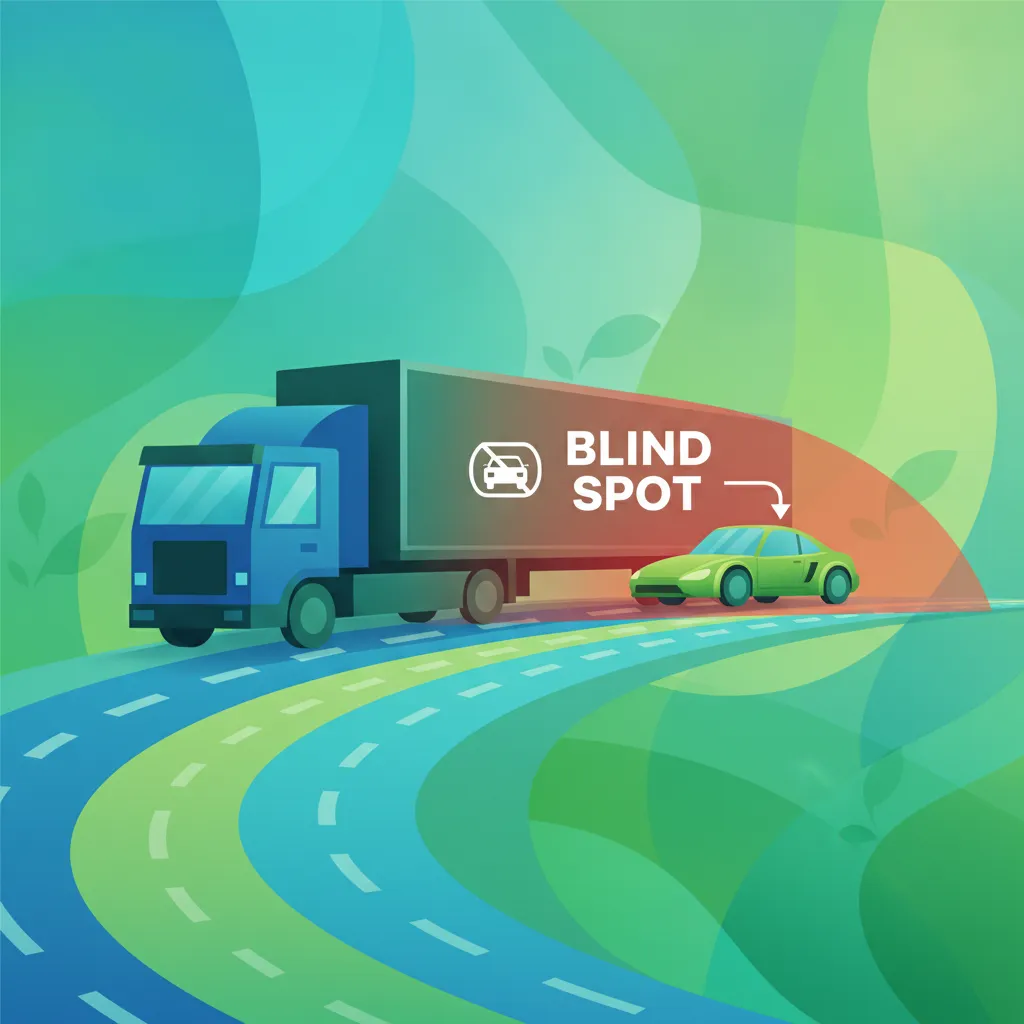
This lesson focuses on the blind spot zones specific to trucks and vehicle combinations, explaining where these zones are located. It covers the use of blind spot mirrors and other aids to enhance driver awareness during lane changes and turns. The content stresses the importance of maintaining safe distances from vulnerable road users.

This lesson provides a systematic approach to safely negotiating blind corners where visibility is limited. It teaches riders to control their entry speed, adopt a defensive lane position, and use visual scanning techniques to assess the road ahead. The content emphasizes adjusting lean angle and being prepared for unexpected hazards that may be hidden around the bend.
This lesson addresses the challenges of maneuvering heavy vehicles in confined spaces such as loading bays and narrow streets. It provides strategies for planning the maneuver, accounting for vehicle dimensions, turning radius, and blind spots. The content emphasizes slow, controlled movements and the need for high situational awareness.
This lesson covers safe reversing techniques for both rigid trucks and articulated combinations, emphasizing the use of mirrors and cameras. It discusses the risks of jackknifing during reversal and the importance of speed control and safety checks. The content outlines best practices for planning a safe reversing path, potentially with a guide person.

This lesson examines the risks associated with load shifting during braking and cornering maneuvers. It explains how inertia and weight transfer can cause cargo to move, potentially leading to instability or loss of control. The content emphasizes the importance of proper load securing to mitigate these risks and maintain vehicle stability.

This lesson teaches the proper adjustment of all required mirrors to maximize the field of vision and minimize blind spots. It discusses the limitations of indirect vision and the importance of aligning mirrors based on the driver's seating position. The content also outlines the typical blind zones for heavy vehicles and strategies to mitigate them.
This lesson focuses on the risks of jackknifing and trailer swing, particularly during braking and on downhill descents. It provides recommendations for safe speed management, proper braking techniques, and maintaining vehicle stability. The content also addresses safe reversing practices and the importance of monitoring blind spots during maneuvers.
This lesson covers safe interaction with special vehicles. It details the challenges of driving near large trucks (LKW), including their extensive blind spots, longer stopping distances, and the effects of wind turbulence when overtaking them. A critical part of the lesson is explaining the correct procedure for reacting to emergency vehicles by creating an emergency corridor ('Rettungsgasse') on multi-lane roads.

This lesson provides a comprehensive guide to identifying and managing the significant blind spots around a large passenger vehicle. It covers the correct adjustment and use of all mirrors, supplemented by camera systems, to gain maximum visibility. The importance of performing physical checks ('shoulder checks') before turning or changing lanes is emphasized to detect smaller road users like cyclists and pedestrians who may be hidden from view.
This lesson focuses on the interaction between heavy vehicles and vulnerable road users at crossings, particularly when turning right. It covers the need for heightened vigilance, the importance of properly using mirrors, and correct signaling to alert others. The content highlights legal responsibilities and safe distance requirements to prevent accidents.
Find clear answers to common questions learners have about Turning Radii, Swept Path and Lane Discipline. Learn how the lesson is structured, which driving theory objectives it supports, and how it fits into the overall learning path of units and curriculum progression in Germany. These explanations help you understand key concepts, lesson flow, and exam focused study goals.
Off-tracking occurs when the rear wheels of a heavy vehicle follow a path inside the arc taken by the front wheels. In your exam, you must recognize that this creates a 'danger zone' on the inside of a turn, which can strike pedestrians or cyclists.
Not always. You must balance the need for space with lane discipline. Over-steering or swinging too wide can cause hazards to vehicles in adjacent lanes, so you must observe your mirrors and wait for the appropriate moment based on your vehicle's specific length.
Trailers increase the complexity of your swept path significantly. In the CE category, the articulation point means the trailer will cut the corner much more aggressively than a rigid vehicle, requiring careful management of your mirrors.
The biggest risk is the 'blind spot' on the passenger side combined with the vehicle's swept path. Pedestrians and cyclists often underestimate how much space a turning truck requires, making your mirror checks and signaling absolutely critical.
Begin your targeted revision now. Use our practice search to quickly find specific German driving theory questions. Filter by StVO rules, road signs, or hazard perception to create your focused study plan. Master challenging areas and prepare confidently for your theoretical driving test.