
This lesson explores how proper load distribution and a low centre of gravity are vital for the safe operation of heavy goods vehicles. You will learn how cargo placement affects vehicle stability, axle loads, and overall maneuverability in line with German traffic regulations. Understanding these principles is essential for passing your C1, C1E, C, and CE theory exams and ensuring safety on the road.
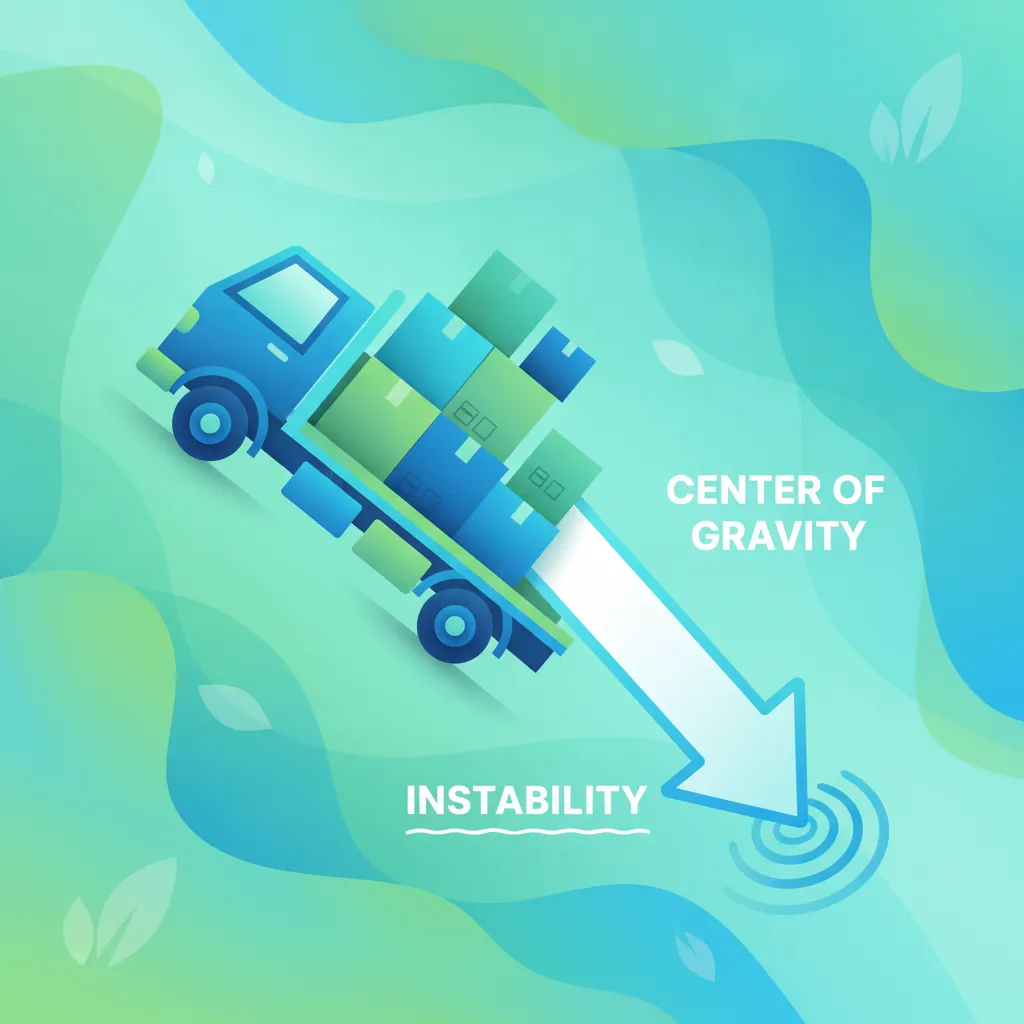
Lesson content overview
Operating heavy goods vehicles, whether for local deliveries or long-haul journeys across Germany and beyond, demands a profound understanding of how mass is distributed and its impact on vehicle stability and safety. This lesson delves into the fundamental principles of load distribution and the crucial role of the centre of gravity, knowledge that is indispensable for every professional driver seeking a German heavy vehicle driving license in categories C1, C1E, C, and CE. Mastering these concepts is not just about compliance; it's about preventing serious accidents, ensuring optimal vehicle performance, and protecting yourself and other road users.
The way cargo is placed within or on a heavy vehicle fundamentally alters its handling characteristics, braking performance, and susceptibility to instability. Unlike passenger cars, heavy vehicles carry significant and often variable loads, making load management a core competency for drivers. A poorly distributed load can lead to catastrophic consequences, including vehicle rollover, loss of control during braking or cornering, and excessive wear on vehicle components.
For professional drivers in Germany, adherence to precise load distribution regulations is paramount. German traffic law, in conjunction with European directives, sets strict limits on overall vehicle weight, individual axle loads, and the securement of cargo. Ignoring these principles not only risks severe penalties but also compromises road safety. This lesson provides the theoretical foundation for making informed decisions about loading, ensuring your vehicle remains stable and controllable under all conditions.
The principles discussed here – Centre of Gravity (CoG), Axle Load Distribution, and Load Transfer – are directly linked to safe operational practices and legal obligations. They form the basis for understanding why specific load securing methods are required and why certain driving techniques are safer with particular loads. These concepts are foundational for subsequent lessons on load securing and advanced stability management.
The Centre of Gravity (CoG) is perhaps the most critical concept when considering vehicle stability. It is the theoretical point where the entire mass of a vehicle and its load can be considered to act. Imagine trying to balance the loaded vehicle on a single point; that point would be its centre of gravity.
The CoG is not a fixed point within a heavy vehicle; it shifts dynamically based on the weight and placement of the cargo. Even the driver and fuel can subtly alter its position. Understanding where this point lies is crucial for predicting how a vehicle will react during various maneuvers.
The vertical CoG refers to the height of the centre of gravity above the ground. A higher vertical CoG is directly associated with an increased risk of rollover, especially during cornering or sudden evasive maneuvers. Heavy vehicles, by their nature, often have a higher CoG than passenger cars due to their size and the height at which cargo is carried.
When a vehicle corners, centrifugal force pushes it outwards. If the CoG is high, this force creates a larger lever arm, increasing the overturning moment and making the vehicle more susceptible to tipping. Conversely, a lower CoG reduces this lever arm, making the vehicle more stable and resistant to rolling. This is why heavy items should always be loaded as low as possible in the cargo area.
Beyond its height, the horizontal CoG—its position along the length and width of the vehicle—is equally important.
Every item of cargo contributes to the overall CoG. Placing a heavy object on the roof of a vehicle, for example, will raise the vertical CoG significantly more than placing the same object on the floor. Similarly, placing heavy items to one side will shift the horizontal CoG laterally. Professional drivers must consciously consider the weight and position of each item to ensure the CoG remains within safe and manufacturer-specified limits. This often means distributing cargo not just for space efficiency but for optimal weight balance.
Beyond the overall Centre of Gravity, the distribution of the vehicle's total weight across its individual axles is a critical aspect of heavy vehicle operation. Each axle has a maximum permissible load, which, if exceeded, can lead to severe safety hazards and legal infractions.
Axle load distribution is the division of the total vehicle mass (tare weight plus payload) among its various axles. For heavy vehicles, this includes front axles, rear axles, and sometimes middle or steerable axles. Proper distribution ensures that no single axle or tire is overloaded, preserving vehicle integrity and road safety.
In Germany and throughout the European Union, strict legal limits govern the maximum permissible load for each axle type (e.g., single drive axle, tandem axle). These limits are designed to protect road infrastructure, ensure safe vehicle handling, and prevent excessive wear. Vehicle manufacturers also specify maximum technical axle loads, which must never be exceeded, even if they are technically higher than the legal limits. Drivers are always bound by the lower of the two values.
Failing to comply with these limits can result in significant fines, mandatory unloading of excess cargo, and points on a driver's license. Regular checks of axle loads, often performed using weighbridges or on-board weighing systems, are crucial.
An overloaded axle creates multiple safety and performance issues:
To ensure optimal axle load distribution, drivers should:
Vehicle loads are not static; they shift in response to acceleration, braking, and cornering. This phenomenon, known as load transfer, plays a crucial role in vehicle dynamics and must be understood and managed by heavy vehicle drivers to maintain control and safety.
Load transfer is a direct consequence of a vehicle's inertia and the forces applied during driving. When a vehicle changes speed or direction, the mass resists these changes, causing a momentary shift in the perceived weight distribution. This is not a change in the total weight, but rather how that weight is distributed onto the tires and axles at that specific moment.
Longitudinal load transfer occurs along the vehicle's length, primarily between the front and rear axles.
Drivers must anticipate these shifts. For instance, progressive braking allows for a controlled transfer of load to the front, maximizing braking efficiency without overwhelming the front axles or causing the rear wheels to lose too much traction.
Lateral load transfer occurs from side to side during cornering or when the vehicle encounters uneven road surfaces.
Managing lateral load transfer is crucial for maintaining stability in turns. Smooth, gradual steering inputs and appropriate speeds are vital, especially with high or uneven loads.
Effective management of load transfer is a hallmark of a skilled heavy vehicle driver. This involves:
Rollover is one of the most dangerous types of accidents involving heavy vehicles, often resulting in severe injury, fatalities, and extensive damage. Understanding and actively mitigating rollover risk is a primary responsibility for professional drivers.
Rollovers can be broadly categorized into two types:
As discussed, a lower CoG is the single most effective way to reduce rollover risk. When the CoG is high, less lateral force is required to cause the vehicle to tip. Think of a tall, narrow object versus a short, wide object; the taller one is much easier to push over. Heavy vehicles, especially those carrying high or dense loads, must prioritize keeping their CoG as low as possible.
Proper load securing plays a direct role in preventing dynamic rollover. If cargo is not secured, it can shift during a turn or braking event. This sudden shift of mass changes the vehicle's CoG, often raising it or moving it towards the outside of a turn, which can instantly trigger a rollover. Even a small shift of a heavy item can be enough to destabilize a vehicle already operating near its stability limits. German regulations mandate specific methods and equipment for securing all types of cargo to prevent such shifts.
Drivers can significantly reduce rollover risk through cautious and skilled driving:
Compliance with German legal requirements for load distribution and securing is not optional; it is mandatory and subject to stringent enforcement. Professional drivers must be fully aware of their obligations to avoid penalties and, more importantly, ensure safety.
In Germany, the Straßenverkehrs-Zulassungs-Ordnung (StVZO) and the Straßenverkehrs-Ordnung (StVO) contain crucial regulations regarding vehicle dimensions, weights, and loads. Key principles include:
These limits are designed to protect road infrastructure and ensure safe vehicle operation. Drivers are legally responsible for verifying their vehicle's weight and axle loads before commencing a journey.
While there isn't a direct "CoG rule" in the German StVO, the principle of maintaining a safe CoG is implicitly mandated through general safety regulations and explicit load securing requirements. The StVO § 22 "Ladung" (Cargo) requires that cargo must be stowed and secured in such a way that it cannot slip, fall over, roll away, fall down, or generate avoidable noise, even in emergency braking or sudden evasive maneuvers. This directly implies a need to manage the CoG.
The directive to keep the CoG as low as practical is a best practice that translates directly into legal compliance under general safety clauses. Loading heavy items high on a vehicle, even if the total weight and axle loads are within limits, could be deemed negligent if it leads to instability.
Proper load securing is intrinsically linked to load distribution and CoG management. If cargo shifts, it can instantly disrupt the carefully calculated weight distribution and elevate the CoG, leading to instability. German law requires loads to be secured against movement in all directions: forward, backward, and laterally. This is usually achieved through:
Drivers are typically required to carry documentation that verifies the vehicle's specifications, including permissible weights and axle loads. During roadside checks by the Polizei or Bundesamt für Güterverkehr (BAG), these documents, along with the actual load, will be inspected. Ignorance of the rules is not an excuse.
Even experienced drivers can sometimes make errors in load distribution. Recognizing these common pitfalls is the first step towards preventing them.
A frequent mistake is to overload one or more axles while the total vehicle weight might still be within limits.
Stacking cargo too high, especially heavy items, is a critical error that significantly increases rollover risk. Even if total weight and axle loads are legal, a high CoG makes the vehicle inherently unstable.
Assuming the weight of the cargo alone is enough to prevent movement, or using insufficient securing methods, is a recipe for disaster. Load securing must be robust enough to withstand forces generated during emergency braking, sudden evasive maneuvers, or even minor bumps.
Failing to account for how weight shifts during driving maneuvers can lead to loss of control. Aggressive braking or sharp cornering, particularly with a high or poorly distributed load, can quickly overwhelm the vehicle's stability limits.
Load distribution principles remain constant, but their practical application must adapt to various external factors.
In urban areas or dense traffic, the need for safe load distribution becomes even more critical due to the presence of vulnerable road users like pedestrians and cyclists. An unpredictable load shift during emergency braking or a sudden turn can lead to catastrophic consequences if it results in loss of control or an extended stopping distance. A vehicle with compromised stability cannot react safely in an emergency.
Understanding the principles of load distribution and centre of gravity is a cornerstone of safe heavy vehicle operation. This theoretical knowledge must be reinforced with practical application and continuous learning.
This lesson covers the fundamental physics of load distribution and Centre of Gravity for heavy vehicles in Germany. The CoG position—affected by cargo placement—determines vehicle stability, with a higher CoG creating greater rollover risk during cornering. Axle load distribution must comply with German legal limits and ensures proper braking, steering, and tire performance. Dynamic load transfer during maneuvers shifts weight longitudinally and laterally, requiring smooth driving inputs and anticipation. Proper load securing is legally mandated and prevents cargo shift that could instantly destabilize an otherwise properly loaded vehicle.
A short set of high-value points that capture the most important learning from this lesson.
The Centre of Gravity (CoG) is the theoretical point where a vehicle's total mass is concentrated, and its height above ground directly determines rollover susceptibility
Axle load distribution divides total vehicle mass across individual axles, each with maximum permissible limits enforced by German law
Dynamic load transfer shifts weight between axles during braking, acceleration, and cornering, requiring anticipatory driving techniques
A lower CoG reduces the overturning moment during turns, making the vehicle inherently more stable against rollover
German StVZO and StVO mandate strict compliance with axle load limits and require cargo to be secured against movement in all directions
Explore all units and lessons included in this driving theory course.
Heavier items should always be placed as low and centrally as possible to minimize CoG height
During braking, weight transfers forward increasing front axle load; during acceleration it transfers backward
Uneven side-to-side load distribution causes vehicle lean and increases rollover risk during turns toward the heavier side
StVO § 22 requires cargo to be secured so it cannot shift even during emergency braking or evasive maneuvers
Drivers must verify actual axle loads using weighbridges when uncertain about distribution compliance
Concentrating heavy cargo at one end or side, which overloads specific axles while leaving others underutilized
Stacking heavy items high in the cargo area, unnecessarily raising the CoG and increasing rollover vulnerability
Relying solely on cargo weight friction instead of proper lashing, blocking, or form-fitting securing methods
Driving aggressively with poorly distributed loads, failing to account for amplified load transfer effects
Assuming total vehicle weight within limits means axle loads are also within limits without verification
Lesson content overview
A short set of high-value points that capture the most important learning from this lesson.
The Centre of Gravity (CoG) is the theoretical point where a vehicle's total mass is concentrated, and its height above ground directly determines rollover susceptibility
Axle load distribution divides total vehicle mass across individual axles, each with maximum permissible limits enforced by German law
Dynamic load transfer shifts weight between axles during braking, acceleration, and cornering, requiring anticipatory driving techniques
A lower CoG reduces the overturning moment during turns, making the vehicle inherently more stable against rollover
German StVZO and StVO mandate strict compliance with axle load limits and require cargo to be secured against movement in all directions
Explore all units and lessons included in this driving theory course.
Heavier items should always be placed as low and centrally as possible to minimize CoG height
During braking, weight transfers forward increasing front axle load; during acceleration it transfers backward
Uneven side-to-side load distribution causes vehicle lean and increases rollover risk during turns toward the heavier side
StVO § 22 requires cargo to be secured so it cannot shift even during emergency braking or evasive maneuvers
Drivers must verify actual axle loads using weighbridges when uncertain about distribution compliance
Concentrating heavy cargo at one end or side, which overloads specific axles while leaving others underutilized
Stacking heavy items high in the cargo area, unnecessarily raising the CoG and increasing rollover vulnerability
Relying solely on cargo weight friction instead of proper lashing, blocking, or form-fitting securing methods
Driving aggressively with poorly distributed loads, failing to account for amplified load transfer effects
Assuming total vehicle weight within limits means axle loads are also within limits without verification
Explore search topics learners often look for when studying Principles of Load Distribution and Centre of Gravity. These topics reflect common questions about road rules, driving situations, safety guidance, and lesson level theory preparation for learners in Germany.
Browse additional driving theory lessons that cover connected traffic rules, road signs, and common driving situations related to this topic. Improve your understanding of how different rules interact across everyday traffic scenarios.
Understand the critical principles of securing loads and maintaining vehicle stability. This lesson explores how proper cargo placement, load distribution, and understanding the centre of gravity prevent dangerous shifts and rollovers, essential for the German C and CE license theory.

This lesson focuses on vehicle stability and the risks of rollover, particularly for vehicles with a high centre of gravity. It discusses how load placement, speed, and cornering affect rollover risk. The content outlines countermeasures such as speed reduction, load lowering, and the use of anti-roll devices.

This lesson examines the risks associated with load shifting during braking and cornering maneuvers. It explains how inertia and weight transfer can cause cargo to move, potentially leading to instability or loss of control. The content emphasizes the importance of proper load securing to mitigate these risks and maintain vehicle stability.

This lesson focuses on the critical relationship between load distribution, the center of gravity, and vehicle stability. It explains how the placement of passengers and luggage can raise the center of gravity, increasing the risk of rollover during turns or sudden maneuvers. Learners will understand how to manage loading within legal weight limits to maintain optimal handling, braking performance, and overall safety.

This lesson explains the legal and safety requirements for transporting goods and cargo. It covers the importance of proper load distribution to maintain vehicle stability and the methods for securely fastening items to prevent them from shifting or falling. The regulations concerning maximum vehicle weight, roof loads, and the correct marking of loads that overhang the vehicle are also detailed.

This lesson covers the various methods and equipment used to secure loads, including friction, blocking, and lashing techniques. It describes the proper use of tie-down straps, cargo nets, load bars, and other securing devices. The content also explains how to achieve sufficient tension and use secure fastening points.

This lesson outlines the legal requirements for load securing according to German traffic law (StVO) and other relevant regulations. It details the obligations for cargo safety, inspection, and documentation. The content also explains the penalties for non-compliance, emphasizing adherence to legal standards to ensure safety.

This lesson covers safe reversing techniques for both rigid trucks and articulated combinations, emphasizing the use of mirrors and cameras. It discusses the risks of jackknifing during reversal and the importance of speed control and safety checks. The content outlines best practices for planning a safe reversing path, potentially with a guide person.

This lesson focuses on the risks of jackknifing and trailer swing, particularly during braking and on downhill descents. It provides recommendations for safe speed management, proper braking techniques, and maintaining vehicle stability. The content also addresses safe reversing practices and the importance of monitoring blind spots during maneuvers.

This lesson explains the specific regulations for operating heavy vehicles on Autobahnen, including speed limits, lane discipline, and overtaking rules. It discusses the use of dedicated truck lanes and the importance of maintaining appropriate following distances. The content also covers procedures for merging and exiting high-speed roads safely.

This lesson examines the concepts of turning radius and swept path, explaining how a heavy vehicle's size influences the space required for a turn. It highlights the importance of maintaining proper lane positioning to accommodate the vehicle's dimensions. The content provides guidance on planning maneuvers and accounting for off-tracking during cornering.
Learn about the fundamental principles of axle load distribution and permissible vehicle masses. This lesson covers how cargo affects axle weights and overall vehicle balance, ensuring compliance with German road traffic regulations for heavy goods vehicles and combinations.

This lesson teaches how to calculate the payload and gross combination mass (GCM) for vehicle combinations. It explains the difference between vehicle mass and payload, and introduces the concept of tongue load and its impact on handling and braking. The content provides practical examples and calculation formulas for determining permissible loads for safe operation.

This lesson focuses on the distribution of loads across axle groups and the legal limits for axle loads. It explains the importance of correct weight distribution to avoid axle overloading, which can lead to road damage and safety hazards. The content also covers methods for measuring axle loads and the legal requirements for maintaining proper axle load limits.

This lesson explains the concepts of permissible total mass and actual mass, as well as the risks and legal consequences of overloading. It discusses how exceeding mass limits can lead to fines, increased stopping distances, and a higher risk of instability. Additionally, the content highlights the impact of overloading on vehicle wear and legal liabilities.

This lesson covers the dimensional limits for heavy vehicles, focusing on height, width, and length restrictions. It explains how to interpret clearance signage for bridges, tunnels, and overhead obstacles, and discusses the implications for route planning. The content also addresses the importance of understanding turning radii and swept paths to avoid collisions.
This lesson explains the specific regulations for operating heavy vehicles on Autobahnen, including speed limits, lane discipline, and overtaking rules. It discusses the use of dedicated truck lanes and the importance of maintaining appropriate following distances. The content also covers procedures for merging and exiting high-speed roads safely.
This lesson explains the legal and safety requirements for transporting goods and cargo. It covers the importance of proper load distribution to maintain vehicle stability and the methods for securely fastening items to prevent them from shifting or falling. The regulations concerning maximum vehicle weight, roof loads, and the correct marking of loads that overhang the vehicle are also detailed.
Find clear answers to common questions learners have about Principles of Load Distribution and Centre of Gravity. Learn how the lesson is structured, which driving theory objectives it supports, and how it fits into the overall learning path of units and curriculum progression in Germany. These explanations help you understand key concepts, lesson flow, and exam focused study goals.
A high centre of gravity makes a vehicle significantly more unstable during cornering and sudden maneuvers. In heavy vehicles, this increases the risk of a rollover, which is why cargo must be packed low and centred to maintain equilibrium.
Yes, improper load distribution can overload specific axles, preventing the braking system from functioning correctly across all wheels. This leads to increased braking distances and potential brake failure due to overheating on specific components.
Questions often present scenarios where you must decide if a vehicle is safely loaded based on diagrams or descriptions of cargo placement. You will need to identify if the centre of gravity is too high or if the weight is unevenly distributed across the axles.
Exceeding axle load limits is illegal and dangerous; it can cause structural damage to the vehicle, increase wear on tires and suspension, and significantly compromise your ability to steer or brake safely, which is a core focus of the C/CE examination.
Begin your targeted revision now. Use our practice search to quickly find specific German driving theory questions. Filter by StVO rules, road signs, or hazard perception to create your focused study plan. Master challenging areas and prepare confidently for your theoretical driving test.