
This lesson guides you through the legal and safety requirements for transporting cargo in your vehicle. You will learn how to properly distribute loads, calculate weight limits, and secure items effectively to ensure stability and safety on German roads. This knowledge is essential for both your theory exam and your future as a responsible driver.

Lesson content overview
Transporting goods safely and legally is a fundamental skill for every driver, especially when preparing for the German Category B driving license theory exam. Improper loading, whether it's too much weight, poor distribution, or unsecured items, can severely compromise vehicle stability, braking performance, and steering, leading to dangerous situations for yourself and other road users. This lesson delves into the critical principles, regulations, and best practices for loading your vehicle, managing roof loads, and securing cargo according to German traffic law.
Every item you place in or on your vehicle impacts its dynamics. A poorly distributed or unsecured load can transform your vehicle into a hazard. Imagine sudden braking, sharp turns, or even a minor collision: unsecured cargo can become projectiles inside the vehicle, injure passengers, or be ejected onto the road, creating immediate dangers for traffic behind you. Understanding how your vehicle responds to different loads is not just about compliance; it's about preventing accidents and ensuring the safety of everyone.
Vehicle dynamics refer to how a vehicle moves and reacts under various conditions. When you add cargo, you change the vehicle's total weight and its center of gravity. A higher or off-center load can significantly increase the risk of oversteering, understeering, or even a rollover, particularly during emergency maneuvers. Braking distances can also be extended, and acceleration can be sluggish. Therefore, meticulous load management is essential for maintaining predictable and safe vehicle handling.
In Germany, strict regulations govern how vehicles are loaded to ensure road safety and protect infrastructure. These rules are primarily found in the Straßenverkehrs-Zulassungs-Ordnung (StVZO), which outlines the technical requirements for vehicles and their operation. Adhering to these legal limits is not optional; it is a mandatory part of safe driving.
The maximum permissible total weight of a vehicle when fully loaded. This includes the vehicle's empty weight, fuel, passengers, and all cargo.
The Gross Vehicle Weight (GVW), or in German, zulässiges Gesamtgewicht, is a crucial figure specified by the vehicle manufacturer and found in your vehicle's registration documents. It represents the absolute maximum weight your vehicle can safely carry. Exceeding the GVW is a serious offense under §§ 2 and 3 of the StVZO because it overstresses vital vehicle components like brakes, suspension, and tires. This can lead to component failure, loss of control, and increased braking distances. Always check your vehicle's GVW before loading.
Exceeding the Gross Vehicle Weight (GVW) is illegal and extremely dangerous. It compromises vehicle safety and handling, and can lead to significant fines and penalties.
The maximum allowable weight of passengers and cargo that a vehicle can carry without exceeding its Gross Vehicle Weight (GVW). It is calculated by subtracting the vehicle's empty weight from its GVW.
While GVW refers to the total weight, payload capacity (in German, Zuladung) focuses specifically on what you can add to the vehicle. This includes the weight of all occupants, personal belongings, luggage, and any additional cargo. It is essential to remember that even if individual items are light, their cumulative weight can quickly exceed the payload limit. Manufacturers specify this limit to ensure that the vehicle's performance characteristics, particularly braking and handling, remain within safe parameters.
Transporting items on the roof rack is common but comes with its own set of rules. Your vehicle has a specific roof load capacity, specified by the manufacturer. This limit is usually lower than the overall payload capacity because roof loads significantly raise the vehicle's center of gravity. Exceeding this limit dramatically increases the risk of instability, especially during cornering or in strong winds, and can put undue strain on the roof structure itself. Always consult your vehicle's manual for its specific roof load limit.
Proper load distribution is arguably as important as staying within weight limits. It involves arranging cargo to maintain the vehicle's balance and stability, ensuring predictable handling under all driving conditions.
The hypothetical point where the entire weight of the vehicle and its load is concentrated. Its position greatly influences vehicle stability.
The center of gravity (CoG) is a crucial concept in vehicle dynamics. Ideally, the CoG should be as low and as central as possible.
To achieve optimal load distribution, follow these guidelines:
Securing cargo is a legal requirement under StVZO § 22, stating that loads must be secured such that they cannot slip, fall, roll, or cause danger even under sudden braking or evasive maneuvers. Proper securing prevents cargo from becoming a projectile or creating a road hazard.
The type of restraint depends on the cargo's weight, size, and shape:
Regardless of the restraint type, follow these key securing techniques:
Anchor Points: Always use strong, designated anchor points on your vehicle or roof rack. Never attach straps to plastic trim or non-structural parts.
Direct Securing (Lashing): This involves tying the load directly to the vehicle, pressing it down or holding it in place. Use multiple straps to prevent movement in all directions (forward, backward, sideways, and upward).
Friction Securing (Tie-down): Straps are tightened over the top of the load, pressing it against the loading surface to increase friction. This is effective but requires sufficient friction and tension.
Padding and Protection: Protect both the cargo and the vehicle from abrasion. Use corner protectors or padding under straps where they might rub against sharp edges or delicate surfaces.
Check Tension: After driving a short distance (e.g., 5-10 km), pull over and re-check the tension of all straps. Cargo can settle, and straps might loosen.
Cargo on the roof is exposed to wind resistance, which can exert significant forces.
Any load that extends beyond the outer dimensions of your vehicle can pose a significant hazard to other road users, especially cyclists and pedestrians. German law (StVZO § 28) has specific rules for marking these overhanging loads to ensure they are clearly visible.
For loads that overhang the rear of the vehicle by more than 1.5 meters, a bright red-orange warning sign (often a square panel with diagonal stripes, or a triangular flag) must be attached to the outermost point of the load. This sign must be clearly visible from behind. At night or in poor visibility, this overhang must also be illuminated with a red light, and the warning sign itself might need to be reflective. This ensures that following drivers, cyclists, and pedestrians can accurately judge the length of your vehicle and avoid collisions with the extended load.
Even experienced drivers can make mistakes when loading their vehicles. Awareness of common pitfalls is key to prevention.
Let's look at some real-world examples to illustrate proper loading and securing.
Setting: A driver is preparing for a holiday trip and wants to load a roof box weighing 30 kg onto the roof rack of their compact hatchback. The vehicle's manual specifies a roof load limit of 50 kg.
Relevant Rule: The roof load must not exceed the manufacturer's specified limit, and cargo must be secured against movement.
Correct Behavior: The driver verifies the roof load limit (50 kg), confirming the 30 kg box is well within the safe range. They position the roof box centrally on the roof rack to maintain even weight distribution and minimize wind resistance. The box is then securely fastened to the roof rack using the manufacturer's recommended attachment system, supplemented by two strong ratchet straps tightened over the box and attached to the rack's anchor points, ensuring no movement.
Incorrect Behavior: The driver ignores the roof load limit and places a 70 kg roof box on the vehicle. They place it slightly off-center and only use one flimsy strap to secure it, or rely solely on the box's internal locking mechanism without external securing.
Explanation: Exceeding the roof load limit (70 kg vs. 50 kg) significantly raises the vehicle's center of gravity, making it prone to instability, especially at higher speeds or in crosswinds. Improper securing means the box could shift, detach, or even become airborne, creating a severe road hazard.
Setting: A family car is equipped with a rear-mounted bicycle rack that, with bicycles, extends 1.6 meters beyond the rear bumper of the vehicle.
Relevant Rule: Loads extending more than 1.5 meters beyond the vehicle's rear must be marked with a warning sign (StVZO § 28).
Correct Behavior: Since the total overhang (1.6 meters) exceeds the mandatory 1.5-meter threshold, the driver attaches a clearly visible red-orange warning sign with diagonal stripes to the furthest point of the bicycle rack. They also ensure the vehicle's rear lights and license plate are visible; if not, a light bar with a duplicate license plate is used.
Incorrect Behavior: The driver assumes the overhang is negligible or believes that because it's only slightly over 1.5 meters, it doesn't require marking. They drive without any warning sign.
Explanation: Failing to mark the overhang significantly increases the risk of other road users misjudging the vehicle's length, leading to potential collisions. This is especially dangerous for cyclists or pedestrians, who might not see the protrusion.
Setting: A driver of a small delivery van needs to transport several heavy items, including a washing machine, some boxes of tiles, and lighter packages.
Relevant Rule: The load should be distributed evenly side-to-side and front-to-rear to maintain vehicle stability and within the payload capacity.
Correct Behavior: The driver first places the heaviest item (washing machine) centrally and as low as possible within the cargo area, ideally over the rear axle. The boxes of tiles are then distributed evenly on both sides of the washing machine, also low down. Lighter packages are placed on top or around the heavy items. All items are secured with multiple ratchet straps to prevent shifting during transit. The driver also ensures the total weight remains within the van's payload capacity.
Incorrect Behavior: All heavy items are placed solely on the right side of the van, and towards the very rear. Lighter packages are haphazardly thrown in without securing.
Explanation: Concentrating all heavy items on one side causes an uneven lateral load distribution, making the vehicle pull to that side and become unstable during turns or braking. Placing all heavy items at the extreme rear shifts the longitudinal center of gravity backward, reducing front-wheel traction and making steering less responsive and braking less effective.
Adhering to these German loading regulations is not merely about avoiding fines; it's about fundamental road safety. Improper loading can lead to:
Punkte in Flensburg), and potential criminal charges for negligence. Insurance coverage may also be affected.By understanding and applying these principles, you ensure your vehicle remains safe and roadworthy, protecting yourself and others on German roads.
This lesson covers the essential German regulations for vehicle loading under StVZO, including Gross Vehicle Weight limits, payload capacity, and specific roof load restrictions. Proper load distribution principles are explained, emphasizing keeping heavy items low and centered to maintain vehicle stability and safe handling. The legal requirements for cargo securing under StVZO § 22 mandate using appropriate restraints like ratchet straps, and the overhang marking rules under StVZO § 28 require red-orange warning signs for loads extending beyond 1.5 meters. Understanding these rules is critical for both passing the Category B theory exam and ensuring road safety in real-world driving.
A short set of high-value points that capture the most important learning from this lesson.
Never exceed your vehicle's Gross Vehicle Weight (GVW) or roof load limit as specified in registration documents and owner's manual.
Place heavy items low and centered over the axles, distributing weight evenly both front-to-rear and side-to-side.
Use robust ratchet straps for heavy cargo and secure items to prevent movement in all directions (StVZO § 22).
Loads extending more than 1.5 meters beyond the vehicle's rear require a red-orange warning sign attached at the outermost point.
Improper loading compromises vehicle stability, braking performance, and steering, creating serious safety hazards.
Explore all units and lessons included in this driving theory course.
GVW (zulässiges Gesamtgewicht) includes the vehicle itself, fuel, all passengers, and cargo — never exceed this total.
Roof loads significantly raise the center of gravity and are limited to a lower specific weight than overall payload.
Re-check all restraint tension after driving a short distance (5-10 km) as cargo can settle and straps can loosen.
Use only structural anchor points for securing cargo; never attach straps to plastic trim or non-structural parts.
Overhanging loads must be illuminated at night or in poor visibility, not just marked with a warning sign.
Using bungee cords as primary restraints for heavy items instead of proper ratchet straps.
Concentrating all heavy cargo at one end (especially the rear) or entirely on one side, causing unstable handling.
Exceeding the roof load limit because individual items seem light without considering cumulative weight.
Failing to attach mandatory warning signs to loads extending beyond 1.5 meters, assuming small overhangs are negligible.
Not verifying that rear lights and license plate remain visible when using rear-mounted bike racks or cargo carriers.
Lesson content overview
A short set of high-value points that capture the most important learning from this lesson.
Never exceed your vehicle's Gross Vehicle Weight (GVW) or roof load limit as specified in registration documents and owner's manual.
Place heavy items low and centered over the axles, distributing weight evenly both front-to-rear and side-to-side.
Use robust ratchet straps for heavy cargo and secure items to prevent movement in all directions (StVZO § 22).
Loads extending more than 1.5 meters beyond the vehicle's rear require a red-orange warning sign attached at the outermost point.
Improper loading compromises vehicle stability, braking performance, and steering, creating serious safety hazards.
Explore all units and lessons included in this driving theory course.
GVW (zulässiges Gesamtgewicht) includes the vehicle itself, fuel, all passengers, and cargo — never exceed this total.
Roof loads significantly raise the center of gravity and are limited to a lower specific weight than overall payload.
Re-check all restraint tension after driving a short distance (5-10 km) as cargo can settle and straps can loosen.
Use only structural anchor points for securing cargo; never attach straps to plastic trim or non-structural parts.
Overhanging loads must be illuminated at night or in poor visibility, not just marked with a warning sign.
Using bungee cords as primary restraints for heavy items instead of proper ratchet straps.
Concentrating all heavy cargo at one end (especially the rear) or entirely on one side, causing unstable handling.
Exceeding the roof load limit because individual items seem light without considering cumulative weight.
Failing to attach mandatory warning signs to loads extending beyond 1.5 meters, assuming small overhangs are negligible.
Not verifying that rear lights and license plate remain visible when using rear-mounted bike racks or cargo carriers.
Explore search topics learners often look for when studying Loading, Roof Loads, Securing Cargo. These topics reflect common questions about road rules, driving situations, safety guidance, and lesson level theory preparation for learners in Germany.
Browse additional driving theory lessons that cover connected traffic rules, road signs, and common driving situations related to this topic. Improve your understanding of how different rules interact across everyday traffic scenarios.
Understand the critical rules for distributing cargo and adhering to weight limits in your vehicle. This lesson covers how proper load balancing impacts stability and safe driving according to German StVO regulations.

This lesson focuses on the distribution of loads across axle groups and the legal limits for axle loads. It explains the importance of correct weight distribution to avoid axle overloading, which can lead to road damage and safety hazards. The content also covers methods for measuring axle loads and the legal requirements for maintaining proper axle load limits.

This lesson focuses on the critical relationship between load distribution, the center of gravity, and vehicle stability. It explains how the placement of passengers and luggage can raise the center of gravity, increasing the risk of rollover during turns or sudden maneuvers. Learners will understand how to manage loading within legal weight limits to maintain optimal handling, braking performance, and overall safety.
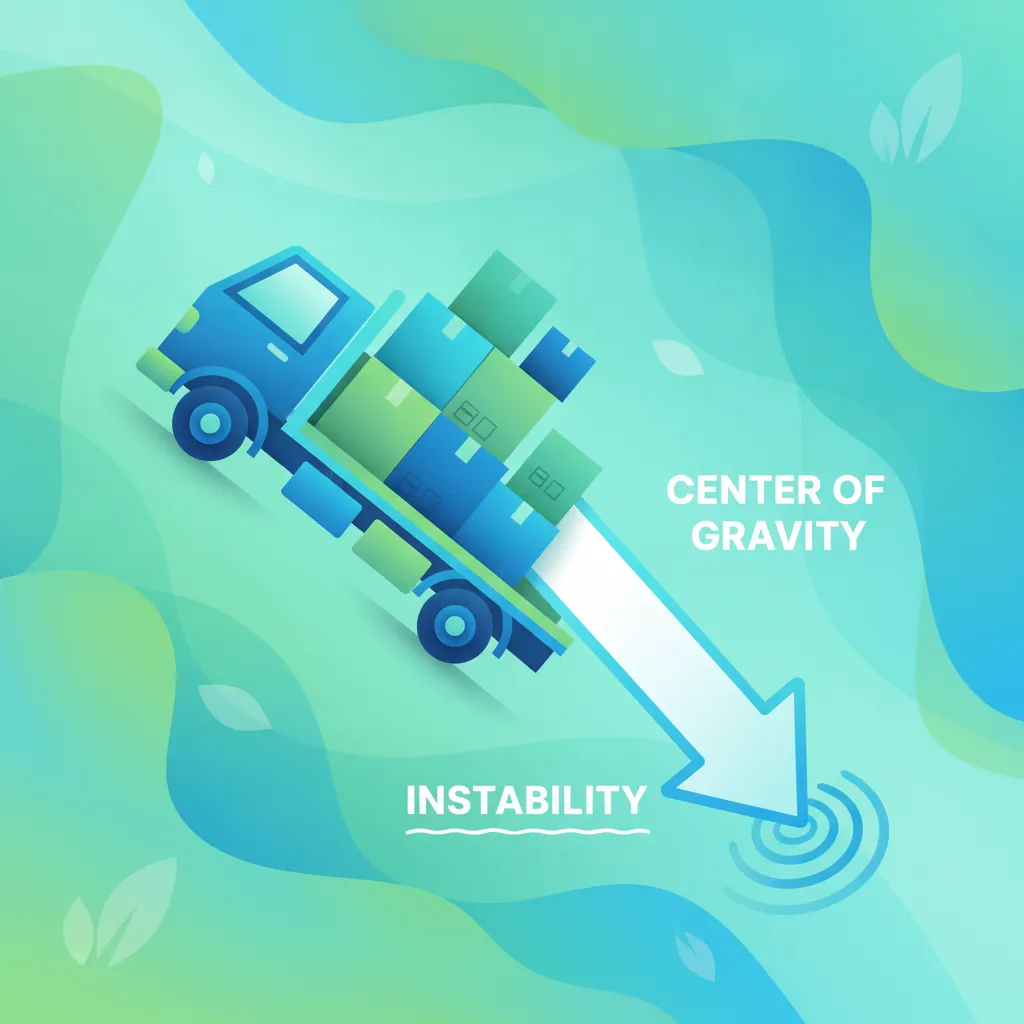
This lesson introduces the principles of load distribution and the impact of the centre of gravity on vehicle stability. It explains how cargo placement influences axle loads and the overall balance of the vehicle. The content emphasizes the importance of maintaining a low centre of gravity to reduce rollover risk.
This lesson explains the specific rules and limitations for towing trailers with a Category B license in Germany. It details how to calculate the permissible total weight of the car and trailer combination. The lesson also covers the practical aspects of safely coupling a trailer, checking its lights, and the changes in vehicle handling that drivers must adapt to when towing.
This lesson explains the specific regulations for operating heavy vehicles on Autobahnen, including speed limits, lane discipline, and overtaking rules. It discusses the use of dedicated truck lanes and the importance of maintaining appropriate following distances. The content also covers procedures for merging and exiting high-speed roads safely.

This lesson explains the concepts of permissible total mass and actual mass, as well as the risks and legal consequences of overloading. It discusses how exceeding mass limits can lead to fines, increased stopping distances, and a higher risk of instability. Additionally, the content highlights the impact of overloading on vehicle wear and legal liabilities.

This lesson covers the dimensional limits for heavy vehicles, focusing on height, width, and length restrictions. It explains how to interpret clearance signage for bridges, tunnels, and overhead obstacles, and discusses the implications for route planning. The content also addresses the importance of understanding turning radii and swept paths to avoid collisions.

This lesson outlines the legal ramifications of operating a heavy vehicle while fatigued or overloaded. It covers potential fines, license suspension, and the negative impact on insurance coverage. The content also discusses the increased liability in the event of an accident caused by these violations.

This lesson examines best practices for loading and unloading heavy vehicles at delivery points, including proper vehicle positioning and coordination with ground personnel. It emphasizes the importance of verifying load stability during unloading to prevent accidents. The content also discusses time-window management and safety protocols for loading docks.

This lesson explores the principles of carrying luggage safely without compromising the motorcycle's handling. It emphasizes the importance of securing the load properly and distributing the weight evenly and low to maintain a stable center of gravity. The content explains how improperly loaded luggage can negatively impact steering, braking, and overall stability, particularly at speed.
Learn the specific German regulations for transporting loads that extend beyond your vehicle's dimensions. This includes correct marking procedures to ensure visibility and safety for other road users.
This lesson covers the dimensional limits for heavy vehicles, focusing on height, width, and length restrictions. It explains how to interpret clearance signage for bridges, tunnels, and overhead obstacles, and discusses the implications for route planning. The content also addresses the importance of understanding turning radii and swept paths to avoid collisions.

This lesson examines the specific height, width, and length constraints that affect heavy vehicle operation, including bridge and tunnel clearances. It discusses how to interpret and comply with traffic signs indicating dimensional limits and the consequences of violating these restrictions. The content also covers practical strategies for route planning to avoid restricted areas.

This lesson outlines the legal requirements for load securing according to German traffic law (StVO) and other relevant regulations. It details the obligations for cargo safety, inspection, and documentation. The content also explains the penalties for non-compliance, emphasizing adherence to legal standards to ensure safety.
This lesson focuses on the distribution of loads across axle groups and the legal limits for axle loads. It explains the importance of correct weight distribution to avoid axle overloading, which can lead to road damage and safety hazards. The content also covers methods for measuring axle loads and the legal requirements for maintaining proper axle load limits.
This lesson explains the concepts of permissible total mass and actual mass, as well as the risks and legal consequences of overloading. It discusses how exceeding mass limits can lead to fines, increased stopping distances, and a higher risk of instability. Additionally, the content highlights the impact of overloading on vehicle wear and legal liabilities.
This lesson examines best practices for loading and unloading heavy vehicles at delivery points, including proper vehicle positioning and coordination with ground personnel. It emphasizes the importance of verifying load stability during unloading to prevent accidents. The content also discusses time-window management and safety protocols for loading docks.

This lesson focuses on interpreting various road markings, from lane lines and directional arrows to stop lines and pedestrian crossings. It explains the rules associated with solid versus broken lines and how to navigate temporary markings found in construction zones. Correctly reading these markings is vital for proper lane discipline and safety.

This lesson focuses on the importance of thorough route planning for heavy vehicles, taking into account dimensional and weight limits. It discusses how to use mapping tools and road signage to identify bridges, tunnels, and roads with restrictions. The content also covers how to plan alternative routes to avoid impassable areas.

This lesson covers the lighting and reflector requirements for heavy vehicles, including headlamps, side markers, and brake lights. It explains the function of these systems and the necessity of underrun protection to safeguard other road users. The content also discusses regulations governing lighting systems and their importance for safety in all conditions.
Find clear answers to common questions learners have about Loading, Roof Loads, Securing Cargo. Learn how the lesson is structured, which driving theory objectives it supports, and how it fits into the overall learning path of units and curriculum progression in Germany. These explanations help you understand key concepts, lesson flow, and exam focused study goals.
Loads can extend up to 1.5 meters behind the vehicle, provided the total vehicle length does not exceed 18.75 meters. If the load extends more than 1 meter, it must be clearly marked with a red flag, sign, or light depending on visibility.
Excessive or incorrectly distributed weight shifts your center of gravity, significantly increasing braking distances and reducing vehicle stability in curves. You must always adhere to the maximum permissible mass stated in your vehicle documents.
Yes, you must ensure the roof load is within the manufacturer's specified limit for your vehicle. The load must be securely fastened to prevent shifting during emergency braking or evasive maneuvers.
Beyond risking a safety hazard, driving with insecure cargo is a violation of the StVO. You may be fined and incur penalty points in the German Fahreignungsregister for endangering others on the road.
Begin your targeted revision now. Use our practice search to quickly find specific German driving theory questions. Filter by StVO rules, road signs, or hazard perception to create your focused study plan. Master challenging areas and prepare confidently for your theoretical driving test.