
This lesson teaches you the critical techniques of road positioning and visual focus required for safe riding in Germany. By mastering these skills, you will understand how to choose the optimal lane position to remain visible to other road users and maintain stability in various traffic scenarios. This knowledge is essential for both your theoretical exam and your practical riding progression across licence classes A1, A2, and A.

Lesson content overview
Mastering road positioning, maintaining a sharp visual focus, and adhering to safe lane discipline are fundamental skills for every motorcyclist in Germany. These techniques are critical for enhancing safety, improving visibility, and ensuring a predictable presence on the road. This comprehensive lesson will explore how to proactively select and maintain your position on the road to navigate traffic, anticipate hazards, and execute maneuvers safely, aligning with the requirements for the German Motorcycle Licence Theory Course (Classes A, A1, A2).
Strategic road positioning is not merely about staying within your lane; it's a dynamic skill that involves continuously assessing your environment and adjusting your motorcycle's placement to optimize your view of the road and ensure other road users can see you. For motorcyclists, whose smaller profile can make them harder to spot, effective positioning is a primary defensive riding strategy.
Motorcycles offer unique advantages in agility and maneuverability, but they also come with inherent vulnerabilities. A well-chosen road position can significantly reduce risks by creating safety buffers, reducing blind spots, and providing more time to react to unexpected events. This proactive approach allows riders to dictate their own safety envelope rather than merely reacting to situations as they arise.
Several core principles guide effective road positioning, ensuring a rider consistently makes safe and informed decisions:
Lane positioning refers to both the choice of which lane to occupy on a multi-lane road and your precise placement within that chosen lane. Both decisions significantly impact your safety and ability to interact with traffic.
On roads with multiple lanes in one direction, selecting the appropriate lane is crucial for maintaining smooth traffic flow and ensuring your safety.
The rightmost lane, or rechter Fahrstreifen, is generally intended for slower traffic or when preparing to exit the road to the right. Motorcyclists should use this lane when their speed aligns with slower traffic or when they are approaching a right turn or exit. However, riding too close to the far right edge of the lane can expose you to road debris, poor road surfaces, or blind spots of vehicles turning right.
On multi-lane roads, the middle lane is often the preferred Fahrstreifen for normal cruising. It provides a balanced position, offering good visibility ahead while maintaining a safe distance from merging or exiting traffic on the right and faster overtaking traffic on the left. This position minimizes the need for frequent lane changes, promoting predictability.
The leftmost lane, or linker Fahrstreifen, is primarily for overtaking (Überholen) slower vehicles. Once an overtaking maneuver is complete, riders should return to the rightmost available lane. In some specific situations, such as approaching a sharp left-hand bend, moving slightly into the leftmost lane (if it is safe and legal to do so, considering oncoming traffic and road markings) can improve your line of sight and trajectory. On multi-lane highways, using the leftmost lane can also be necessary for continuous overtaking or when road conditions ahead require better visibility, provided you are maintaining an appropriate speed.
Beyond choosing a lane, your lateral position—where your motorcycle sits side-to-side within that lane—is equally vital.
Positioning your motorcycle nearer to the left edge of your chosen lane (typically about two-thirds from the left, or within the left Drittel of the lane) often provides the best forward visibility. This allows you to see more of the road ahead, including potential hazards, road signs, and traffic conditions, especially when following larger vehicles. This position also makes you more visible in the rearview mirrors of vehicles ahead and creates a larger safety margin from potential hazards on the right side of the road, such as parked cars, opening doors, or pedestrians.
A central lane position offers a balanced approach, providing a safe distance from both lane edges. This can be beneficial in situations where hazards might appear from either side, such as on narrow streets or when navigating areas with frequent driveways. It also clearly signals your presence and intention to other road users, positioning you squarely in their line of sight.
Riding near the right edge of the lane (curbside) is typically reserved for specific situations, such as preparing for a right turn, allowing other vehicles to pass on the left in very narrow conditions, or avoiding specific hazards in the centre or left of the lane. However, as mentioned, this position often compromises forward visibility and reduces your safety buffer from the curb, road debris, or right-turning vehicles. It's generally not recommended for sustained cruising, especially on high-speed roads.
When deciding on your lateral position, always consider what gives you the best view, makes you most visible to others, and provides the largest safety buffer around your motorcycle.
Your visual focus, or how you scan the road, is inextricably linked to effective road positioning and hazard perception. It determines how quickly you can identify and react to potential dangers.
Maintaining a long visual focus means consistently looking far ahead down the road, rather than concentrating only on the immediate path in front of your motorcycle. This habit is critical for expanding your reaction window, allowing you to detect obstacles, traffic changes, and road conditions much earlier. By looking ahead for several hundred metres on straight roads, and through the entire curve on bends, you give your brain more time to process information and formulate a safe response.
One of the most dangerous visual habits for motorcyclists is target fixation. This occurs when a rider focuses intently on a single point or hazard (e.g., a pothole, a car veering off course), unconsciously steering towards it. A narrow focus, or tunnel vision, reduces your awareness of the broader environment. By deliberately maintaining a long, wide visual scan, moving your eyes frequently across the road and to the sides, you actively counteract target fixation and ensure you are aware of your entire surroundings. This helps you to identify escape routes and alternative paths.
A long visual focus directly contributes to an expanded reaction window. The further ahead you look, the more time you have to perceive a hazard, decide on a course of action (e.g., brake, swerve, accelerate), and then execute that action. This additional time can be the difference between avoiding an accident and being involved in one.
Lane discipline is the adherence to lane rules, maintaining a consistent and predictable presence on the road. It involves selecting the correct lane, staying within its markings, and executing any lane changes safely and predictably.
Effective lane discipline is built upon several key components:
Whenever you intend to change lanes, turn, or exit, it is mandatory to signal your intention to other road users. In Germany, this means using your indicators (Blinker) well in advance. Before signaling, always check your mirrors (Rückspiegel) and perform a head check (Schulterblick) to verify your blind spots are clear. A predictable lane change is a gradual, smooth movement, not an abrupt swerve.
Unsignaled or abrupt lane changes are a common cause of accidents. They surprise other drivers and deny them the opportunity to react safely to your actions.
Cornering is one of the most exhilarating aspects of motorcycle riding, but it also demands precise positioning and visual focus for safety. The goal is to maintain optimal visibility, a smooth trajectory, and adequate safety buffers throughout the curve.
Before entering a bend (Kurve), your positioning is crucial.
This initial positioning sets up your corner entry, allowing you to smoothly lean into the turn.
As you lean into the bend, maintain a long visual focus through the curve, aiming towards its apex (the innermost point of your trajectory) and beyond to the exit. Avoid looking down at your front wheel or fixating on the immediate road surface. Your eyes should guide your motorcycle; where you look is where you will go.
The apex is the innermost point of a vehicle's trajectory through a curve. For optimal cornering, riders aim to reach the apex at a speed and lean angle that allows them to smoothly accelerate out of the bend.
As you pass the apex and begin to straighten out of the bend, your visual focus should shift to the upcoming straight section of road. Gradually reduce your lean angle and gently apply throttle to stabilize the motorcycle. Choose your lane position for the subsequent section of road, adjusting for the next hazard or upcoming turn.
Approach: Adjust speed before the bend. Position your motorcycle for optimal visibility and trajectory (left for right bends, right for left bends).
Entry: Maintain a long visual focus through the bend to the exit. Initiate your turn-in smoothly, applying countersteering as needed.
Mid-corner: Your gaze should be far ahead, scanning for hazards. Maintain your chosen line, passing the apex.
Exit: Look towards the exit of the bend. Gradually reduce lean angle and accelerate smoothly to straighten the motorcycle. Readjust your lane position for the upcoming road section.
Adhering to German road traffic regulations (Straßenverkehrs-Ordnung, StVO) is paramount. Several rules directly govern road positioning, visual focus, and lane discipline, ensuring safety and order on public roads.
Blinker) and observe traffic to ensure it is safe to proceed. This is mandatory whenever moving laterally.Sicherheitsabstand) from the vehicle in front, suitable for their speed and road conditions. A common rule of thumb is to maintain at least a two-second gap. This rule is mandatory in all traffic situations.Kreuzungen or Einmündungen) and roundabouts (Kreisverkehre), your lane position must provide a clear view of traffic, signals, and priority rules. For example, positioning towards the left of the lane when preparing for a left turn ensures a better view of oncoming traffic.Abbiegespuren), which dictate specific positioning.Punkte in Flensburg).The dynamic nature of riding means your road positioning must constantly adapt to environmental and situational changes.
Abblendlicht) and potentially fog lights (Nebelscheinwerfer, if equipped and legally allowed for motorcycles) is crucial. A central or slightly leftward position within the lane might make you more visible in the rearview mirrors of vehicles ahead.Landstraßen): On narrow, winding rural roads, maintaining a flexible central or slightly rightward position may be necessary to leave maximum room from oncoming traffic, especially when cresting hills or entering blind bends.Autobahnen): On multi-lane highways, the principles of choosing the appropriate lane (right for slower, middle for cruising, left for overtaking) apply. Lateral positioning towards the left of your chosen lane optimizes visibility.Stadtverkehr): In dense urban environments, defensive positioning is crucial. Be prepared for frequent stops, starts, and sudden movements from other road users. Maintaining generous safety buffers is essential.Sozius) handles differently. Its centre of gravity shifts, and braking distances may increase. Adjust your lateral position to account for these changes, often requiring more space and smoother maneuvers.Fußgänger), cyclists (Radfahrer), or other vulnerable road users, significantly increase your safety buffer. Give them ample space, often requiring a temporary shift in your lane position to the opposite side of the road user. Anticipate unpredictable movements, especially from children or animals.The choices you make regarding road positioning and visual focus have direct, measurable consequences for your safety and the safety of others.
The strong correlation between maintaining a long visual focus and sufficient reaction time cannot be overstated. A rider who consistently scans far ahead and processes a wide field of view will have a demonstrably longer reaction time than one who suffers from target fixation or tunnel vision. This is a fundamental principle of defensive riding.
This lesson teaches motorcycle riders how to use road positioning strategically to enhance visibility and safety on German roads. The core principles of visibility, predictability, and safety buffers guide all positioning decisions, whether selecting a lane, adjusting laterally within a lane, or navigating corners. Long visual focus extending far ahead prevents target fixation and expands the reaction window for hazard avoidance. Lane discipline requires consistent, signaled movements that help other road users anticipate your actions. These skills are essential for passing the German motorcycle theory exam and riding safely across all licence classes A1, A2, and A.
A short set of high-value points that capture the most important learning from this lesson.
Strategic lane positioning balances three core principles: maximizing your view, ensuring other road users can see you, and maintaining a safety buffer around your motorcycle
Lateral position within your lane directly affects visibility: riding near the left edge optimizes forward sightlines, while central position provides balanced awareness
Long visual focus extending far ahead expands your reaction window, allowing earlier hazard detection and smoother responses
Lane discipline requires consistent lane selection, signaling before any lateral movement, and smooth predictable lane changes
Cornering technique follows a sequence: position toward the outside before the bend, look through to the apex, then adjust position for the exit
Explore all units and lessons included in this driving theory course.
On multi-lane roads in Germany: right lane for slower traffic/exiting, middle lane for normal cruising, left lane for overtaking only (§ 2 StVO)
Target fixation is the dangerous tendency to steer toward an obstacle you are staring at; maintain a wide visual scan to prevent it
Before changing lanes or turning, you must signal with indicators and perform a head check (Schulterblick) to clear blind spots (§ 9 StVO)
In right-hand bends, position toward the left side of your lane for a wider turning radius and better visibility of oncoming traffic
Maintain at least a two-second following distance (Sicherheitsabstand) suitable for your speed and conditions (§ 4 StVO)
Riding too close to the right edge of the lane, which reduces forward visibility and places you in blind spots of vehicles ahead
Failing to signal before lane changes or using indicators too late, surprising other road users and increasing collision risk
Staring at an obstacle while cornering (target fixation), which often causes the rider to steer directly toward it
Riding in the leftmost lane at slow speeds unnecessarily, obstructing faster traffic and creating frustration that can lead to risky overtaking from other drivers
Zigzagging between lanes to gain position, which is unpredictable, dangerous, and a violation of lane discipline rules
Lesson content overview
A short set of high-value points that capture the most important learning from this lesson.
Strategic lane positioning balances three core principles: maximizing your view, ensuring other road users can see you, and maintaining a safety buffer around your motorcycle
Lateral position within your lane directly affects visibility: riding near the left edge optimizes forward sightlines, while central position provides balanced awareness
Long visual focus extending far ahead expands your reaction window, allowing earlier hazard detection and smoother responses
Lane discipline requires consistent lane selection, signaling before any lateral movement, and smooth predictable lane changes
Cornering technique follows a sequence: position toward the outside before the bend, look through to the apex, then adjust position for the exit
Explore all units and lessons included in this driving theory course.
On multi-lane roads in Germany: right lane for slower traffic/exiting, middle lane for normal cruising, left lane for overtaking only (§ 2 StVO)
Target fixation is the dangerous tendency to steer toward an obstacle you are staring at; maintain a wide visual scan to prevent it
Before changing lanes or turning, you must signal with indicators and perform a head check (Schulterblick) to clear blind spots (§ 9 StVO)
In right-hand bends, position toward the left side of your lane for a wider turning radius and better visibility of oncoming traffic
Maintain at least a two-second following distance (Sicherheitsabstand) suitable for your speed and conditions (§ 4 StVO)
Riding too close to the right edge of the lane, which reduces forward visibility and places you in blind spots of vehicles ahead
Failing to signal before lane changes or using indicators too late, surprising other road users and increasing collision risk
Staring at an obstacle while cornering (target fixation), which often causes the rider to steer directly toward it
Riding in the leftmost lane at slow speeds unnecessarily, obstructing faster traffic and creating frustration that can lead to risky overtaking from other drivers
Zigzagging between lanes to gain position, which is unpredictable, dangerous, and a violation of lane discipline rules
Explore search topics learners often look for when studying Road Positioning, Visual Focus, and Safe Lane Discipline. These topics reflect common questions about road rules, driving situations, safety guidance, and lesson level theory preparation for learners in Germany.
Browse additional driving theory lessons that cover connected traffic rules, road signs, and common driving situations related to this topic. Improve your understanding of how different rules interact across everyday traffic scenarios.
Deepen your understanding of strategic road positioning and visual focus techniques. Learn how advanced lane discipline and hazard perception improve safety and visibility in complex German traffic situations for motorcycle riders.
This lesson covers the principles of correct vehicle positioning and lane discipline, which are essential for predictable and safe driving. It reinforces the 'Rechtsfahrgebot' (drive on the right) principle and explains how to choose the appropriate lane on multi-lane roads and motorways. Proper positioning for turns and maintaining a safe space cushion around the vehicle are also key topics.

This lesson focuses on strategic road positioning to enhance safety and visibility. It explains where to ride within a lane under different circumstances, such as approaching intersections or riding alongside parked cars. A key skill covered is anticipating the potential actions of other drivers, cyclists, and pedestrians.

This lesson details the correct procedures for entering a motorway, using the acceleration lane to match traffic speed, and merging safely. It reinforces the strict lane discipline required, including keeping to the right lane except when overtaking. The content also provides guidance on maintaining increased following distances and performing safe lane changes at high speeds.

This lesson focuses on the specific techniques for safely navigating roundabouts, a common feature in urban traffic. Learners are taught the correct lane selection for their intended exit, the importance of proper signaling upon entry and exit, and maintaining an appropriate speed. The content highlights the need to yield to circulating traffic and to be aware of other vehicles changing lanes within the roundabout.
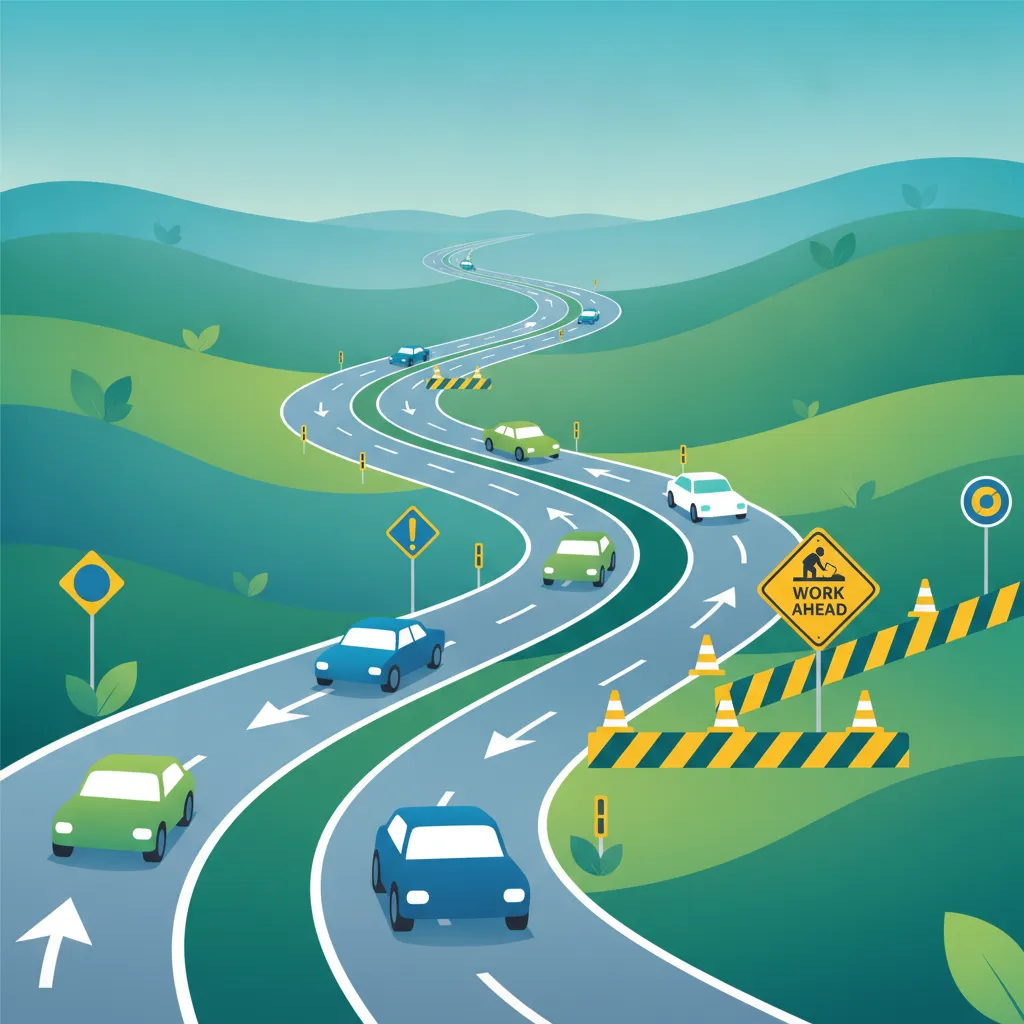
This lesson focuses on interpreting various road markings, from lane lines and directional arrows to stop lines and pedestrian crossings. It explains the rules associated with solid versus broken lines and how to navigate temporary markings found in construction zones. Correctly reading these markings is vital for proper lane discipline and safety.

This lesson covers the regulations and safe techniques for overtaking other vehicles in urban environments. It emphasizes the importance of thorough observation, including mirror and blind spot checks, before committing to the maneuver. Learners will understand how to choose a safe gap, manage their speed differential, and maintain strict lane discipline throughout the overtaking process.

This lesson focuses on the critical maneuver of changing lanes ('Fahrstreifenwechsel'), a common cause of accidents if done incorrectly. It teaches a systematic, safe procedure based on thorough observation, clear signaling, and a final blind spot check. You will learn how to assess traffic speed and identify a safe gap before smoothly moving into the adjacent lane.

This lesson addresses the challenges of operating a small AM vehicle in dense, mixed traffic. It provides strategies for increasing visibility to other drivers, positioning oneself defensively, and safely sharing lanes with cyclists. The content emphasizes awareness of larger vehicles' blind spots and maintaining a safe space cushion.

This lesson details the safe approach and navigation of various intersection types, including those controlled by traffic lights, stop signs, and give-way signs. Emphasis is placed on comprehensive observation of traffic flow, establishing eye contact with other road users, and ensuring clear visibility before proceeding. The lesson also covers correct lane positioning for turning and the importance of anticipating pedestrian movements.

This lesson provides a systematic approach to safely negotiating blind corners where visibility is limited. It teaches riders to control their entry speed, adopt a defensive lane position, and use visual scanning techniques to assess the road ahead. The content emphasizes adjusting lean angle and being prepared for unexpected hazards that may be hidden around the bend.
Explore essential techniques for maintaining proper visual focus and avoiding target fixation. This lesson covers how strategic observation and understanding road positioning prevent common hazards for A1, A2, and A licence holders in Germany.
This lesson highlights the specific risks associated with motorcyclists, who are less visible and more vulnerable than car drivers. It teaches you to actively look for motorcycles, especially at intersections and during lane changes, as their smaller profile can be easily missed. You will learn about their potential for rapid acceleration and instability, emphasizing the need for extra following distance.

This lesson teaches crucial risk awareness and accident prevention strategies for motorcyclists. It examines common accident scenarios and teaches riders how to identify potential hazards in advance. Key concepts include defensive riding, maintaining situational awareness, and understanding how a proactive mindset contributes to a safer riding experience on the road.

This lesson teaches the essential observation techniques required for safe riding, focusing on the systematic use of mirrors and shoulder checks to manage blind spots. It emphasizes developing active scanning habits to maintain constant situational awareness of the surrounding traffic environment. Learners will understand how effective head movement and use of peripheral vision are critical for detecting potential hazards early.
This lesson details the safe approach and navigation of various intersection types, including those controlled by traffic lights, stop signs, and give-way signs. Emphasis is placed on comprehensive observation of traffic flow, establishing eye contact with other road users, and ensuring clear visibility before proceeding. The lesson also covers correct lane positioning for turning and the importance of anticipating pedestrian movements.
This lesson provides a systematic approach to safely negotiating blind corners where visibility is limited. It teaches riders to control their entry speed, adopt a defensive lane position, and use visual scanning techniques to assess the road ahead. The content emphasizes adjusting lean angle and being prepared for unexpected hazards that may be hidden around the bend.

This lesson focuses on how motorcyclists can clearly communicate their intentions to other road users to prevent misunderstandings and collisions. It covers the correct use of indicators, brake lights, and standardized hand signals for turning and stopping. The importance of making eye contact with other drivers to confirm they have seen you is also a key topic for enhancing safety.

This lesson focuses on maintaining a safe buffer around the vehicle in traffic. It explains the 'two-second rule' as a simple method for ensuring adequate following distance and discusses how to adjust this for adverse conditions. A key focus is on developing hazard anticipation skills through continuous scanning and risk assessment.

This lesson teaches riders how to interact safely and predictably with pedestrians, cyclists, and public transport vehicles. It highlights the importance of yielding at designated crossings, maintaining a safe passing distance, and anticipating the movements of buses and trams. The content emphasizes using eye contact and clear signaling to foster safe and respectful interactions with all road users.

This lesson examines how different weather conditions, such as rain, strong winds, and fog, directly impact motorcycle safety. It explains how wet surfaces reduce tyre grip and increase braking distances, requiring smoother rider inputs. The content also provides strategies for managing reduced visibility and the physical effects of crosswinds on the motorcycle's stability.
This lesson covers the regulations and safe techniques for overtaking other vehicles in urban environments. It emphasizes the importance of thorough observation, including mirror and blind spot checks, before committing to the maneuver. Learners will understand how to choose a safe gap, manage their speed differential, and maintain strict lane discipline throughout the overtaking process.
Find clear answers to common questions learners have about Road Positioning, Visual Focus, and Safe Lane Discipline. Learn how the lesson is structured, which driving theory objectives it supports, and how it fits into the overall learning path of units and curriculum progression in Germany. These explanations help you understand key concepts, lesson flow, and exam focused study goals.
Proper lane positioning allows you to maximize your visibility to other drivers, especially at junctions, and provides you with a buffer zone to react to hazards. In Germany, being in the right spot makes you more predictable and ensures you aren't hidden in the blind spots of larger vehicles.
Target fixation happens when a rider focuses exclusively on a single object, such as a pothole or vehicle, causing them to inadvertently steer toward it. The exam tests your understanding of scanning the road broadly to avoid this, ensuring you maintain a focus on your intended path of travel.
While the fundamental principles of visibility and safety remain the same for A1, A2, and A classes, higher-performance motorcycles require even greater attention to line selection and road positioning due to their handling characteristics. The exam assumes all riders are proficient in these basic safety habits.
Practice scanning well ahead of your current position rather than looking directly at your front tyre or the bumper of the vehicle in front. The German theory exam expects you to demonstrate anticipation; looking further down the road is the primary way to achieve this.
Begin your targeted revision now. Use our practice search to quickly find specific German driving theory questions. Filter by StVO rules, road signs, or hazard perception to create your focused study plan. Master challenging areas and prepare confidently for your theoretical driving test.