
This lesson explores the essential techniques for maintaining a safe following distance, a core requirement for safe driving in Germany. You will learn to apply the two-second rule and the half-speedometer method, ensuring you are prepared for both the theoretical exam and real-world road conditions.

Lesson content overview
Driving safely on German roads, and indeed anywhere, hinges significantly on maintaining an appropriate distance to the vehicle ahead. This crucial space, known as the safe following distance or Sicherheitsabstand in German, provides the necessary time and room for you to react to unexpected situations and bring your vehicle to a stop without colliding. Failing to keep a sufficient distance is a leading cause of accidents, particularly rear-end collisions, which can have severe consequences.
This lesson will delve into the critical aspects of safe following distance, introducing you to universally applicable methods like the two-second rule and the specific German guideline known as the 'halber Tacho' rule. We will also explore how various conditions, such as weather, visibility, and road type, necessitate adjustments to this vital safety margin. Mastering these principles is fundamental for anyone preparing for their German Category B driving license theory exam and for becoming a responsible, defensive driver.
The concept of safe following distance is not merely a recommendation; it is a fundamental pillar of defensive driving and a legal requirement in German road traffic law (Straßenverkehrs-Ordnung, StVO). It represents the minimum gap you should keep between your vehicle and the one directly in front of you. This distance is vital for several reasons, primarily to allow sufficient reaction time and braking distance.
The minimum distance a driver must maintain to the vehicle ahead, allowing enough time to perceive a hazard, react, and bring their vehicle to a safe stop without collision.
When the vehicle in front suddenly brakes, swerves, or encounters an obstacle, your ability to respond safely depends entirely on the space you have available. If the distance is too short, you will not have enough time to process the situation, decide on an action, and execute the necessary maneuver (like braking or steering) before an impact occurs. This is why a fixed distance, such as a car length, is insufficient at varying speeds; the faster you drive, the more distance you need to cover before stopping.
Maintaining a safe following distance directly accounts for both your reaction time and your vehicle's braking distance. Your reaction time is the period from when you first perceive a hazard (e.g., brake lights of the car ahead) to when you actually initiate a response (e.g., pressing the brake pedal). For most alert drivers, this is typically around one second, but it can be longer if you are distracted, tired, or under the influence of substances.
The time it takes for a driver to perceive a hazard, process the information, and initiate a response, typically estimated at around one second for an alert driver.
Braking distance is the distance your vehicle travels from the moment you apply the brakes until it comes to a complete stop. This distance is heavily influenced by your speed, the condition of your brakes and tyres, the road surface (dry, wet, icy), and the weight of your vehicle. As speed doubles, braking distance increases by a factor of four. Therefore, a safe following distance must proportionally increase with speed to cover both these critical components.
Beyond speed, several other factors demand an adjustment to your following distance:
Understanding these variables is key to practicing defensive driving, where you constantly assess the environment and adjust your driving behaviour to minimize risk.
The two-second rule is a simple, effective, and universally applicable guideline for determining a safe following distance. It is speed-independent, meaning it inherently adjusts the physical distance according to your current speed, making it suitable for almost all normal driving conditions. This rule is taught worldwide and is an excellent habit to develop for your German driving license.
A practical guideline suggesting that a driver should maintain a minimum gap of at least two seconds behind the vehicle immediately in front.
Applying the two-second rule is straightforward:
Identify a fixed point: As the vehicle in front of you passes a fixed, easily identifiable object on the side of the road (e.g., a road sign, a bridge, a tree, a lamp post), begin counting.
Count "one thousand one, one thousand two": Start your count aloud or mentally: "one thousand one, one thousand two..."
Check your position: Your vehicle should only reach the same fixed point after you have finished counting "one thousand two". If you reach the point before or at the end of "one thousand two," you are following too closely and need to increase your distance.
This method automatically adjusts for speed:
The beauty of the two-second rule is its simplicity and adaptability. It directly factors in your reaction time and provides a sufficient buffer for most dry conditions.
The primary advantage of the two-second rule is its universal applicability and ease of use. It requires no complex calculations and can be applied mentally by any driver, anywhere. It also inherently adjusts the physical distance to your speed, making it a robust guideline.
However, the two-second rule represents a minimum safe distance for ideal conditions. It is crucial to understand its limitations:
Always remember that the two-second rule is a minimum. When in doubt, add more time – "three seconds is better than two, and four seconds is better than three."
While the two-second rule is globally recognized, German traffic law (StVO) also endorses a specific, speed-proportional rule for safe following distance known as the "Halber Tacho" rule. This rule provides a concrete meter-based guideline, particularly useful on higher-speed roads like the Autobahn, and is frequently referenced in official German driving theory.
A German-specific guideline stating that the safe following distance in meters should be at least half the current speedometer reading in km/h.
The literal translation "half the speedometer" directly explains the principle: if you are driving at 100 km/h, your minimum safe following distance should be 50 meters.
The calculation is straightforward: Safe Distance (in meters) = Current Speed (in km/h) / 2
Let's look at some examples:
The Halber Tacho rule is often used on motorways (Autobahnen) where consistent speeds allow for easier estimation of fixed distances. But how do you accurately judge meters while driving?
While the Halber Tacho rule provides a concrete measurement, it's important to remember that it is also a minimum for ideal conditions. Like the two-second rule, it needs to be extended under adverse circumstances.
The minimum safe following distance, whether calculated by the two-second rule or the Halber Tacho rule, applies to ideal driving conditions: dry roads, good visibility, and a calm driver. In reality, conditions are rarely consistently ideal. A responsible driver must constantly assess the environment and significantly increase their following distance when factors reduce safety margins. This concept is central to defensive driving.
Adverse weather dramatically impacts traction and visibility, directly affecting both reaction and braking distances.
Driving in darkness or through tunnels presents unique challenges for judging distance and perceiving hazards.
The environment you're driving in also dictates appropriate distances.
Your vehicle's characteristics and its load directly affect its stopping capability.
Never assume that the driver behind you is maintaining a safe distance. Always drive defensively by creating your own space cushion.
In Germany, the requirement to maintain a safe following distance is explicitly enshrined in the Straßenverkehrs-Ordnung (StVO), the Road Traffic Act. These regulations are not merely guidelines; they are legally binding, and violations can lead to significant penalties, including fines, points on your license, and driving bans.
The fundamental principle is laid out in §3 Absatz 1 StVO:
"Anyone driving a vehicle may only drive so fast that the vehicle is constantly under control. The speed must be adapted to the road, traffic, visibility, and weather conditions as well as to personal abilities and the vehicle's characteristics. A driver must ensure that they always maintain a distance to the vehicle ahead that allows them to stop, even with sudden braking, without endangering other road users."
This paragraph clearly states the driver's responsibility to adjust speed and distance to the prevailing conditions. It emphasizes the need to be able to stop safely in an emergency, highlighting the legal backing for the principles discussed earlier. While it doesn't specify an exact meter or second rule, the "Halber Tacho" rule is widely accepted by courts as a benchmark for determining sufficient distance at higher speeds.
Tailgating (Abstandsunterschreitung), or following too closely, is considered a serious traffic offense in Germany. It significantly increases the risk of rear-end collisions and is rigorously enforced, especially on motorways. The penalties for tailgating are severe and escalate with higher speeds and shorter distances.
Even if no accident occurs, simply being caught driving too closely can result in hefty fines, points on your driving license, and potentially a driving ban, particularly at speeds above 80 km/h and with distances significantly less than "Halber Tacho".
It is imperative for every driver to understand that maintaining a safe following distance is not just about personal safety; it is a legal obligation with significant consequences for non-compliance.
Even with clear rules and guidelines, drivers frequently make mistakes regarding following distance, leading to dangerous situations. Understanding these common errors can help you avoid them.
One of the most frequent mistakes is simply misjudging the actual distance to the vehicle ahead.
The immediate and most obvious consequence of insufficient following distance is a rear-end collision. However, the impact extends beyond this:
Maintaining a safe following distance is a cornerstone of defensive driving. It's not just about obeying a rule; it's about adopting a mindset that prioritizes safety, anticipation, and risk reduction.
Defensive driving involves continuously scanning the road ahead—not just the vehicle immediately in front, but several vehicles down the line. Look for:
By anticipating potential issues, you can often make smooth, gradual adjustments to your speed and position, rather than relying on sudden, emergency braking. This also helps maintain a smoother traffic flow and reduces the risk of surprising the driver behind you.
The primary goal of a safe following distance is to prevent rear-end collisions. To achieve this:
By consciously practicing these defensive driving techniques, you transform the abstract concept of following distance into a practical, life-saving habit. This commitment to safety is a hallmark of a competent and responsible driver on German roads and beyond.
Maintaining an appropriate safe following distance (Sicherheitsabstand) is paramount for road safety and is a core requirement for your German Category B driving license.
By understanding and consistently applying these rules and principles, you will contribute to safer roads and be well-prepared for the challenges of driving in Germany.
Safe following distance (Sicherheitsabstand) is both a legal requirement under StVO and a fundamental defensive driving skill. The two-second rule offers a universal, speed-adaptive method where you count to two after the vehicle ahead passes a fixed object. For German-specific guidance, the Halber Tacho rule states your distance in metres should be at least half your speed in km/h. Both rules represent minimums that must be extended under adverse conditions like rain, snow, fog, night driving, or when following heavy vehicles. Failure to maintain sufficient distance constitutes tailgating (Abstandsunterschreitung), a prosecutable offense with escalating penalties, and almost guarantees fault in any rear-end collision.
A short set of high-value points that capture the most important learning from this lesson.
The two-second rule provides a speed-independent minimum following distance by counting 'one thousand one, one thousand two' after the vehicle ahead passes a fixed point.
The German Halber Tacho rule requires maintaining a distance in meters equal to at least half your speed in km/h (e.g., 100 km/h = 50 metres).
Following distance must be significantly increased in adverse conditions such as rain, fog, snow, night driving, and when behind heavy vehicles.
Tailgating (Abstandsunterschreitung) is a serious offense under StVO §3, with severe penalties including fines, points, and potential driving bans.
Defensive driving requires scanning several vehicles ahead and continuously adjusting your gap rather than relying on fixed distances.
Explore all units and lessons included in this driving theory course.
Doubling your following distance (three to four seconds) is essential when visibility is reduced by weather or darkness.
Braking distance increases by a factor of four when speed doubles, making proportional following distance critical.
The Halber Tacho rule (speed ÷ 2 = minimum metres) serves as a concrete measurement benchmark on higher-speed roads like the Autobahn.
Always assume the driver behind you is too close and create your own space cushion defensively.
Heavier vehicles require significantly longer braking distances, demanding increased buffer zones when following trucks or buses.
Assuming a fixed car-length distance is sufficient regardless of speed, when distance must actually be proportional to speed.
Relying solely on the two-second rule in poor weather without extending it to three, four, or more seconds.
Underestimating distance at night or in fog due to reduced depth perception from limited lighting.
Believing that if you can brake in time, the following distance is sufficient, ignoring the need for evasion options.
Closing the gap when another driver merges in front instead of calmly recreating your safe space.
Lesson content overview
A short set of high-value points that capture the most important learning from this lesson.
The two-second rule provides a speed-independent minimum following distance by counting 'one thousand one, one thousand two' after the vehicle ahead passes a fixed point.
The German Halber Tacho rule requires maintaining a distance in meters equal to at least half your speed in km/h (e.g., 100 km/h = 50 metres).
Following distance must be significantly increased in adverse conditions such as rain, fog, snow, night driving, and when behind heavy vehicles.
Tailgating (Abstandsunterschreitung) is a serious offense under StVO §3, with severe penalties including fines, points, and potential driving bans.
Defensive driving requires scanning several vehicles ahead and continuously adjusting your gap rather than relying on fixed distances.
Explore all units and lessons included in this driving theory course.
Doubling your following distance (three to four seconds) is essential when visibility is reduced by weather or darkness.
Braking distance increases by a factor of four when speed doubles, making proportional following distance critical.
The Halber Tacho rule (speed ÷ 2 = minimum metres) serves as a concrete measurement benchmark on higher-speed roads like the Autobahn.
Always assume the driver behind you is too close and create your own space cushion defensively.
Heavier vehicles require significantly longer braking distances, demanding increased buffer zones when following trucks or buses.
Assuming a fixed car-length distance is sufficient regardless of speed, when distance must actually be proportional to speed.
Relying solely on the two-second rule in poor weather without extending it to three, four, or more seconds.
Underestimating distance at night or in fog due to reduced depth perception from limited lighting.
Believing that if you can brake in time, the following distance is sufficient, ignoring the need for evasion options.
Closing the gap when another driver merges in front instead of calmly recreating your safe space.
Explore search topics learners often look for when studying Following Distance and Two-second Rule. These topics reflect common questions about road rules, driving situations, safety guidance, and lesson level theory preparation for learners in Germany.
Browse additional driving theory lessons that cover connected traffic rules, road signs, and common driving situations related to this topic. Improve your understanding of how different rules interact across everyday traffic scenarios.
Explore advanced concepts for maintaining safe following distances beyond the basic two-second rule. Understand how to adapt your distance in challenging German driving conditions like rain, fog, and Autobahn speeds. Essential theory for safe driving.

This lesson teaches drivers how to safely manage their vehicle in challenging weather. It explains the dangers of aquaplaning in heavy rain, the loss of traction on snow and ice (including 'black ice'), and the severely reduced visibility in fog. You will learn to adjust your speed, increase following distances, and use lights correctly to suit these conditions.

This lesson explores how different weather conditions impact driving safety and vehicle performance. It discusses the risks of hydroplaning in heavy rain, reduced visibility in fog, and loss of traction on snow and ice. Drivers will learn how to adapt their speed, increase following distances, and make smooth control inputs to maintain vehicle stability and prevent skids in these challenging conditions.

This lesson focuses on the critical safety practice of maintaining an adequate following distance from the vehicle ahead. It explains how to use the 'two-second rule' as a simple and effective method for judging a safe gap in ideal conditions. The content also covers why this distance must be increased significantly in adverse weather or poor visibility to allow for longer reaction and braking times.

This lesson covers the crucial skills of managing speed and maintaining a safe buffer from other vehicles. It teaches methods for calculating an appropriate following distance, such as the time-gap method, which adapts to different speeds and conditions. Learners will understand how to adjust their speed based on traffic flow, road surface, and weather to ensure they always have enough time and space to stop safely.

This lesson explores the critical role of visibility in safe driving, covering topics such as sight distance, managing blind spots, and the correct use of mirrors. It provides guidance on how to adjust your driving in conditions of reduced visibility, such as at night, in fog, or during heavy rain, including the proper use of headlights. The importance of the over-the-shoulder check ('Schulterblick') is also a key focus.

This lesson examines the specific hazards posed by different weather conditions. It explains how rain can lead to hydroplaning and reduced grip, how fog impairs visibility, and how strong winds can affect stability. Riders will learn practical strategies, such as reducing speed and increasing following distance, to mitigate these risks.

This lesson addresses the challenges posed by various weather conditions on heavy vehicle operation. It discusses the effects of crosswinds on stability, reduced traction in rain or ice, and diminished visibility in fog. The content provides guidance on adjusting speed and using vehicle technologies to maintain control.

This lesson focuses on maintaining a safe buffer around the vehicle in traffic. It explains the 'two-second rule' as a simple method for ensuring adequate following distance and discusses how to adjust this for adverse conditions. A key focus is on developing hazard anticipation skills through continuous scanning and risk assessment.
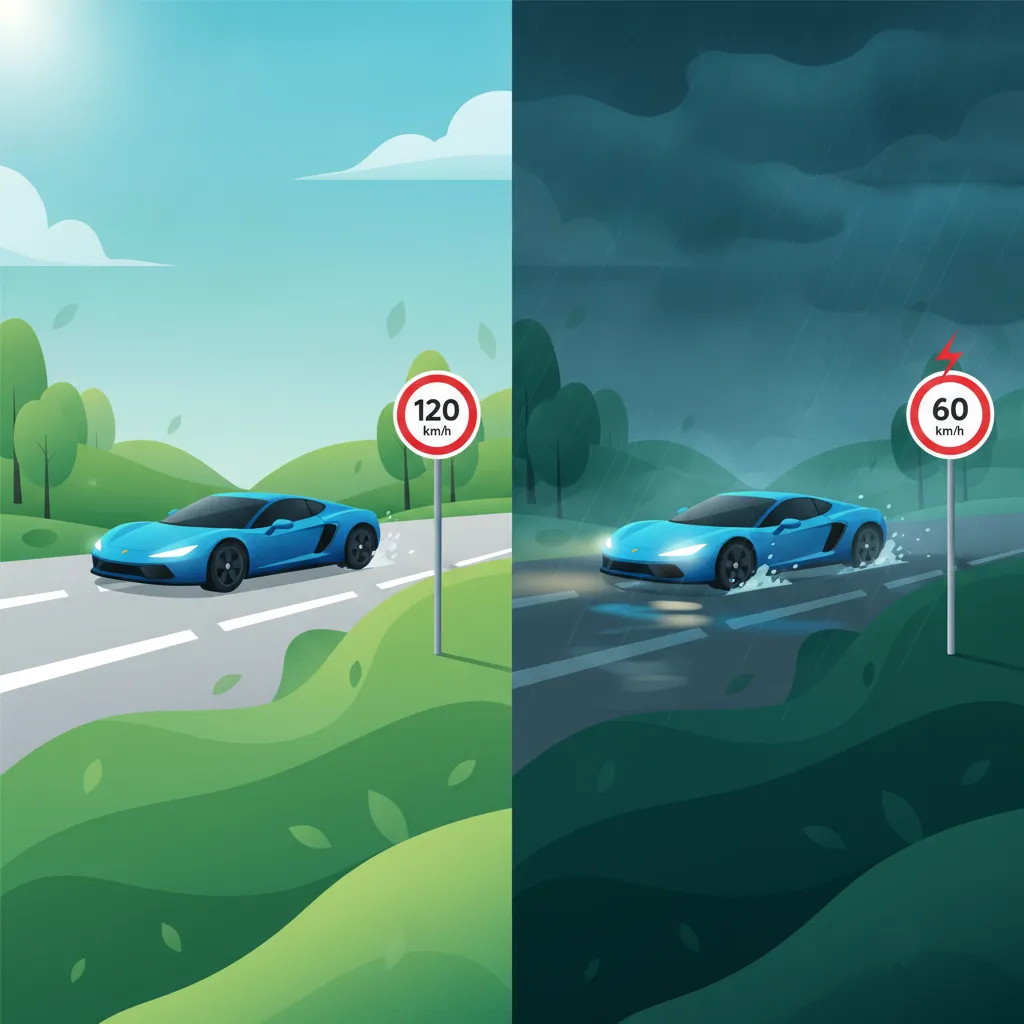
This lesson details the various speed limits applicable in Germany, from urban zones to rural roads. It emphasizes the critical skill of adapting speed to prevailing conditions such as rain, fog, or poor road surfaces. The content explains how external factors significantly impact vehicle handling and stopping distances.

This lesson explains the physics behind stopping a vehicle, breaking down the total stopping distance ('Anhalteweg') into its two key components: reaction distance and braking distance. It provides formulas for estimating these distances at various speeds and discusses the critical factors that can increase them, such as driver fatigue, poor weather, and worn tires. Understanding this relationship is vital for appreciating the need for safe speeds and distances.
Learn the core principles of defensive driving crucial for German theory exams. This lesson covers essential observation techniques, anticipation of hazards, and maintaining safe distances to ensure a proactive and safe driving approach on German roads.

This lesson builds on defensive driving by focusing specifically on hazard perception ('Gefahrenerkennung'). It teaches you how to actively scan the driving environment for potential risks, not just immediate dangers. You will learn to anticipate the likely actions of other road users and identify clues that signal a developing hazardous situation, allowing you to react early and safely.
This lesson introduces the concept of defensive driving ('vorausschauendes Fahren'), a proactive approach focused on anticipating and mitigating potential risks. It teaches techniques for scanning the road ahead, identifying potential hazards early, and managing the space around your vehicle to create a safety buffer. The goal is to develop a mindset that prioritizes safety and collision avoidance above all else.

This lesson trains drivers to proactively identify vulnerable road users and anticipate their often unpredictable behavior. It highlights the specific risks posed by children, elderly pedestrians, cyclists, and e-scooter users, particularly near bus stops and crossings. The goal is to develop a heightened sense of risk perception and apply defensive driving techniques to protect those who are most at risk on the road.
This lesson explores the critical role of visibility in safe driving, covering topics such as sight distance, managing blind spots, and the correct use of mirrors. It provides guidance on how to adjust your driving in conditions of reduced visibility, such as at night, in fog, or during heavy rain, including the proper use of headlights. The importance of the over-the-shoulder check ('Schulterblick') is also a key focus.

This lesson teaches the systematic observation techniques required for safe driving, starting with how to scan the road far ahead, nearby, and to the sides. It details the correct frequency for checking interior and exterior mirrors to maintain situational awareness. The lesson highlights the indispensable over-the-shoulder check ('Schulterblick') to cover the vehicle's blind spot before any change in direction.

This lesson focuses on the particular care required when driving near pedestrians, with a special emphasis on children and the elderly, whose behavior can be unpredictable. It covers the rules for yielding at zebra crossings and the importance of reducing speed near schools, playgrounds, and residential areas. The goal is to instill a habit of constant vigilance and readiness to stop.

This lesson focuses on warning signs, which are designed to alert drivers to potential dangers or unusual conditions on the road ahead. You will learn to identify signs indicating sharp bends, upcoming intersections, railway crossings, road works, and risks like slippery surfaces or wildlife. Recognizing these signs allows you to anticipate hazards and adjust your driving proactively.
This lesson focuses on maintaining a safe buffer around the vehicle in traffic. It explains the 'two-second rule' as a simple method for ensuring adequate following distance and discusses how to adjust this for adverse conditions. A key focus is on developing hazard anticipation skills through continuous scanning and risk assessment.

This lesson focuses on the high-risk maneuver of reversing, emphasizing the importance of all-around observation due to limited visibility. It teaches techniques for controlling the vehicle at very low speeds and using mirrors and direct observation to manage large blind spots behind the car. The priority is to ensure the path is clear of pedestrians and obstacles at all times.
This lesson explores how different weather conditions impact driving safety and vehicle performance. It discusses the risks of hydroplaning in heavy rain, reduced visibility in fog, and loss of traction on snow and ice. Drivers will learn how to adapt their speed, increase following distances, and make smooth control inputs to maintain vehicle stability and prevent skids in these challenging conditions.
Find clear answers to common questions learners have about Following Distance and Two-second Rule. Learn how the lesson is structured, which driving theory objectives it supports, and how it fits into the overall learning path of units and curriculum progression in Germany. These explanations help you understand key concepts, lesson flow, and exam focused study goals.
In Germany, this is a rule of thumb for safe following distance: your distance in meters should be at least half of the speed shown on your speedometer. For example, at 100 km/h, you should maintain at least 50 meters distance.
Pick a stationary object on the side of the road, such as a sign or tree. When the car in front passes it, start counting. If you reach the same object before two seconds have passed, you are following too closely.
Yes. The half-speedometer and two-second rules are for ideal conditions. In rain, snow, or fog, you must significantly increase your following distance to allow for longer braking distances and reduced traction.
Hazard perception questions often test your ability to identify when a driver is following too closely or failing to react to a sudden slowdown. Understanding these rules is critical for identifying risky situations in the test videos.
Begin your targeted revision now. Use our practice search to quickly find specific German driving theory questions. Filter by StVO rules, road signs, or hazard perception to create your focused study plan. Master challenging areas and prepare confidently for your theoretical driving test.