
Navigating Polish roads requires a precise understanding of the rules governing road markings and signage. This guide breaks down the legal differences between crossing a continuous line and the act of overtaking, ensuring you know exactly what is permitted and what carries heavy penalties in the Polish traffic system.
Article content overview
When studying for your Polish driving theory exam, few topics are as critical—or as frequently misunderstood—as the distinction between road markings and traffic signs. In Poland, the law distinguishes clearly between the act of crossing a road marking and the maneuver of overtaking. A common point of confusion for many students is the relationship between the P-4 double continuous line and the B-25 no-overtaking sign. Misinterpreting these can lead to failing your exam or, in the real world, incurring heavy fines and penalty points.
The P-4 sign, known as the "podwójna linia ciągła," is a fundamental road marking in Poland. Its primary function is to separate lanes of opposing traffic. By law, this line creates an absolute prohibition against crossing or even driving onto it. Unlike some other jurisdictions, Polish regulations do not provide exceptions to this rule for passing slower road users, such as cyclists, mopeds, or agricultural vehicles. If you cross a P-4 line, you are violating the traffic code, regardless of whether your intention was to overtake a slower vehicle.
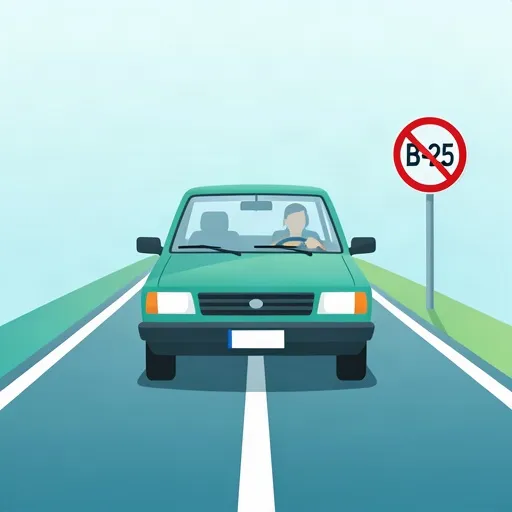
While the P-4 line governs the physical positioning of your vehicle relative to the road axis, the B-25 sign is an explicit regulation regarding the maneuver of overtaking. The B-25 prohibits drivers of motor vehicles from overtaking multi-track motor vehicles. This means that if you encounter this sign, the prohibition applies to the action itself, even if there is no continuous line present on the pavement.
Remember that the P-4 line and the B-25 sign are legally distinct. You can be fined for crossing a continuous line even if a B-25 sign is not present, and you can be fined for illegal overtaking even if the road marking is only a broken line, provided a B-25 sign prohibits the maneuver.
In Poland, the enforcement system is designed to prioritize road safety through strict penalties. Understanding the cost of these violations is essential for every driver. Crossing a double continuous line is generally considered a traffic maneuver violation with a penalty of 200 PLN and 5 points. However, performing an illegal overtaking maneuver—especially where prohibited by a B-25 sign—carries a much higher penalty of 1000 PLN and 15 penalty points.
| Violation Type | Primary Restriction | Penalty (PLN) | Penalty Points |
|---|---|---|---|
| Crossing P-4 | Prohibits crossing/touching line | 200 | 5 |
| Ignoring B-25 | Prohibits overtaking maneuver | 1000 | 15 |
It is interesting to note how different countries manage traffic behavior. While Poland relies on standard white markings and signs, other countries have experimented with more aggressive visual deterrents. For instance, in Spain, some regions have introduced thick red lines to act as a psychological barrier against overtaking in dangerous sections. While these serve a similar safety purpose, they do not change the fact that in Poland, you must adhere strictly to the P-4 and B-25 standards defined by the local Ministry of Infrastructure.
When you encounter exam questions regarding these rules, always check for the presence of both the sign and the line. If a question asks if you can pass a bicycle on a road with a P-4 line, the answer is always no. If the question asks when the B-25 prohibition ends, remember that it persists until the next intersection or until an end-of-restriction sign, such as the B-27 or B-42, is encountered. Focusing on these details will help you navigate the trickier parts of the theory test with confidence.
This article explains the critical legal distinction between the P-4 double continuous line, which prohibits any vehicle positioning across the road axis, and the B-25 no-overtaking sign, which prohibits the specific maneuver of overtaking multi-track motor vehicles. These are separate violations with significantly different penalties: crossing a P-4 line results in 200 PLN and 5 penalty points, while illegal overtaking under a B-25 sign carries 1000 PLN and 15 points. The B-25 prohibition ends only at an intersection or an end-of-restriction sign, making it essential to recognize these termination points for both the exam and real-world driving.
A short set of high-value points that capture the most important ideas from this article.
The P-4 double continuous line creates an absolute prohibition against crossing or driving on it, with no exceptions for passing slower vehicles like cyclists
The B-25 no-overtaking sign specifically prohibits the maneuver of overtaking multi-track motor vehicles, independent of road markings
Crossing a P-4 line and illegal overtaking are legally distinct violations that can be penalized separately
The B-25 prohibition remains in effect until the next intersection or until an end-of-restriction sign (B-27 or B-42) is encountered
The presence of a broken line does not permit overtaking if a B-25 sign prohibits the maneuver
P-4 governs physical positioning relative to the road axis; B-25 governs the overtaking maneuver itself
No exceptions exist for crossing a P-4 line, even to pass agricultural vehicles or cyclists
B-25 applies only to overtaking multi-track motor vehicles (cars, trucks), not all vehicles
Penalties differ significantly: crossing P-4 costs 200 PLN and 5 points, while illegal overtaking costs 1000 PLN and 15 points
A road with only a broken line and a B-25 sign still prohibits overtaking of applicable vehicles
Assuming that a broken line allows overtaking when a B-25 sign is present
Believing exceptions exist for crossing a P-4 line to pass cyclists or mopeds
Confusing when a B-25 prohibition ends—many learners forget it persists past the sign until the next intersection
Thinking P-4 and B-25 are interchangeable or cover the same restriction
Overlooking that B-25 only applies to overtaking multi-track motor vehicles, not all overtaking scenarios
Article content overview
A short set of high-value points that capture the most important ideas from this article.
The P-4 double continuous line creates an absolute prohibition against crossing or driving on it, with no exceptions for passing slower vehicles like cyclists
The B-25 no-overtaking sign specifically prohibits the maneuver of overtaking multi-track motor vehicles, independent of road markings
Crossing a P-4 line and illegal overtaking are legally distinct violations that can be penalized separately
The B-25 prohibition remains in effect until the next intersection or until an end-of-restriction sign (B-27 or B-42) is encountered
The presence of a broken line does not permit overtaking if a B-25 sign prohibits the maneuver
P-4 governs physical positioning relative to the road axis; B-25 governs the overtaking maneuver itself
No exceptions exist for crossing a P-4 line, even to pass agricultural vehicles or cyclists
B-25 applies only to overtaking multi-track motor vehicles (cars, trucks), not all vehicles
Penalties differ significantly: crossing P-4 costs 200 PLN and 5 points, while illegal overtaking costs 1000 PLN and 15 points
A road with only a broken line and a B-25 sign still prohibits overtaking of applicable vehicles
Assuming that a broken line allows overtaking when a B-25 sign is present
Believing exceptions exist for crossing a P-4 line to pass cyclists or mopeds
Confusing when a B-25 prohibition ends—many learners forget it persists past the sign until the next intersection
Thinking P-4 and B-25 are interchangeable or cover the same restriction
Overlooking that B-25 only applies to overtaking multi-track motor vehicles, not all overtaking scenarios
Explore related topics, search based questions, and concepts that learners often look up when studying Continuous Lines and Overtaking Rules. These themes reflect real search intent and help you understand how this topic connects to wider driving theory knowledge in Poland.
Find clear and practical answers to common questions learners often have about Continuous Lines and Overtaking Rules. This section helps explain difficult points, remove confusion, and reinforce the key driving theory concepts that matter for learners in Poland.
No. In Poland, you are strictly prohibited from crossing or driving over a continuous line for any reason, including overtaking cyclists or other slow-moving vehicles.
Ignoring a continuous line (P-2 or P-4) generally results in a 200 PLN fine and 5 penalty points.
The B-25 sign forbids the maneuver of overtaking motor vehicles with more than two wheels, regardless of the road markings present.
Ignoring a B-25 'no overtaking' sign is a more serious violation in Poland, typically carrying a 1000 PLN fine and 15 penalty points.
Not legally. A continuous line restricts you from crossing the axis of the road, whereas the 'no overtaking' prohibition is explicitly established by the B-25 sign.
After finding your specific article, continue your targeted learning by exploring related topics or diving deeper into practice questions. Our extensive library ensures you have all the resources needed to confidently prepare for your Polish driving license theory exam. Discover more guides and solidify your understanding of Polish road rules.