
Driving at night presents unique challenges, from reduced visibility to the increased risk of dazzling other drivers. In this guide, we break down the Polish traffic regulations regarding external vehicle lighting and provide practical advice on how to adapt your driving habits to ensure safety for yourself and other road users.
Article content overview
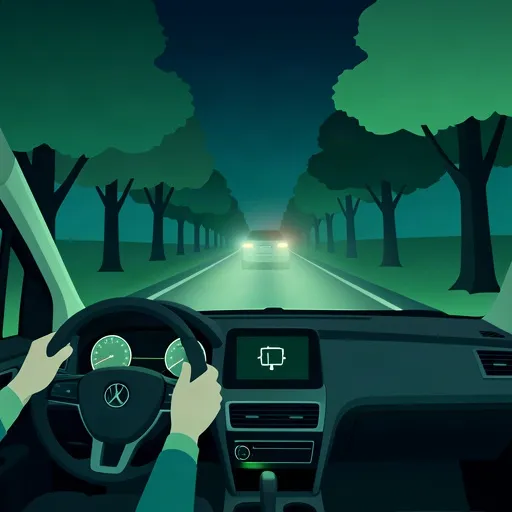
Driving at night in Poland requires a thorough understanding of traffic regulations regarding vehicle lighting and a high level of vigilance. Whether you are navigating urban streets or rural roads, visibility is significantly reduced, making it difficult to detect pedestrians, cyclists, and unexpected obstacles. Mastering these rules is not only vital for passing your Polish driving theory exam but is also a cornerstone of defensive driving, which helps prevent accidents in conditions of limited visibility.
In Poland, the Prawo o ruchu drogowym (Road Traffic Act) strictly regulates how and when different types of vehicle lights should be used. The fundamental rule is that drivers must use dipped headlights (światła mijania) throughout the day and night when visibility is normal. Many new drivers mistakenly believe that daytime running lights (światła do jazdy dziennej) are a universal replacement for dipped headlights, but this is a common trap.
Conditions where the air clarity allows a driver to see objects, people, and vehicles at a sufficient distance to react safely to traffic conditions.
Daytime running lights are permitted only from dawn until dusk and exclusively in conditions of normal visibility. Once dusk falls, or if fog, rain, or snowfall occurs, you are legally required to switch to dipped headlights. Failure to do so often results in the absence of rear position lights, making your vehicle invisible to drivers approaching from behind, which is a frequent cause of traffic fines and collisions.
Main beam lights, commonly known as "high beams" (światła drogowe), are essential for illuminating the road ahead on unlit sections of highways or rural roads. However, their use is strictly controlled to prevent dazzling (oślepienie) other road users. According to Polish regulations, you must switch from high beams to dipped headlights in several specific situations.
You are required to switch to dipped headlights when:
If you encounter a driver who has forgotten to turn off their high beams, do not retaliate by turning yours on. Instead, focus your gaze slightly to the right toward the edge of the road to avoid being blinded and adjust your speed immediately to account for the temporary loss of clear vision.
Driving at night is not just about having your lights turned on; it is about adapting your driving style to the environment. When visibility is poor due to darkness, fog, or heavy precipitation, your braking distance remains the same, but your "visual range"—the distance at which you can identify a hazard—shrinks significantly.
To handle such scenarios, you must proactively reduce your speed. In areas with high pedestrian or cyclist traffic, such as roads near villages without proper sidewalks, assume that individuals might be walking on the edge of the road. Keeping your windshield and light covers clean is another simple yet critical step; dirt and grime on your headlamps can drastically reduce the reach of your light beam, leaving you with less time to react to danger.
| Lighting Type | Time of Day | Condition |
|---|---|---|
| Dipped Headlights | 24/7 | Mandatory (unless using DRL) |
| Daytime Running | Dawn to Dusk | Only normal visibility |
| High Beam | Dusk to Dawn | Unlit roads, no blinding others |
| Front Fog Lights | Anytime | Decreased visibility (fog/rain) |
This article covers the essential Polish regulations for night driving, emphasizing that daytime running lights cannot replace dipped headlights once visibility drops or after dusk. It explains the specific situations requiring drivers to switch from high beams to dipped headlights to prevent dazzling other road users, including when approaching oncoming vehicles, following another car, or near rail and water transport. The content highlights that while braking distance remains constant at night, your ability to detect hazards decreases, making speed reduction critical. Polish-specific terminology such as światła mijania, światła drogowe, and oślepienie is introduced through definitions and a glossary to support exam preparation alongside practical safety guidance.
A short set of high-value points that capture the most important ideas from this article.
Daytime running lights are permitted only from dawn to dusk and exclusively in normal visibility conditions
Dipped headlights become mandatory once dusk falls, or when fog, rain, or snow reduces visibility
You must switch to dipped headlights when approaching oncoming traffic, following another vehicle, or near rail or water transport
Driving at night requires reducing speed because your visual range shrinks even though braking distance stays the same
Dirty or grime-covered headlights significantly reduce light beam reach and reaction time
In Poland, the Road Traffic Act (Prawo o ruchu drogowym) requires dipped headlights whenever visibility is reduced
DRL alone leaves your vehicle without rear position lights, making you invisible to drivers behind you
High-beam lights (światła drogowe) are only for unlit roads where no other road users can be blinded
When dazzled by oncoming high beams, focus gaze to the right edge of the road and reduce speed
Built-up areas (tereny zabudowane) have specific night driving rules separate from open roads
Assuming daytime running lights replace dipped headlights at night or in poor weather
Failing to switch from high beams when following another vehicle, causing mirror glare
Not adjusting speed when visibility decreases, treating night driving like daytime conditions
Neglecting to clean headlights before a night journey, reducing effective illumination
Using front fog lights in conditions of normal visibility, which is prohibited by Polish regulations
Article content overview
A short set of high-value points that capture the most important ideas from this article.
Daytime running lights are permitted only from dawn to dusk and exclusively in normal visibility conditions
Dipped headlights become mandatory once dusk falls, or when fog, rain, or snow reduces visibility
You must switch to dipped headlights when approaching oncoming traffic, following another vehicle, or near rail or water transport
Driving at night requires reducing speed because your visual range shrinks even though braking distance stays the same
Dirty or grime-covered headlights significantly reduce light beam reach and reaction time
In Poland, the Road Traffic Act (Prawo o ruchu drogowym) requires dipped headlights whenever visibility is reduced
DRL alone leaves your vehicle without rear position lights, making you invisible to drivers behind you
High-beam lights (światła drogowe) are only for unlit roads where no other road users can be blinded
When dazzled by oncoming high beams, focus gaze to the right edge of the road and reduce speed
Built-up areas (tereny zabudowane) have specific night driving rules separate from open roads
Assuming daytime running lights replace dipped headlights at night or in poor weather
Failing to switch from high beams when following another vehicle, causing mirror glare
Not adjusting speed when visibility decreases, treating night driving like daytime conditions
Neglecting to clean headlights before a night journey, reducing effective illumination
Using front fog lights in conditions of normal visibility, which is prohibited by Polish regulations
Explore related topics, search based questions, and concepts that learners often look up when studying Night Driving and Lighting Rules. These themes reflect real search intent and help you understand how this topic connects to wider driving theory knowledge in Poland.
Find clear and practical answers to common questions learners often have about Night Driving and Lighting Rules. This section helps explain difficult points, remove confusion, and reinforce the key driving theory concepts that matter for learners in Poland.
You must switch to low-beam (dipped) headlights when approaching an oncoming vehicle, following another vehicle closely, or nearing railway/waterway traffic if there is a risk of blinding other operators.
No. Daytime running lights are only permitted from dawn to dusk in conditions of normal visibility. Once visibility decreases or night falls, you must switch to dipped headlights.
Reduce your speed immediately, avoid looking directly at the approaching light source, and focus your vision on the right edge of the road to maintain your position.
Yes, high-beam lights are permitted in built-up areas from dusk to dawn, provided that the road is not sufficiently illuminated and you do not blind other road users.
After finding your specific article, continue your targeted learning by exploring related topics or diving deeper into practice questions. Our extensive library ensures you have all the resources needed to confidently prepare for your Polish driving license theory exam. Discover more guides and solidify your understanding of Polish road rules.