Understanding that tractors are legally equal to other vehicles is critical for passing your Polish driving theory exam. This guide breaks down how priority rules apply to agricultural machinery at various intersections, including the 'skrzyżowanie równorzędne', and clarifies common pitfalls where learners mistakenly assume special status for larger vehicles. You will learn the exact legal requirements for signaling, yielding, and navigating road signs, ensuring your driving theory knowledge is precise and exam-ready.
Article content overview
For many learner drivers preparing for the Polish driving theory exam, the presence of agricultural machinery on public roads can be a significant source of confusion. It is a common misconception that tractors, due to their size and slow speed, might possess special privileges or be exempt from standard right-of-way rules. However, the Polish Road Traffic Law (Prawo o ruchu drogowym) is very clear on this matter: tractors are full participants in road traffic and must adhere to the same priority regulations as passenger cars, trucks, or motorcycles.
Whether you are navigating a busy urban street or a rural road, your priority status is determined by road signs, markings, and, in their absence, the fundamental principles of the traffic code. Failing to recognize that a tractor must obey the same yielding rules as any other vehicle is a frequent cause of errors in the theory exam. Mastering these concepts is not just about passing your test at teoriajazdy.pl; it is about ensuring safety for all road users.
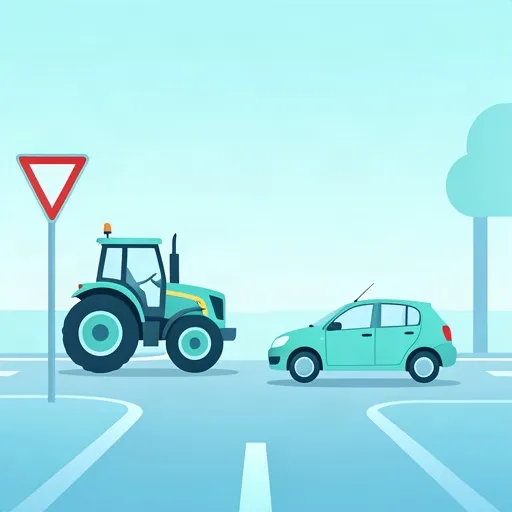
When approaching an intersection, you must first identify how the priority is regulated. If there are no road signs present, you are dealing with a "skrzyżowanie równorzędne," or equal-priority intersection. At these junctions, the "right-hand rule" (zasada prawej ręki) applies universally. This means you must yield to any vehicle approaching from your right side, regardless of whether that vehicle is a high-speed car or a slow-moving agricultural tractor.
Many exam questions present scenarios where a student must decide who goes first at a crossroads. A common trap involves a tractor approaching from the right. Some learners mistakenly wait for the tractor to pass out of "courtesy" or assume the tractor will yield due to its slower pace. In the eyes of the law, the priority is absolute; if a tractor is on your right at an equal-priority junction, you must yield. Conversely, if you are approaching from the right of a tractor, you have the legal priority, though you should always maintain defensive driving habits given the limited visibility and maneuverability of heavy machinery.
When an intersection is governed by traffic signs, the hierarchy of the law is simplified. Signs such as D-1 or A-7 clearly dictate the order of movement, leaving no room for ambiguity based on the type of vehicle.
If you are on a road marked with a D-1 sign, you have priority over a tractor entering from a side street marked with an A-7 "Yield" sign. In this situation, the tractor operator is legally obligated to wait for you to pass. It is crucial to remember that the size of the vehicle does not change the validity of these signs. Whether it is a small tractor or a large combine harvester, the legal obligation to yield remains identical to that of a standard passenger vehicle.
One major area of confusion is the obligation of tractor drivers to facilitate passing. While the law mandates that operators of slow-moving vehicles should stay as far to the right as possible to allow faster traffic to overtake, this does not grant them special "right-of-way" status at intersections.
A common exam trap is assuming that because a tractor is required to pull over to let you pass on an open road, it must also yield to you at an intersection even when you are on a minor road. This is false. Always follow the signs, not the perceived size or "politeness" of other drivers.
Tractors in Poland hold the same legal priority status as passenger cars and must follow identical right-of-way rules at intersections. At equal-priority intersections without signs, the right-hand rule requires yielding to all vehicles approaching from your right, including slow-moving agricultural machinery. Traffic signs like D-1 and A-7 establish priority based on road markings, not vehicle type, meaning a tractor on a side road must yield to a vehicle with D-1 priority even when significantly larger. The common trap of assuming tractors yield by default due to their size or speed is a frequent exam error; priority is determined solely by signage and, when absent, the universal right-hand rule. Always maintain defensive driving awareness around heavy agricultural vehicles given their limited visibility and maneuverability, even when you hold legal priority.
A short set of high-value points that capture the most important ideas from this article.
Tractors are full participants in Polish road traffic and have no special priority rights over other vehicles at intersections
At equal-priority intersections (skrzyżowanie równorzędne), the right-hand rule applies universally: always yield to vehicles approaching from your right regardless of vehicle type
Traffic signs D-1 (priority road) and A-7 (yield) dictate movement order based on road markings, not on the size or speed of vehicles involved
A tractor's legal obligation to pull over for faster traffic on open roads does not affect priority status at intersections
Always apply the priority rules shown by signs first; only use the right-hand rule when no signs are present at an intersection
No signs means equal-priority intersection: apply the right-hand rule and yield to vehicles on your right
D-1 sign grants priority over any vehicle entering from a side road, regardless of whether that vehicle is a car or a tractor
A-7 yield sign obligates the tractor driver to wait, just as it would for any other vehicle
Slow-moving vehicle status (limited to 25 km/h) relates to road positioning, not intersection priority
Trams have special priority even at equal-priority intersections and must always be allowed through first
Assuming tractors always yield at intersections because they are slow-moving vehicles
Waiting out of courtesy when a tractor approaches from the right at an equal-priority intersection, despite having legal priority
Confusing the tractor's road courtesy obligations (pulling over to allow overtaking) with intersection priority rights
Misinterpreting a tractor's obligation to stay right on open roads as a universal yielding requirement at all locations
Forgetting to check for trams, which have priority even when the right-hand rule would otherwise apply
Article content overview
A short set of high-value points that capture the most important ideas from this article.
Tractors are full participants in Polish road traffic and have no special priority rights over other vehicles at intersections
At equal-priority intersections (skrzyżowanie równorzędne), the right-hand rule applies universally: always yield to vehicles approaching from your right regardless of vehicle type
Traffic signs D-1 (priority road) and A-7 (yield) dictate movement order based on road markings, not on the size or speed of vehicles involved
A tractor's legal obligation to pull over for faster traffic on open roads does not affect priority status at intersections
Always apply the priority rules shown by signs first; only use the right-hand rule when no signs are present at an intersection
No signs means equal-priority intersection: apply the right-hand rule and yield to vehicles on your right
D-1 sign grants priority over any vehicle entering from a side road, regardless of whether that vehicle is a car or a tractor
A-7 yield sign obligates the tractor driver to wait, just as it would for any other vehicle
Slow-moving vehicle status (limited to 25 km/h) relates to road positioning, not intersection priority
Trams have special priority even at equal-priority intersections and must always be allowed through first
Assuming tractors always yield at intersections because they are slow-moving vehicles
Waiting out of courtesy when a tractor approaches from the right at an equal-priority intersection, despite having legal priority
Confusing the tractor's road courtesy obligations (pulling over to allow overtaking) with intersection priority rights
Misinterpreting a tractor's obligation to stay right on open roads as a universal yielding requirement at all locations
Forgetting to check for trams, which have priority even when the right-hand rule would otherwise apply
Explore related topics, search based questions, and concepts that learners often look up when studying Tractor Priority Rules in Poland. These themes reflect real search intent and help you understand how this topic connects to wider driving theory knowledge in Poland.
Find clear and practical answers to common questions learners often have about Tractor Priority Rules in Poland. This section helps explain difficult points, remove confusion, and reinforce the key driving theory concepts that matter for learners in Poland.
No. Under the Polish Law on Road Traffic (Prawo o ruchu drogowym), tractors are subject to the same priority rules as all other vehicles. They must follow standard traffic signs, signals, and the right-hand rule at equal-priority intersections.
At an equal-priority intersection (skrzyżowanie równorzędne) without traffic signs, a tractor must yield to all vehicles approaching from its right, exactly like any other car.
A tractor must follow the same hierarchy of right-of-way rules as any light vehicle. While they have an obligation to drive as far to the right as possible to facilitate being overtaken on open roads, this does not grant them special priority or the right to disrupt traffic flow at intersections.
Yes. If a tractor is entering a main road from a minor road, it must yield to all traffic currently on the main road, regardless of the size of the vehicles involved.
After finding your specific article, continue your targeted learning by exploring related topics or diving deeper into practice questions. Our extensive library ensures you have all the resources needed to confidently prepare for your Polish driving license theory exam. Discover more guides and solidify your understanding of Polish road rules.