Learners often struggle with exam questions involving tractors because they attempt to apply courtesy rather than the strict written code. This guide details how to correctly apply priority rules at intersections when agricultural vehicles are involved. By understanding that tractors must obey the same signs and intersection rules as any other vehicle, you will avoid common pitfalls that lead to exam failure.
Article content overview
Many candidates preparing for the Polish driving theory exam struggle with questions involving agricultural vehicles. There is a common misconception that tractors and other slow-moving machines possess an inherent "right of way" or special status due to their size or the public nature of agricultural work. In reality, the Polish Road Traffic Act (Prawo o ruchu drogowym) treats tractors as standard road users, subject to the same fundamental rules of priority and signage as every other driver on the road.
Failure to understand these dynamics often leads to mistakes in the examination room, particularly when presented with complex intersection scenarios. By applying the "rule of the right hand" consistently and adhering strictly to vertical and horizontal road signs, you can avoid these common pitfalls and ensure your decisions align with official traffic regulations.
The most common trap in the theory exam occurs at unmarked intersections, where no traffic signs dictate who should go first. Many students hesitate, assuming the tractor’s lower speed grants it a tactical advantage or requires the other driver to yield out of courtesy. However, the law does not operate on feelings of courtesy; it relies on the principle of the "right-hand rule."
If you approach an intersection where the right-of-way is not regulated by signs, you must yield to any vehicle approaching from your right. This includes tractors, combine harvesters, and animal-drawn vehicles. If a tractor is coming from your right, you must wait, regardless of how slowly it is moving or how much it might be obstructing traffic flow. Conversely, if you are approaching from the right, the law grants you priority over the tractor, and you should proceed with caution once you have confirmed that the driver of the agricultural vehicle is indeed yielding to you.
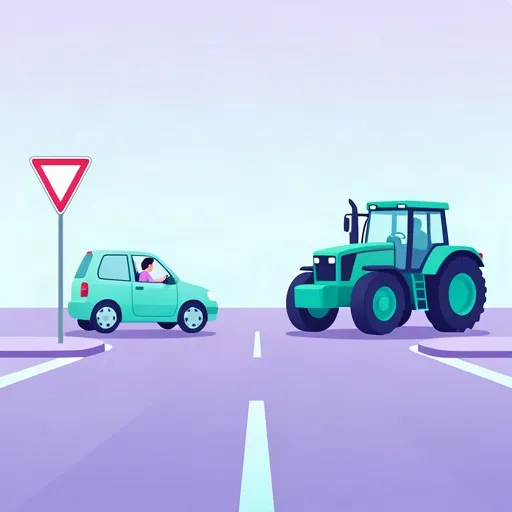
When an intersection is regulated by signage, the rules are absolute. If a tractor driver approaches an intersection marked with an A-7 "Give Way" sign or a B-20 "Stop" sign, they are strictly required to yield to all traffic on the priority road. You must not overthink these scenarios by questioning whether the tractor "needs" to stop; the presence of the sign dictates the legal obligation.
Do not confuse the moral obligation to be patient with the legal rules of priority. A slow-moving tractor does not earn a 'right of way' simply because it is difficult to pass or because it is causing a queue. Always base your exam answers on the explicit rules of the road, not on the inconvenience caused by the tractor.
In the Polish legal system, distinguishing between a "slow-moving vehicle" (pojazd wolnobieżny) and an agricultural tractor is important for technical definitions, but it does not change the priority rules. Both types of vehicles have the same responsibilities when it comes to facilitating passing. According to the law, the driver of such a vehicle should stay as far to the right as possible to allow faster vehicles to pass safely. However, this does not mean they must pull over or stop; they simply must not unnecessarily impede the flow of traffic where it is safe to do otherwise.
When answering questions about agricultural vehicles, keep these essential terms in mind to ensure your logic remains aligned with the official Polish exam standards.
In Polish traffic law, tractors and agricultural vehicles are standard road users with no special priority status - they obey the same rules as passenger cars at intersections. At unmarked intersections, the right-hand rule applies universally: you must yield to any vehicle approaching from your right, regardless of vehicle type. When traffic signs are present, they create absolute legal obligations that apply equally to tractors, so an A-7 Give Way sign means the tractor must yield just as any other vehicle would. While slow-moving vehicle rules require agricultural vehicles to stay right and facilitate passing, this does not grant them priority at intersections. Common exam errors arise from confusing politeness with legal requirements and forgetting that trams have absolute priority over all vehicles including tractors at unmarked intersections.
A short set of high-value points that capture the most important ideas from this article.
Tractors have no special priority rights and are subject to the same traffic rules as all other vehicles in Poland.
At unmarked intersections, apply the right-hand rule consistently - yield to any vehicle approaching from your right, including tractors.
Traffic signs create absolute legal obligations: an A-7 Give Way sign requires tractors to yield just as it would for any vehicle.
Trams have absolute priority at unmarked intersections, overriding the standard right-hand rule.
Slow-moving vehicle regulations only affect obligations to facilitate passing, not priority rights at intersections.
Skrzyżowanie równorzędne is an unmarked intersection where the right-hand rule applies to all vehicles.
Ciągnik rolniczy (agricultural tractor) is a standard road user under the Polish Road Traffic Act.
Pojazd wolnobieżny describes a vehicle limited to 25 km/h - this classification affects passing rules but not priority.
Zasada ograniczonego zaufania (principle of limited trust) requires anticipating potential errors from other drivers.
A-7 Give Way sign creates a mandatory obligation to yield regardless of which vehicle type is on the priority road.
Assuming tractors have inherent right of way due to their size, public function, or slow speed.
Confusing courtesy with legal rules - yielding to a tractor out of politeness does not establish a legal priority.
Overthinking scenarios with A-7 signs by questioning whether a tractor really needs to stop.
Failing to recognize that trams override the right-hand rule at unmarked intersections.
Treating slow-moving vehicle passing obligations as if they determine priority at intersections.
Article content overview
A short set of high-value points that capture the most important ideas from this article.
Tractors have no special priority rights and are subject to the same traffic rules as all other vehicles in Poland.
At unmarked intersections, apply the right-hand rule consistently - yield to any vehicle approaching from your right, including tractors.
Traffic signs create absolute legal obligations: an A-7 Give Way sign requires tractors to yield just as it would for any vehicle.
Trams have absolute priority at unmarked intersections, overriding the standard right-hand rule.
Slow-moving vehicle regulations only affect obligations to facilitate passing, not priority rights at intersections.
Skrzyżowanie równorzędne is an unmarked intersection where the right-hand rule applies to all vehicles.
Ciągnik rolniczy (agricultural tractor) is a standard road user under the Polish Road Traffic Act.
Pojazd wolnobieżny describes a vehicle limited to 25 km/h - this classification affects passing rules but not priority.
Zasada ograniczonego zaufania (principle of limited trust) requires anticipating potential errors from other drivers.
A-7 Give Way sign creates a mandatory obligation to yield regardless of which vehicle type is on the priority road.
Assuming tractors have inherent right of way due to their size, public function, or slow speed.
Confusing courtesy with legal rules - yielding to a tractor out of politeness does not establish a legal priority.
Overthinking scenarios with A-7 signs by questioning whether a tractor really needs to stop.
Failing to recognize that trams override the right-hand rule at unmarked intersections.
Treating slow-moving vehicle passing obligations as if they determine priority at intersections.
Explore related topics, search based questions, and concepts that learners often look up when studying Tractor Priority Rules in Poland. These themes reflect real search intent and help you understand how this topic connects to wider driving theory knowledge in Poland.
Find clear and practical answers to common questions learners often have about Tractor Priority Rules in Poland. This section helps explain difficult points, remove confusion, and reinforce the key driving theory concepts that matter for learners in Poland.
No. At an unmarked intersection, the same 'priority to the right' rule applies to tractors as to any other vehicle. You must yield to vehicles approaching from your right.
No. A tractor's speed does not grant it any special priority. It must follow all road signs and markings just like any other vehicle.
Yes. If a tractor is entering a road marked with an A-7 'Give Way' sign, the driver must yield to all traffic on the priority road regardless of the vehicle type.
In the context of the theory exam, you must follow the formal traffic rules. Yielding when you have the right of way is not only unnecessary but can be considered an error in exam simulations if it disrupts traffic flow or violates priority principles.
After finding your specific article, continue your targeted learning by exploring related topics or diving deeper into practice questions. Our extensive library ensures you have all the resources needed to confidently prepare for your Polish driving license theory exam. Discover more guides and solidify your understanding of Polish road rules.