
Understanding the correct use of vehicle lighting is a cornerstone of safe driving and a frequent topic in the Polish theory exam. This guide clarifies the legal distinction between high and low beam usage, providing essential knowledge on when you must switch your lights to ensure you do not blind oncoming traffic or vehicles you are following. Mastering these protocols is vital for both your practical safety and your success on the state exam.
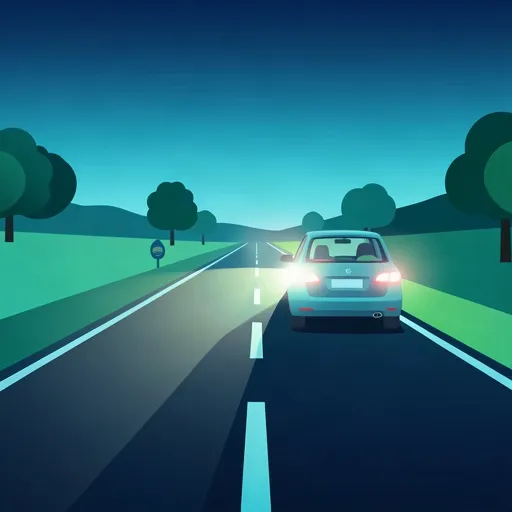
Article content overview
Driving after dark in Poland presents unique challenges that every learner must master, both for road safety and to succeed on the official state theory exam. Visibility is significantly reduced, meaning that your ability to correctly identify hazards depends heavily on the proper use of your vehicle’s lighting systems. Under the Polish traffic law (Prawo o ruchu drogowym), lighting requirements are precise and non-negotiable; failing to adhere to them often leads to fines, penalty points, and, more importantly, dangerous traffic situations.
In Poland, the default rule is that you must drive with your low beam headlights (światła mijania) turned on at all times, regardless of the time of day or the season. While daylight running lights (światła do jazdy dziennej) are a permitted alternative during the day, they can only be used under conditions of "normal air transparency." As soon as visibility drops—whether due to twilight, fog, heavy rain, or snowfall—you are legally obligated to switch to low beam headlights.
A condition where visibility is sufficient to clearly see road obstacles and other users at a standard distance, with no weather-related impairment such as fog, heavy rain, or snow.
Many modern vehicles feature automatic lighting systems, but as a driver, you are ultimately responsible for ensuring the correct lights are active. Relying solely on automation can be a trap; if your car's sensors fail to detect light changes or if your daytime running lights do not activate your rear position lights, you risk being invisible to drivers behind you, especially in tunnel or dusk conditions.
High beam headlights (światła drogowe) are designed for long-range visibility on unlit roads between dusk and dawn. While they are a vital tool for spotting pedestrians or animals early, their use is strictly regulated to prevent the "dazzling" (oślepienie) of other road users. According to Polish law, you must switch back to low beam headlights immediately when there is a risk of blinding an oncoming driver, a driver in front of you, or the driver of a rail vehicle.
You must switch from high beams to low beams immediately if there is even a chance that you might dazzle an oncoming driver or a driver you are following. If an oncoming driver dims their lights first, you are legally required to do the same.
One of the most common exam questions involves the appropriate reaction when being dazzled by another vehicle. If you find yourself blinded by oncoming high beams, you should focus your gaze toward the right edge of the road to maintain your lane position and reduce the effect of the glare. Additionally, you must always adjust your speed to your current range of visibility; if you cannot see clearly, you must slow down to a point where you can stop within the distance illuminated by your headlights.
| Light Type | Time/Condition | Usage Rule |
|---|---|---|
| Low Beam | 24/7 | Mandatory for normal visibility; default setting. |
| High Beam | Night / Unlit roads | Permitted if it does not dazzle other users. |
| Daytime Running | Day / Normal visibility | Optional alternative to low beams. |
| Fog Lights | Reduced visibility | Permitted during fog/heavy rain; switch off when it clears. |
The Polish theory exam frequently tests your understanding of scenarios involving pedestrians and cyclists. You are strictly forbidden from using high beams if there is any possibility of blinding pedestrians, especially those walking in a column. Furthermore, remember that using high beams in a built-up area is not inherently illegal, but it is effectively impossible to use them safely without dazzling someone, given the proximity of other road users and urban lighting.
Polish traffic law mandates low beam headlights at all times, with high beams permitted only on unlit roads at night when they will not dazzle other road users. The concept of 'normal air transparency' determines when daytime running lights are acceptable, and drivers are always legally responsible for correct lighting regardless of automatic systems. High beams must be dimmed immediately upon approaching oncoming traffic, pedestrians, or cyclists, and this obligation is mutual—if an oncoming driver dims first, you must do the same. Fog lights may be used during reduced visibility but must be deactivated once conditions clear, and drivers should adjust their speed to match their new visibility range when switching to low beams.
A short set of high-value points that capture the most important ideas from this article.
Low beam headlights (światła mijania) are mandatory 24/7 in Poland; daytime running lights are only permitted when air transparency is normal.
High beam headlights must be switched to low beams immediately whenever there is any risk of dazzling oncoming drivers, pedestrians, or cyclists.
If an oncoming driver dims their high beams first, you are legally obligated to do the same in response.
Automatic lighting systems do not transfer legal responsibility; you remain accountable for ensuring the correct lights are active.
Fog lights are permitted during reduced visibility but must be switched off once conditions improve.
The term 'normal air transparency' means no weather impairment (fog, heavy rain, snow) is reducing visibility.
High beams are forbidden if there is any possibility of blinding pedestrians, especially those walking in a column.
When dazzled by oncoming high beams, focus your gaze toward the right edge of the road and reduce your speed.
Built-up areas (teren zabudowany) make high beam use effectively impossible without risking dazzling other road users.
After overtaking another vehicle at night, wait until it has fully passed before switching back to high beams.
Assuming daytime running lights satisfy nighttime requirements—they do not activate rear position lights, making the vehicle invisible from behind.
Relying solely on automatic lighting sensors without manually checking, as sensor failure can leave you with incorrect lights.
Waiting until the last second to dim high beams instead of anticipating the need when oncoming traffic approaches.
Using high beams in built-up areas where urban lighting and the proximity of pedestrians and cyclists make it dangerous.
Forgetting to switch off fog lights after visibility improves, which can distract or dazzle other drivers.
Article content overview
A short set of high-value points that capture the most important ideas from this article.
Low beam headlights (światła mijania) are mandatory 24/7 in Poland; daytime running lights are only permitted when air transparency is normal.
High beam headlights must be switched to low beams immediately whenever there is any risk of dazzling oncoming drivers, pedestrians, or cyclists.
If an oncoming driver dims their high beams first, you are legally obligated to do the same in response.
Automatic lighting systems do not transfer legal responsibility; you remain accountable for ensuring the correct lights are active.
Fog lights are permitted during reduced visibility but must be switched off once conditions improve.
The term 'normal air transparency' means no weather impairment (fog, heavy rain, snow) is reducing visibility.
High beams are forbidden if there is any possibility of blinding pedestrians, especially those walking in a column.
When dazzled by oncoming high beams, focus your gaze toward the right edge of the road and reduce your speed.
Built-up areas (teren zabudowany) make high beam use effectively impossible without risking dazzling other road users.
After overtaking another vehicle at night, wait until it has fully passed before switching back to high beams.
Assuming daytime running lights satisfy nighttime requirements—they do not activate rear position lights, making the vehicle invisible from behind.
Relying solely on automatic lighting sensors without manually checking, as sensor failure can leave you with incorrect lights.
Waiting until the last second to dim high beams instead of anticipating the need when oncoming traffic approaches.
Using high beams in built-up areas where urban lighting and the proximity of pedestrians and cyclists make it dangerous.
Forgetting to switch off fog lights after visibility improves, which can distract or dazzle other drivers.
Explore related topics, search based questions, and concepts that learners often look up when studying Night Driving Light Rules in Poland. These themes reflect real search intent and help you understand how this topic connects to wider driving theory knowledge in Poland.
Find clear and practical answers to common questions learners often have about Night Driving Light Rules in Poland. This section helps explain difficult points, remove confusion, and reinforce the key driving theory concepts that matter for learners in Poland.
You must switch to low-beam headlights when approaching oncoming vehicles, driving behind another vehicle if you might dazzle the driver, or nearing rail vehicles or water transport vessels if there is a risk of blinding the operators.
Yes, high-beam lights are permitted in built-up areas provided there is sufficient road darkness and their use does not blind other road users or pedestrians.
It refers to standard weather conditions without significant fog, heavy rain, or snowfall. When air transparency is reduced, you must switch from daytime running lights to low-beam headlights or fog lights to ensure you are visible.
No. Daytime running lights are only permitted from dawn to dusk under normal visibility conditions. Once it gets dark or visibility drops, you must use your low-beam or high-beam headlights.
After finding your specific article, continue your targeted learning by exploring related topics or diving deeper into practice questions. Our extensive library ensures you have all the resources needed to confidently prepare for your Polish driving license theory exam. Discover more guides and solidify your understanding of Polish road rules.