
This lesson explores the legal weight constraints for axles on heavy goods vehicles, a critical topic for your C, C1, C1E, and CE theory exam. You will learn how to balance your payload correctly to prevent road damage and ensure optimal handling. Mastering these concepts is essential for maintaining vehicle stability and compliance with the Italian Codice della Strada.

Lesson content overview
Operating heavy goods vehicles (HGVs) in Italy requires a thorough understanding of stringent regulations governing vehicle weight, particularly concerning axle load distribution. These rules are crucial not only for compliance with the Italian Codice della Strada but also for ensuring road safety, preserving infrastructure, and optimizing vehicle performance. This lesson delves into the complexities of axle load limits, how weight is distributed across your vehicle, and the critical role these factors play in safe and legal goods transport.
For professional drivers holding C, C1, C1E, or CE licenses, mastering the principles of axle load distribution is as fundamental as understanding vehicle dimensions or braking systems. Improper loading can have severe consequences, ranging from fines and legal penalties to catastrophic accidents. This section introduces why careful attention to how weight is supported by each axle is paramount.
The weight carried by a heavy goods vehicle is not uniformly spread. Instead, it is distributed unevenly across its axles, with each axle bearing a specific portion of the total mass. Governments impose strict limits on the maximum weight an individual axle or an axle group can support. These axle load limits (limiti di carico per asse) are primarily designed to:
Before delving into the specifics, it is important to have a grasp of certain fundamental terms and their implications. This lesson builds upon knowledge of overall vehicle mass limits, such as massa complessiva (maximum authorized total weight) and massa a pieno carico (weight of the vehicle when fully loaded), which determine the total weight available for distribution among the axles. Understanding the vehicle's payload (usable cargo capacity) and portata (maximum permissible load on a specific axle group) is also crucial for effective load planning.
Effective axle load management hinges on understanding several interconnected principles. These principles guide how cargo should be positioned to ensure legal compliance and safe operation.
The axle load limit (limite di carico per asse) refers to the absolute maximum permissible weight that can be exerted by a single axle or a group of axles on the road surface. These limits are specific to the vehicle's design, axle configuration (e.g., single, tandem, multi-axle), and the country of operation. Their purpose is to prevent localized stress on roads and bridges and to maintain the structural integrity and handling capabilities of the vehicle.
It is a common misunderstanding to confuse these limits with the overall vehicle mass limits. A vehicle may be within its massa complessiva but still have one or more axles overloaded due to poor load placement. Drivers must be aware of the specific limits for each axle or axle group as stated in their vehicle’s technical documentation, such as the Carta di Circolazione.
Axle load distribution (distribuzione del carico sull'asse) is the process of dividing the total vehicle weight, including its cargo, proportionally among all its axles. This distribution is typically expressed as a percentage of the total weight supported by each axle or axle group. The goal is to ensure that no single axle or group of axles bears more weight than its legal limit, thereby promoting vehicle stability and effective braking.
Proper distribution guarantees that the vehicle’s handling characteristics are maintained, preventing issues like excessive tire wear on some axles while others are underutilized. It's not enough for the total weight to be legal; each axle must also be within its individual limit.
The Center of Gravity (CoG) is the imaginary point where the entire weight of the vehicle and its cargo can be considered to act. Its longitudinal position – its placement along the vehicle's length relative to the axles – is the primary factor determining how the total weight is distributed among the front and rear axles.
A properly placed CoG is critical for vehicle stability, particularly during acceleration, braking, and cornering. If the CoG is too far forward, the front axle may become overloaded, compromising steering and potentially reducing braking effectiveness at the rear. Conversely, if the CoG is too far rearward, the rear axles might be overloaded, leading to poor steering response, reduced traction on the drive wheels, and increased risk of fishtailing or jackknifing, especially with trailers. Understanding and controlling the CoG is thus fundamental to safe load planning.
The sagoma limite refers to the maximum cross-sectional area or profile that the vehicle, including its load, can occupy when viewed from the front or rear. While primarily concerned with width and height, it indirectly affects load distribution by dictating how widely or high cargo can extend. This limit prevents loads from protruding dangerously beyond the vehicle's footprint, which could strike roadside infrastructure, other vehicles, or vulnerable road users.
Compliance with the sagoma limite is essential for ensuring that the vehicle's overall dimensions, as affected by its load, remain within safe and legal bounds, particularly in tight urban environments, tunnels, or narrow roads.
Let's delve deeper into the specific terminology and practical implications of axle load management as encountered in the Italian goods vehicle context.
In Italy, as in many European countries, axle load limits vary significantly depending on the type and configuration of the axles. These limits are precisely specified in the vehicle's Carta di Circolazione (registration document) and are regulated by the Codice della Strada.
Drivers must meticulously understand these specific limits for their vehicle and trailer combination. Overlooking these specific limits is a common error, leading to unintentional overloading of individual axle groups even when the total vehicle weight appears acceptable.
Optimizing load distribution involves strategically placing cargo to ensure each axle bears a weight within its legal limits. This is typically achieved by understanding the vehicle's wheelbase and the position of its axles.
The sum of the weights on all individual axles must equal the total weight of the vehicle and its load, and critically, each individual axle's weight must not exceed its specific legal limit.
The longitudinal position of the Center of Gravity (CoG) is the most important factor in determining how a load is distributed between the front and rear axles.
Professional load planners and drivers often use calculations or specialized software to determine the optimal CoG position, ensuring that both front and rear axle loads remain within their respective limits. The vertical height of the CoG is also important for stability, especially during cornering, as a higher CoG increases the risk of rollover, though it less directly impacts static axle loads.
These terms are closely related but distinct and crucial for calculating permissible cargo weight:
Understanding these allows drivers to not only know how much cargo they can carry in total (payload) but also how that cargo must be positioned to avoid exceeding the specific limits (portata) for each axle, all while staying under the overall vehicle limit (massa a pieno carico).
The sagoma limite sets the maximum external dimensions a loaded vehicle can present. While primarily defining overall height and width, it influences load distribution laterally. For example, if a load is excessively wide, it may not be permissible even if it doesn't overload an axle vertically. This is because the lateral projection could pose a hazard on the road, impacting other vehicles or infrastructure.
In Italy, the standard maximum width for vehicles, including their load, is generally 2.55 meters (or 2.60 meters for refrigerated vehicles). Exceeding these dimensions requires special authorization and often specific escort vehicles. The sagoma limite ensures that vehicles, when loaded, can safely navigate the road network without becoming an obstruction or danger due to their physical footprint.
The rules concerning axle loads and their distribution are firmly embedded in the Italian legal framework, primarily the Codice della Strada. Adherence is non-negotiable for all professional drivers.
Rule Statement: Each axle or axle group on a heavy goods vehicle must not support a weight exceeding the limit prescribed for that specific axle configuration as detailed in the vehicle's registration certificate (Carta di Circolazione) and consistent with national regulations.
Rule Statement: The cargo must be distributed across the vehicle’s length and width in a manner that ensures all individual axles remain within their respective legal load limits. The distribution must also secure the load against shifting.
Rule Statement: The cross-sectional profile of the vehicle, including its load, must not exceed the prescribed maximum dimensions (sagoma limite) for width and height.
Failing to properly manage axle loads can lead to several dangerous scenarios and legal infringements:
Effective axle load management is not a static exercise but rather a dynamic one that must adapt to various operational conditions.
The relationship between load management choices and their outcomes is clear and direct:
This lesson on axle load distribution and limits is not isolated; it builds upon and directly influences several other critical areas of goods vehicle operation:
Understanding these concepts is best solidified through practical application:
These scenarios highlight the daily practical application of understanding axle load limits, proper distribution, Center of Gravity, and adherence to the sagoma limite for safe and legal goods transport in Italy.
This lesson covers the critical topic of axle load limits for heavy goods vehicles under Italian law. Learners must understand that each axle configuration has specific legal weight limits that cannot be exceeded regardless of total vehicle weight. The Center of Gravity position along the vehicle's length directly determines how weight is distributed between front and rear axles, requiring careful cargo placement. Key terms include massa complessiva (total permissible weight), portata (axle group capacity), and sagoma limite (maximum cross-sectional profile). Proper load distribution ensures vehicle stability, effective braking, and compliance with the Codice della Strada, while violations result in fines, penalties, and serious safety risks including rollover and loss of control.
A short set of high-value points that capture the most important learning from this lesson.
Axle load limits (limiti di carico per asse) differ by axle type: single axles (~8,000 kg), tandem axles (~14,000 kg), and tridem configurations (~24,000 kg)
A vehicle can be within its massa complessiva while still having individual axles overloaded due to poor cargo placement
The longitudinal position of the Center of Gravity (CoG) determines how total weight is divided between front and rear axles
The Sagoma Limite restricts the maximum cross-sectional profile (width and height) of the loaded vehicle
Trailer nose weight (peso sull'occhione) adds to the towing vehicle's rear axle load and must be factored into calculations
Explore all units and lessons included in this driving theory course.
Payload (carico utile) = Massa a pieno carico minus massa a vuoto; Portata = maximum permissible load on a specific axle group
Tandem axles consist of two closely spaced axles sharing a combined load limit, not two separate single axle limits
Exceeding Sagoma Limite dimensions (standard width 2.55 m, 2.60 m for refrigerated vehicles) requires special authorization
Dynamic forces during braking and cornering temporarily shift weight, potentially causing an axle to exceed its static limit
Fuel consumption during a journey can shift the vehicle's CoG, subtly altering axle load distribution over long trips
Assuming the total vehicle weight being legal means all individual axles are within their limits
Placing all heavy cargo at the rear to maximize payload, overloading rear axles while underloading the front axle
Forgetting that trailer coupling transfers vertical load to the towing vehicle's rear axle, adding to its burden
Ignoring dynamic load shifts during braking or cornering, which can cause temporary axle overload
Exceeding the Sagoma Limite with lateral load protrusions that create collision hazards for other road users
Lesson content overview
A short set of high-value points that capture the most important learning from this lesson.
Axle load limits (limiti di carico per asse) differ by axle type: single axles (~8,000 kg), tandem axles (~14,000 kg), and tridem configurations (~24,000 kg)
A vehicle can be within its massa complessiva while still having individual axles overloaded due to poor cargo placement
The longitudinal position of the Center of Gravity (CoG) determines how total weight is divided between front and rear axles
The Sagoma Limite restricts the maximum cross-sectional profile (width and height) of the loaded vehicle
Trailer nose weight (peso sull'occhione) adds to the towing vehicle's rear axle load and must be factored into calculations
Explore all units and lessons included in this driving theory course.
Payload (carico utile) = Massa a pieno carico minus massa a vuoto; Portata = maximum permissible load on a specific axle group
Tandem axles consist of two closely spaced axles sharing a combined load limit, not two separate single axle limits
Exceeding Sagoma Limite dimensions (standard width 2.55 m, 2.60 m for refrigerated vehicles) requires special authorization
Dynamic forces during braking and cornering temporarily shift weight, potentially causing an axle to exceed its static limit
Fuel consumption during a journey can shift the vehicle's CoG, subtly altering axle load distribution over long trips
Assuming the total vehicle weight being legal means all individual axles are within their limits
Placing all heavy cargo at the rear to maximize payload, overloading rear axles while underloading the front axle
Forgetting that trailer coupling transfers vertical load to the towing vehicle's rear axle, adding to its burden
Ignoring dynamic load shifts during braking or cornering, which can cause temporary axle overload
Exceeding the Sagoma Limite with lateral load protrusions that create collision hazards for other road users
Explore search topics learners often look for when studying Axle Load Distribution and Limits. These topics reflect common questions about road rules, driving situations, safety guidance, and lesson level theory preparation for learners in Italy.
Browse additional driving theory lessons that cover connected traffic rules, road signs, and common driving situations related to this topic. Improve your understanding of how different rules interact across everyday traffic scenarios.
Explore the intricate details of axle load distribution for heavy goods vehicles in Italy. This lesson covers advanced concepts like dynamic load shifts, the impact of CoG on stability, and the critical relationship between axle limits, vehicle performance, and road safety.

This lesson focuses on the practical skill of distributing the load's weight evenly across the vehicle's axles. It explains how improper placement can overload one axle while underloading another, leading to legal violations and poor vehicle handling, steering, and braking performance. Learners will understand how to create a balanced load plan that respects legal axle limits and ensures the vehicle remains stable and controllable.
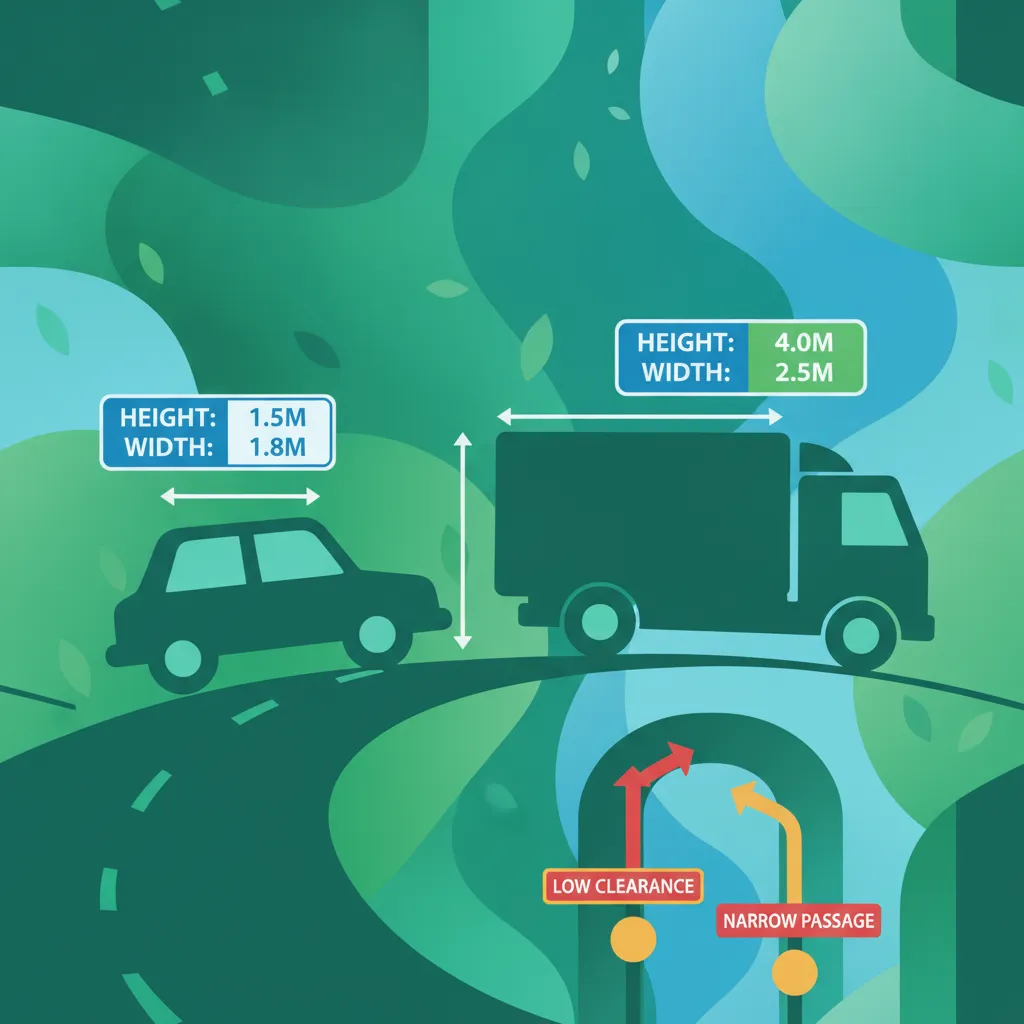
This lesson focuses on the specific dimensional limits that heavy goods vehicles must adhere to on Italian roads, as stipulated by the Codice della Strada. It covers the maximum permissible length, width, and height, explaining how these restrictions impact navigation through tunnels, under bridges, and within urban environments. Learners will also understand the conditions under which special permits for exceptional or oversized transport are required.

This lesson synthesizes the unit's concepts through practical, real-world examples of load planning. Learners will work through scenarios that require calculating payload, distributing weight across axles, and checking dimensions to ensure full compliance with 'sagoma limite'. These exercises reinforce the importance of meticulous pre-trip planning to guarantee a safe, legal, and efficient transport operation from start to finish.

This lesson explores the critical physics behind stopping a heavy vehicle. It breaks down the components of total stopping distance—thinking distance and braking distance—and explains how this is significantly increased by vehicle mass and speed. Learners will understand the necessity of maintaining a much greater following distance than a car to allow enough space to stop safely in all conditions.

This lesson introduces the core physical principles behind effective cargo restraint. It explains how different methods—such as blocking to prevent sliding, and lashing to increase pressure and friction—work to counteract the forces of acceleration, braking, and cornering. Learners will become familiar with the various types of equipment, like straps and chains, and understand the basic concepts that underpin all secure loading practices.

This lesson vividly illustrates the dangers of a load that moves during transit. It explains how a sudden load shift during braking can increase stopping distance or cause a jack-knife, while a shift during cornering can easily lead to a rollover. By understanding these dynamic forces, learners will appreciate the absolute necessity of ensuring every piece of cargo is properly and robustly secured before starting a journey.

This lesson explains the critical concept of the center of gravity (CoG) and its direct impact on a vehicle's susceptibility to rolling over. It demonstrates how placing heavy items high up raises the CoG, making the vehicle less stable in corners or during evasive maneuvers. Learners will understand the importance of loading the heaviest goods as low and as centrally as possible to maximize stability and reduce rollover risk.

This lesson bridges the gap between general traffic laws and their specific application to heavy goods vehicles. It examines how rules regarding speed limits, lane discipline, overtaking, and priority are modified or have special considerations for trucks due to their size, weight, and reduced maneuverability. Drivers will learn to correctly interpret road signs and signals within the context of operating a large vehicle, ensuring safe and compliant integration with other traffic.
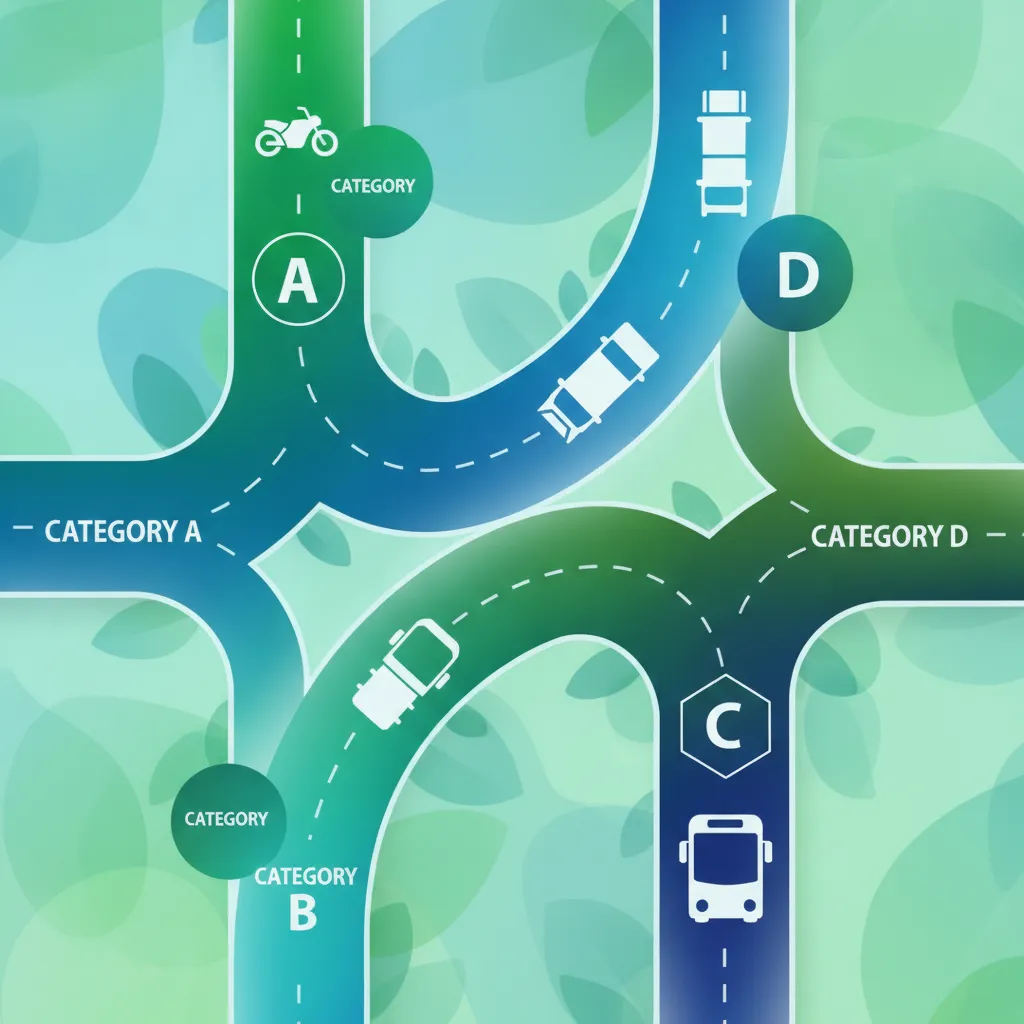
This lesson provides a detailed breakdown of the Italian goods vehicle licence categories, explaining the criteria that define each one. It covers the maximum authorized mass (MAM), vehicle configurations such as rigid trucks and articulated combinations, and the specific permissions granted by the C1, C1E, C, and CE licenses. Understanding these distinctions is fundamental to ensuring legal operation and choosing the correct qualification for specific transport tasks and vehicle types.

This lesson focuses on the specific regulations and techniques for operating a heavy vehicle on high-speed motorways. It covers mandatory lane discipline for trucks, the rules governing overtaking other heavy vehicles, and the specific speed limits that apply. Best practices for merging onto and exiting the motorway, maintaining safe following distances, and using the hard shoulder only in genuine emergencies are also detailed.
Understand the severe legal penalties and safety risks associated with exceeding Italian axle load limits and improper weight distribution. This lesson details common violations, their impact on vehicle safety, road infrastructure, and potential fines for C and CE license holders.
This lesson focuses on the practical skill of distributing the load's weight evenly across the vehicle's axles. It explains how improper placement can overload one axle while underloading another, leading to legal violations and poor vehicle handling, steering, and braking performance. Learners will understand how to create a balanced load plan that respects legal axle limits and ensures the vehicle remains stable and controllable.

This lesson defines 'sagoma limite', which refers to the maximum outline or silhouette a vehicle and its load can occupy. It then explores the serious repercussions of overloading, which include substantial legal fines, increased stress on vehicle components like brakes and suspension, and dangerously compromised handling and stability. Learners will understand that overloading is not just a legal issue but a critical safety hazard for the driver and all other road users.
This lesson provides a clear overview of the legal consequences for failing to comply with road transport regulations in Italy. It covers the system of fines for common offenses like speeding, overloading, and violations of driving hours. The lesson also explains the penalty point system that can lead to license suspension and touches upon the responsibilities and potential liability of the transport company.

This lesson provides a detailed overview of the legal framework for load securing in Italy, focusing on the relevant articles of the Codice della Strada. It outlines the driver's legal responsibility for ensuring the load is secure and covers the standards that securing equipment must meet. Learners will be made aware of the significant fines and other penalties that can be imposed for violations, reinforcing the importance of diligent compliance.

This lesson delves into the specific articles of the Italian Codice della Strada that apply to heavy goods vehicles. It outlines the core legal and professional obligations of a driver, including the heightened duty of care owed to other road users and the responsibility for the vehicle's roadworthiness and load. Learners will understand the legal consequences of non-compliance, such as fines and sanctions, reinforcing the importance of adhering to all traffic regulations.
This lesson focuses on the specific dimensional limits that heavy goods vehicles must adhere to on Italian roads, as stipulated by the Codice della Strada. It covers the maximum permissible length, width, and height, explaining how these restrictions impact navigation through tunnels, under bridges, and within urban environments. Learners will also understand the conditions under which special permits for exceptional or oversized transport are required.

This lesson explains the principles of safe load management to maintain vehicle stability and comply with legal requirements. It covers how to properly distribute and secure cargo inside the vehicle, the rules for using roof racks, and the specific signaling required for loads that project beyond the vehicle's rear. The content also provides a basic introduction to the rules and safety considerations when towing a small trailer.

This lesson prepares drivers for incidents beyond a simple breakdown, such as losing part of the load onto the roadway or dealing with a spillage. It outlines the immediate priorities: ensuring personal safety, warning other traffic of the hazard, and notifying the authorities. The lesson also covers the fundamental principles of managing an accident scene, including protecting the area, assessing for casualties, and providing essential information to emergency services.
This lesson synthesizes the unit's concepts through practical, real-world examples of load planning. Learners will work through scenarios that require calculating payload, distributing weight across axles, and checking dimensions to ensure full compliance with 'sagoma limite'. These exercises reinforce the importance of meticulous pre-trip planning to guarantee a safe, legal, and efficient transport operation from start to finish.
This lesson vividly illustrates the dangers of a load that moves during transit. It explains how a sudden load shift during braking can increase stopping distance or cause a jack-knife, while a shift during cornering can easily lead to a rollover. By understanding these dynamic forces, learners will appreciate the absolute necessity of ensuring every piece of cargo is properly and robustly secured before starting a journey.
Find clear answers to common questions learners have about Axle Load Distribution and Limits. Learn how the lesson is structured, which driving theory objectives it supports, and how it fits into the overall learning path of units and curriculum progression in Italy. These explanations help you understand key concepts, lesson flow, and exam focused study goals.
Even if your total vehicle mass is within the legal limit, an individual axle can still be overloaded if the weight is not distributed correctly. This causes excessive wear on road surfaces and tires, and significantly compromises your vehicle's braking and cornering stability.
A load that is placed too high or too far to one side shifts the vehicle's center of gravity. This increases the risk of rollover when cornering, especially in articulated vehicles where the trailer can swing outward due to poorly balanced weight.
Exam questions often present scenarios where a vehicle is within its total mass limit but has an axle exceeding the allowed pressure. Always check the distribution of the cargo rather than just the total tonnage.
As a professional driver, you are legally responsible for the load you transport. You must verify that the distribution is balanced, ensure securing devices are used correctly, and be aware of your vehicle's maximum allowable axle loads before departing.
Start searching now to pinpoint exactly which Italian driving theory topics, road signs, or traffic rules you need to master. Use our advanced filters to build a custom practice session and ensure you're fully prepared for every aspect of your official driving licence exam.