This lesson covers the advanced techniques required for safely handling trailers and articulated vehicles in the Turkish transport sector. You will explore vehicle dynamics, including pivot points and sway mitigation, to ensure you are prepared for both the C/CE theory exam and real-world professional driving tasks.

Lesson content overview
Operating a vehicle combination—whether a heavy truck towing a full trailer (C1E/CE license classes) or an articulated tractor-unit pulling a semi-trailer—demands a completely different set of skills than driving a rigid vehicle. In Turkey, professional freight transport relies heavily on these high-capacity vehicle configurations.
According to the Turkish Highway Traffic Regulation (Karayolları Trafik Yönetmeliği), drivers must understand the complex physics, altered dimensions, and heightened risks associated with articulated units. Safe operations prevent devastating road accidents caused by trailer detachment, jackknifing, or structural rollovers.
At the heart of trailer handling is the pivot point. This is the mechanical connection point about which the trailer rotates relative to the towing vehicle.
In a tractor-semi-trailer combination, the pivot point is the fifth wheel (beşinci teker) and the kingpin (beşik pimi). For a rigid truck pulling a drawbar trailer, the pivot is the coupling hitch (römork çeki demiri) at the rear of the truck.
These pivot points act as hinges. While they allow the vehicle to negotiate tight curves and navigate urban environments, they introduce a state of articulation. This means the rear unit does not naturally follow the exact track of the front unit during a steering maneuver.
Jackknifing (makaslama) occurs when the angle between the towing vehicle and the trailer becomes so acute that the vehicle folds in on itself, forming a "V" shape. This is typically triggered by a loss of traction at the drive axles of the tractor or towing vehicle.
During heavy braking or acceleration on slippery surfaces (such as wet asphalt or black ice on mountain passes), the drive wheels may lock up or spin. When this happens, they lose lateral grip. The heavy momentum of the trailer continues to push forward against the fifth wheel, forcing the rear of the tractor to swing outward.
How to Prevent Jackknifing: Never brake abruptly while turning. If you feel the tractor sliding, immediately release the service brake to allow the wheels to regain traction, and gently steer in the direction of the slide to realign the combination.
When an articulated vehicle turns, the rear wheels of the trailer do not follow the path of the tractor’s front wheels. Instead, they cut inward toward the center of the turn. This phenomenon is known as off-tracking (içten kesme or dingil sapması).
The longer the distance between the pivot point (kingpin) and the trailer’s rear axles, the greater the off-tracking effect. The area swept by the entire body of the vehicle during a turn is called the swept path.
Right turns at intersections are particularly challenging for professional drivers in Turkey due to narrow urban streets and pedestrian safety zones. To execute a right turn safely without clipping the curb or hitting street furniture, you must use a "buttonhook" or "wide-turn" strategy:
Approach and Positioning: Keep your vehicle in the center or slightly to the left of your lane as you approach the intersection. Do not swing out to the left too early, as this invites smaller vehicles (like cars or motorcycles) to attempt to pass you on your right, placing them directly in your blind spot.
Speed Reduction: Slow down to a walking pace before starting the turn. This gives you more time to monitor your mirrors.
The Turning Phase: Drive the tractor straight into the intersection before turning the steering wheel sharp right. This "deep entry" allows the front of your vehicle to clear the turn while pulling the trailer's rear axles far enough forward to clear the curb.
Mirror Monitoring: Continuously check your right-hand side mirror to ensure the trailer wheels maintain a safe distance from the curb and vulnerable road users.
When turning left, off-tracking can cause the trailer to cut across oncoming lanes or adjacent lanes on your left. You must ensure that the front of your tractor goes deep enough into the intersection before turning, and verify that the path is clear of oncoming vehicles that may have stopped past the stop line.
Trailer sway (or yalpalanma) refers to the self-sustaining, lateral oscillation of the trailer from side to side. If unchecked, trailer sway can quickly escalate into a catastrophic loss of control, causing the vehicle to spin, rollover, or run off the road.
Trailer sway is caused by lateral aerodynamic or mechanical forces that exceed the natural damping capabilities of the combination’s suspension and tires. Several factors contribute to this dangerous state:
If your trailer begins to sway or fishtail, your natural instinct may be to brake hard or steer quickly to correct it. Doing so will worsen the sway.
Sway Recovery Technique: Keep the steering wheel straight and firm. Do not try to "steer out" of the sway, as human reaction time is too slow and you will likely overcorrect, worsening the oscillation. Gradually ease off the accelerator pedal to slow down. Do not apply the service brakes unless absolutely necessary, as this can transfer weight forward, making the trailer even more unstable.
A trailer detachment on a public highway is almost always fatal for trailing motorists. Ensuring the integrity of the coupling connection is a primary legal responsibility of any commercial driver under Turkish traffic safety laws.
When coupling a tractor-unit to a semi-trailer, you must follow a methodical checklist to ensure the kingpin is locked into the fifth wheel jaws:
Visual Alignment: Align the tractor with the trailer. Reverse slowly until the fifth wheel is just touching the trailer apron.
Height Check: Check that the trailer is at the correct height. The fifth wheel should lift the trailer slightly when you back under it. If the trailer is too high, the kingpin can slide over the top of the fifth wheel (known as "high-hitching"), preventing locking and damaging the cab.
Secure Coupling: Reverse gently until you hear the locking jaws engage around the kingpin.
The Tug Test: Put the tractor in a forward gear, apply the trailer brakes (using the trailer hand valve, if equipped), and pull forward gently. The tractor should not move. This is a physical test to confirm the lock has engaged.
Physical Inspection: Exit the cab with a flashlight. Look underneath the trailer. Verify that there is no space between the trailer apron and the fifth wheel. Confirm that the locking jaws are closed around the kingpin shank and that the safety release lever is in the locked position.
Connect Lines: Connect the air lines (glad hands) and electrical cables. Ensure the safety chains (for drawbar configurations) are securely attached with enough slack to allow full turning.
Adding a trailer to a heavy vehicle creates massive blind spots (kör noktalar), particularly along the right side (passenger side) of the vehicle and directly behind the trailer.
Because the trailer angles relative to the tractor during turns, your side-view mirrors will temporarily point away from the rear of the trailer. When turning right, your right-hand mirror will only show the side of your own trailer rather than the traffic lane beside it.
Reversing a trailer requires the driver to understand that the trailer moves in the opposite direction of the steering wheel input.
Under the Turkish Highway Traffic Regulation (Karayolları Trafik Yönetmeliği), driving a vehicle with an attached trailer comes with specific legal constraints designed to offset the physical risks of towing.
In Turkey, vehicles towing a trailer are subject to lower speed limits than rigid vehicles of the same class. Generally, the speed limit for any vehicle towing a trailer is reduced by 10 km/h compared to the standard speed limit for that vehicle category on that specific road type.
Drivers of CE-class combinations must comply with strict vehicle weight and dimension limits. Exceeding these limits reduces braking efficiency and increases the risk of trailer sway and rollover.
To help solidify your understanding of maneuvering articulated vehicles and trailers, review these essential concepts before your exam:
Explore all units and lessons included in this driving theory course.
Lesson content overview
Explore all units and lessons included in this driving theory course.
Explore search topics learners often look for when studying Manoeuvring with Trailers and Articulated Vehicles. These topics reflect common questions about road rules, driving situations, safety guidance, and lesson level theory preparation for learners in Turkey.
Browse additional driving theory lessons that cover connected traffic rules, road signs, and common driving situations related to this topic. Improve your understanding of how different rules interact across everyday traffic scenarios.
Learn how to navigate narrow urban streets and manage blind spots when interacting with cyclists, pedestrians, and motorcyclists. This guide explains safety protocols for heavy goods vehicle drivers in Turkish traffic, focusing on mirror usage and spatial awareness to prevent accidents in high-density urban environments.

This lesson examines the critical interactions between goods vehicles and vulnerable road users such as pedestrians, cyclists, and motorcyclists, particularly in urban environments. Learners will explore right-of-way rules, maintaining safe distances, and strategies for anticipating the actions of these road users. The lesson emphasizes the importance of clear communication and protective driving.

This lesson explores the unique challenges faced during urban deliveries, such as navigating restricted loading zones, traffic congestion, and narrow streets. Learners will learn strategies for safe maneuvering, efficient loading and unloading, and maintaining situational awareness in high-pedestrian traffic areas. Emphasis is placed on complying with local regulations and optimizing time management.

This lesson focuses on protecting vulnerable road users, such as pedestrians, cyclists, and motorcyclists, in mixed traffic environments. Learners will examine specific strategies for increased vigilance, anticipatory driving, and properly yielding to these users. The lesson also covers high-risk zones, such as school areas and public transport stops, emphasizing the need for heightened safety.

Learners will examine the complexities of operating in environments where various road users, including pedestrians, cyclists, and motorcyclists, coexist. The lesson emphasizes the need for heightened situational awareness, defensive driving techniques, and proactive hazard anticipation. Strategies for navigating mixed traffic safely, especially in congested urban areas, are highlighted.

Learners will identify the different categories of vulnerable road users and understand the heightened risks they face. The lesson emphasizes the importance of recognizing these users, anticipating their actions, and taking proactive measures to ensure their safety while operating passenger vehicles. Strategies for mitigating danger and fostering a protective driving environment are explored.

This lesson delves into specific manoeuvring strategies required when navigating both tight urban environments and open rural roads with large passenger vehicles. Learners will explore techniques for handling narrow streets, tight turns, and intersections, while maintaining safety and efficiency. The content emphasizes planning and execution of manoeuvres based on road conditions and vehicle dimensions.
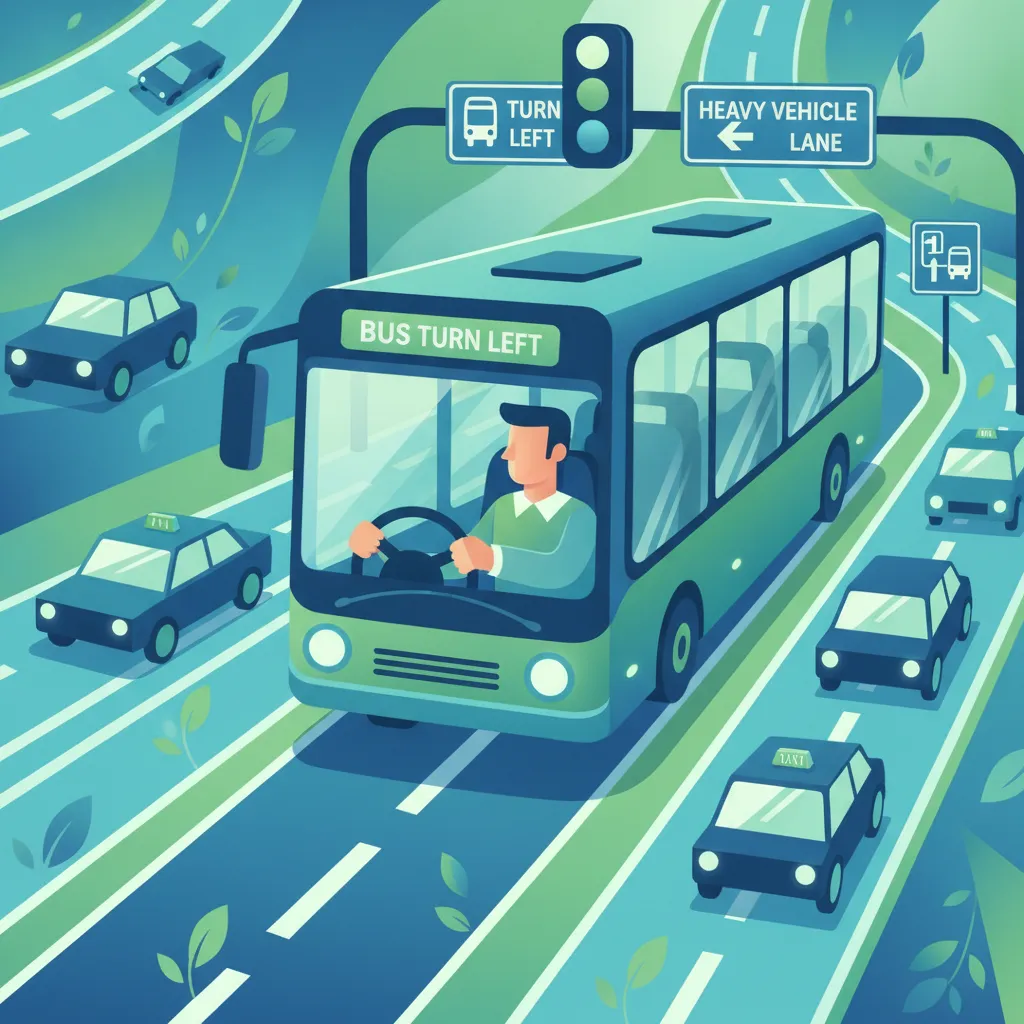
Learners will explore strategies for navigating congested urban traffic environments while operating large passenger vehicles. The lesson covers lane selection, adherence to traffic signals, and the use of bus lanes where applicable. Understanding how to maintain smooth traffic flow while ensuring passenger safety is crucial for efficient urban transportation.

This lesson explores the unique challenges encountered when driving goods vehicles on rural roads, including narrow widths, sharp curves, animal crossings, and varying road surface conditions. Learners will understand the importance of adjusting speed, maintaining vigilance, and respecting road markings. Emphasis is placed on safe navigation practices to mitigate risks associated with rural areas.

This lesson focuses on the safe interaction with other traffic participants at bus stops and traffic intersections. Learners will explore right-of-way rules, signal compliance, and techniques for maintaining safe distances while stopping and departing. Understanding these interactions is vital for preventing accidents in complex traffic environments.

This lesson explores the hazards characteristic of rural roads, including narrow paths, lack of lighting, slow agricultural vehicles, and sharp curves. It teaches drivers how to anticipate blind corners, adjust speed, and pass slow-moving tractors safely. Motorists will learn to remain highly alert for unexpected roadway obstructions.
Understand the mechanical limits of braking systems and safe following distances for heavy transport combinations. This overview details how to manage vehicle stability on steep gradients and highway curves, ensuring you understand the physics of load distribution and momentum required for the Turkish professional driving theory license.

This lesson addresses the techniques required for safely navigating grades and slopes with heavy goods vehicles. Learners will explore the use of engine braking, proper gear selection, and auxiliary retarders to manage speed on steep downhill sections. The lesson also covers strategies for starting on uphill grades without rollback, considering vehicle weight and load distribution.

Learners will learn how to calculate and maintain safe following distances, accounting for the longer braking distances and reaction times inherent to larger passenger vehicles. The lesson emphasizes the importance of a sufficient time gap to allow for safe stopping and to prevent rear-end collisions, particularly in varying traffic conditions.

This lesson provides an in-depth understanding of the braking systems used in goods vehicles, including air and hydraulic brakes. Learners will explore the limitations of these systems, such as brake fade and overheating, especially under heavy loads. The lesson also covers essential maintenance practices and regular brake inspections to ensure optimal performance and safe stopping distances.

This lesson presents effective braking strategies designed to safeguard passengers and prevent wheel lock-up or skidding. Learners will become familiar with progressive braking, the use of ABS, and techniques for maintaining vehicle stability during sudden stops. Proper braking ensures passenger comfort and reduces accident risk, especially in adverse road conditions.

Learners will explore techniques for adjusting driving styles based on different road surface conditions, such as gravel, potholes, and wet pavement. The lesson emphasizes the importance of adapting speed, braking, and steering inputs to maintain vehicle control and passenger comfort. Strategies for detecting and responding to road hazards are discussed to ensure safety across diverse driving environments.

This lesson examines the effects of load dynamics on vehicle stability during acceleration and deceleration. Learners will learn how cargo can shift and affect handling, particularly during sudden speed changes or emergency braking situations. The lesson emphasizes proper load securing, gradual acceleration, and controlled braking to maintain stability and prevent serious accidents.

This lesson focuses on the importance of maintaining safe following distances for goods vehicles, taking into account longer braking distances and increased load. Learners will learn how to calculate appropriate gaps based on speed, road conditions, and vehicle dynamics. The lesson emphasizes safe following practices to prevent rear-end collisions and improve overall traffic safety in Turkey.

This lesson focuses on the principles governing safe following distances between vehicles. Topics include understanding time and distance gaps, reaction times, and braking distances. Learners will explore guidelines for maintaining proper following distances based on speed and road conditions. Real-world examples demonstrate the importance of safe following practices in preventing rear-end collisions.

Learners will explore methods for achieving smooth acceleration and deceleration, focusing on gradual throttle application and progressive brake pressure to maintain passenger comfort and vehicle stability. The lesson highlights the importance of anticipating road conditions and traffic flow to avoid abrupt speed changes, thereby enhancing safety and reducing fuel consumption.

This lesson delves into the principles of weight distribution and load limits for goods vehicles, emphasizing the impact on vehicle stability and safety. It examines the concept of Gross Vehicle Weight (GVW) and the legal limits imposed on individual axles to prevent overloading. Learners will explore how improper weight distribution affects the centre of gravity, braking performance, and handling characteristics.
Find clear answers to common questions learners have about Manoeuvring with Trailers and Articulated Vehicles. Learn how the lesson is structured, which driving theory objectives it supports, and how it fits into the overall learning path of units and curriculum progression in Turkey. These explanations help you understand key concepts, lesson flow, and exam focused study goals.
The pivot point is the area between the truck and the trailer that allows for independent movement. Understanding this is crucial because the trailer follows a shorter path than the truck during turns, which is a frequent source of exam questions regarding obstacle clearance.
Trailer sway is often caused by excessive speed or improper load distribution. To mitigate it, you should maintain a steady speed, avoid harsh braking or sudden steering inputs, and ensure your cargo is secured correctly according to the centre of gravity.
Yes, the exam often tests your understanding of 'jack-knifing' risks and the importance of using a spotter. You must demonstrate knowledge of how the trailer steers in the opposite direction of the tractor unit when reversing.
Because heavy vehicles have a large turning radius and an 'off-tracking' effect, you must often swing wide into the turn to prevent the rear wheels or trailer from clipping curbs or hitting road furniture.
Use our comprehensive practice search to find exactly the Turkish driving theory questions you need to master. Whether reviewing specific road signs, traffic rules, or first aid scenarios, select your perfect practice set and boost your confidence for the official ehliyet sınavı.