
This lesson details the critical safety regulations for navigating tunnels on the Austrian road network. You will learn the mandatory behaviour rules, including light usage and distance requirements, as well as the correct emergency procedures to ensure safety in the event of a breakdown, traffic jam, or fire.
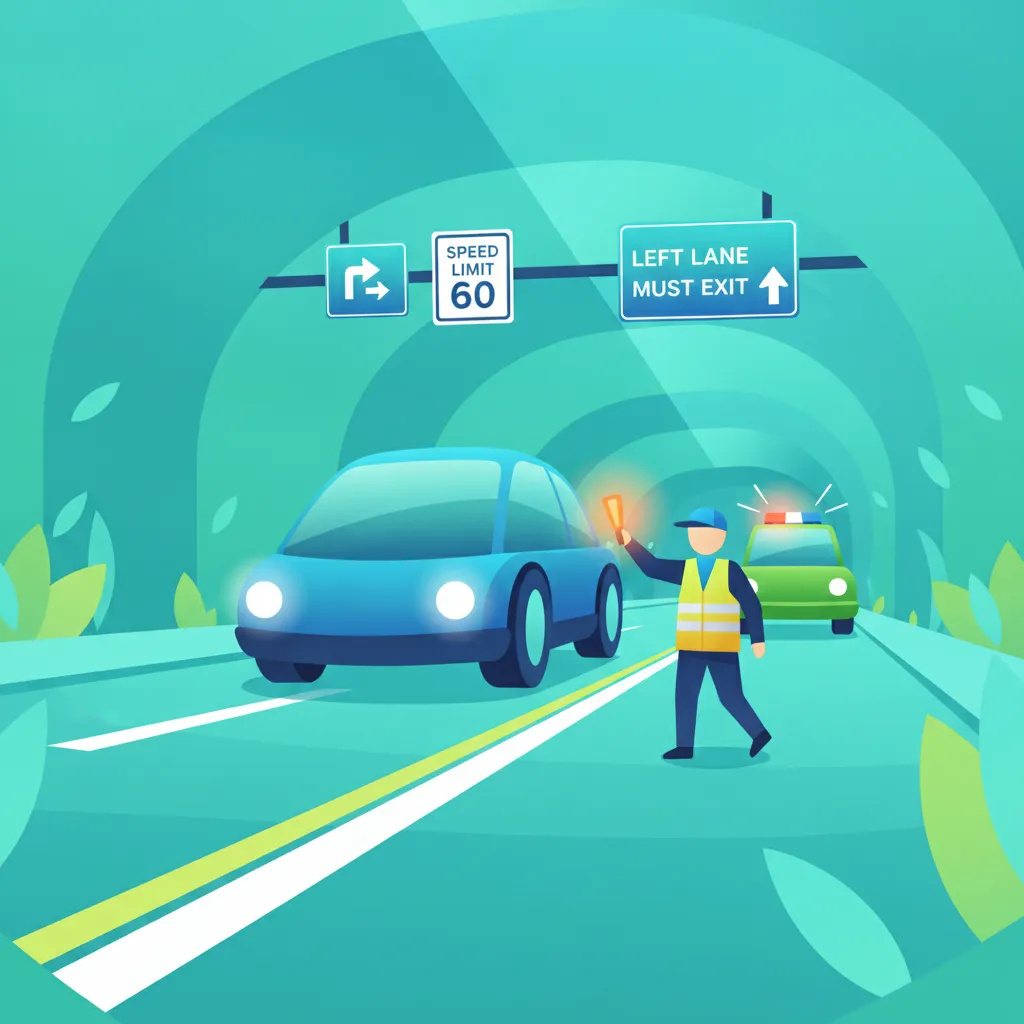
Lesson content overview
Welcome to the Austrian Driving License B Theory Course. This lesson delivers a detailed account of driving regulations and essential safety measures specific to tunnel travel in Austria. Tunnels are unique environments that demand heightened awareness and adherence to specific rules. Understanding these regulations is crucial for ensuring safety for all road users within Austria's extensive tunnel network.
Driving through tunnels presents distinct challenges compared to open-road driving. The confined, low-visibility environment means that even minor incidents can quickly escalate into serious hazards, impacting numerous vehicles and potentially causing extensive congestion or damage. Therefore, specific regulations are in place to minimize risks to vehicle occupants, tunnel infrastructure, and emergency responders.
The unique conditions within tunnels, such as altered acoustics and lighting, can affect a driver's perception and reaction times. For instance, decreased peripheral vision and depth perception necessitate reduced speeds and greater following distances to ensure adequate stopping distances. Headlights are mandatory not just for seeing, but also for being seen, ensuring obstacles, lane markings, and emergency signage are clearly visible despite the tunnel's own lighting. The Austrian traffic laws (Straßenverkehrsordnung or StVO) enforce these rules consistently to prevent accidents, facilitate orderly evacuation in emergencies, and allow rapid access for emergency services. This lesson builds upon fundamental knowledge of basic traffic rules, road signs, vehicle lighting operations, speed limit determination, and general emergency signaling.
Successfully navigating Austria's numerous tunnels requires strict adherence to specific driving rules. These regulations are designed to compensate for the confined space, reduced visibility, and limited escape routes inherent in tunnel environments.
One of the most critical rules for tunnel driving in Austria is the mandatory use of headlights. Regardless of whether it is day or night, or how well the tunnel appears to be lit, your vehicle's low-beam headlights must be activated before entering a tunnel and remain on until you have fully exited. This rule is stipulated in the StVO, specifically § 48.
Using low-beam headlights ensures that your vehicle is clearly visible to other drivers, especially when entering or exiting, where lighting conditions can change abruptly. It also helps illuminate the road surface, lane markings, and any potential obstacles that might otherwise be obscured by shadows or variations in the tunnel's artificial lighting. Daytime running lights (DRL), while useful for increasing visibility during daylight hours on open roads, are insufficient for tunnel driving. DRLs are generally not designed to illuminate the road ahead to the required degree and do not activate the rear lights of the vehicle, which is essential for being seen from behind in a tunnel. Always manually switch on your low-beam headlights.
Speed limits within tunnels are frequently lower than those on the adjoining open roads. These specific limits are always indicated by clear traffic signs at the tunnel entrance and sometimes throughout its length. It is crucial to observe these signs and adjust your speed immediately upon entering the tunnel, as failure to do so can lead to fines and significantly increase the risk of an accident.
Some tunnels may also feature a mandatory minimum speed limit to ensure a smooth flow of traffic. Drivers must not travel significantly slower than this posted minimum, as doing so can create an obstruction and lead to rear-end collisions. Maintaining the correct speed allows for sufficient reaction time in the event of sudden stops or emergencies, which is paramount in a confined tunnel environment.
Maintaining a safe following distance is always important, but it becomes even more critical inside a tunnel due to reduced visibility and the potential for chain-reaction collisions. The general rule of thumb for safe following distance is a minimum of 2 seconds under normal driving conditions. However, in tunnels, this should be extended to at least 3 seconds. Some tunnels may even have signage indicating an even greater required distance.
To estimate your following distance, choose a fixed point on the road ahead, such as a road sign or a bridge. When the vehicle in front of you passes that point, start counting "one-thousand-one, one-thousand-two, one-thousand-three." If your vehicle reaches the same fixed point before you finish counting, you are following too closely. Adjust your speed to increase the gap. This increased distance provides vital extra time to react to sudden braking or incidents ahead, helping to prevent rear-end accidents.
In most Austrian tunnels, overtaking is strictly prohibited unless explicitly allowed by specific signage. This restriction is primarily due to the confined nature of tunnels, which limits visibility, reduces maneuverability, and increases the risk of head-on or side-swipe collisions.
If a "No Overtaking" sign is displayed at the tunnel entrance or within the tunnel, you must remain in your lane and refrain from attempting to pass other vehicles. Even in multi-lane tunnels where overtaking might seem possible, specific lane discipline rules often apply, and drivers should generally avoid unnecessary lane changes. Adhering to these rules helps maintain a steady and predictable flow of traffic, significantly reducing the likelihood of accidents.
Despite all precautions, emergencies can occur in tunnels. Knowing the correct procedures for breakdowns, fires, and accidents is vital for your safety and the safety of others. Rapid and calm action can prevent minor incidents from escalating into major disasters.
Austrian tunnels are equipped with clearly marked emergency exits and evacuation routes. These are designed to provide safe passage out of the tunnel to a protected area or the open air in case of a major incident such as a fire or significant congestion. Emergency exits are typically marked with illuminated "Emergency Exit" signs, often in green or white, pointing towards the nearest escape route.
In an emergency requiring evacuation, you should remain calm and follow these illuminated signs. These exits usually lead to emergency stairways, parallel escape tunnels, or designated safe bays. Never attempt to reverse or use the opposite lane to exit the tunnel, as this could cause further collisions or obstruct emergency services. Always prioritize getting yourself and your passengers to the nearest designated safe area.
Effective communication is crucial during a tunnel emergency. Mobile phone signals can be unreliable or non-existent inside many tunnels. For this reason, SOS telephones (emergency call boxes) are strategically located at regular intervals throughout tunnels. These conspicuous red boxes provide a direct, immediate line of communication to the tunnel control center or emergency services.
If you experience a breakdown, witness an accident, or detect a fire, proceed to the nearest SOS telephone as soon as it is safe to do so. Activate your hazard lights before leaving your vehicle, and ensure you know your approximate location within the tunnel (e.g., by noting the nearest emergency exit number or tunnel section markers). When using the SOS phone, stay calm, clearly describe the situation, and provide your location accurately. This enables emergency services to respond quickly and effectively.
Fire is one of the most dangerous emergencies that can occur in a tunnel due to the confined space, rapid smoke accumulation, and limited ventilation. Tunnels are equipped with portable fire extinguishers at regular intervals, often located near SOS telephones or emergency exits. These extinguishers are primarily for use on small, manageable fires.
Attempting to fight a large or rapidly spreading fire without proper training is extremely dangerous and should be avoided. Your priority should always be safe evacuation.
If a fire starts in your vehicle:
Immediately activate your hazard warning lights.
Try to pull over to the side of the road or into an emergency bay if safely possible, away from the main traffic flow.
Switch off your engine and remove the keys.
Help your passengers exit the vehicle quickly and move to the nearest emergency exit.
If the fire is very small (e.g., under the hood, easily accessible) and you feel it is safe to do so, you may attempt to use the nearest fire extinguisher. However, never put yourself or others at undue risk.
Once passengers are safe, use an SOS telephone to report the fire to the tunnel control center, providing your precise location.
Rapid evacuation is paramount. Smoke can quickly become toxic and reduce visibility to zero. Follow the illuminated emergency exit signs immediately.
A vehicle breakdown inside a tunnel requires a specific sequence of actions to ensure your safety and prevent further incidents.
Activate Hazard Lights: As soon as you realize your vehicle is breaking down, turn on your hazard warning lights (StVO § 35) to alert other drivers of your stationary hazard.
Safe Stopping Position: If possible, steer your vehicle to the extreme right-hand side of the road or into a designated emergency bay. If there's no safe shoulder or bay, stop as close to the right curb as possible, ensuring you do not block an emergency exit.
Turn Off Engine: Switch off your engine.
Evacuate Passengers: Have all occupants exit the vehicle and move to a safe location, preferably behind a safety barrier or towards the nearest emergency exit, ensuring they are clear of traffic.
Use SOS Telephone: Proceed to the nearest SOS telephone to report your breakdown to the tunnel control center. Clearly state your location and the nature of the problem. Do not rely solely on your mobile phone, as signal strength may be poor.
Wait for Assistance: Wait for assistance in a safe area, away from your vehicle and the main traffic flow. Do not attempt to fix the vehicle yourself while inside the tunnel unless it's a very minor issue that can be resolved instantly and safely.
It is crucial not to attempt to restart your vehicle repeatedly if it has stalled, as this can waste valuable time and increase the risk of a more serious incident or fire.
Should a fire occur inside a tunnel, whether in your vehicle or another, a clear and immediate response is critical.
Stop and Activate Hazard Lights: If your vehicle is on fire, or you are directly affected by another vehicle's fire, stop safely at the side of the road if possible, and immediately activate your hazard warning lights.
Switch Off Engine and Keys: Turn off your engine and take your keys to prevent accidental restart or further danger.
Assess Fire: If the fire is very small and contained (e.g., a small electrical fire under the hood that has just started), and you have access to a fire extinguisher and feel safe, you may attempt to put it out.
Prioritize Evacuation: If the fire is growing, involves fuel, or creates significant smoke, your absolute priority is immediate evacuation. Leave your vehicle and move quickly to the nearest marked emergency exit.
Alert Others: If possible and safe, use your horn briefly to warn approaching traffic of the danger.
Communicate with Control Center: As soon as you are in a safe location (e.g., at an emergency exit or an SOS phone bay), use an SOS telephone to report the fire, providing exact details of its location and severity.
Do Not Re-enter: Never re-enter the tunnel or the danger zone for personal belongings.
Smoke inside a tunnel spreads rapidly and can be highly toxic. Do not delay evacuation. Follow the illuminated "Emergency Exit" signs and proceed in an orderly manner to a safe zone.
Compliance with Austrian traffic laws (StVO) is not only essential for safety but also legally binding. Violations of tunnel-specific regulations can result in significant penalties.
| Rule | Legal Status | Rationale | Correct Application | Incorrect Application |
|---|---|---|---|---|
| Headlights must be used inside tunnels | Mandatory (StVO § 48) | Ensures visibility and signals vehicle presence. | Turn on low-beam headlights before tunnel entrance. | Driving with only daytime running lights or fog lights. |
| Adherence to posted speed limits | Mandatory (StVO § 45) | Allows safe stopping distances and reaction time. | Adjust speed to the sign's limit immediately upon entry. | Maintaining higher speed than indicated. |
| Observe minimum speed limit when posted | Mandatory (StVO § 45) | Prevents traffic stagnation and rear-end collisions. | Maintain at least the minimum speed. | Driving significantly below the minimum speed. |
| Maintain safe following distance (min. 3 sec) | Mandatory (StVO § 16) | Accounts for reduced visibility and reaction times. | Keep a 3-second gap (or more) to the vehicle ahead. | Following too closely (e.g., less than 2 seconds). |
| No overtaking unless explicitly allowed | Mandatory (StVO § 12, § 45) | Reduces collision risk in confined environments. | Stay in lane; only overtake if a sign permits. | Attempting to overtake despite prohibition. |
| Stop in safe position in case of breakdown | Mandatory (StVO § 16) | Prevents secondary accidents and clears traffic. | Pull to the side, activate hazard lights, use SOS phone. | Stopping in the middle of a lane, no hazard lights. |
| Activate hazard warning lights during emergency | Mandatory (StVO § 35) | Alerts other road users to a stationary hazard. | Flash hazard lights continuously during a stop or incident. | Forgetting to turn on hazard lights. |
| Use emergency exits as marked | Mandatory (EN 16245 Safety Standards) | Facilitates safe and orderly evacuation. | Follow illuminated exit signs directly to a safe area. | Ignoring exit signs, attempting to reverse or drive against traffic. |
| Report emergencies via SOS telephone | Recommended (Guideline) | Enables prompt assistance and coordinated response. | Use SOS telephone immediately when safe to do so. | Delaying reporting, or only relying on unreliable mobile signal. |
Failure to comply with these rules can result in significant fines and, in some cases, demerit points on your driving license. More serious offenses, especially those causing danger or accidents, can lead to criminal charges or higher liability in an incident. For example, driving without headlights in a tunnel, exceeding the speed limit, or dangerous overtaking are common violations with direct consequences.
Tunnel driving is not always a static experience; various factors can influence how you should adapt your driving behavior.
External weather conditions, such as fog, heavy rain, or snow, can impact visibility even inside tunnels. While tunnels are sheltered from direct precipitation, the approaches can be hazardous. Ensure your low-beam headlights are on, and consider activating your rear fog lights if visibility is severely reduced before entering the tunnel, but remember to switch them off inside if they cause glare for following drivers. High-beam headlights are strictly prohibited in tunnels as they cause dangerous glare against reflective surfaces and oncoming traffic.
The time of day does not alter the mandatory headlight rule. Whether it's bright noon or the middle of the night, low-beam headlights are always required inside tunnels. However, during daylight, drivers may be more prone to forgetting to switch on their lights due to the perceived brightness at the tunnel entrance.
Longer tunnels often have more sophisticated safety systems, including multiple emergency exits, SOS phones, and fire extinguisher stations. They may also have variable message signs providing real-time information about traffic flow or incidents. In longer tunnels, driver fatigue can also become a factor, so maintaining focus and vigilance is even more crucial.
If you are driving a heavier vehicle, such as a truck, or towing a trailer, you must adjust your driving even further. Heavier vehicles require significantly longer stopping distances, necessitating an even greater following distance than the standard 3 seconds. They may also have stricter speed limits, so always observe specific signage for different vehicle categories.
While rare, it's possible to encounter pedestrians or maintenance workers in tunnels. These individuals are highly vulnerable, so if you see them, reduce your speed significantly, be prepared to stop, and give them ample space.
If your vehicle breaks down and there is no safe emergency bay or shoulder to pull into, you must stop in your current lane. In such a critical scenario:
Activate hazard lights immediately.
Leave your vehicle quickly and move to the nearest emergency exit, taking your passengers with you.
Use the SOS telephone to report your exact location and the situation, explaining that your vehicle is obstructing a lane.
Wait in a safe area for emergency services.
Adhering to tunnel driving rules and emergency procedures is not just about avoiding fines; it's about minimizing risk and safeguarding lives. The confined and often isolated nature of tunnels means that a small error or lapse in judgment can have significant, far-reaching consequences.
The relationship between your actions and their outcomes in a tunnel is direct and critical:
Drivers sometimes underestimate the need for low-beam headlights in tunnels during daylight due to a perceived level of ambient light; however, regulations correct this human bias. The reverberating acoustics of a tunnel can amplify sounds, making hazard lights a clearer and less confusing warning signal than excessive horn use. Ultimately, understanding these principles and practicing safe driving habits ensures a secure passage through Austria's tunnels for yourself and all other road users.
This lesson covers Austria's strict tunnel driving regulations and emergency procedures essential for the Category B theory exam. Key rules include mandatory low-beam headlights (StVO § 48) regardless of daylight conditions, minimum 3-second following distances, and prohibition of overtaking unless explicitly signed. Emergency procedures detail correct breakdown and fire response: activate hazard lights, evacuate passengers to emergency exits, and use SOS telephones to report incidents. The confined nature of tunnels means visibility, stopping distances, and reaction times differ significantly from open-road driving, making adherence to these specific rules critical for safety.
A short set of high-value points that capture the most important learning from this lesson.
Low-beam headlights are mandatory in all Austrian tunnels regardless of time of day; daytime running lights (DRL) are insufficient as they do not activate rear lights
Following distance must be increased to a minimum of 3 seconds in tunnels compared to 2 seconds on open roads
Overtaking is prohibited in most Austrian tunnels unless explicitly permitted by signage
In emergencies, evacuate immediately following illuminated emergency exit signs; never attempt to reverse or drive against traffic
SOS telephones at regular intervals provide reliable communication as mobile signals may be unreliable inside tunnels
Explore all units and lessons included in this driving theory course.
StVO § 48 mandates low-beam headlights before entering and until fully exiting any tunnel
Activate hazard warning lights immediately during any breakdown, fire, or emergency stop (StVO § 35)
If no safe shoulder or emergency bay is available, evacuate with all passengers to the nearest emergency exit and report via SOS telephone
Use a 3-second counting method to verify safe following distance: 'one-thousand-one, one-thousand-two, one-thousand-three'
Portable fire extinguishers in tunnels are for small, manageable fires only; evacuation always takes priority over firefighting
Relying on daytime running lights (DRL) inside tunnels because ambient light appears sufficient at the entrance
Following too closely with less than the required 3-second gap, especially underestimating stopping distances in confined spaces
Attempting to overtake another vehicle in a tunnel despite no explicit permission to do so
Delaying evacuation during a fire to retrieve personal belongings or attempt to restart a stalled vehicle
Relying solely on mobile phones in emergencies when SOS telephones provide a direct line to tunnel control centers
Lesson content overview
A short set of high-value points that capture the most important learning from this lesson.
Low-beam headlights are mandatory in all Austrian tunnels regardless of time of day; daytime running lights (DRL) are insufficient as they do not activate rear lights
Following distance must be increased to a minimum of 3 seconds in tunnels compared to 2 seconds on open roads
Overtaking is prohibited in most Austrian tunnels unless explicitly permitted by signage
In emergencies, evacuate immediately following illuminated emergency exit signs; never attempt to reverse or drive against traffic
SOS telephones at regular intervals provide reliable communication as mobile signals may be unreliable inside tunnels
Explore all units and lessons included in this driving theory course.
StVO § 48 mandates low-beam headlights before entering and until fully exiting any tunnel
Activate hazard warning lights immediately during any breakdown, fire, or emergency stop (StVO § 35)
If no safe shoulder or emergency bay is available, evacuate with all passengers to the nearest emergency exit and report via SOS telephone
Use a 3-second counting method to verify safe following distance: 'one-thousand-one, one-thousand-two, one-thousand-three'
Portable fire extinguishers in tunnels are for small, manageable fires only; evacuation always takes priority over firefighting
Relying on daytime running lights (DRL) inside tunnels because ambient light appears sufficient at the entrance
Following too closely with less than the required 3-second gap, especially underestimating stopping distances in confined spaces
Attempting to overtake another vehicle in a tunnel despite no explicit permission to do so
Delaying evacuation during a fire to retrieve personal belongings or attempt to restart a stalled vehicle
Relying solely on mobile phones in emergencies when SOS telephones provide a direct line to tunnel control centers
Explore search topics learners often look for when studying Tunnel Driving Rules and Emergency Procedures. These topics reflect common questions about road rules, driving situations, safety guidance, and lesson level theory preparation for learners in Austria.
Browse additional driving theory lessons that cover connected traffic rules, road signs, and common driving situations related to this topic. Improve your understanding of how different rules interact across everyday traffic scenarios.
Learn the critical steps for handling breakdowns, fires, and other emergencies within Austrian tunnels. This lesson covers using SOS phones, fire extinguishers, and emergency exits to ensure safety and proper response.
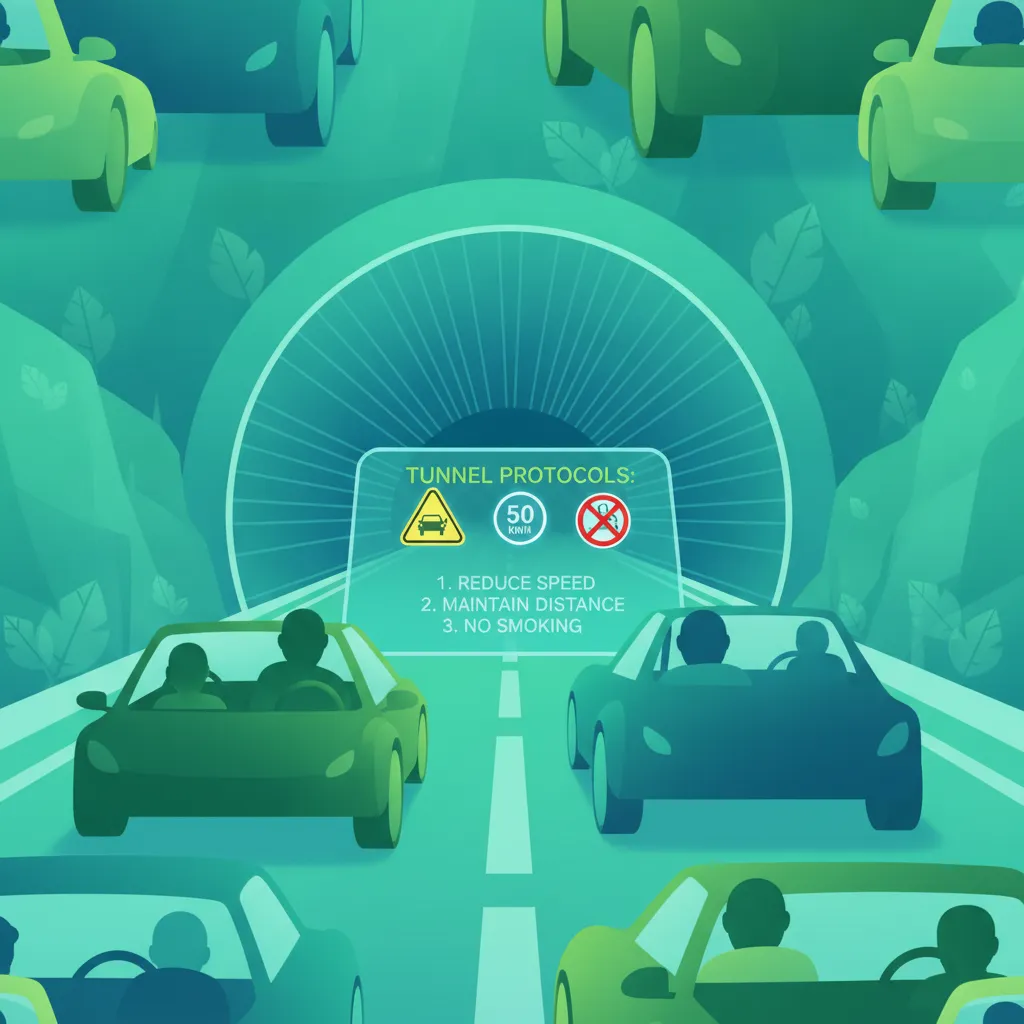
Austria's mountainous terrain means drivers will frequently encounter long tunnels. This lesson details the specific regulations, such as turning on lights and maintaining distance, as well as how to react to tunnel-specific warning signs and signals. Crucially, it covers the correct emergency procedures to follow in the event of a fire, accident, or breakdown inside a tunnel.
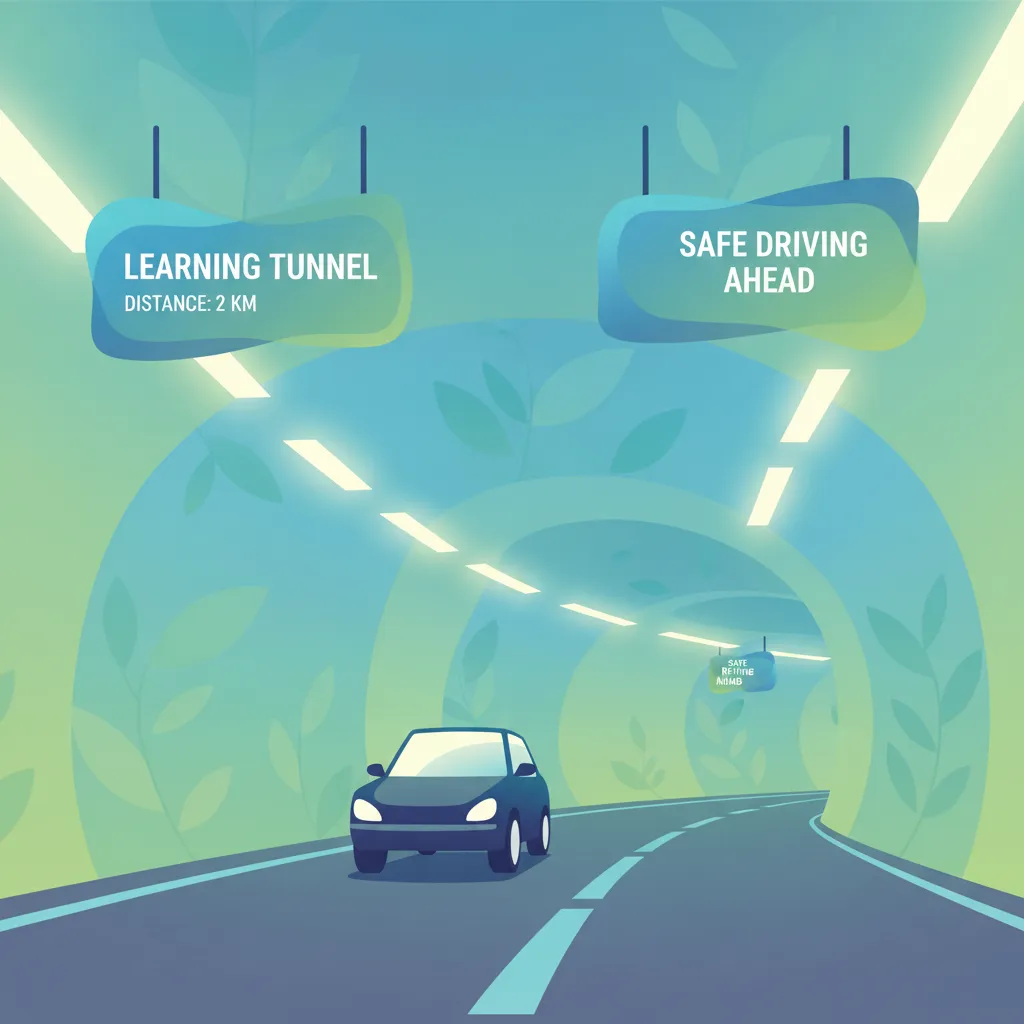
This lesson addresses the unique environment of road tunnels, common in Austria's alpine regions. Key safety practices include removing sunglasses before entry, adhering to specific tunnel speed limits, and maintaining a safe following distance. It also covers emergency procedures, such as locating emergency exits and using designated call boxes in case of a breakdown or accident.

This lesson outlines the standardized procedure for handling a vehicle breakdown safely. It covers pulling over to a safe location, activating hazard lights, deploying the warning triangle, and wearing a high-visibility vest. It also explains when and how to contact roadside assistance or emergency services.

This lesson provides a step-by-step guide for safely managing a vehicle breakdown on the road. It covers the correct procedure for pulling over to a safe location, activating hazard lights, and wearing a high-visibility vest. Learners will understand the legal requirement and correct placement of the warning triangle to alert oncoming traffic, as well as the necessary information to provide when contacting roadside assistance services.

This lesson prepares drivers for the demanding conditions of Alpine driving. It covers techniques for managing speed on steep up-hill and down-hill sections, being prepared for sudden weather changes, and following safety protocols inside mountain tunnels. This specialized knowledge is essential for operating safely in mountainous terrain.
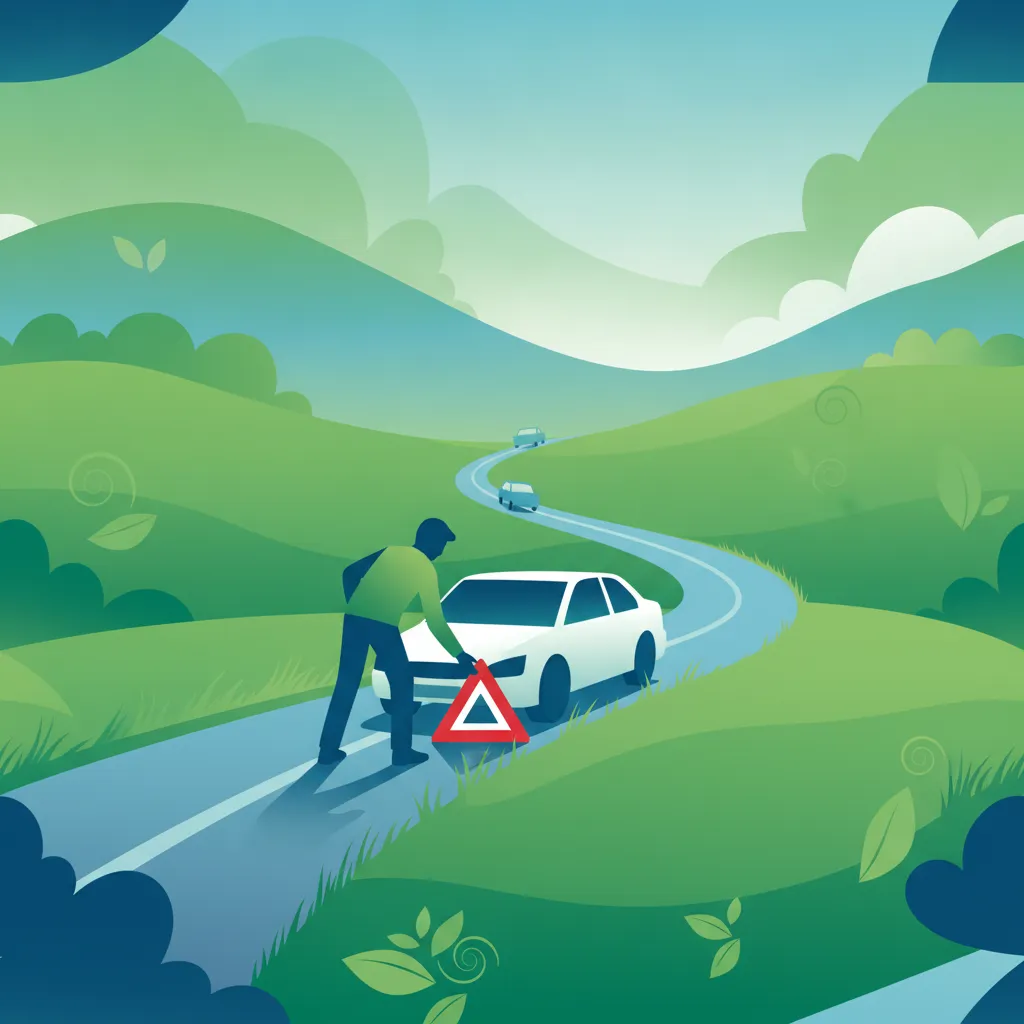
A breakdown requires a calm, systematic response to keep everyone safe. This lesson details the procedure: move to the safest possible location, activate hazard lights, secure the vehicle, and deploy warning triangles. It emphasizes the importance of moving passengers to a safe place away from the vehicle, especially on a motorway, before contacting your company or the breakdown services.
This final lesson summarizes the core principles of responding to any on-road emergency, from a breakdown to an accident. It reinforces the priorities of personal safety, securing the scene to protect others, and providing clear, concise information when calling the pan-European emergency number, 112. This knowledge is essential for managing any unforeseen incident effectively.
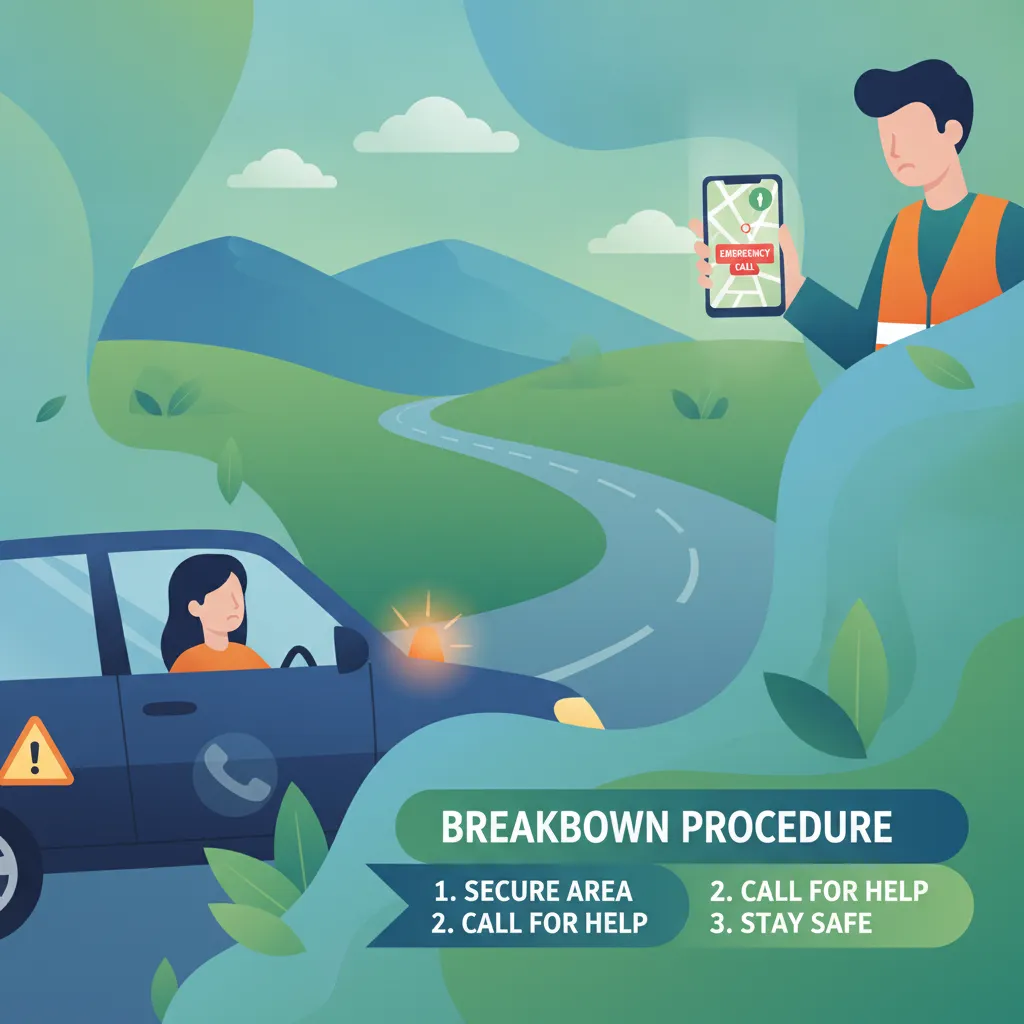
This lesson outlines the step-by-step safety protocol for a vehicle breakdown. It instructs the rider to move the motorcycle to the safest possible location, activate hazard lights, and put on a high-visibility vest. The proper placement of a warning triangle and the procedure for making an emergency call to 112 or a roadside assistance service are also detailed.
This lesson equips drivers with the essential knowledge for responding to a traffic accident. It outlines the critical first steps: securing the scene to prevent further incidents, assessing the situation, and contacting the correct emergency services (112). The content provides an overview of basic first aid principles applicable at an accident scene and explains the driver's legal obligations regarding incident reporting and cooperation with authorities.
This lesson explains the correct protocol when encountering emergency vehicles with active sirens and lights. It details the legal requirement to yield the right-of-way and provides practical guidance on how to pull over safely and efficiently. Understanding these procedures helps ensure emergency services can reach their destination without delay.
Understand the specific regulations for driving in Austrian tunnels, including mandatory headlight use, speed limits, safe following distances, and lane discipline. Essential knowledge for safe tunnel navigation and passing the theory exam.
Austria's mountainous terrain means drivers will frequently encounter long tunnels. This lesson details the specific regulations, such as turning on lights and maintaining distance, as well as how to react to tunnel-specific warning signs and signals. Crucially, it covers the correct emergency procedures to follow in the event of a fire, accident, or breakdown inside a tunnel.
This lesson addresses the unique environment of road tunnels, common in Austria's alpine regions. Key safety practices include removing sunglasses before entry, adhering to specific tunnel speed limits, and maintaining a safe following distance. It also covers emergency procedures, such as locating emergency exits and using designated call boxes in case of a breakdown or accident.

This lesson covers the proper and legal use of a vehicle's entire lighting system to see and be seen. It explains the regulations for using headlights, including daytime running lights, and the specific conditions under which fog lights and high beams are permitted. Correct use of turn signals and brake lights is also emphasized as essential for communicating intentions to other drivers and ensuring safety in all visibility conditions.
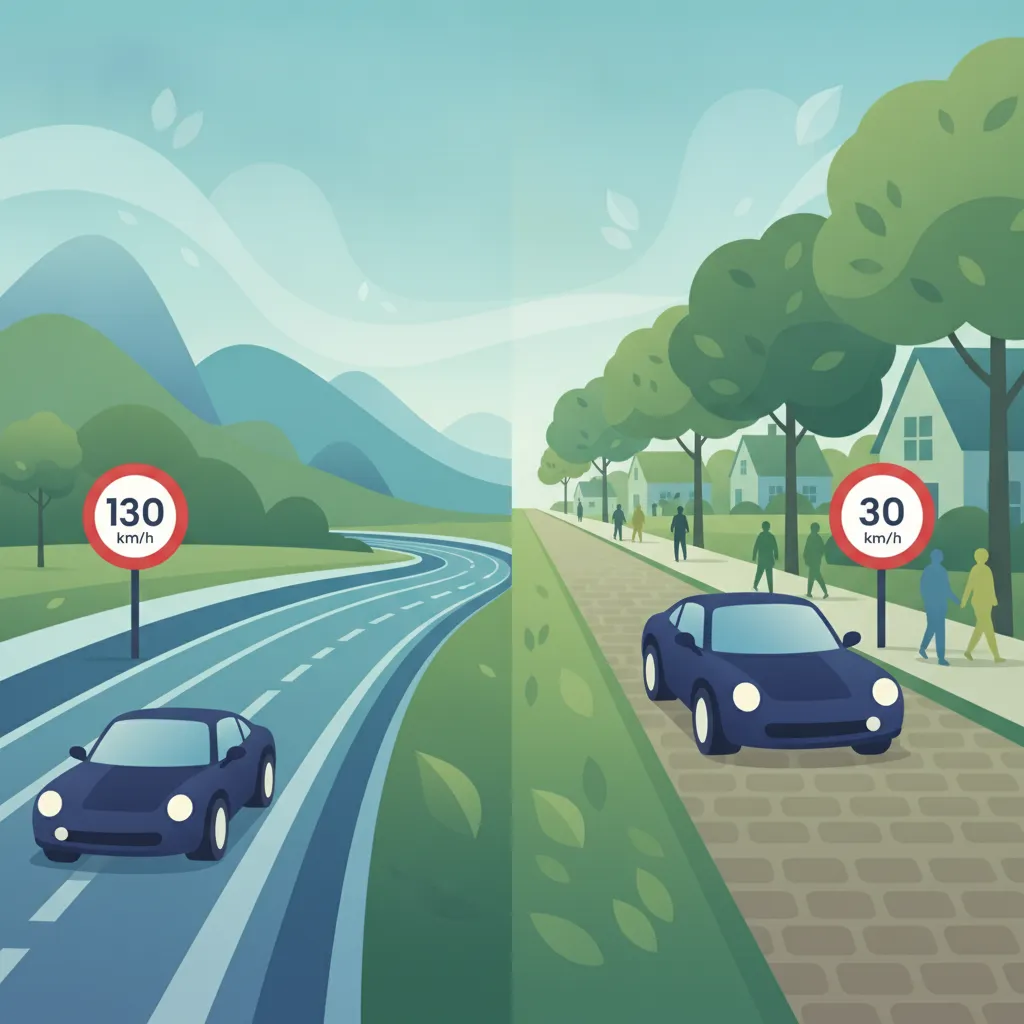
This lesson details the legally prescribed speed limits across Austria's road network, including the specific limits for urban areas (Ortsgebiet), rural roads (Landstraßen), motorways (Autobahnen), and expressways (Schnellstraßen). Learners will understand how to interpret speed limit signs, including those with supplementary conditions. Adherence to these legal requirements is a fundamental aspect of road safety and compliance with the Austrian road traffic act (StVO).

This lesson addresses the critical skill of adapting driving behavior to conditions of reduced visibility, such as fog, heavy rain, snow, or darkness. It explains the principle of driving only as fast as you can see, ensuring your stopping distance is within your visibility range. The content covers the correct use of headlights and fog lights and emphasizes why speed reduction is essential for maintaining safety when your ability to perceive hazards is compromised.

This lesson details the general traffic rules applicable to heavy goods vehicles on Austrian roads, highlighting differences from passenger car regulations. It covers key topics such as right-of-way at intersections, specific rules for overtaking, maintaining proper lane discipline, and adhering to designated speed limits. Understanding these rules is critical for safe integration into mixed traffic.
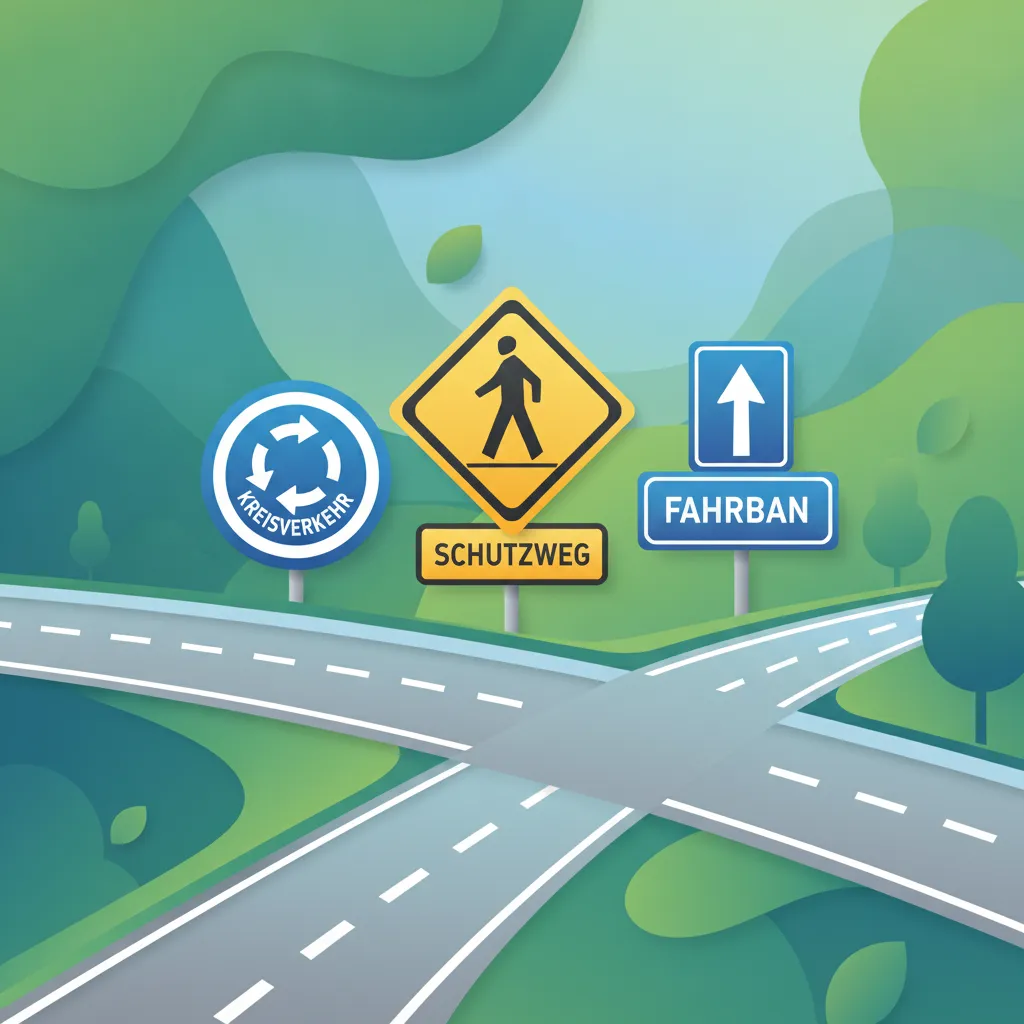
This lesson covers the specific regulations associated with special Austrian road signs and areas. It details the rules for 'Schutzweg' (protected pedestrian crossings), 'Kreisverkehr' (roundabouts), and the distinction between 'Fahrbahn' (road) and 'Fahrstreifen' (lane). Understanding these specific contexts is essential for safe navigation in urban and suburban environments.
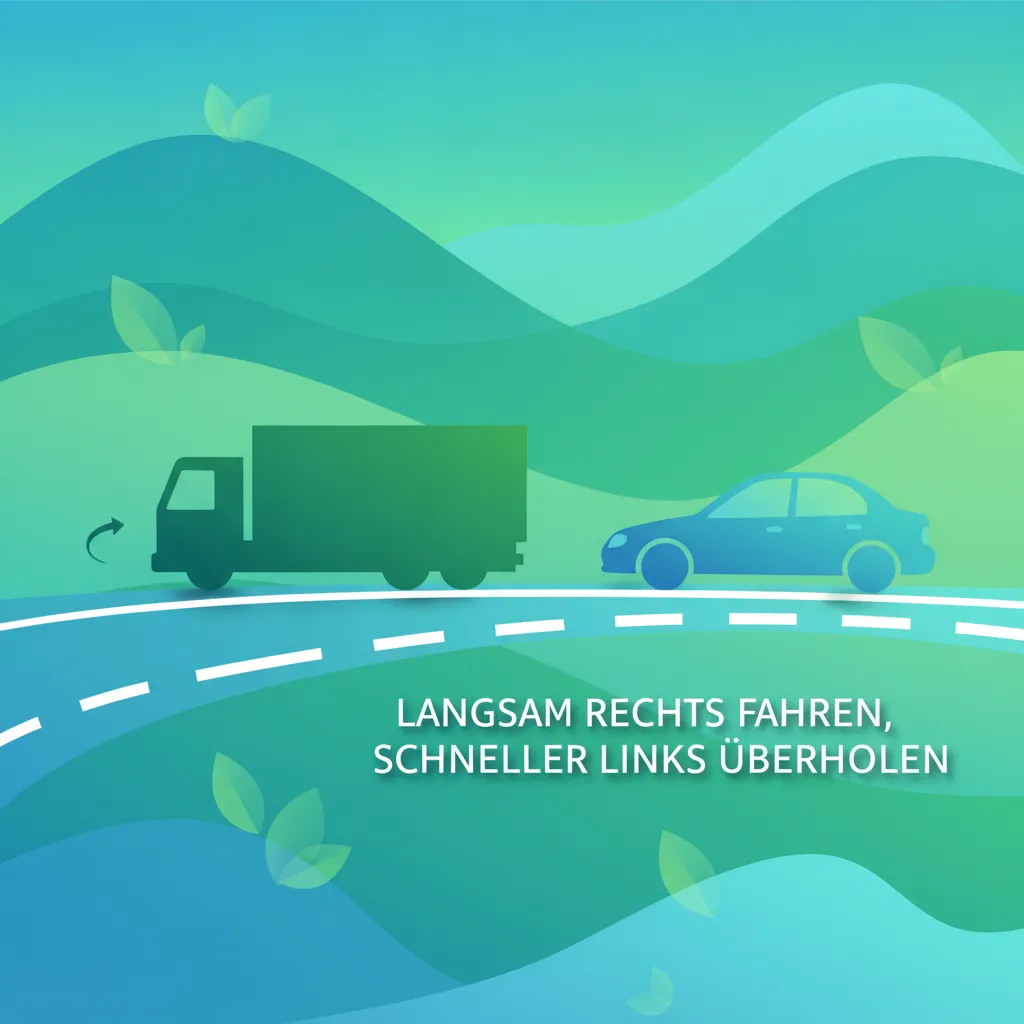
High-speed driving in a large vehicle requires excellent lane discipline and forward planning. This lesson covers Austrian speed limits for buses, rules for joining and leaving the motorway, safe overtaking procedures, and maintaining appropriate following distances. The critical importance of forming an emergency corridor ('Rettungsgasse') in traffic jams is also a key topic.
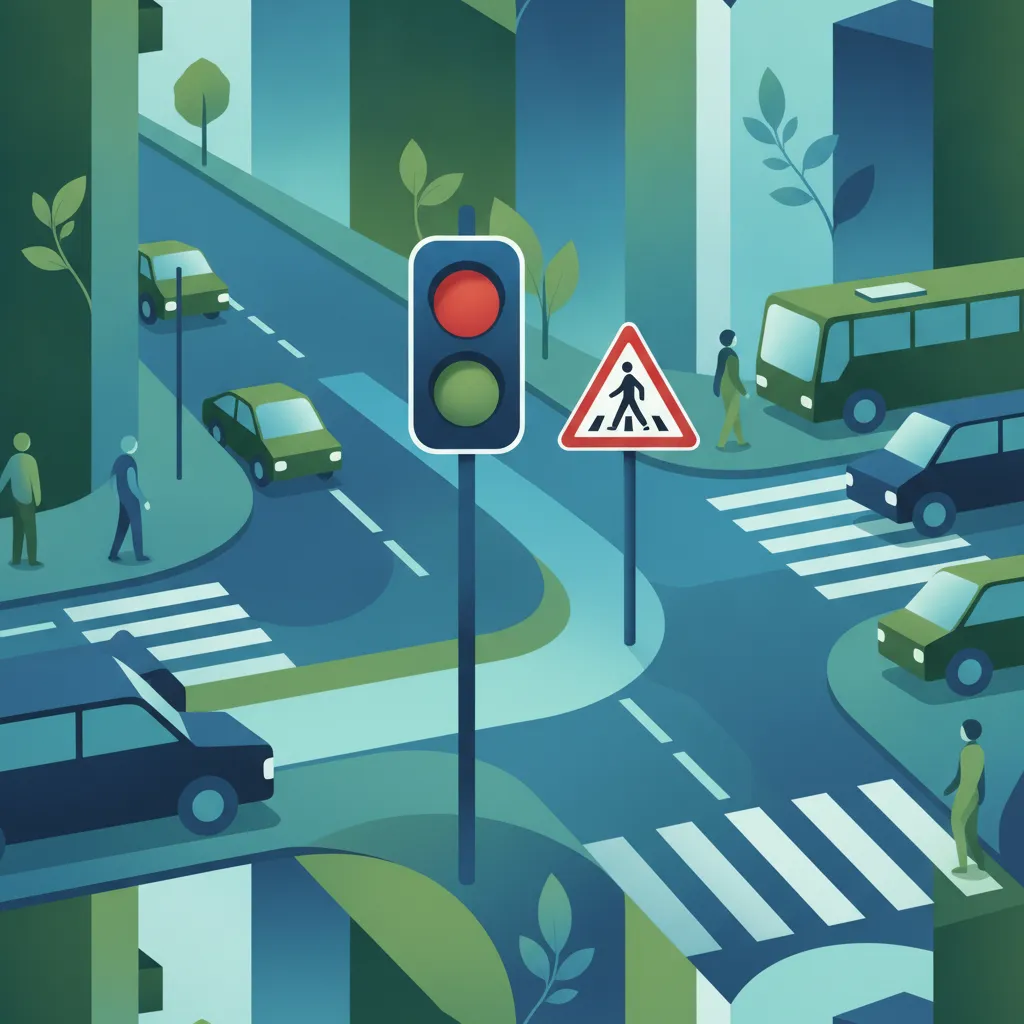
This lesson explains the operation and meaning of traffic light signals in Austria, including the standard red, yellow, and green phases, as well as flashing signals and arrows. It also covers other priority control devices, such as stop signs and yield signs, which are used to manage right-of-way at intersections. Understanding the hierarchy between these signals and signs is crucial for navigating junctions safely and in compliance with the law.
This lesson details the various types of road markings and their significance for guiding traffic and ensuring safety. Learners will understand the rules associated with solid versus broken lane lines, the instructions provided by directional arrows painted on the road, and the purpose of stop lines and pedestrian crossing markings. The content emphasizes how these markings work in conjunction with signs to regulate traffic flow and define legal lane usage.
Find clear answers to common questions learners have about Tunnel Driving Rules and Emergency Procedures. Learn how the lesson is structured, which driving theory objectives it supports, and how it fits into the overall learning path of units and curriculum progression in Austria. These explanations help you understand key concepts, lesson flow, and exam focused study goals.
Yes, in Austria, you are required to use dipped headlights when entering a tunnel, regardless of the time of day or lighting conditions, to ensure you are visible to other road users.
Switch on your hazard lights, turn off the engine, and exit the vehicle if it is safe to do so. Move towards the nearest emergency exit or stay inside the car if the traffic flow prevents safe movement, but always follow local signage and tunnel radio instructions.
You must maintain a greater distance than on an open road, typically adhering to the two-second rule or following specific tunnel signage instructions, to provide enough space to react to sudden braking or obstructions.
Yes, speed limits in tunnels are often lower than on the surrounding highway and are clearly indicated by variable speed limit signs; these must be strictly followed for safety.
Refine your study plan by searching for specific Austrian driving theory practice sets. Pinpoint questions related to particular road rules, signs, or challenge levels, and begin practicing immediately to reinforce your knowledge and excel in your official exam with confidence. Get started with focused revision today.