
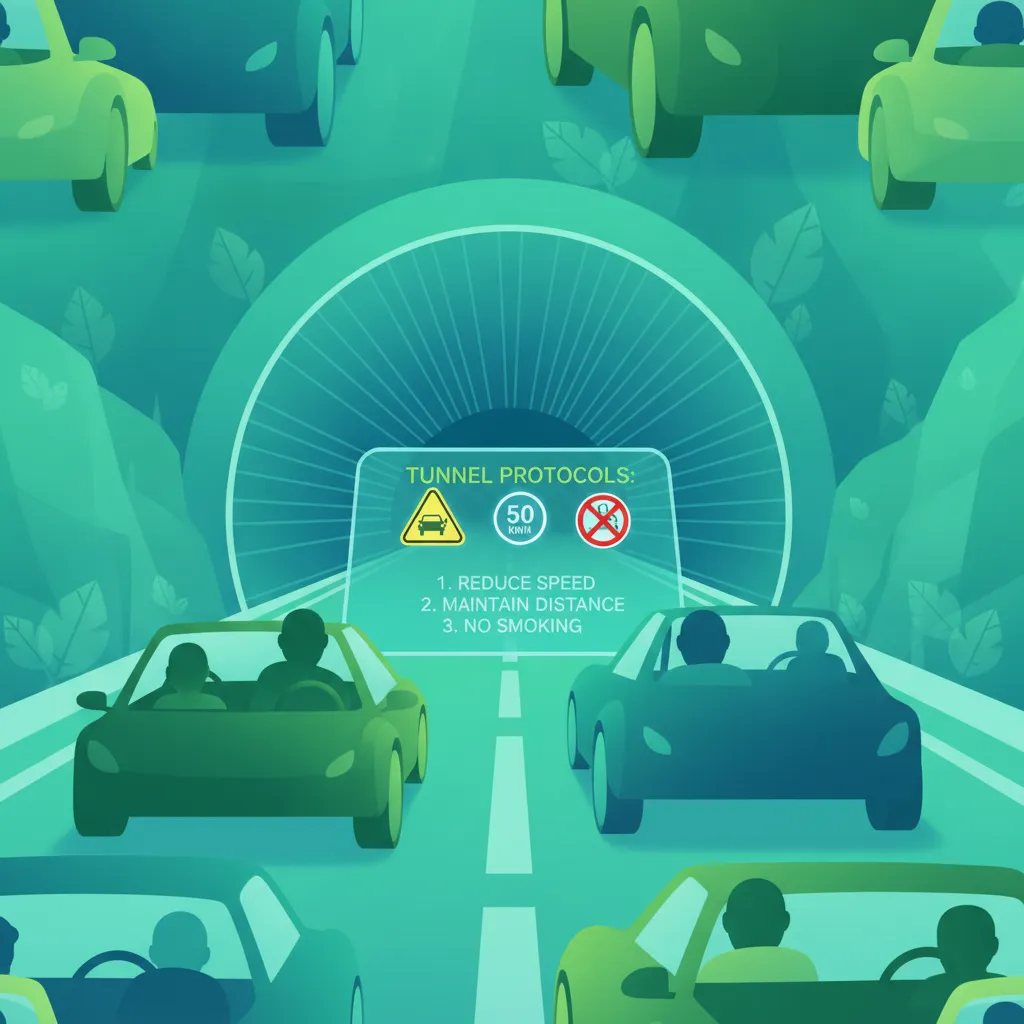
This lesson details the critical safety regulations and emergency procedures for navigating tunnels while operating a bus or coach in Austria. You will learn how to properly manage your vehicle's lighting, maintain safe distances, and react effectively to tunnel-specific warning signs. These skills are vital for ensuring passenger safety and passing the professional Category D theory examination.
Lesson content overview
Austria's stunning alpine landscapes are traversed by an extensive network of tunnels, making encounters with these confined road sections a regular part of driving, especially for bus and coach operators. For professional drivers holding an Austrian Driving Theory Course for Bus & Coach Licence (Category D), understanding and strictly adhering to specific tunnel regulations and safety procedures is paramount. This lesson provides a detailed guide to ensure the safety of passengers and the efficient operation of your vehicle through Austrian tunnels, covering everything from mandatory lighting and speed limits to comprehensive emergency response protocols.
Driving a bus or coach through an Austrian tunnel demands heightened attention and strict adherence to specific traffic laws, primarily outlined in the Strassenverkehrsordnung (StVO), especially Section 67 concerning tunnel traffic. These rules are designed to mitigate risks associated with reduced visibility, limited escape routes, and the potential for rapid fire spread in a confined environment.
Before entering any tunnel in Austria, it is a legal requirement to activate your non-dipper headlights (low beam). This ensures optimal visibility for your vehicle and helps you to see other road users, while also making your bus or coach clearly visible to oncoming traffic and vehicles behind you, compensating for the natural reduction in light inside the tunnel.
Automatic lighting systems may not always activate in tunnels if ambient light outside is still bright. Always manually switch on your low beam headlights before entering a tunnel.
High beam headlights are strictly prohibited within tunnels due to the risk of dazzling other drivers, which can lead to dangerous situations in the enclosed space. Interior lighting within the passenger compartment should generally remain off unless specifically indicated by signage for very long tunnels or during emergency evacuations to aid passenger movement. Always perform a pre-trip check to ensure all vehicle lighting systems, including hazard warning lights, are fully functional.
Also known as low beam headlights, these lights provide adequate illumination for driving in reduced visibility conditions without dazzling other road users. They are mandatory in all Austrian tunnels.
Tunnels often have specific speed limits that may differ from the general road speed limits outside. These are clearly indicated by road signs at the tunnel entrance and throughout its length. Drivers must observe these posted maximum speed limits diligently. For many tunnels, particularly on motorways (Autobahnen) or Schnellstraßen, the maximum speed might be 80 km/h or 100 km/h.
In addition to maximum limits, some Austrian tunnels also impose a minimum speed limit, commonly 40 km/h. This rule is crucial for maintaining smooth traffic flow and preventing congestion, which can be particularly hazardous in a confined tunnel environment. Driving significantly below the minimum speed can be as dangerous as speeding, as it can cause unexpected braking or unsafe overtaking maneuvers by other drivers.
Drivers of buses and coaches must continuously monitor their speed and adjust it according to signage and traffic conditions, considering the vehicle's load and prevailing weather.
Maintaining a safe following distance is one of the most critical safety measures, especially inside tunnels and for heavy vehicles like buses and coaches. The general recommendation is to maintain at least a two-second gap to the vehicle in front. This distance should be significantly increased when driving a heavily loaded bus or coach, as heavier vehicles require much longer braking distances.
The confined nature of tunnels, coupled with potentially limited visibility and the absence of clear visual reference points, necessitates this extra caution. An adequate following distance provides the crucial reaction time needed to respond safely to sudden stops, accidents, or other unforeseen incidents ahead, thereby preventing rear-end collisions.
Strict lane discipline is essential in tunnels. Drivers should stay in their designated lane and avoid unnecessary lane changes. Overtaking is generally prohibited in most Austrian tunnels unless specific signage explicitly permits it, usually indicated by clear lane markings or signs allowing lane changes for overtaking. Solid white lines in tunnels typically signify no overtaking zones.
For bus and coach drivers, it is imperative to adhere to these restrictions to minimize conflict points and reduce the risk of accidents within the narrow tunnel geometry. Moving into a lane designated for slower traffic is usually acceptable if not explicitly forbidden and safe to do so. Always ensure your passengers are seated and stable before any lane change, even if permitted.
Austrian tunnels are equipped with specific signage and signal systems designed to guide drivers and alert them to potential hazards or emergencies. Understanding these quickly is vital for safe passage.
Key signs to recognize include:
Bus drivers must be trained to interpret and react appropriately to these signs and signals, which provide critical information for both regular driving and emergency situations.
Despite all precautions, emergencies can occur. As a Category D driver, your primary responsibility is the safety of your passengers. Knowing and practicing the correct emergency procedures for fire, accidents, or breakdowns inside a tunnel is crucial.
In the event of an emergency such as a fire, accident, or breakdown within an Austrian tunnel, a structured protocol must be followed to minimize risks and ensure passenger safety.
Stop Safely: If possible, drive to the nearest emergency lay-by or designated stopping area. If not, pull over to the far right side of the road, as close to the tunnel wall as possible, without obstructing traffic more than necessary.
Activate Hazard Warning Lights: Immediately switch on your hazard warning lights to alert following traffic to your stationary vehicle. This is mandatory for any unexpected stop in a tunnel.
Turn Off Engine and Remove Key: Cut the engine and remove the ignition key to prevent accidental restarting and to reduce fire risk.
Inform Passengers: Use your public address (PA) system to inform passengers calmly about the situation and the immediate next steps. Instruct them to remain seated initially, unless evacuation is ordered.
Assess and Report: If it's safe to do so, quickly assess the situation (e.g., extent of fire, injuries, blockage). Use an emergency telephone (often marked with an "SOS" sign) located in emergency niches along the tunnel wall to contact tunnel control or emergency services. Provide clear and concise information about your location (tunnel name, kilometer marker), the nature of the emergency, and the type of vehicle.
Consider Evacuation: Only begin evacuation if there is an immediate threat (e.g., fire in your vehicle, thick smoke, or a clear instruction from tunnel control/emergency services).
As a bus or coach driver, you are in charge of many lives. Clear, calm, and authoritative communication is vital during a tunnel emergency. Before entering a long tunnel, it is good practice to remind passengers of safety protocols, such as remaining seated and keeping seat belts fastened where applicable.
During an emergency, use your PA system to:
Your composure directly influences passenger behavior, helping to prevent panic and ensure an orderly response.
Buses and coaches operating in Austria are legally required to carry specific fire extinguishing equipment. During your pre-trip inspection, you must verify the presence and functionality of these extinguishers.
Typically, passenger vehicles are equipped with dry powder or CO₂ extinguishers.
Know the location of your extinguisher (often near the driver's seat or in accessible compartments) and how to use it. Remember the PASS method:
Only attempt to extinguish small fires that pose no immediate threat to your safety or that of your passengers. In case of a large or rapidly spreading fire, prioritize evacuation.
If evacuation becomes necessary due to fire, heavy smoke, or direct instruction from tunnel authorities, guide your passengers quickly and safely.
Order Evacuation: Announce "Evacuate the vehicle!" and direct passengers to the nearest emergency exits, following the illuminated emergency exit signs.
Guide Passengers: Assist passengers, especially those with reduced mobility, to the exits. Direct them away from the vehicle and towards the designated safe areas or cross-passages.
Leave Belongings: Instruct passengers to leave all personal belongings behind to speed up the evacuation process.
Secure Vehicle: Before exiting yourself, ensure the bus is secured (engine off, parking brake engaged).
Proceed to Safety: Lead passengers towards the emergency exit routes, emphasizing to stay calm and follow the signs. Never attempt to re-enter the tunnel or vehicle once evacuated.
Always follow the instructions provided by tunnel staff, police, or firefighters, who are trained to manage these complex situations.
The unique environment of tunnels presents several specific challenges that require careful consideration from professional drivers.
While tunnels are enclosed, external weather conditions can still influence the internal driving environment, particularly near entrances and exits, or if water penetrates the tunnel structure.
Before embarking on any journey that includes tunnels, a thorough pre-trip inspection of your bus or coach is mandatory. This check must specifically include components critical for tunnel safety:
These checks are not just regulatory requirements but vital steps in proactive safety management.
The general framework for road traffic in Austria is the Strassenverkehrsordnung (StVO). Specific to tunnels, StVO Section 67 outlines detailed provisions. Compliance with these laws is non-negotiable and failure to adhere can result in severe penalties, especially for professional drivers of Category D vehicles.
Key legal aspects include:
Staying updated with the latest amendments to the StVO and any specific regulations issued by tunnel operating authorities is part of a professional driver's duty.
Understanding common mistakes can help prevent them:
The strict regulations for tunnel driving are not arbitrary; they are rooted in sound safety principles and physics:
By understanding these underlying reasons, bus and coach drivers can appreciate the importance of every rule and apply them conscientiously, ensuring the highest level of safety for all occupants and road users.
This lesson covers the essential Austrian tunnel regulations for Category D bus and coach drivers, focusing on mandatory safety measures including low beam headlight activation, adherence to posted speed limits (both maximum and minimum), and maintaining extended following distances for heavy vehicles. The emergency procedures section provides a structured protocol for responding to fires, accidents, or breakdowns inside tunnels, emphasizing safe stopping practices, hazard light activation, passenger communication via PA system, and appropriate use of emergency telephones and fire extinguishers. Key tunnel signage such as tunnel start signs (A18), emergency exit indicators (H16), and variable message signs are identified for proper recognition. Understanding StVO Section 67 and related Austrian traffic law provisions ensures compliance and helps drivers pass their theory examination while protecting passenger safety.
A short set of high-value points that capture the most important learning from this lesson.
Low beam headlights (non-dipper) are mandatory before entering any Austrian tunnel; automatic systems may fail, so manual activation is required.
Speed limits in Austrian tunnels typically range from 80-100 km/h maximum, but minimum speeds of 40 km/h may apply to prevent dangerous congestion.
Heavy vehicles like buses require significantly extended following distances beyond the standard two-second rule due to longer braking distances.
In tunnel emergencies, the priority sequence is: stop safely, activate hazard lights, turn off engine, inform passengers via PA system, then assess and report via emergency telephone.
Evacuation should only begin when there is immediate threat (fire, smoke, or instruction from tunnel control), and passengers must leave belongings behind.
Explore all units and lessons included in this driving theory course.
Solid white lines in tunnels indicate overtaking is prohibited unless signage explicitly permits lane changes.
Fire extinguisher PASS technique: Pull the pin, Aim at the base of the fire, Squeeze the handle, Sweep side to side.
When reporting a tunnel emergency, provide tunnel name and kilometer marker location to tunnel control.
Wet tunnel surfaces increase stopping distances by 10-20%; reduce speed and increase following distance accordingly.
Interior passenger lighting should remain off in tunnels unless evacuation signage specifically indicates otherwise.
Failing to manually switch on low beam headlights before tunnel entry, relying on automatic lighting systems that may not activate.
Exceeding posted tunnel speed limits, which is especially dangerous in confined spaces with limited reaction room.
Driving below minimum speed limits, causing unexpected braking from following traffic and potential congestion.
Not activating hazard warning lights immediately during a breakdown, leaving approaching traffic without adequate warning.
Panic-driven evacuation without proper instruction, leading to passenger confusion and potential injuries in the tunnel environment.
Lesson content overview
A short set of high-value points that capture the most important learning from this lesson.
Low beam headlights (non-dipper) are mandatory before entering any Austrian tunnel; automatic systems may fail, so manual activation is required.
Speed limits in Austrian tunnels typically range from 80-100 km/h maximum, but minimum speeds of 40 km/h may apply to prevent dangerous congestion.
Heavy vehicles like buses require significantly extended following distances beyond the standard two-second rule due to longer braking distances.
In tunnel emergencies, the priority sequence is: stop safely, activate hazard lights, turn off engine, inform passengers via PA system, then assess and report via emergency telephone.
Evacuation should only begin when there is immediate threat (fire, smoke, or instruction from tunnel control), and passengers must leave belongings behind.
Explore all units and lessons included in this driving theory course.
Solid white lines in tunnels indicate overtaking is prohibited unless signage explicitly permits lane changes.
Fire extinguisher PASS technique: Pull the pin, Aim at the base of the fire, Squeeze the handle, Sweep side to side.
When reporting a tunnel emergency, provide tunnel name and kilometer marker location to tunnel control.
Wet tunnel surfaces increase stopping distances by 10-20%; reduce speed and increase following distance accordingly.
Interior passenger lighting should remain off in tunnels unless evacuation signage specifically indicates otherwise.
Failing to manually switch on low beam headlights before tunnel entry, relying on automatic lighting systems that may not activate.
Exceeding posted tunnel speed limits, which is especially dangerous in confined spaces with limited reaction room.
Driving below minimum speed limits, causing unexpected braking from following traffic and potential congestion.
Not activating hazard warning lights immediately during a breakdown, leaving approaching traffic without adequate warning.
Panic-driven evacuation without proper instruction, leading to passenger confusion and potential injuries in the tunnel environment.
Explore search topics learners often look for when studying Austrian Tunnel Regulations and Safety Procedures. These topics reflect common questions about road rules, driving situations, safety guidance, and lesson level theory preparation for learners in Austria.
Browse additional driving theory lessons that cover connected traffic rules, road signs, and common driving situations related to this topic. Improve your understanding of how different rules interact across everyday traffic scenarios.
Explore critical, in-depth procedures for handling major incidents like fires and breakdowns within Austrian tunnels. This lesson focuses on advanced passenger management, evacuation strategies, and effective use of onboard safety equipment for professional drivers.
This lesson covers the specific regulations for driving through Austria's numerous tunnels. It highlights mandatory rules such as turning on headlights, adhering to posted speed limits, and maintaining a safe following distance. Crucially, the content details the correct emergency procedures to follow in the event of a traffic jam, breakdown, or fire inside a tunnel, including how to use emergency exits and communication devices.

Rural Austrian roads present unique challenges, including lack of markings, tight spaces, and slow-moving agricultural vehicles. This lesson teaches how to read the road ahead, anticipate hazards around blind bends, and use passing places effectively when meeting other large vehicles. It emphasizes adjusting speed to suit the limited visibility and variable road conditions.
High-speed driving in a large vehicle requires excellent lane discipline and forward planning. This lesson covers Austrian speed limits for buses, rules for joining and leaving the motorway, safe overtaking procedures, and maintaining appropriate following distances. The critical importance of forming an emergency corridor ('Rettungsgasse') in traffic jams is also a key topic.
Bus stations and depots are complex, hazardous environments. This lesson covers the unique challenges, such as navigating tight spaces with other buses moving, adhering to site-specific speed limits and traffic flow systems, and being highly aware of staff and passengers walking in operational areas. Safe positioning in designated bays is a key focus.
This lesson addresses the unique environment of road tunnels, common in Austria's alpine regions. Key safety practices include removing sunglasses before entry, adhering to specific tunnel speed limits, and maintaining a safe following distance. It also covers emergency procedures, such as locating emergency exits and using designated call boxes in case of a breakdown or accident.
In an emergency, knowing the location and status of safety equipment is critical. This lesson details how to locate and inspect fire extinguishers, first aid kits, emergency hammers, and all designated emergency exits, including doors and roof hatches. It emphasizes the importance of ensuring these items are unobstructed and included in the daily pre-trip inspection.
A breakdown requires a calm, systematic response to keep everyone safe. This lesson details the procedure: move to the safest possible location, activate hazard lights, secure the vehicle, and deploy warning triangles. It emphasizes the importance of moving passengers to a safe place away from the vehicle, especially on a motorway, before contacting your company or the breakdown services.

In a serious incident, a swift and orderly evacuation can save lives. This lesson teaches the principles of taking command, giving clear and simple instructions, and directing passengers to the nearest safe exit. It covers the importance of assisting those with mobility issues and guiding everyone to a safe assembly point away from the vehicle and any traffic.

Driving a bus in a busy city like Vienna or Salzburg requires constant forward planning and anticipation. This lesson teaches techniques for maintaining adequate space around the vehicle, positioning correctly for upcoming junctions, and reading the flow of traffic. Adopting a defensive mindset is key to navigating complex urban environments without incident.

Providing safe and respectful access for all passengers is a legal and professional duty. This lesson details the correct operation of accessibility features like ramps, lifts, and kneeling systems. It covers how to secure wheelchairs and mobility aids, and how to communicate effectively and respectfully with passengers who may require assistance with boarding or alighting.
Understand the nuanced rules for driving buses and coaches in Austrian tunnels, focusing on speed limits, lane discipline, signage interpretation, and the rationale behind these specific regulations for professional drivers.
High-speed driving in a large vehicle requires excellent lane discipline and forward planning. This lesson covers Austrian speed limits for buses, rules for joining and leaving the motorway, safe overtaking procedures, and maintaining appropriate following distances. The critical importance of forming an emergency corridor ('Rettungsgasse') in traffic jams is also a key topic.
Bus lanes are a key tool for public transport efficiency, but they have specific rules. This lesson explains how to identify Austrian bus lanes through road markings and signs, including their hours of operation. It clarifies the regulations for entering or leaving a lane to make turns and identifies other authorized users, such as taxis or cyclists, where permitted.
This lesson covers the specific regulations for driving through Austria's numerous tunnels. It highlights mandatory rules such as turning on headlights, adhering to posted speed limits, and maintaining a safe following distance. Crucially, the content details the correct emergency procedures to follow in the event of a traffic jam, breakdown, or fire inside a tunnel, including how to use emergency exits and communication devices.

Transporting children carries the highest level of responsibility. This lesson covers the specific Austrian rules for school buses, including the use of warning signs and lights. It focuses on developing a mindset of extreme caution, anticipating that children may run into the road unexpectedly, and managing the chaotic traffic environment often found around schools during drop-off and pick-up times.
Rural Austrian roads present unique challenges, including lack of markings, tight spaces, and slow-moving agricultural vehicles. This lesson teaches how to read the road ahead, anticipate hazards around blind bends, and use passing places effectively when meeting other large vehicles. It emphasizes adjusting speed to suit the limited visibility and variable road conditions.
Driving a bus in a busy city like Vienna or Salzburg requires constant forward planning and anticipation. This lesson teaches techniques for maintaining adequate space around the vehicle, positioning correctly for upcoming junctions, and reading the flow of traffic. Adopting a defensive mindset is key to navigating complex urban environments without incident.
This lesson details the specific regulations and best practices for driving in areas with high pedestrian activity, such as bus stops and school zones. It explains the driver's obligation to stop for school buses with flashing lights and to yield to public buses pulling out from a stop. The content emphasizes the requirement to significantly reduce speed in marked school zones to ensure the safety of children.

Cities like Vienna and Graz have extensive tram networks that require special attention from bus drivers. This lesson covers the rules of priority concerning trams, the dangers of crossing tracks, and the specific hazards at shared stops where passengers cross traffic lanes. It emphasizes the need for extreme caution and clear communication with other road users in these complex environments.

This lesson details the general traffic rules applicable to heavy goods vehicles on Austrian roads, highlighting differences from passenger car regulations. It covers key topics such as right-of-way at intersections, specific rules for overtaking, maintaining proper lane discipline, and adhering to designated speed limits. Understanding these rules is critical for safe integration into mixed traffic.

This lesson addresses the unique challenges and priority rules that apply when interacting with public transport and cyclists at intersections. It clarifies the specific right-of-way regulations for trams, which often have priority over other traffic, and the procedures for navigating around bus stops. The content also covers how to safely manage crossings with dedicated bicycle lanes, ensuring the protection of all road users.
Find clear answers to common questions learners have about Austrian Tunnel Regulations and Safety Procedures. Learn how the lesson is structured, which driving theory objectives it supports, and how it fits into the overall learning path of units and curriculum progression in Austria. These explanations help you understand key concepts, lesson flow, and exam focused study goals.
You must immediately switch on your hazard warning lights, turn off the engine, and exit the vehicle through the side doors. If safe to do so, move passengers to a designated emergency exit or a safe area, keeping them away from traffic while you alert emergency services using the tunnel's SOS call points.
Yes, drivers must ensure that low-beam headlights are switched on before entering any tunnel, regardless of how well-lit it appears. This increases your vehicle's visibility to other road users and ensures you can see potential hazards immediately upon entry.
Even in a tunnel, you must maintain the emergency corridor (Rettungsgasse) if traffic comes to a standstill. On multi-lane roads, move to the far left lane or the edge of the right lane to allow emergency vehicles clear passage through the centre.
If safe, attempt to drive out of the tunnel. If you cannot reach the exit, stop at the edge of the carriageway, switch off the engine, leave the keys in the ignition, and evacuate your passengers immediately to an emergency exit, following all tunnel signage.
Refine your study plan by searching for specific Austrian driving theory practice sets. Pinpoint questions related to particular road rules, signs, or challenge levels, and begin practicing immediately to reinforce your knowledge and excel in your official exam with confidence. Get started with focused revision today.