
This lesson provides a critical guide to interacting with public transport and vulnerable road users at intersections. It builds upon your understanding of basic priority rules by focusing on the special regulations that apply when trams, buses, or cyclists are involved, ensuring you are ready for both the Austrian Category B theory exam and real-world traffic scenarios.
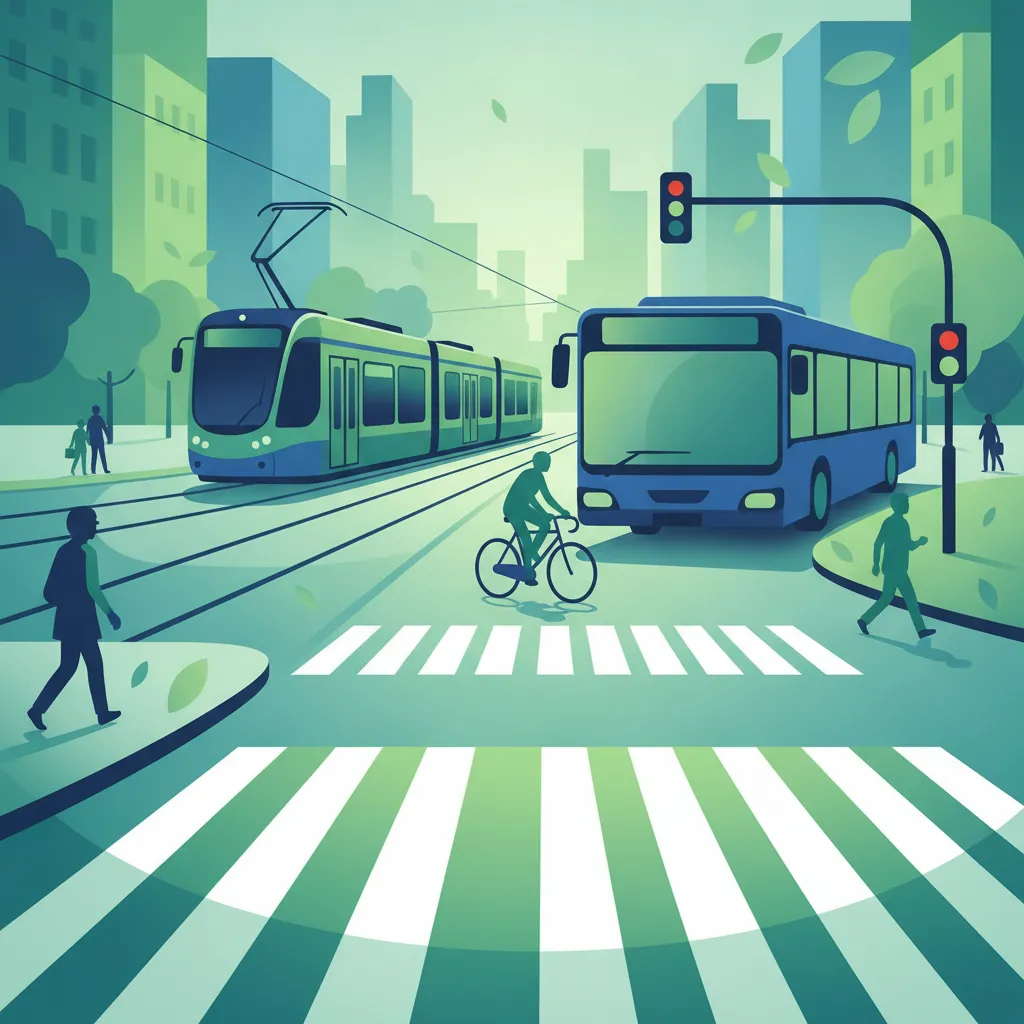
Lesson content overview
Navigating intersections in urban areas of Austria requires a thorough understanding of general priority rules, but special attention must be paid to trams, buses, and cyclists. These road users have unique legal standings and operational characteristics that necessitate specific yielding procedures from other drivers. Mastering these special situations is crucial for road safety, preventing accidents, and complying with Austrian traffic law (StVO). This lesson will delve into the specific regulations and best practices for interacting safely with public transport and vulnerable road users at intersections within the context of the Austrian Driving License B Theory Course.
Before delving into the specifics, it's vital to recall the foundational principles of priority (Vorrang) and yielding (Nachrang) at intersections. These general rules, often governed by traffic signs, signals, or the "right before left" principle, establish a basic framework for orderly traffic flow. However, certain road users are granted special status due to their size, fixed routes, or vulnerability, overriding typical priority considerations.
The right-of-way, meaning a driver has the legal entitlement to proceed before other road users at an intersection or conflict point.
The obligation to yield or give way to a road user with Vorrang, requiring a driver to stop or slow down to allow the other vehicle to proceed safely.
The primary purpose of these special priority rules for trams, buses, and cyclists is to enhance safety and ensure the efficient operation of public transport. Trams and buses, being large and carrying many passengers, cannot stop or maneuver as quickly as private vehicles. Cyclists, conversely, are vulnerable road users who require extra protection due to their limited visibility and lack of physical protection.
Trams, known as Straßenbahnen in Austria, are a fundamental part of urban public transport. They operate on fixed tracks embedded in the road surface, often sharing space with other vehicles. Their inability to steer around obstacles or stop quickly means they are granted a very high level of priority at intersections.
Tram tracks are clearly visible in the road. When approaching an intersection where your path crosses tram tracks, it is considered a Tram track crossing. These crossings can be at signalized intersections, uncontrolled intersections, or simply where a street briefly crosses the tracks. Always assume a tram may be approaching.
The core rule regarding trams is that they generally have absolute priority over motor vehicles and cyclists at intersections, unless explicitly indicated otherwise by specific traffic signs or signals. This means that even if you have a green traffic light or are on a priority road, you must still yield to an approaching tram.
The only exception to this default tram priority is the rare presence of a sign specifically indicating "Vorrang für Kraftfahrzeuge" (Priority for Motor Vehicles) at a particular tram crossing. Even in such cases, extreme caution is still paramount.
When approaching tram tracks, you must ensure that you can stop safely and completely before the tracks if a tram is approaching or if you would obstruct the tram's path. This applies even if you intend to turn. Never drive onto tram tracks if there isn't enough space to clear them fully on the other side.
You must maintain a minimum safety distance before tram tracks. Never stop on the tracks. Ensure there is at least 5 meters between your vehicle and an approaching tram or before entering the track area if stopping is required.
At some signalized intersections, trams may have their own dedicated traffic lights, often diamond-shaped with white lights. These tram signals supersede the regular traffic lights for other vehicles concerning tram movements. If a tram has a green signal, it has priority, regardless of the signal color for motor vehicles. As a driver, you must be aware of these dedicated signals and anticipate tram movements accordingly.
Buses are another integral part of Austrian public transport. While they do not have the same absolute priority as trams, specific rules apply when they are pulling out from designated bus stops.
Bus stops, or Bushaltestellen, are designated areas where buses stop to allow passengers to board and alight. These are clearly marked with signs. Some bus stops include a Bus Bay (Busspur), which is a recessed lane allowing the bus to pull out of the main flow of traffic while stopped.
In Austria, buses pulling out from a designated bus stop have priority over other approaching or merging traffic, especially when re-entering the main traffic flow. This rule ensures that buses can safely and efficiently continue their routes without being unduly delayed.
When you see a bus signaling its intention to pull out from a stop, you must slow down and be prepared to stop to allow the bus to merge safely into your lane. Anticipate this maneuver, especially in busy urban areas.
If a bus stop is on the right side of the road, vehicles in the lane to the left may proceed if their movement is not in conflict with the bus pulling out. However, if the bus needs to merge into your lane, you are obligated to yield.
Where a bus bay is provided, buses use this recessed lane to stop, allowing other traffic to flow more freely. However, the rule regarding bus pull-out priority still applies. If you are approaching a bus that is in a bus bay and signaling its departure, you must still yield. It is also important not to block a bus bay, preventing a bus from using it properly.
Cyclists are considered vulnerable road users, and their safety is a high priority in Austrian traffic law. Dedicated bicycle lanes (Radwege) are designed to provide them with a safer and more consistent path, and specific rules apply at intersections to protect them.
Dedicated bicycle lanes can take several forms:
When cyclists are traveling in dedicated bicycle lanes, they generally have priority over motor vehicles at intersections, especially when crossing the path of turning vehicles, unless signage explicitly dictates otherwise. This is particularly critical for right-turning vehicles.
The most common conflict point between motor vehicles and cyclists in dedicated lanes occurs during turns, particularly right turns.
Check Mirrors and Blind Spots: Before indicating your turn and beginning to slow down, thoroughly check your right-side mirror and perform a quick head check (shoulder check) to look for cyclists approaching in the bike lane.
Signal Early: Clearly indicate your intention to turn right with your turn signal.
Yield to Cyclists: If a cyclist is approaching in the dedicated lane and intends to proceed straight through the intersection, you must yield to them. Wait until the cyclist has passed the intersection before completing your turn.
Turn When Clear: Only proceed with your right turn when the bike lane is completely clear of cyclists, ensuring you do not cut them off or force them to brake.
For left turns across a bike lane, the principle is similar: you must ensure the lane is clear before making your turn, yielding to any cyclists proceeding straight. Cyclists may be less visible than motor vehicles, so extra vigilance is always required.
Many urban intersections present a combination of these special situations, featuring tram tracks, bus stops, and dedicated bike lanes all within the same area. In these complex scenarios, drivers must apply a clear hierarchy of priority and remain highly vigilant.
When multiple special road users are present, the following general hierarchy of priority typically applies, though specific signage or signals can alter this:
You must assess the presence and movement of each type of road user to determine the correct sequence of yielding. For example, if a tram is approaching, it takes precedence over a bus pulling out from a stop, and both would take precedence over a cyclist in a dedicated lane relative to a turning car.
At signalized intersections, dedicated signals for trams or cyclists can further complicate matters. Always observe these specific signals in addition to the general traffic lights. A tram's green signal or a cyclist's green signal indicates their priority, and other road users must yield, even if their own general traffic light is green.
Always remember that traffic signals for specific road users (like trams or cyclists) take precedence for that user type. A green light for your car does not automatically grant you priority over a tram with a conflicting green signal or an approaching cyclist with their own green signal.
Ignoring or misinterpreting priority rules for trams, buses, and cyclists is a significant cause of accidents and traffic violations in Austria. Awareness of these common mistakes can help drivers avoid them:
Driving conditions and the type of vehicle you are operating significantly influence how you should approach special situations involving trams, buses, and cyclists.
Understanding the "why" behind these rules reinforces their importance for safety:
Defensive driving means always anticipating potential hazards. When approaching intersections in Austria, especially in urban areas, actively look for tram tracks, bus stop signs, and dedicated bike lane markings. Be prepared to yield even if you think you have priority, as this extra caution can prevent accidents.
This lesson covers the special priority rules for trams, buses, and cyclists at Austrian intersections, establishing a clear hierarchy where trams hold the highest priority due to their fixed routes and inability to stop quickly, followed by buses pulling out from stops and cyclists in dedicated lanes. Drivers must always yield to trams unless explicitly signed otherwise, allow buses to merge when pulling from stops, and check blind spots when turning across bicycle lanes. The content emphasizes defensive driving principles including the importance of reaction time, stopping distances, and maintaining clear safety distances from tram tracks to prevent accidents with high-capacity public transport vehicles.
A short set of high-value points that capture the most important learning from this lesson.
Trams (Straßenbahnen) have absolute priority at intersections unless a 'Vorrang für Kraftfahrzeuge' sign explicitly states otherwise
Buses pulling out from designated bus stops have priority over other traffic and must be allowed to merge safely
Cyclists in dedicated bicycle lanes (Radwege) have priority over turning motor vehicles and must be yielded to
The priority hierarchy is: trams first, buses pulling out second, cyclists in dedicated lanes third, then other motor vehicles
Always stop before tram tracks with at least 5 meters clearance and never obstruct the tracks
Explore all units and lessons included in this driving theory course.
Never proceed over tram tracks when a tram is approaching, as trams cannot stop quickly due to their mass and fixed routes
When turning right across a bike lane, check mirrors and blind spots, signal early, yield to cyclists, and turn only when the lane is clear
Dedicated tram or cyclist signals take precedence over general traffic signals for those road users
Bus bays allow buses to stop without blocking traffic, but the pull-out priority rule still applies
At complex intersections with multiple special users, assess each type of road user and yield according to the established hierarchy
Proceeding over tram tracks while a tram is approaching, creating an extremely dangerous situation
Failing to yield to a bus that is signaling to pull out from a bus stop, disrupting public transport
Turning right without checking for cyclists in bike lanes, a frequent cause of accidents at intersections
Misinterpreting the 'Vorrang für Kraftfahrzeuge' sign as granting full priority over trams when it only applies under specific conditions
Stopping with part of the vehicle on tram tracks, even briefly, which obstructs trams and violates safety distances
Lesson content overview
A short set of high-value points that capture the most important learning from this lesson.
Trams (Straßenbahnen) have absolute priority at intersections unless a 'Vorrang für Kraftfahrzeuge' sign explicitly states otherwise
Buses pulling out from designated bus stops have priority over other traffic and must be allowed to merge safely
Cyclists in dedicated bicycle lanes (Radwege) have priority over turning motor vehicles and must be yielded to
The priority hierarchy is: trams first, buses pulling out second, cyclists in dedicated lanes third, then other motor vehicles
Always stop before tram tracks with at least 5 meters clearance and never obstruct the tracks
Explore all units and lessons included in this driving theory course.
Never proceed over tram tracks when a tram is approaching, as trams cannot stop quickly due to their mass and fixed routes
When turning right across a bike lane, check mirrors and blind spots, signal early, yield to cyclists, and turn only when the lane is clear
Dedicated tram or cyclist signals take precedence over general traffic signals for those road users
Bus bays allow buses to stop without blocking traffic, but the pull-out priority rule still applies
At complex intersections with multiple special users, assess each type of road user and yield according to the established hierarchy
Proceeding over tram tracks while a tram is approaching, creating an extremely dangerous situation
Failing to yield to a bus that is signaling to pull out from a bus stop, disrupting public transport
Turning right without checking for cyclists in bike lanes, a frequent cause of accidents at intersections
Misinterpreting the 'Vorrang für Kraftfahrzeuge' sign as granting full priority over trams when it only applies under specific conditions
Stopping with part of the vehicle on tram tracks, even briefly, which obstructs trams and violates safety distances
Explore search topics learners often look for when studying Special Situations: Trams, Buses, and Cyclists at Intersections. These topics reflect common questions about road rules, driving situations, safety guidance, and lesson level theory preparation for learners in Austria.
Browse additional driving theory lessons that cover connected traffic rules, road signs, and common driving situations related to this topic. Improve your understanding of how different rules interact across everyday traffic scenarios.
Learn the specific priority rules for trams, buses, and cyclists in Austrian urban intersections. Understand how to safely navigate complex situations involving public transport and vulnerable road users for your Category B theory.
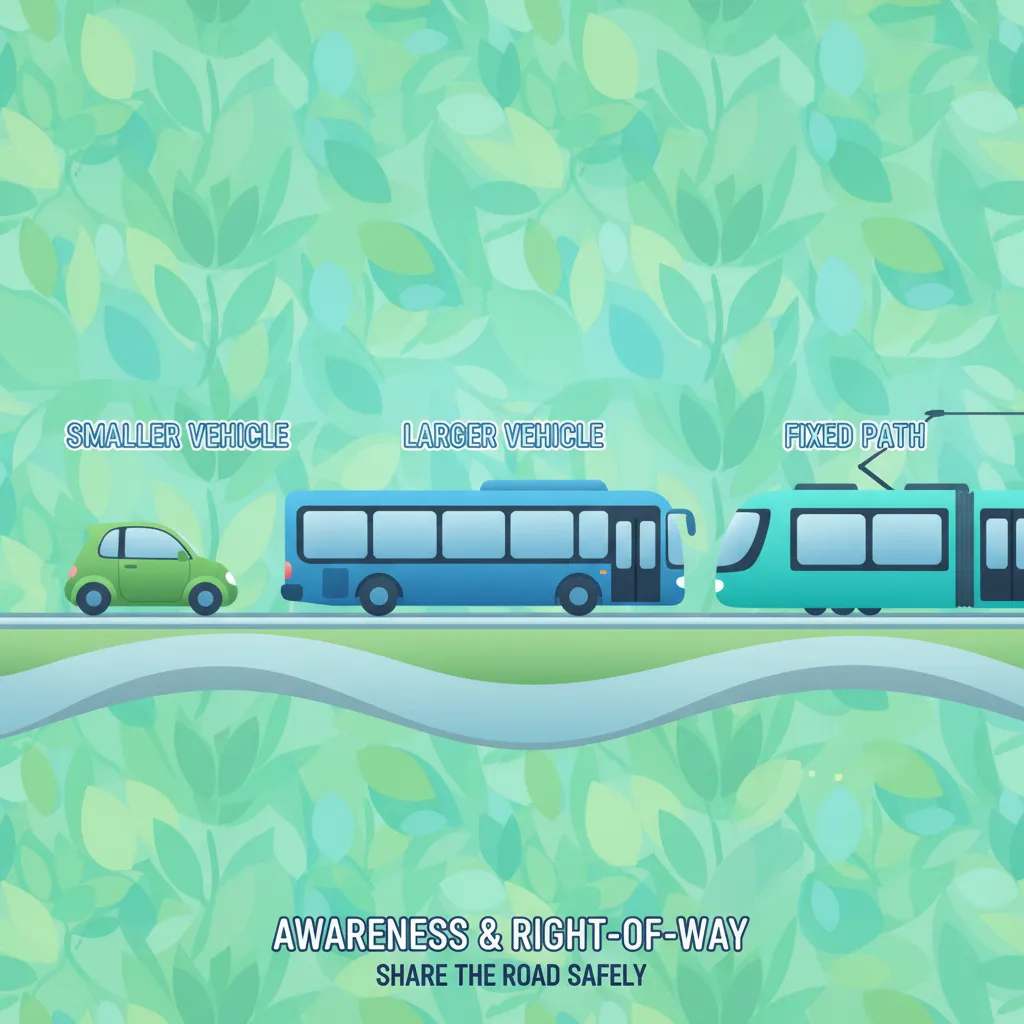
This lesson provides specific guidance for sharing the road with different types of vehicles in Austria. It covers the dangers of large vehicle blind spots, the rules for navigating near buses and dedicated tram tracks, and common conflict points at intersections. Understanding the behavior and limitations of other vehicles is key to safely navigating complex urban environments.
Cities like Vienna and Graz have extensive tram networks that require special attention from bus drivers. This lesson covers the rules of priority concerning trams, the dangers of crossing tracks, and the specific hazards at shared stops where passengers cross traffic lanes. It emphasizes the need for extreme caution and clear communication with other road users in these complex environments.
This lesson focuses on the specific regulations and safety protocols for driving near trams (Straßenbahn) in Austrian cities. It clarifies the priority rules, which almost always favor the tram, and explains how to safely share lanes or cross tram tracks. The content provides critical guidance on how to behave at tram stops, ensuring the safety of boarding and alighting passengers is always the primary concern.
This lesson addresses the specific challenges of interacting with larger vehicles like buses and trams in an urban environment. It explains how to signal intentions clearly and predictably to avoid conflicts in shared spaces. Key topics include safely crossing tram tracks and maintaining awareness around public transport stops.
This lesson focuses on the unique challenges presented by tram systems in Austrian cities. It teaches riders how to cross tracks at a safe angle to avoid tyres getting caught, especially in wet conditions, and explains the absolute priority trams have in most situations. Awareness around tram stops and bus lanes is also covered to ensure safe coexistence with public transport.
Driving a bus in a busy city like Vienna or Salzburg requires constant forward planning and anticipation. This lesson teaches techniques for maintaining adequate space around the vehicle, positioning correctly for upcoming junctions, and reading the flow of traffic. Adopting a defensive mindset is key to navigating complex urban environments without incident.
This lesson teaches drivers how to safely coexist with cyclists and pedestrians, who are prevalent in urban areas. It covers the rules for dedicated bike lanes (Radweg), the importance of yielding to pedestrians in designated zones, and the need for extra caution when turning or opening car doors. Maintaining safe overtaking distances and anticipating the movements of these vulnerable road users are key themes for preventing accidents.
This lesson details the specific regulations and best practices for driving in areas with high pedestrian activity, such as bus stops and school zones. It explains the driver's obligation to stop for school buses with flashing lights and to yield to public buses pulling out from a stop. The content emphasizes the requirement to significantly reduce speed in marked school zones to ensure the safety of children.
Many Austrian cities use special signalling to give buses and trams priority at intersections. This lesson explains how to identify and understand these signals, which often use white bars or letters instead of standard colours. Learning to anticipate these signals allows for a smoother, more efficient driving style that takes full advantage of the public transport infrastructure.
This lesson provides advanced strategies for proactively managing interactions with vulnerable road users to prevent conflicts before they arise. It teaches drivers to predict the likely behavior of pedestrians, cyclists, and e-scooter riders, especially at intersections and in congested areas. Key techniques include maintaining larger safety distances, covering the brake, and making eye contact to ensure mutual awareness and avoid accidents.
Identify and understand common errors drivers make regarding trams, buses, and cyclists at intersections in Austria. This lesson focuses on avoiding typical violations and enhancing safety in complex urban traffic scenarios.
This lesson provides specific guidance for sharing the road with different types of vehicles in Austria. It covers the dangers of large vehicle blind spots, the rules for navigating near buses and dedicated tram tracks, and common conflict points at intersections. Understanding the behavior and limitations of other vehicles is key to safely navigating complex urban environments.
This lesson addresses the specific challenges of interacting with larger vehicles like buses and trams in an urban environment. It explains how to signal intentions clearly and predictably to avoid conflicts in shared spaces. Key topics include safely crossing tram tracks and maintaining awareness around public transport stops.
Cities like Vienna and Graz have extensive tram networks that require special attention from bus drivers. This lesson covers the rules of priority concerning trams, the dangers of crossing tracks, and the specific hazards at shared stops where passengers cross traffic lanes. It emphasizes the need for extreme caution and clear communication with other road users in these complex environments.
This lesson teaches drivers how to safely coexist with cyclists and pedestrians, who are prevalent in urban areas. It covers the rules for dedicated bike lanes (Radweg), the importance of yielding to pedestrians in designated zones, and the need for extra caution when turning or opening car doors. Maintaining safe overtaking distances and anticipating the movements of these vulnerable road users are key themes for preventing accidents.
This lesson focuses on the specific regulations and safety protocols for driving near trams (Straßenbahn) in Austrian cities. It clarifies the priority rules, which almost always favor the tram, and explains how to safely share lanes or cross tram tracks. The content provides critical guidance on how to behave at tram stops, ensuring the safety of boarding and alighting passengers is always the primary concern.
This lesson focuses on the unique challenges presented by tram systems in Austrian cities. It teaches riders how to cross tracks at a safe angle to avoid tyres getting caught, especially in wet conditions, and explains the absolute priority trams have in most situations. Awareness around tram stops and bus lanes is also covered to ensure safe coexistence with public transport.
This lesson addresses the specific hazard of tram tracks in urban areas, which can be slippery and cause a loss of balance. It teaches the correct angle at which to cross tracks and the importance of being aware of tram signals and movements. The content also provides guidance for safely sharing road space near tram and bus stops.
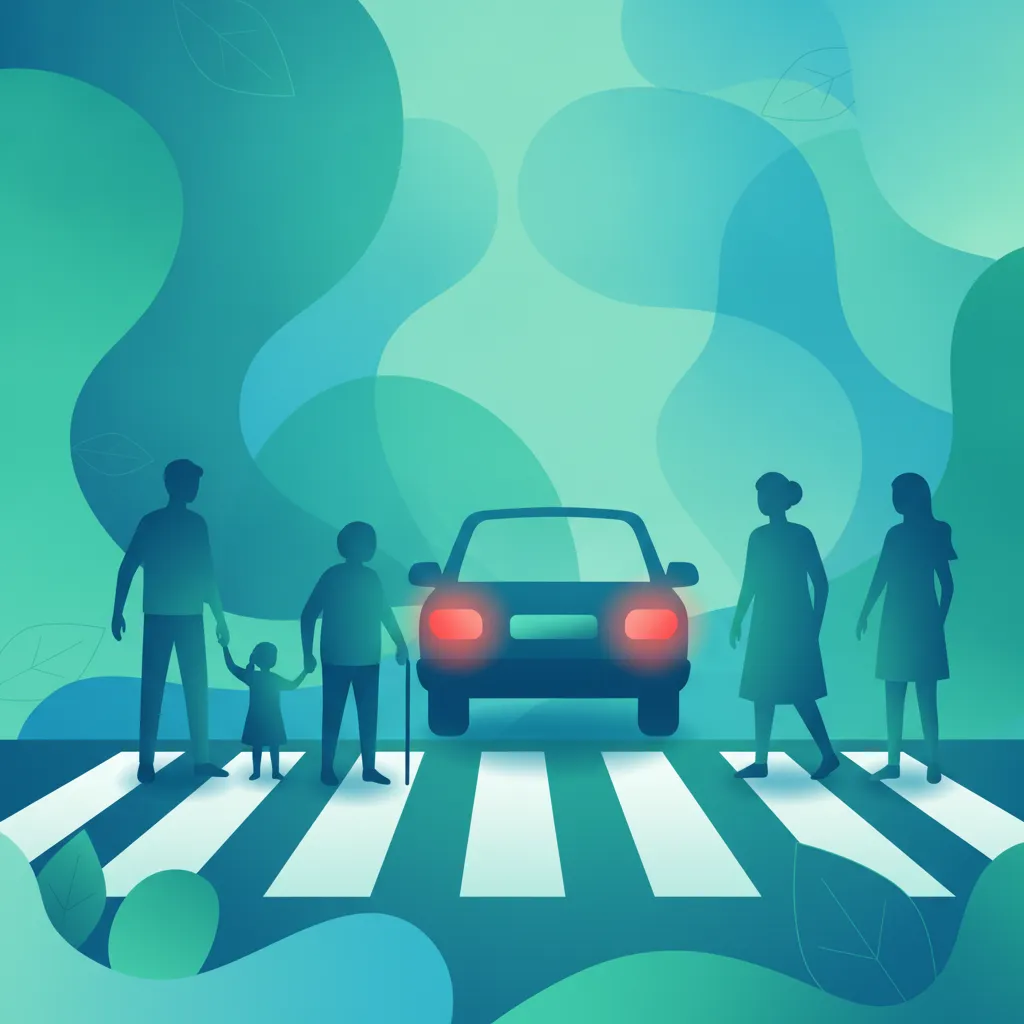
Pedestrians have absolute priority on marked crossings in Austria, and a bus driver must always be ready to give way. This lesson covers the rules for approaching and stopping for pedestrians, and highlights the risk of pedestrians being hidden by the vehicle's structure. It also stresses the danger of passengers crossing the road after alighting from your bus.
This lesson provides advanced strategies for proactively managing interactions with vulnerable road users to prevent conflicts before they arise. It teaches drivers to predict the likely behavior of pedestrians, cyclists, and e-scooter riders, especially at intersections and in congested areas. Key techniques include maintaining larger safety distances, covering the brake, and making eye contact to ensure mutual awareness and avoid accidents.
This lesson details the specific regulations and best practices for driving in areas with high pedestrian activity, such as bus stops and school zones. It explains the driver's obligation to stop for school buses with flashing lights and to yield to public buses pulling out from a stop. The content emphasizes the requirement to significantly reduce speed in marked school zones to ensure the safety of children.
Find clear answers to common questions learners have about Special Situations: Trams, Buses, and Cyclists at Intersections. Learn how the lesson is structured, which driving theory objectives it supports, and how it fits into the overall learning path of units and curriculum progression in Austria. These explanations help you understand key concepts, lesson flow, and exam focused study goals.
Not always. Trams have priority when moving on their tracks if traffic signs or signals do not dictate otherwise, but they must obey traffic lights just like other vehicles. Always check for specific signs indicating priority.
In Austria, if a bus in an urban area signals to pull away from a marked stop, you are required to allow them to merge if it is safe to do so. This is a common test question scenario regarding cooperation in traffic.
You must ensure there is sufficient lateral clearance to prevent accidents, especially when turning right across a cycle path. Always perform a shoulder check to ensure no cyclists are in your blind spot.
Yes, cyclists often have dedicated infrastructure like bike lanes or boxes at the front of intersections. You must respect these areas and avoid encroaching on them while waiting at a red light.
Refine your study plan by searching for specific Austrian driving theory practice sets. Pinpoint questions related to particular road rules, signs, or challenge levels, and begin practicing immediately to reinforce your knowledge and excel in your official exam with confidence. Get started with focused revision today.