Understanding how to safely approach and cross railway tracks is essential for passing your Belgian driving theory exam and ensuring road safety. This guide covers the critical legal signals you must obey and highlights why failure to follow these rules is treated as a serious criminal offense under Belgian law.
Article content overview
Navigating railway level crossings (spoorwegovergang / passage à niveau) is a fundamental part of the Belgian driving theory exam. Because Belgium maintains a high density of rail infrastructure relative to its road network, drivers in both Flanders and Wallonia frequently encounter crossings that vary significantly in their level of protection. Understanding your legal obligations at these locations is not just about passing the theory test; it is a vital skill for preventing life-threatening accidents.
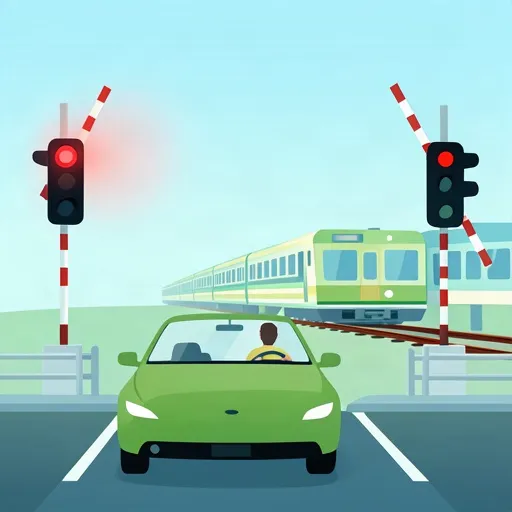
A common misconception among learner drivers is that the physical position of the barrier is the primary indicator of whether a crossing is safe to enter. In Belgian traffic law, this is incorrect. The flashing red light signals and audible warnings act as the definitive legal prohibition. If the red lights are flashing, or if the audible warning is sounding, you are legally forbidden from entering the crossing, regardless of whether the barriers are fully down, partially raised, or just beginning to move.
Drivers must also exercise extreme caution when barriers begin to rise. Even if the path appears clear, you must wait until the red flashing lights have completely extinguished before moving your vehicle. In the context of the theory exam, this is a frequently tested "trap" scenario: if a test image shows the barrier lifting but the light still flashing, the only correct answer is to remain stopped.
Belgium utilizes several categories of crossings to manage traffic safely across its dense rail network. Recognizing the signage associated with these categories is essential for your hazard perception.
At crossings without automatic signals—often found on rural branch lines—you will see a St. Andrew's Cross (Croix de Saint-André). At these passive crossings, you bear the sole responsibility for checking that no rail vehicle is approaching before you commit to crossing the tracks. If you cannot clearly see down the line in both directions, you are required to stop before the crossing, even if there is no official "Stop" sign, to ensure your path is entirely clear.
When approaching any railway level crossing in Belgium, your behavior should be guided by heightened vigilance. The following procedure is standard practice as outlined by the Belgian Highway Code and supported by safety organizations like Vias Institute.
Belgium consistently records a high number of incidents at level crossings compared to European averages. This is largely due to the combination of high train frequency and the prevalence of older, passive crossings in rural areas. Because of this, the legal framework regarding "passing on the red" is strictly enforced. When preparing for your theory exam, always prioritize the legal requirement of the signal over any visual assumption regarding the physical state of the infrastructure.
This article covers the critical rules for navigating Belgian railway level crossings, emphasizing that flashing red lights are the ultimate legal command that supersedes barrier position. It distinguishes between active crossings with signals and barriers and passive crossings marked by a St. Andrew's Cross that require full driver responsibility. The piece outlines a systematic procedure for approaching any crossing, including speed reduction, mirror checks, and ensuring complete clearance before entering. Importantly, it clarifies that violations at level crossings carry severe legal consequences in Belgium, making this a high-priority topic for theory exam preparation.
A short set of high-value points that capture the most important ideas from this article.
Flashing red light signals are the definitive legal prohibition - they override any barrier position in Belgian traffic law
An active crossing has automatic signals and barriers; a passive crossing relies solely on driver vigilance
You must have enough space to clear the tracks completely before entering - never enter if you cannot exit
At passive crossings marked by a St. Andrew's Cross, you must stop if you cannot see clearly in both directions
Violating flashing red signals at a level crossing is a criminal offense in Belgium, not a minor traffic violation
Red flashing lights = absolute stop, even if barriers are still rising or partially open
Wait until red lights have completely extinguished before moving - barrier position alone means nothing
St. Andrew's Cross (Croix de Saint-André) indicates a passive crossing with no automatic protection
Always stop behind the designated stop line at any active crossing when signals are active
If your vehicle stalls on the tracks, evacuate all passengers immediately and move to safety
Assuming the crossing is safe once barriers begin to rise while lights are still flashing
Believing that partially raised barriers indicate it is permissible to cross
Entering a crossing without verifying you can clear it completely on the other side
Failing to stop at passive crossings when visibility is limited in either direction
Treating level crossing violations as minor infractions rather than criminal offenses
Article content overview
A short set of high-value points that capture the most important ideas from this article.
Flashing red light signals are the definitive legal prohibition - they override any barrier position in Belgian traffic law
An active crossing has automatic signals and barriers; a passive crossing relies solely on driver vigilance
You must have enough space to clear the tracks completely before entering - never enter if you cannot exit
At passive crossings marked by a St. Andrew's Cross, you must stop if you cannot see clearly in both directions
Violating flashing red signals at a level crossing is a criminal offense in Belgium, not a minor traffic violation
Red flashing lights = absolute stop, even if barriers are still rising or partially open
Wait until red lights have completely extinguished before moving - barrier position alone means nothing
St. Andrew's Cross (Croix de Saint-André) indicates a passive crossing with no automatic protection
Always stop behind the designated stop line at any active crossing when signals are active
If your vehicle stalls on the tracks, evacuate all passengers immediately and move to safety
Assuming the crossing is safe once barriers begin to rise while lights are still flashing
Believing that partially raised barriers indicate it is permissible to cross
Entering a crossing without verifying you can clear it completely on the other side
Failing to stop at passive crossings when visibility is limited in either direction
Treating level crossing violations as minor infractions rather than criminal offenses
Explore related topics, search based questions, and concepts that learners often look up when studying Belgian Railway Crossing Rules. These themes reflect real search intent and help you understand how this topic connects to wider driving theory knowledge in Belgium.
Find clear and practical answers to common questions learners often have about Belgian Railway Crossing Rules. This section helps explain difficult points, remove confusion, and reinforce the key driving theory concepts that matter for learners in Belgium.
The flashing red light signal is the absolute legal command to stop. You must stop if these lights are active, regardless of the position or status of the barriers.
Yes, it is strictly forbidden to cross if the barriers are in motion or if the flashing lights are active. This is considered a serious traffic violation with significant legal consequences.
At passive crossings, you must be extremely cautious. You are legally required to verify that no train is approaching before proceeding, as there are no automatic light or barrier signals to warn you.
Belgian law prioritizes the light signal as the binding command. Relying on the barrier's position is dangerous because mechanical delays can occur; the light signal is the only legally binding prohibition.
Continue your learning journey by exploring related articles and guides on specific Belgian traffic situations, advanced road signs, or vehicle safety topics. Use our search to pinpoint what you need to review next, deepening your understanding for your driving license theory exam.