The Risk Perception Test is a crucial milestone that evaluates your ability to identify hazards in real-world traffic scenarios. This guide clarifies the specific documentation, scoring criteria, and remedial training requirements mandated by Belgian authorities, helping you approach your exam with confidence.
Article content overview
Obtaining a Belgian driving license is a multi-stage process that goes beyond just passing the standard theory test. One of the most critical hurdles for learner drivers is the Risk Perception Test, commonly referred to as the TPR (Test de perception des risques). This mandatory assessment is designed to evaluate your ability to identify potential hazards in real-world traffic scenarios before you are allowed to sit for your practical driving exam. Unlike the traditional theory test, which focuses on knowledge of road signs and traffic rules, the TPR tests your defensive driving instincts and your capacity to react to dynamic road situations.
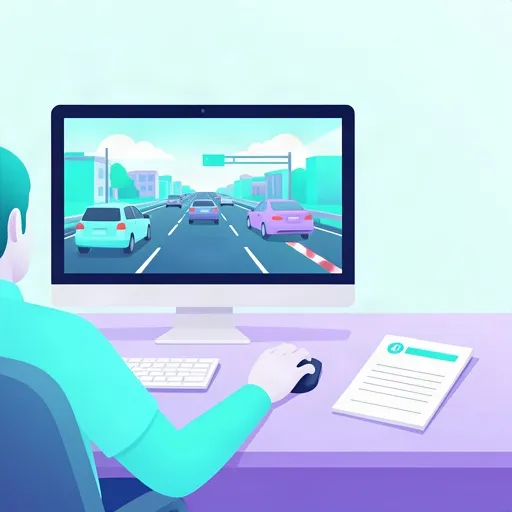
The primary goal of the Risk Perception Test is to ensure that a candidate can detect danger early enough to take appropriate action. By simulating various traffic conditions through short video clips, the test measures your situational awareness. When you sit at the computer, you are expected to place yourself in the position of the driver. As you watch the video, you must click on the screen the moment you identify a risk—such as a pedestrian stepping onto the road, a car pulling out unexpectedly, or a cyclist approaching a dangerous intersection.
The test consists of five short video sequences, and collectively, you must identify 10 hazards. Each film contains between zero and three potential risks. You are granted a pool of 10 clicks to identify these hazards; if you click incorrectly, you lose one of your available clicks. The test concludes once you have used all your clicks or the videos have finished. To pass, you must achieve a minimum score of 6 out of 10.
It is important for candidates to recognize that the administrative process for the TPR can vary depending on whether you are in Wallonia or the Brussels-Capital Region. These regional differences mainly concern the cost of the exam and the specific booking requirements at authorized test centers. In Wallonia, fees are set at approximately €17, while in Brussels, the cost is currently €45.
Regardless of your region, you must be in possession of a valid theory exam pass certificate to take the TPR. This certificate remains valid for three years, and your TPR must be successfully completed within this window to qualify for the practical exam.
Failing the test twice is a common point of stress for many learners, but the Belgian system provides a clear pathway for improvement. If you have failed the Risk Perception Test on two consecutive occasions, you are required by law to complete a three-hour mandatory training course at an approved driving school. Once you have completed this training, you will receive a certificate of education that you must present when booking your next attempt. There is no hard limit on the number of times you can attempt the test, provided you follow these remedial steps when necessary.
During the TPR, you will encounter diverse environments, ranging from dense urban centers to rural roads. You should be prepared to recognize hazards such as vehicles pulling out of side streets, interactions with public transport like trams and buses, and vulnerable road users like cyclists. Keeping a safe following distance and being aware of your surroundings are key concepts that apply here just as they do on the road.
If you are preparing for your upcoming exam, focus on practicing with official tools and familiarizing yourself with the interface. Consistent practice helps lower the anxiety of the computer-based format.
The Belgian Risk Perception Test (TPR) is a mandatory computer-based assessment between your theory and practical exams, consisting of five video sequences where you must identify 10 hazards using 10 clicks and score at least 6/10 to pass. Candidates need a valid theory certificate (valid for 3 years), a Belgian identity card, and should expect regional cost variations between Wallonia and Brussels. After two consecutive failures, you must complete a 3-hour mandatory training course at an approved driving school before booking a third attempt. Practice focusing on early hazard detection in urban, rural, and mixed traffic environments to build the situational awareness the test evaluates.
A short set of high-value points that capture the most important ideas from this article.
The TPR uses 5 video sequences where you must identify 10 hazards using a pool of 10 clicks, with a minimum passing score of 6/10
A hazard is defined as any external event that requires you to change your driving behavior (braking, steering, or signaling)
Incorrect clicks consume your available clicks, so only click when you genuinely perceive a risk developing
Your theory certificate remains valid for 3 years, and you must complete the TPR within this window
After two failed attempts, you must complete a 3-hour mandatory training course before retaking the test
Bring your valid Belgian identity card on test day—a passport is not accepted
Test costs differ by region: approximately €17 in Wallonia and €45 in Brussels
Wait times at test centers can reach six weeks, so book your appointment well in advance
The TPR tests your situational awareness and defensive driving instincts, not memorized rules
There is no limit on retakes, but you must complete mandatory training after each pair of failures
Clicking too early or on non-hazard events, which wastes your limited click pool
Assuming a passport is acceptable identification when only a Belgian identity card is accepted
Booking the test too late without accounting for potential six-week wait times
Failing to present the theory pass certificate along with identification on test day
Confusing the TPR format with standard theory questions—it requires active hazard spotting, not knowledge recall
Article content overview
A short set of high-value points that capture the most important ideas from this article.
The TPR uses 5 video sequences where you must identify 10 hazards using a pool of 10 clicks, with a minimum passing score of 6/10
A hazard is defined as any external event that requires you to change your driving behavior (braking, steering, or signaling)
Incorrect clicks consume your available clicks, so only click when you genuinely perceive a risk developing
Your theory certificate remains valid for 3 years, and you must complete the TPR within this window
After two failed attempts, you must complete a 3-hour mandatory training course before retaking the test
Bring your valid Belgian identity card on test day—a passport is not accepted
Test costs differ by region: approximately €17 in Wallonia and €45 in Brussels
Wait times at test centers can reach six weeks, so book your appointment well in advance
The TPR tests your situational awareness and defensive driving instincts, not memorized rules
There is no limit on retakes, but you must complete mandatory training after each pair of failures
Clicking too early or on non-hazard events, which wastes your limited click pool
Assuming a passport is acceptable identification when only a Belgian identity card is accepted
Booking the test too late without accounting for potential six-week wait times
Failing to present the theory pass certificate along with identification on test day
Confusing the TPR format with standard theory questions—it requires active hazard spotting, not knowledge recall
Explore related topics, search based questions, and concepts that learners often look up when studying Belgian Risk Perception Test Guide. These themes reflect real search intent and help you understand how this topic connects to wider driving theory knowledge in Belgium.
Find clear and practical answers to common questions learners often have about Belgian Risk Perception Test Guide. This section helps explain difficult points, remove confusion, and reinforce the key driving theory concepts that matter for learners in Belgium.
You must score at least 6 out of 10 points to pass the test.
Yes, if you fail the TPR twice, you are required to complete a 3-hour mandatory training course at an approved driving school before you can attempt the test again.
You must present your valid original Belgian identity card and your theoretical exam pass certificate. Depending on your training path, you may also need your provisional Model 36 license or a training certificate.
No, costs vary by region; for instance, the fee is typically lower in Wallonia compared to the Brussels-Capital Region.
Continue your learning journey by exploring related articles and guides on specific Belgian traffic situations, advanced road signs, or vehicle safety topics. Use our search to pinpoint what you need to review next, deepening your understanding for your driving license theory exam.