
Learning how to overtake safely is a fundamental requirement for the Belgian driving theory exam. This guide breaks down the specific legal prohibitions, distance requirements for cyclists, and the correct use of traffic lanes to ensure you are fully prepared for situational questions on the test.
Article content overview
Overtaking is a high-risk maneuver that requires precision, foresight, and a complete understanding of the Belgian Highway Code. In the context of your Belgian driving theory exam, mastering these rules is not just about memorizing facts; it is about recognizing the safety implications of every pass. The general principle in Belgium is clear: you may only overtake when you have clear visibility of the road ahead and sufficient space to complete the maneuver without endangering or obstructing other road users.
The core of the Belgian Highway Code, specifically Article 37, stipulates that overtaking should generally be performed on the left. However, the driver must ensure that the speed difference between their vehicle and the one being overtaken is sufficient to complete the maneuver quickly. Before moving into the passing lane, you must verify that no driver behind you has already signaled their intent to overtake and that you have enough room to return to the right-hand lane without cutting off the driver you have just passed.
Attempting to overtake when visibility is compromised—such as near the crest of a hill or in a sharp curve—is a common trap in theory exam questions. If you cannot see far enough ahead to guarantee the maneuver is safe, you are legally obligated to remain behind the slower vehicle.
One of the most critical topics for the theory exam is the protection of vulnerable road users, such as cyclists, pedestrians, and moped riders. To ensure their safety, Belgian law imposes strict lateral distance requirements that depend on your location relative to built-up areas.
When passing a cyclist, moped rider, or pedestrian on the road, you must leave a minimum lateral distance of at least 1 meter in built-up areas and at least 1.5 meters outside of built-up areas.
If the width of the road makes it impossible to maintain this distance, you are legally required to wait behind the vulnerable user until the road widens or traffic conditions permit a safe, wider passage. In the theory exam, remember that "waiting" is always the correct answer if the safety of a cyclist or pedestrian is at risk.
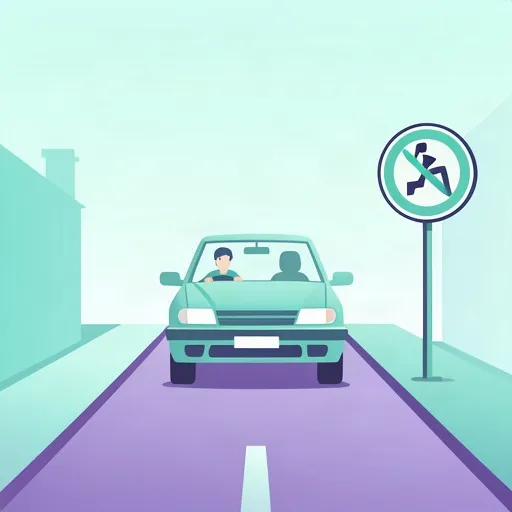
The Belgian Highway Code explicitly identifies several scenarios where overtaking is forbidden. Understanding these "no-go" zones is essential for avoiding errors during your test.
Belgian motorways operate on the right-hand traffic principle. Drivers are expected to keep to the right-most lane unless they are overtaking or if the lanes are congested. While it is common to see drivers lingering in the middle lane, the law remains firm: the left lanes are reserved for overtaking. Overtaking on the right is generally prohibited, though there are specific exceptions, such as when vehicles in the left lane are moving slower due to heavy congestion or traffic density.
This article covers Belgium's overtaking regulations essential for the theory exam, including the requirement to overtake on the left with sufficient visibility and speed differential under Article 37 of the Highway Code. The critical cyclist clearance rule mandates 1 meter in built-up areas and 1.5 meters outside, with drivers required to wait if this distance cannot be maintained. Overtaking is strictly prohibited at pedestrian crossings, within 100 meters of junctions with priority signs, at railway crossings (A45/A47), and across continuous white lines. Belgian motorways follow right-hand traffic principles with left lanes reserved for overtaking only, and overtaking on the right is generally forbidden except in specific congestion scenarios.
A short set of high-value points that capture the most important ideas from this article.
In Belgium, overtaking must be performed on the left side and only when you have clear visibility of the road ahead
You must maintain at least 1 meter lateral distance from cyclists in built-up areas and 1.5 meters outside built-up areas
If the road is too narrow to maintain safe clearance from vulnerable users, you must wait behind them
Overtaking is prohibited at pedestrian crossings, near junctions within 100 meters of priority signs, and at railway crossings marked A45 or A47
On Belgian motorways, keep to the right lane unless you are actively overtaking
Article 37 of the Belgian Highway Code governs overtaking rules and requires sufficient speed difference to complete the maneuver quickly
Built-up areas require 1m clearance from cyclists; outside built-up areas the requirement increases to 1.5m
Never cross or drive to the left of a continuous white line to overtake
Approaching within 100 meters of a Stop, Yield sign, or traffic light prohibits overtaking unless regulated by personnel or specific signage
The right-hand traffic principle applies on Belgian motorways with left lanes reserved exclusively for overtaking
Attempting to overtake when visibility is compromised near hills or curves, which is a common exam trap
Crossing continuous white lines to overtake, which is strictly prohibited regardless of circumstances
Overtaking at pedestrian crossings even when no pedestrian is present, as the prohibition applies regardless
Assuming you can overtake any vehicle on the right in heavy congestion, when exceptions are narrowly defined
Forgetting that waiting is the correct answer if safe lateral clearance cannot be maintained for vulnerable road users
Article content overview
A short set of high-value points that capture the most important ideas from this article.
In Belgium, overtaking must be performed on the left side and only when you have clear visibility of the road ahead
You must maintain at least 1 meter lateral distance from cyclists in built-up areas and 1.5 meters outside built-up areas
If the road is too narrow to maintain safe clearance from vulnerable users, you must wait behind them
Overtaking is prohibited at pedestrian crossings, near junctions within 100 meters of priority signs, and at railway crossings marked A45 or A47
On Belgian motorways, keep to the right lane unless you are actively overtaking
Article 37 of the Belgian Highway Code governs overtaking rules and requires sufficient speed difference to complete the maneuver quickly
Built-up areas require 1m clearance from cyclists; outside built-up areas the requirement increases to 1.5m
Never cross or drive to the left of a continuous white line to overtake
Approaching within 100 meters of a Stop, Yield sign, or traffic light prohibits overtaking unless regulated by personnel or specific signage
The right-hand traffic principle applies on Belgian motorways with left lanes reserved exclusively for overtaking
Attempting to overtake when visibility is compromised near hills or curves, which is a common exam trap
Crossing continuous white lines to overtake, which is strictly prohibited regardless of circumstances
Overtaking at pedestrian crossings even when no pedestrian is present, as the prohibition applies regardless
Assuming you can overtake any vehicle on the right in heavy congestion, when exceptions are narrowly defined
Forgetting that waiting is the correct answer if safe lateral clearance cannot be maintained for vulnerable road users
Explore related topics, search based questions, and concepts that learners often look up when studying Belgian Overtaking Rules. These themes reflect real search intent and help you understand how this topic connects to wider driving theory knowledge in Belgium.
Find clear and practical answers to common questions learners often have about Belgian Overtaking Rules. This section helps explain difficult points, remove confusion, and reinforce the key driving theory concepts that matter for learners in Belgium.
You must maintain a minimum lateral distance of at least 1 meter in built-up areas and at least 1.5 meters outside of built-up areas.
No, overtaking a vehicle that is approaching or stopping at a pedestrian crossing is strictly prohibited, even if no pedestrian is currently on the crossing.
Generally, no. You must keep to the right lane and only use the left lane(s) for overtaking. The right lane is intended for driving, while the left is reserved for passing.
Yes, overtaking is forbidden where there is a continuous white line on your side of the road, on the top of a hill with limited visibility, at certain intersections with priority from the right, and near specific warning signs like pedestrian or level crossings.
Continue your learning journey by exploring related articles and guides on specific Belgian traffic situations, advanced road signs, or vehicle safety topics. Use our search to pinpoint what you need to review next, deepening your understanding for your driving license theory exam.