
This lesson explores the strict Danish legal framework regarding alcohol, narcotics, and distracted driving. It is essential for your Category B exam and prepares you to handle high-risk situations, ensuring you understand the severe consequences of violating traffic laws.
Lesson content overview
Driving is a privilege that comes with significant responsibilities, particularly regarding the safety of all road users. In Denmark, the law takes a very strict stance against any form of impaired driving, whether it's due to alcohol, illegal drugs, or driver distractions like mobile phone use. Understanding these regulations and their severe consequences is paramount for anyone preparing for the Danish Driving License Theory Course: Category B Preparation, as it directly impacts your ability to drive safely and legally.
This lesson will detail the specific legal limits for alcohol in your bloodstream, explain the absolute zero-tolerance policy for illegal drugs, and highlight the significant risks and legal ramifications of distracted driving. Mastering these concepts is not just about passing your theory test; it's about adopting a mindset of responsible and safe driving that protects yourself and others on the road.
Impaired driving significantly reduces a driver's ability to react, make sound judgments, and control their vehicle safely. Danish traffic law has established clear limits and policies to combat this dangerous behaviour, with severe penalties for those who violate them.
Blood Alcohol Concentration (BAC) refers to the amount of alcohol present in your bloodstream, typically measured in grams per liter (g/L) of blood. This measurement is crucial as it directly correlates with the level of impairment. Even small amounts of alcohol can affect your coordination, reaction time, and decision-making capabilities.
For most experienced drivers in Denmark, the maximum permissible BAC when operating a motor vehicle is 0.5 g/L. This limit is set to ensure that drivers maintain sufficient cognitive and motor skills to navigate traffic safely. Exceeding this limit is a criminal offense, regardless of whether you feel impaired or not. The law prioritises objective measurements over subjective feelings of sobriety.
It is crucial to remember that your ability to drive safely begins to deteriorate even before reaching the 0.5 g/L limit. The legal limit should be seen as an absolute maximum, not a target.
New drivers, particularly those who have held their Category B driving license for less than two years, face an even stricter BAC limit. For these novice drivers, the legal limit is 0.2 g/L. This lower threshold acknowledges that new drivers typically have less experience in complex traffic situations and are more susceptible to the impairing effects of alcohol. This policy encourages new drivers to adopt a zero-alcohol approach when getting behind the wheel during their initial, most vulnerable period of driving.
Law enforcement officers in Denmark have the authority to conduct roadside breath tests using a breathalyzer if they suspect a driver is under the influence of alcohol. If the breathalyzer test indicates a BAC above the legal limit, or if there is any doubt regarding the accuracy, a blood sample will be taken for a more precise laboratory analysis. Refusing to cooperate with these tests can lead to immediate legal consequences, including license suspension.
Beyond alcohol, Danish law enforces a zero-tolerance policy for illegal drugs in a driver's system. This means that any detectable amount of illicit substances in your bloodstream while driving constitutes an offense. Unlike alcohol, there is no permissible limit; if illegal drugs are detected, you are considered to be driving under the influence and face severe penalties.
The zero-tolerance policy applies to all illegal drugs, including cannabis, cocaine, amphetamines, ecstasy, and heroin, among others. It is not dependent on whether you feel impaired or how long ago you consumed the substance. The mere presence of these drugs in your system while operating a vehicle is sufficient for a conviction. This strict approach is rooted in the understanding that illegal drugs can severely impair judgment, perception, reaction time, and motor control, making driving extremely dangerous.
While the zero-tolerance policy specifically targets illegal drugs, drivers must also be aware of the potential impairing effects of prescription medications. Many prescribed drugs, especially those affecting the central nervous system, can cause drowsiness, dizziness, blurred vision, or slowed reaction times.
It is your responsibility to read the warning labels on all medications and consult your doctor or pharmacist about any potential side effects that could impact your driving ability. If a prescribed medication carries a warning about driving, you must heed that advice. Driving while impaired by a legal prescription drug can still lead to charges if your driving ability is demonstrably compromised.
Driver distraction is a growing concern on roads worldwide, and Denmark has strict laws in place to combat it. Distracted driving occurs when a driver's attention is diverted from the primary task of driving, leading to reduced awareness, delayed reactions, and an increased risk of accidents.
Using a mobile phone while driving is one of the most common and dangerous forms of distraction. It typically involves three types of impairment:
All three forms dramatically increase the risk of collisions.
In Denmark, it is strictly prohibited to hold a mobile phone in your hand while driving a vehicle. This rule applies whether you are talking, texting, browsing, or using any app on the phone. The law is designed to eliminate the manual and visual distractions associated with manipulating a handheld device. Even if you are stopped in traffic or at a red light, holding and using your phone is still considered an offense.
Using a mobile phone in a hands-free setup (e.g., via Bluetooth in-car system, speakerphone mounted in a cradle) is generally allowed. However, it comes with a critical caveat: your hands-free use must not impair your driving ability or attention. Even if your hands are on the wheel, engaging in an intense conversation, being engrossed in navigating complex menus, or receiving constant notifications can lead to significant cognitive distraction. This can cause you to miss crucial road signs, traffic changes, or the presence of vulnerable road users like cyclists and pedestrians. If your hands-free phone use is deemed to be distracting you to the point of impairing your driving, you can still face penalties.
Many drivers mistakenly believe that hands-free phone use is completely safe. Research consistently shows that cognitive distraction, even without physical phone manipulation, significantly degrades driving performance and reaction time.
While mobile phones are a primary focus, other activities can also distract a driver and potentially lead to legal consequences if they impair safe driving. These include:
Although specific laws might not explicitly prohibit these actions, if they lead to dangerous driving, an accident, or a traffic violation, they can be considered contributing factors or evidence of reckless driving.
The Danish legal system imposes a range of serious penalties for impaired and distracted driving. These penalties are designed to deter such dangerous behaviour and protect public safety. The severity of the consequences typically increases with the level of impairment, the risk posed, and the number of previous offenses.
One of the most common consequences for traffic violations, including those related to impaired or distracted driving, is the imposition of fines. These are monetary penalties that you must pay to the state. The amount of the fine varies significantly depending on the specific offense and the circumstances. For instance, a fine for handheld mobile phone use is usually a fixed amount, while fines for driving under the influence of alcohol or drugs are often calculated based on your income and the severity of the offense.
License suspension is a temporary revocation of your driving rights for a specified period, while license revocation is a permanent withdrawal. Both are serious consequences that can severely impact your daily life, work, and independence.
For alcohol-related offenses, the severity of license suspension directly correlates with your measured Blood Alcohol Concentration (BAC):
Driving under the influence of illegal drugs, given the zero-tolerance policy, typically results in penalties comparable to, or even more severe than, high-level alcohol offenses. These consequences almost always include significant fines and unconditional license suspension, often for 6 months or more, depending on the specific drug, the amount detected, and any aggravating circumstances. Repeated offenses will lead to much longer suspensions or outright revocation.
For less severe violations, such as illegal mobile phone use, drivers may incur demerit points on their driving record in addition to a fine. Accumulating a certain number of demerit points within a specific timeframe can lead to a mandatory license suspension. This system ensures that even minor infractions, if repeated, contribute to a loss of driving privileges, reinforcing the importance of consistent safe driving behaviour.
In the most severe cases of impaired driving, particularly those involving very high BAC levels, multiple prior offenses, or incidents resulting in injury or death, imprisonment is a possible consequence. This underscores the Danish legal system's commitment to public safety and its zero-tolerance for reckless behaviour that endangers lives. Jail sentences are typically reserved for the most egregious violations, sending a clear message about the seriousness of such offenses.
Understanding the legal framework is essential, but it's equally important to apply this knowledge to real-world driving situations. Many violations stem from common misunderstandings or a misjudgment of personal capabilities.
One of the most frequent causes of impaired driving offenses is underestimating the lasting effects of alcohol. Many drivers assume that if they feel sober a few hours after drinking, their BAC will be within legal limits. However, alcohol metabolizes at a relatively slow and consistent rate for most people.
The process by which the body breaks down and eliminates alcohol. On average, the liver can process about one standard alcoholic drink per hour, but this varies significantly based on individual factors.
Modern smartphones are invaluable for navigation, but their use while driving requires careful consideration of the distraction rules.
The risks associated with impairment are not static; they are significantly amplified by various environmental and situational factors.
These conditional variations underscore why adherence to legal limits and a proactive approach to avoiding distractions are not just about compliance, but about fundamental safety and responsibility.
Driving on Danish roads requires a deep understanding and unwavering commitment to responsible behavior. The legal framework surrounding impaired and distracted driving is designed to foster a safe environment for everyone.
The fundamental principle is that your ability to safely operate a vehicle must never be compromised. This means:
By internalizing these principles, you contribute to a safer traffic culture and ensure that you remain a responsible and confident participant on Denmark's roads.
This lesson covers Denmark's strict legal framework for impaired and distracted driving, including the 0.5 g/L BAC limit for experienced drivers and the stricter 0.2 g/L limit for novice drivers during their first two years. Danish law applies zero-tolerance to illegal drugs, meaning any detectable amount results in conviction, while handheld mobile phone use is prohibited entirely and hands-free use is permitted only if it does not impair driving ability. Penalties range from fines and demerit points to license suspension and imprisonment, with severity escalating based on BAC levels, prior offenses, and whether harm was caused. Understanding these rules is essential for both passing the Category B theory exam and adopting responsible driving habits that protect all road users.
A short set of high-value points that capture the most important learning from this lesson.
Denmark's general BAC limit is 0.5 g/L, but novice drivers face a stricter 0.2 g/L limit for their first two years
Denmark enforces zero-tolerance for illegal drugs—any detectable amount in your system while driving is a criminal offense
Handheld mobile phone use is strictly prohibited while driving; hands-free is allowed only if it does not impair your driving ability
Alcohol-related penalties escalate with BAC levels, from conditional license suspension at 0.5–0.8 g/L to severe consequences above 0.8 g/L
Distraction risks multiply in adverse conditions such as rain, darkness, high speeds, or areas with cyclists and pedestrians
Explore all units and lessons included in this driving theory course.
The legal BAC limit should be seen as an absolute maximum, not a target—impairment begins well before reaching 0.5 g/L
Zero-tolerance drug policy means no permissible level for illegal substances; detection alone is sufficient for conviction
Cognitive distraction from hands-free phone use can be just as dangerous as holding the phone physically
Prescription medications with warnings about driving must be heeded—impairment from legal drugs can still lead to charges
Feeling sober after drinking does not guarantee your BAC is within legal limits; alcohol metabolizes slowly and varies by individual
Novice drivers forgetting they are subject to the stricter 0.2 g/L limit during their first two years
Drivers believing that hands-free phone use is completely safe and does not affect driving performance
Assuming they are fit to drive hours after drinking based on subjective feelings of sobriety rather than objective measurement
Drivers not checking medication labels for driving-related warnings or failing to consult their doctor about side effects
Thinking that being stopped in traffic or at a red light exempts them from handheld phone restrictions
Lesson content overview
A short set of high-value points that capture the most important learning from this lesson.
Denmark's general BAC limit is 0.5 g/L, but novice drivers face a stricter 0.2 g/L limit for their first two years
Denmark enforces zero-tolerance for illegal drugs—any detectable amount in your system while driving is a criminal offense
Handheld mobile phone use is strictly prohibited while driving; hands-free is allowed only if it does not impair your driving ability
Alcohol-related penalties escalate with BAC levels, from conditional license suspension at 0.5–0.8 g/L to severe consequences above 0.8 g/L
Distraction risks multiply in adverse conditions such as rain, darkness, high speeds, or areas with cyclists and pedestrians
Explore all units and lessons included in this driving theory course.
The legal BAC limit should be seen as an absolute maximum, not a target—impairment begins well before reaching 0.5 g/L
Zero-tolerance drug policy means no permissible level for illegal substances; detection alone is sufficient for conviction
Cognitive distraction from hands-free phone use can be just as dangerous as holding the phone physically
Prescription medications with warnings about driving must be heeded—impairment from legal drugs can still lead to charges
Feeling sober after drinking does not guarantee your BAC is within legal limits; alcohol metabolizes slowly and varies by individual
Novice drivers forgetting they are subject to the stricter 0.2 g/L limit during their first two years
Drivers believing that hands-free phone use is completely safe and does not affect driving performance
Assuming they are fit to drive hours after drinking based on subjective feelings of sobriety rather than objective measurement
Drivers not checking medication labels for driving-related warnings or failing to consult their doctor about side effects
Thinking that being stopped in traffic or at a red light exempts them from handheld phone restrictions
Explore search topics learners often look for when studying Legal Consequences of Impaired Driving and Distractions. These topics reflect common questions about road rules, driving situations, safety guidance, and lesson level theory preparation for learners in Denmark.
Browse additional driving theory lessons that cover connected traffic rules, road signs, and common driving situations related to this topic. Improve your understanding of how different rules interact across everyday traffic scenarios.
Understand the strict Danish legal limits for Blood Alcohol Concentration (BAC) and the zero-tolerance policy for illegal drugs. Learn the specific rules for novice drivers and the severe consequences of impaired driving.
This lesson identifies common high-risk behaviors, including riding while impaired by alcohol, drugs, or fatigue. It details the strict legal limits in Denmark and the severe penalties for violations. The dangers of distraction, particularly from mobile phones, are also explained as a significant cause of accidents.

This lesson addresses the heightened risks faced by novice drivers, such as a tendency towards overconfidence, the influence of peer pressure, and the dangers of fatigue. It provides practical strategies for managing these risks, maintaining focus while driving, and cultivating a responsible attitude. The goal is to build a strong foundation of safe driving habits from the very beginning of your driving career.
This lesson provides a clear overview of the penalties associated with breaking traffic laws as a motorcyclist. It details the Danish penalty point system ('klip i kørekortet') and the conditions that can lead to fines or licence revocation. Understanding these consequences reinforces the importance of lawful riding.
This lesson introduces cooperative driving as a fundamental element of road safety in Denmark. It highlights the social responsibility of drivers to act predictably, anticipate the actions of others, and maintain courteous interactions with all road users. By fostering mutual respect and cooperation, you will learn how to reduce the potential for conflict and enhance overall traffic safety.
This lesson details the legal consequences for professional drivers who commit traffic infractions. It explains the Danish system of fines and penalty points for various offenses, from speeding to load security violations, and outlines the conditions that can lead to license suspension. The content underscores the professional and legal obligation to uphold traffic law at all times to maintain a clean driving record.

This lesson addresses the serious safety risk of driver fatigue. It teaches how to recognize early warning signs and explains the strict Danish and EU regulations on driving hours and mandatory rest periods. The content covers the correct use of the tachograph to log activity and details the legal penalties for non-compliance, emphasizing the importance of being well-rested before every journey.
This lesson focuses on regulatory signs, which enforce mandatory actions or prohibitions, such as speed limits, stop signs, and no-entry signs. You will learn about the legally binding nature of these signs and the serious consequences of non-compliance. The material also explains signs related to parking rules and overtaking restrictions, providing a clear framework for adhering to Danish traffic law.
This lesson provides an overview of the Danish legal system as it applies to motorcyclists. It details the consequences of traffic violations, including fines, penalty points, and potential licence suspension. Learners will also understand their legal responsibilities concerning insurance coverage and procedures to follow in the event of a collision.
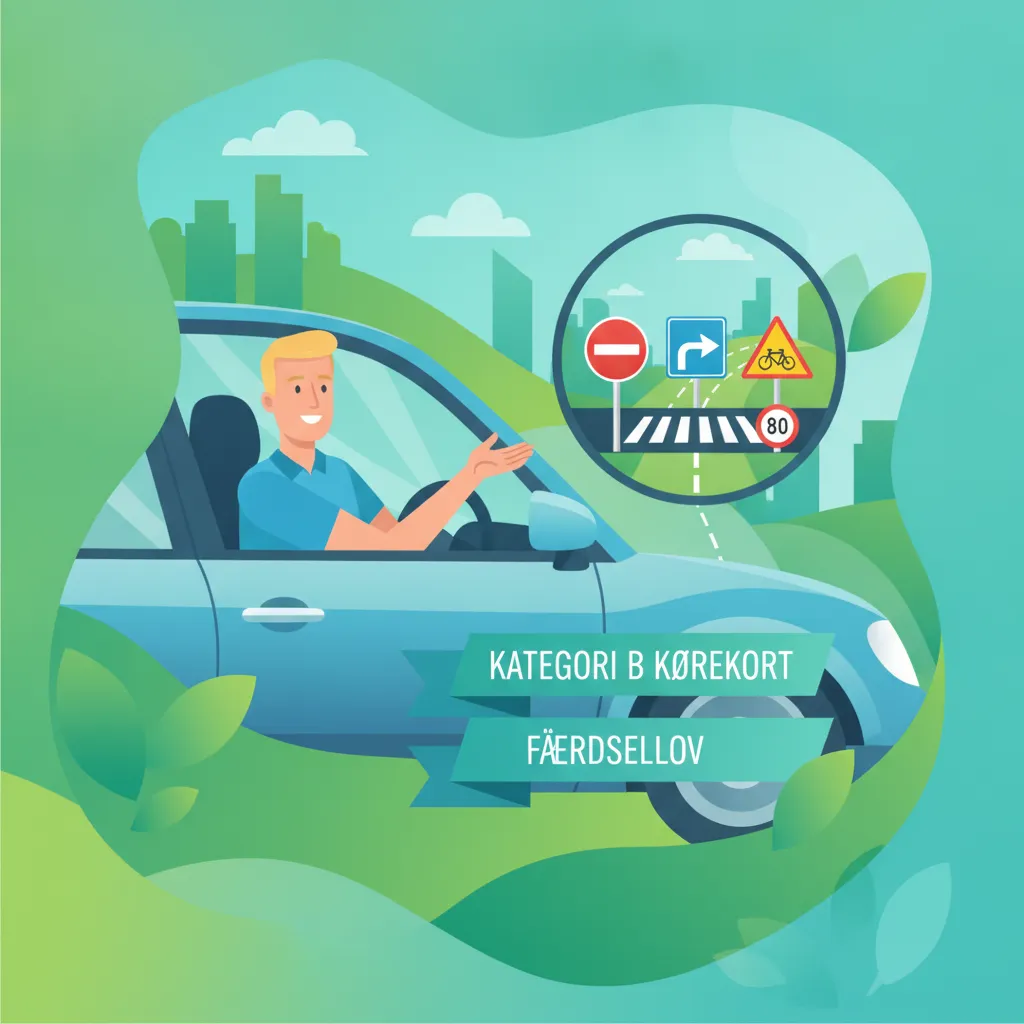
This lesson provides a detailed explanation of the Category B license, specifying which vehicles you are permitted to drive. It covers crucial limitations such as maximum authorised mass, passenger capacity, and the regulations for towing a trailer. Furthermore, it clarifies the legal distinctions between holding a license for an automatic versus a manual transmission vehicle, grounding your knowledge in official Danish legislation.
Explore the Danish regulations regarding mobile phone use while driving, including handheld prohibitions and hands-free usage caveats. Learn about the dangers of distracted driving and its legal ramifications.
This lesson identifies common high-risk behaviors, including riding while impaired by alcohol, drugs, or fatigue. It details the strict legal limits in Denmark and the severe penalties for violations. The dangers of distraction, particularly from mobile phones, are also explained as a significant cause of accidents.
This lesson provides a clear overview of the penalties associated with breaking traffic laws as a motorcyclist. It details the Danish penalty point system ('klip i kørekortet') and the conditions that can lead to fines or licence revocation. Understanding these consequences reinforces the importance of lawful riding.
This lesson provides an overview of the Danish legal system as it applies to motorcyclists. It details the consequences of traffic violations, including fines, penalty points, and potential licence suspension. Learners will also understand their legal responsibilities concerning insurance coverage and procedures to follow in the event of a collision.
This lesson details the legal consequences for professional drivers who commit traffic infractions. It explains the Danish system of fines and penalty points for various offenses, from speeding to load security violations, and outlines the conditions that can lead to license suspension. The content underscores the professional and legal obligation to uphold traffic law at all times to maintain a clean driving record.
This lesson outlines the legal responsibilities of a rider involved in a traffic accident. It explains the legal duty to stop, render aid, and report the incident to the police and insurance providers. The content covers the concepts of liability and the potential legal consequences following an accident.
Find clear answers to common questions learners have about Legal Consequences of Impaired Driving and Distractions. Learn how the lesson is structured, which driving theory objectives it supports, and how it fits into the overall learning path of units and curriculum progression in Denmark. These explanations help you understand key concepts, lesson flow, and exam focused study goals.
The legal limit for blood alcohol concentration (BAC) in Denmark is 0.50 per mille. Driving with a higher level is strictly illegal and subject to severe penalties.
Denmark operates a zero-tolerance policy for driving under the influence of illegal drugs. Even small traces of prohibited substances can result in license suspension and criminal charges.
Yes, but you must ensure it does not cause distraction. Any use of a mobile phone that impairs your ability to drive safely is prohibited and can be penalized.
Exam questions often present scenarios where you must identify if a driver is acting legally or suggest the correct course of action when faced with potential impairment or distraction hazards.
Use our powerful search tool to pinpoint specific Danish driving theory topics, road signs, or traffic situations you need to review. Start exploring relevant practice sets now to reinforce your knowledge and build confidence for your upcoming driving licence exam.