
This lesson explores countersteering, the fundamental technique for steering a motorcycle at speed. You will learn how precise inputs on your handlebars translate into smooth, controlled turns, which is a core skill for both the Danish theory exam and your practical riding safety.

Lesson content overview
Welcome to this essential lesson within your Danish Motorcycle Theory course. Understanding how a motorcycle truly turns at speed is fundamental to safe and proficient riding. This lesson will demystify countersteering, the primary technique for initiating turns on a motorcycle when moving. We will explore the intricate dance between your steering inputs, body position, and the motorcycle's dynamic response, providing you with the knowledge to control your machine smoothly and confidently in any turn.
At low speeds, turning a motorcycle feels intuitive: you simply turn the handlebars in the direction you want to go. However, as speed increases, this direct steering becomes unstable and inefficient. This is where countersteering comes into play – a seemingly counter-intuitive technique that is, in fact, the most effective and stable way to initiate a lean and turn a motorcycle at speed.
Imagine you want to turn left. Instead of turning the handlebars to the left, you briefly push the left handlebar forward (or pull the right handlebar towards you). This momentary input causes the front wheel to steer slightly to the right. As the front wheel moves to the right, the motorcycle begins to lean to the left. Once the desired lean angle is achieved, the rider can relax the countersteering input, and the motorcycle will naturally follow a curved path. It's a precise, subtle push or pull, not a sharp turn of the bars.
The principle of countersteering is rooted in fundamental physics. When you push the left handlebar forward, the front wheel briefly turns right. This action shifts the contact patch of the tires slightly to the right, creating a force that causes the motorcycle to tilt or lean to the left. Once the motorcycle begins to lean, gravity and centripetal force take over, guiding the motorcycle into a turn in the direction of the lean. This process allows for precise control over the lean angle and, consequently, the turning radius.
Countersteering is not just an advanced technique; it's the foundational method for effective steering on any two-wheeled vehicle traveling above very low speeds (typically above 20 km/h). Attempting to steer directly into a turn at higher speeds will often result in instability, resistance from the motorcycle, and an inability to achieve a proper lean angle. It's crucial for optimal cornering speed, maintaining stability, and executing precise maneuvers, making it a foundational skill for all A1, A2, and A license holders in Danish motorcycle theory.
The lean angle is arguably the most critical factor in motorcycle cornering, directly dictating how sharply your motorcycle can turn. Understanding and controlling it is paramount to safe and efficient riding.
This angle is crucial because it balances the forces acting on the motorcycle in a turn, primarily gravity pulling it down and centripetal force pushing it outwards. A motorcycle needs to lean into a turn to counteract the outward pull of centripetal force, preventing it from falling over or running wide. The greater the lean angle, the tighter the turning radius the motorcycle can achieve at a given speed.
The lean angle must always be appropriate for the speed and the desired turning radius. A gentle curve on a highway will require a shallow lean, where the motorcycle is only slightly tilted. Conversely, a tight, winding turn on a rural road demands a much deeper lean to successfully navigate the bend. Riders constantly adjust their lean angle through countersteering inputs and body positioning to match the demands of the road.
Both insufficient and excessive lean angles pose significant risks.
While countersteering initiates the lean, effective body positioning plays a crucial supporting role in refining the turn, enhancing stability, and maximizing tire grip. By strategically shifting your weight, you can influence the motorcycle's dynamics and make it easier to achieve and hold a desired lean angle.
The rider's body mass is a significant component of the total motorcycle-rider system. By moving your hips, torso, and even your head, you can subtly but effectively shift the center of gravity of this system. Shifting your body weight towards the inside of a turn assists the motorcycle in leaning, allowing it to achieve a deeper lean with less countersteering input, or to maintain a specific lean angle more easily. This reduces the stress on the motorcycle's suspension and tires, contributing to greater stability and control.
There are typically two main approaches to body positioning in a turn:
Regardless of the specific body positioning technique, maintaining a secure and flexible posture is key. Your arms should be relaxed, allowing the handlebars to move freely as required by countersteering inputs. A tight grip on the handlebars can inhibit smooth steering. Your core muscles should be engaged to support your upper body, and your legs should be gently gripping the tank to provide stability and feedback from the motorcycle. This flexible posture helps you absorb bumps, maintain balance, and react quickly to changing conditions.
Every motorcycle is designed with specific steering geometry that profoundly affects how it handles and responds to rider inputs. Understanding these characteristics helps a rider anticipate their bike's behavior and fine-tune their steering technique.
Steering geometry refers to the physical design characteristics of a motorcycle's front end, including:
These geometric characteristics determine the "feel" and responsiveness of the handlebars during countersteering. For example, a motorcycle with a longer wheelbase and more trail might require a more pronounced or sustained countersteering input to initiate a lean compared to a motorcycle with a shorter wheelbase and less trail. Riders learn to instinctively adapt their inputs to their specific motorcycle's geometry, but an awareness of these factors helps in understanding why different bikes handle differently. This feedback from the handlebars is crucial for feeling how much lean is being generated and for making continuous, subtle adjustments throughout a turn.
Mastering countersteering and proper body dynamics isn't just about improved control; it's also a matter of complying with safety standards and regulations designed to prevent accidents.
While the Danish Road Traffic Act (Færdselsloven) may not explicitly use the term "countersteering," it implicitly mandates techniques that ensure safe control and maneuverability. Riders are expected to operate their motorcycles safely and with full control at all times. This includes using appropriate steering methods for the prevailing speed and conditions.
Failure to maintain control due to incorrect steering or an inappropriate lean angle could be deemed negligent riding. Riders must always adjust their lean angle according to speed, road surface, and environmental conditions to avoid loss of traction, which can lead to serious accidents. Maintaining both feet on the footrests and a firm, yet relaxed, grip on the handlebars is also crucial for maintaining stability and control, a basic expectation for all riders.
Even experienced riders can sometimes make mistakes in countersteering and body positioning. Being aware of these common pitfalls can help you develop safer habits:
Common Countersteering and Lean Mistakes:
Practicing these techniques in a safe environment and building muscle memory is the best way to avoid these mistakes.
The theoretical principles of countersteering and body dynamics remain constant, but their application must be dynamically adjusted based on prevailing conditions. Safe riding requires constant adaptation.
When riding on wet, icy, or otherwise slippery surfaces, the available tire traction is significantly reduced. In these conditions, all inputs must be smoother and gentler. Countersteering inputs should be less aggressive, and lean angles must be shallower to avoid exceeding the reduced grip limits of the tires. Abrupt movements can easily cause a skid. Maintaining a greater distance from other vehicles also provides more time to react and make gentle adjustments.
The type and quality of the road surface profoundly influence how you steer:
Adding weight to a motorcycle, whether in the form of luggage or a passenger, alters its center of gravity and overall dynamics.
Let's look at how countersteering and body dynamics apply in everyday riding situations, highlighting correct and incorrect approaches.
When performing a lane change on a highway, you need to initiate a subtle lean to move laterally.
Navigating curves, especially on rural roads, requires precise control over lean and direction.
Mastering countersteering, understanding lean angle, and utilizing effective body positioning are not merely techniques – they are the fundamental building blocks of safe, confident, and proficient motorcycle operation. These skills empower you to control your motorcycle accurately across diverse riding scenarios, from routine lane changes to challenging winding roads. By continually practicing and refining these concepts, you not only pass your Danish motorcycle theory exam but also lay the groundwork for a lifetime of enjoyable and secure riding.
Countersteering is a fundamental technique where pushing the handlebar opposite to the desired turn direction initiates a lean that allows the motorcycle to turn smoothly at speed. Understanding lean angle is critical because it directly determines how sharply a motorcycle can turn, requiring riders to balance speed against the available traction. Body positioning, including shifting weight inside the turn, supports the lean and enhances stability and control. Different motorcycles respond differently based on their steering geometry, so riders must adapt their inputs accordingly. Conditions such as wet roads, poor surfaces, or carrying a passenger all require gentler inputs and shallower lean angles to maintain safety.
A short set of high-value points that capture the most important learning from this lesson.
Countersteering is the primary method for steering a motorcycle at speed above 20 km/h: push the handlebar opposite to the desired turn direction to initiate lean.
Lean angle must match speed and turning radius: insufficient lean causes running wide, excessive lean risks losing traction and falling.
Rider body positioning supports lean control by shifting weight toward the inside of a turn, enhancing stability and control.
Steering geometry (rake, trail, wheelbase) varies between motorcycles and affects how much countersteering input is needed.
Reduced traction conditions (wet, icy, or poor surfaces) require gentler countersteering inputs and shallower lean angles.
Explore all units and lessons included in this driving theory course.
To turn left, briefly push the left handlebar forward (or pull the right toward you) to initiate a rightward input that causes the bike to lean left.
Lean angle directly determines turning radius: the greater the lean, the tighter the turn the motorcycle can achieve at a given speed.
Inside body position (leaning hips and torso toward the inside of the turn) helps the motorcycle lean more effectively with less input.
On slippery surfaces, countersteering inputs must be smoother and lean angles shallower to avoid exceeding reduced tire grip limits.
A loaded motorcycle or one with a passenger has a higher center of gravity and requires earlier, more deliberate countersteering inputs.
Turning the handlebars directly into a corner at high speed instead of using countersteering, which causes instability and resistance.
Not leaning enough for the speed and turn radius, leading to running wide or going off the road.
Leaning excessively, especially at higher speeds or on poor surfaces, which can exceed tire grip limits and cause a fall.
Keeping the body upright or rigid during turns, making the motorcycle harder to lean and less stable.
Applying the countersteering input too late, forcing a sudden aggressive maneuver that unsettles the bike and compromises control.
Lesson content overview
A short set of high-value points that capture the most important learning from this lesson.
Countersteering is the primary method for steering a motorcycle at speed above 20 km/h: push the handlebar opposite to the desired turn direction to initiate lean.
Lean angle must match speed and turning radius: insufficient lean causes running wide, excessive lean risks losing traction and falling.
Rider body positioning supports lean control by shifting weight toward the inside of a turn, enhancing stability and control.
Steering geometry (rake, trail, wheelbase) varies between motorcycles and affects how much countersteering input is needed.
Reduced traction conditions (wet, icy, or poor surfaces) require gentler countersteering inputs and shallower lean angles.
Explore all units and lessons included in this driving theory course.
To turn left, briefly push the left handlebar forward (or pull the right toward you) to initiate a rightward input that causes the bike to lean left.
Lean angle directly determines turning radius: the greater the lean, the tighter the turn the motorcycle can achieve at a given speed.
Inside body position (leaning hips and torso toward the inside of the turn) helps the motorcycle lean more effectively with less input.
On slippery surfaces, countersteering inputs must be smoother and lean angles shallower to avoid exceeding reduced tire grip limits.
A loaded motorcycle or one with a passenger has a higher center of gravity and requires earlier, more deliberate countersteering inputs.
Turning the handlebars directly into a corner at high speed instead of using countersteering, which causes instability and resistance.
Not leaning enough for the speed and turn radius, leading to running wide or going off the road.
Leaning excessively, especially at higher speeds or on poor surfaces, which can exceed tire grip limits and cause a fall.
Keeping the body upright or rigid during turns, making the motorcycle harder to lean and less stable.
Applying the countersteering input too late, forcing a sudden aggressive maneuver that unsettles the bike and compromises control.
Explore search topics learners often look for when studying Countersteering Fundamentals and Body Dynamics. These topics reflect common questions about road rules, driving situations, safety guidance, and lesson level theory preparation for learners in Denmark.
Browse additional driving theory lessons that cover connected traffic rules, road signs, and common driving situations related to this topic. Improve your understanding of how different rules interact across everyday traffic scenarios.
Explore the fundamental physics behind motorcycle steering and how rider body dynamics influence countersteering. Essential theory for controlling your bike at speed in Danish traffic conditions.

This lesson focuses on the fundamental skills of balance and steering. It explains how body position affects the vehicle's center of gravity and stability. The concept of counter-steering is introduced as the primary method for initiating turns at moderate to high speeds, a key skill for effective control.

This lesson breaks down the process of cornering into three distinct phases: entry, apex, and exit. It teaches how to choose an appropriate entry speed, select a safe line through the turn, and use smooth throttle control on exit. Proper technique in these areas is fundamental to safe and enjoyable riding.

This lesson explains the physical effects of adding weight to a motorcycle. It covers how passengers or luggage change the center of gravity, affecting steering, stability, and increasing stopping distances. Learners will understand how to adjust suspension and tyre pressure, and adapt their riding inputs accordingly.
This lesson equips riders with the knowledge to handle imperfect road surfaces safely. It covers how to adjust speed, steering, and braking inputs when encountering loose gravel, slippery wet leaves, or other hazards. The focus is on smooth control inputs to avoid upsetting the motorcycle's stability.

This lesson delves into the unique dynamics of articulated vehicles, focusing on the behavior of the combination around its articulation point. It explains the concept of off-tracking, where the trailer's wheels follow a tighter path than the tractor's, and its implications for negotiating turns and corners. Understanding these dynamics is crucial for safe maneuvering in confined spaces and preventing collisions with curbs or other obstacles.

This lesson teaches riders how to manage the destabilizing effects of wind. It covers how to anticipate gusts, adjust body position to counteract pressure, and choose a lane position that offers more stability. These skills are essential for safety on open highways, bridges, and coastal areas.
This lesson introduces the essential controls required to operate a motorcycle, such as the throttle, clutch lever, and brake controls. It explains the purpose and correct use of each function for smooth and safe maneuvering. Learners will also understand the importance of proper ergonomics and riding posture for effective control.

This lesson explains the strategic importance of lane positioning for a motorcyclist. It teaches how to select a position within the lane that makes you most visible to other road users and provides an escape route from potential hazards. The content covers how to adjust your position based on traffic, road conditions, and to avoid being in another vehicle's blind spot.

This lesson focuses on steering techniques designed to maintain vehicle stability and ensure passenger comfort. It explains how to execute turns smoothly and maintain a correct and consistent lane position to avoid sudden lateral movements. The content differentiates between steering inputs required for low-speed maneuvering in cities and those for maintaining stability at higher speeds on motorways.
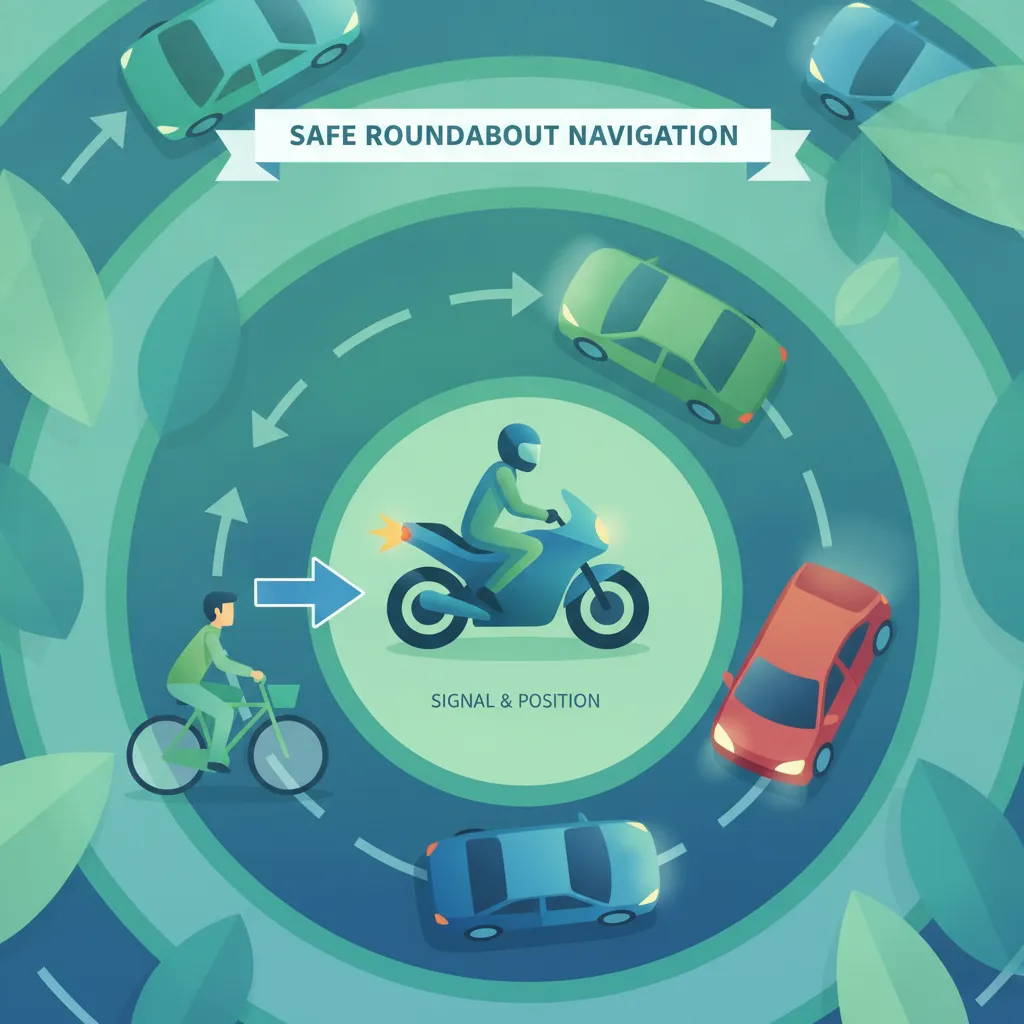
This lesson details the specific skills needed to navigate roundabouts on a motorcycle. It explains how to approach at a safe speed, select the correct lane based on your intended exit, and yield to circulating traffic. Proper use of signals to indicate intentions when entering and exiting is also covered.
Learn how to adjust countersteering, lean angle, and body positioning for diverse conditions like wet roads, gravel, and with passengers or luggage, according to Danish driving theory.
This lesson equips riders with the knowledge to handle imperfect road surfaces safely. It covers how to adjust speed, steering, and braking inputs when encountering loose gravel, slippery wet leaves, or other hazards. The focus is on smooth control inputs to avoid upsetting the motorcycle's stability.
This lesson focuses on the fundamental skills of balance and steering. It explains how body position affects the vehicle's center of gravity and stability. The concept of counter-steering is introduced as the primary method for initiating turns at moderate to high speeds, a key skill for effective control.
This lesson breaks down the process of cornering into three distinct phases: entry, apex, and exit. It teaches how to choose an appropriate entry speed, select a safe line through the turn, and use smooth throttle control on exit. Proper technique in these areas is fundamental to safe and enjoyable riding.

This lesson focuses on the challenges of braking in adverse conditions like rain or on icy patches. It teaches riders to increase their following distance and apply brakes smoothly and gently to prevent traction loss. The role of ABS in these scenarios and strategies for maintaining control are also explained.

This lesson focuses on techniques for riding when visibility and traction are compromised by weather. It explains how to adjust speed, increase following distance, and use lights to see and be seen in rain or fog. Understanding the risk of hydroplaning and making smooth control inputs are key takeaways.
This lesson details the specific skills needed to navigate roundabouts on a motorcycle. It explains how to approach at a safe speed, select the correct lane based on your intended exit, and yield to circulating traffic. Proper use of signals to indicate intentions when entering and exiting is also covered.

This lesson explores the critical relationship between tyres, road surface, and grip. It explains how rain, ice, gravel, and even painted road markings can reduce traction and increase risk. Learners will understand the importance of having correct tyre pressure and adequate tread depth to maintain control.
This lesson teaches riders how to manage the destabilizing effects of wind. It covers how to anticipate gusts, adjust body position to counteract pressure, and choose a lane position that offers more stability. These skills are essential for safety on open highways, bridges, and coastal areas.

This lesson details how to adapt riding techniques for rain and wind. It explains how wet surfaces reduce tyre grip and increase braking distances, requiring smoother control inputs and lower speeds. The content also provides strategies for managing the force of strong crosswinds on a small vehicle.

This lesson prepares riders for the specific hazards of rural roads, which often have less visibility and more unpredictable surfaces. It covers strategies for approaching blind curves, safely passing agricultural machinery, and being vigilant for animals on the road. Adjusting speed to match visibility is a core principle.
Find clear answers to common questions learners have about Countersteering Fundamentals and Body Dynamics. Learn how the lesson is structured, which driving theory objectives it supports, and how it fits into the overall learning path of units and curriculum progression in Denmark. These explanations help you understand key concepts, lesson flow, and exam focused study goals.
It is called countersteering because, at speeds above 20-30 km/h, you must briefly push the right handlebar forward to initiate a lean to the right. While it feels like you are steering in the opposite direction, the motorcycle's geometry causes it to lean and turn in the direction of the push.
No, at very low speeds, traditional steering (turning the handlebars in the direction of the turn) is used. Countersteering is only effective and necessary once you reach the speed where gyroscopic forces and steering geometry dictate the handling of the motorcycle.
While countersteering initiates the turn, your body position acts as a stabilizer. By shifting your weight appropriately, you can assist the motorcycle in maintaining the desired line, reducing the amount of lean required by the bike itself and keeping the machine more upright.
Yes, understanding the dynamics of cornering and vehicle control is part of the curriculum for A-category licenses in Denmark. You may encounter questions regarding how to initiate a turn or how to perform emergency avoidance maneuvers where countersteering is the primary technique.
Use our powerful search tool to pinpoint specific Danish driving theory topics, road signs, or traffic situations you need to review. Start exploring relevant practice sets now to reinforce your knowledge and build confidence for your upcoming driving licence exam.