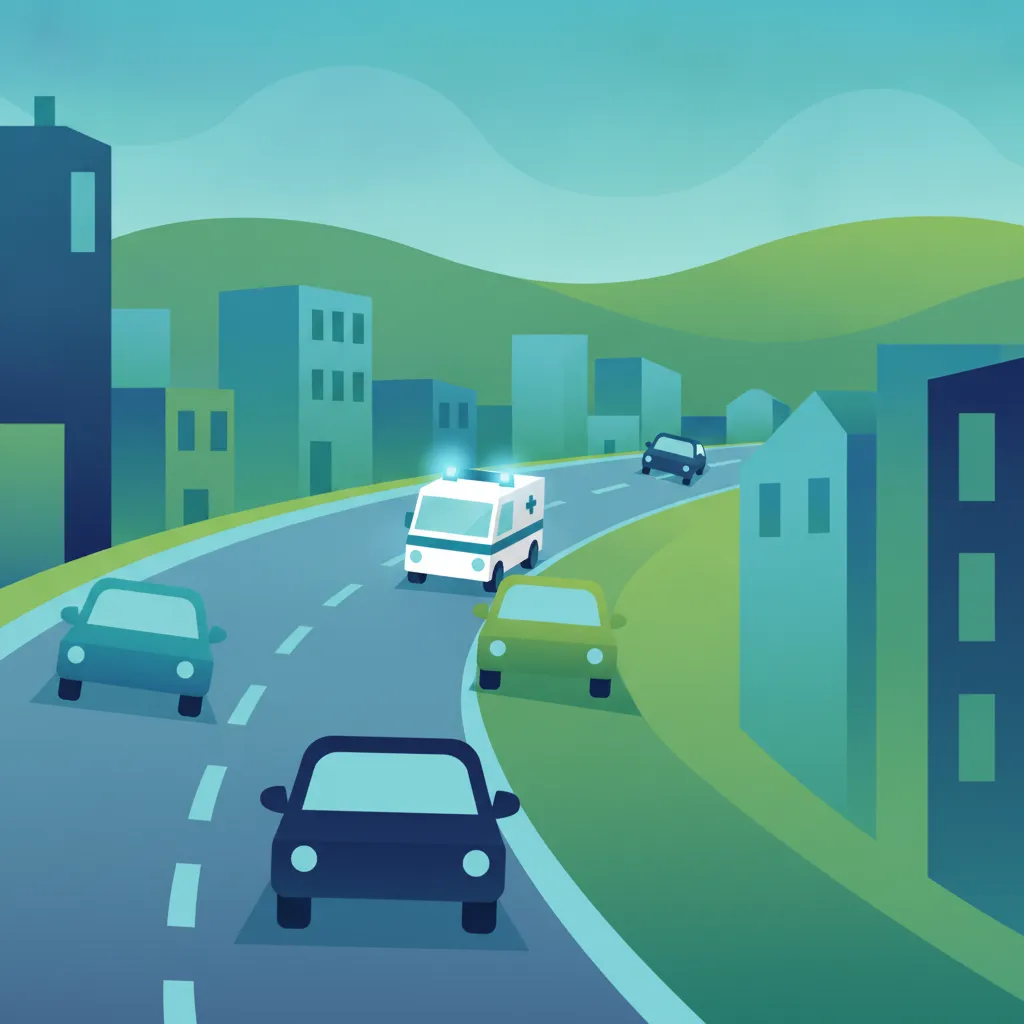
When an emergency vehicle, such as an ambulance, police car, or fire truck, approaches with flashing blue lights or sirens in Denmark, all other road users must immediately give way. This rule ensures that emergency responders can reach incidents without delay. Your safe and timely reaction can save lives, making it a critical aspect of responsible driving.
Theory topic content overview
Read the full theory topic guide for Emergency Vehicle Priority with structured, easy-to-scan content built for learners in Denmark. This detailed section explains the exact rule, meaning, traffic context, comparison points, and exam logic behind this Danish driving theory topic so you can study faster, understand the concept more clearly, and avoid common interpretation mistakes on the theory test.
When driving on Danish roads, you will inevitably encounter udrykningskøretøjer (emergency vehicles) such as ambulances, police cars, and fire trucks. These vehicles are on urgent missions, often responding to life-threatening situations where every second counts. As a driver, it is your legal obligation in Denmark to immediately give priority to these vehicles when they signal their presence with flashing blue lights and/or an audible siren. Understanding and correctly applying these emergency vehicle priority rules in Danish traffic is not just about compliance; it's a critical aspect of road safety and a key component of the Danish driving theory test.
The core concept is to ensure emergency responders have an unobstructed and safe path through traffic, allowing them to reach their destination without delay.
The importance of yielding to emergency vehicles cannot be overstated:
Your primary goal is to create a clear path for the emergency vehicle without creating a new hazard for yourself or other road users. This requires calm, decisive action.
Observe and Listen:
Assess the Situation:
Act Safely and Decisively:
Understanding what emergency vehicle priority is, and what it isn't, is crucial for the Danish theory test.
Danish traffic law is explicit about the requirement for giving way to emergency vehicles. The system is designed to allow police, fire, and ambulance services to respond as quickly as possible. The focus in Danish driving education is heavily on practical application and hazard perception, making this topic critical for the theory test. Scenarios presented often reflect typical Danish road layouts, including roundabouts where emergency vehicles might be approaching from any entry point, or narrow city streets common in older parts of Copenhagen or Aarhus.
Remember that udrykningskøretøjer are trained to navigate traffic, but they rely on your cooperation. Your responsibility extends to anticipating their approach and preparing to yield before they are directly upon you.
When you see or hear an emergency vehicle with blue lights and/or a siren in Denmark:
Your adherence to these Danish rules for yielding to emergency vehicles plays a vital role in road safety and helps our emergency services do their critical work effectively.
In Denmark, drivers must immediately yield to emergency vehicles with flashing blue lights and/or sirens, as this is both a legal requirement and a critical safety practice. The correct response involves observing the emergency vehicle's signals and direction, assessing your surroundings including mirrors and blind spots, then acting calmly to create an unobstructed path. On motorways, drivers must form an emergency corridor by moving to opposite sides of the road, while at intersections drivers should stop before entering even on green or clear the intersection if already inside it. The Danish theory test frequently includes hazard perception scenarios involving emergency vehicles, and failing to yield can result in fines and penalty points on your licence.
A short set of high-value points that capture the most important ideas from this theory explanation.
Drivers in Denmark have a legal obligation to immediately give way to emergency vehicles displaying flashing blue lights and/or sirens
Emergency vehicles include ambulances, police cars, and fire trucks responding to urgent situations where every second counts
The correct reaction follows three steps: observe the signals and direction, assess your surroundings, then act safely to create a clear path
On Danish motorways, drivers must form an emergency corridor by moving left from the leftmost lane or right from other lanes
Never follow closely behind an emergency vehicle to get through traffic yourself—this is illegal and dangerous
Only blue flashing lights grant emergency priority; amber or orange lights indicate slow vehicles or road maintenance without special priority rights
At intersections, stop before entering even on a green light if an emergency vehicle needs to pass through
If already in an intersection, proceed through it to clear the way, then pull over and stop—never block an intersection
Check mirrors and blind spots before making any manoeuvre to avoid creating hazards for cyclists, pedestrians, or other vehicles
Emergency vehicles may not continue straight—they could turn, so wait until they have passed and their intentions are clear
Panicking and making sudden unpredictable movements like swerving without checking mirrors or slamming on brakes
Freezing or failing to move enough to create a genuinely clear path for the emergency vehicle
Relying only on visual cues and ignoring sirens, especially in well-insulated modern vehicles where sirens can be hard to hear
Blocking pedestrian crossings or cycle paths while waiting for an emergency vehicle to pass, endangering vulnerable road users
Assuming the emergency vehicle will continue straight and not preparing for it to turn at an intersection
Start with a short, direct summary of Emergency Vehicle Priority before reading the full explanation below.
In Denmark, drivers must immediately give priority to emergency vehicles displaying blue flashing lights and/or sounding a siren. This means safely moving to the side of the road, stopping, or taking other necessary actions to create an unobstructed path. Always remain calm and check your surroundings to avoid sudden movements or creating additional hazards.
Review the most important terms, rule signals, and traffic concepts linked to Emergency Vehicle Priority.
Explore related theory topic pages connected to Emergency Vehicle Priority and continue with the next useful rule explanation.
See the common search queries learners use when trying to understand Emergency Vehicle Priority in Denmark.

Dive into detailed explanations of Danish traffic legislation, road signs, and driving conventions. Solidify your understanding of key theory topics and prepare confidently for all sections of your official Danish driving license theory exam.
Explore Driving Theory TopicsTheory topic content overview
A short set of high-value points that capture the most important ideas from this theory explanation.
Drivers in Denmark have a legal obligation to immediately give way to emergency vehicles displaying flashing blue lights and/or sirens
Emergency vehicles include ambulances, police cars, and fire trucks responding to urgent situations where every second counts
The correct reaction follows three steps: observe the signals and direction, assess your surroundings, then act safely to create a clear path
On Danish motorways, drivers must form an emergency corridor by moving left from the leftmost lane or right from other lanes
Never follow closely behind an emergency vehicle to get through traffic yourself—this is illegal and dangerous
Only blue flashing lights grant emergency priority; amber or orange lights indicate slow vehicles or road maintenance without special priority rights
At intersections, stop before entering even on a green light if an emergency vehicle needs to pass through
If already in an intersection, proceed through it to clear the way, then pull over and stop—never block an intersection
Check mirrors and blind spots before making any manoeuvre to avoid creating hazards for cyclists, pedestrians, or other vehicles
Emergency vehicles may not continue straight—they could turn, so wait until they have passed and their intentions are clear
Panicking and making sudden unpredictable movements like swerving without checking mirrors or slamming on brakes
Freezing or failing to move enough to create a genuinely clear path for the emergency vehicle
Relying only on visual cues and ignoring sirens, especially in well-insulated modern vehicles where sirens can be hard to hear
Blocking pedestrian crossings or cycle paths while waiting for an emergency vehicle to pass, endangering vulnerable road users
Assuming the emergency vehicle will continue straight and not preparing for it to turn at an intersection
Start with a short, direct summary of Emergency Vehicle Priority before reading the full explanation below.
In Denmark, drivers must immediately give priority to emergency vehicles displaying blue flashing lights and/or sounding a siren. This means safely moving to the side of the road, stopping, or taking other necessary actions to create an unobstructed path. Always remain calm and check your surroundings to avoid sudden movements or creating additional hazards.
Review the most important terms, rule signals, and traffic concepts linked to Emergency Vehicle Priority.
Explore related theory topic pages connected to Emergency Vehicle Priority and continue with the next useful rule explanation.
See the common search queries learners use when trying to understand Emergency Vehicle Priority in Denmark.
Dive into detailed explanations of Danish traffic legislation, road signs, and driving conventions. Solidify your understanding of key theory topics and prepare confidently for all sections of your official Danish driving license theory exam.
Explore Driving Theory TopicsUse this exam-focused revision tip to understand how Emergency Vehicle Priority is likely to appear in theory questions for learners in Denmark. This section helps you identify the most testable part of the rule, avoid common traps, and remember the concept more effectively during Danish driving theory exam preparation.
In the Danish theory test, questions about emergency vehicles often focus on safe and practical reactions. Remember that your priority is to create a clear path safely, without endangering yourself or others. Pay attention to scenarios involving intersections, motorways, and situations where you might need to temporarily adjust your position without causing further obstruction.
Read direct answers to the most common learner questions about Emergency Vehicle Priority in Denmark. This FAQ focuses on rule confusion, practical meaning, comparison with similar concepts, and the exact uncertainties that appear most often in Danish driving theory revision and exam preparation.
In Denmark, emergency vehicles typically include ambulances, police vehicles, and fire trucks that are actively responding to an emergency and are signaling this with flashing blue lights and/or sirens.
You must give priority whenever an emergency vehicle approaches, either from behind, ahead, or from an intersection, and is clearly signaling its urgent task with flashing blue lights or a siren.
If safe to do so, you should move aside to create space. You may cautiously cross the stop line or enter an intersection slightly to make way, but only if it does not endanger other traffic or pedestrians. Return to your original position as soon as the emergency vehicle has passed safely.
While you must give way, you should do so safely and without creating new hazards. This may involve temporarily disregarding a red light or lane marking, but always ensure your actions are predictable and do not put others at risk. The primary goal is safe passage for the emergency vehicle.
Slow down and signal your intention to move. If on a multi-lane road, move to the right-most lane to create a clear path on the left (or as instructed by road markings/signs). If on a single-lane road, move as far to the right as safely possible and stop.
Yes, emergency vehicles using blue flashing lights alone indicate an urgent task, and you are still obligated to give priority, although the urgency might seem less immediate than with a siren.
Stay calm, use your mirrors to assess the situation, signal your intentions clearly, and make gradual, controlled movements to create space. Avoid sudden braking or swerving, which can be dangerous for you and other drivers.
Use our powerful search tool to pinpoint specific Danish driving theory topics, road signs, or traffic situations you need to review. Start exploring relevant practice sets now to reinforce your knowledge and build confidence for your upcoming driving licence exam.