
Giving way means allowing other road users to proceed first to prevent conflicts or collisions. In Denmark, specific rules dictate when and how you must yield, especially at intersections, pedestrian crossings, and when merging. Mastering these priority situations is essential for maintaining safe traffic flow and successfully passing your Danish driving theory exam.
Theory topic content overview
Read the full theory topic guide for Danish Give Way Rules with structured, easy-to-scan content built for learners in Denmark. This detailed section explains the exact rule, meaning, traffic context, comparison points, and exam logic behind this Danish driving theory topic so you can study faster, understand the concept more clearly, and avoid common interpretation mistakes on the theory test.
Giving way, or vigepligt in Danish, means allowing another road user to proceed before you, preventing potential conflicts or collisions. It requires you to slow down, stop if necessary, and ensure that traffic with priority can continue its journey unimpeded. This fundamental principle of Danish traffic law is essential for safe driving and a critical part of the Danish driving theory exam.
At its heart, giving way is about orderly decision-making at conflict points on the road. It establishes a clear hierarchy, ensuring that drivers, cyclists, and pedestrians know whose turn it is to proceed, thereby maintaining safe and efficient traffic flow, particularly at intersections, roundabouts, and pedestrian crossings in Denmark.
Misunderstanding or failing to apply vigepligt rules is a leading cause of accidents and a common pitfall for learners in the Danish driving theory test. Denmark's road network, with its extensive cycling infrastructure and numerous roundabouts, demands a precise understanding of priority.
Vigepligt rules are enshrined in Danish traffic legislation. Failing to comply can result in fines, penalty points, and dangerous situations.When you approach a situation where vigepligt might apply, your decision process should be proactive and systematic:
fodgængerfelter), merging lanes, or any area where your path might cross with another road user.Vigepligt signs (the inverted triangular sign), Stop signs (octagonal), or signs indicating a priority road.højre vigepligt (right-hand priority) rule often applies in Denmark.vigepligt (must give way), slow down or stop completely to allow priority traffic to pass safely. Ensure you can join the traffic stream without forcing others to brake or swerve.The necessity to give way arises in several common scenarios, each with specific Danish interpretations:
Vigepligtstavle): This is the inverted red-and-white triangle. When you see this sign, you must give way to all traffic on the intersecting road, regardless of direction. You do not necessarily have to stop, but you must be able to if traffic requires it.Stopstavle): This red octagonal sign means you must stop completely before the stop line, even if there's no traffic. After stopping, you must then give way to all traffic on the intersecting road. This is a higher degree of vigepligt.Højre Vigepligt)In Denmark, where no signs, traffic lights, or road markings indicate otherwise, the right-hand priority rule (højre vigepligt) applies. This means you must give way to traffic approaching from your right. This rule is particularly prevalent on smaller roads and in residential areas. Always be aware that a vehicle from your right has priority unless signs or signals dictate otherwise.
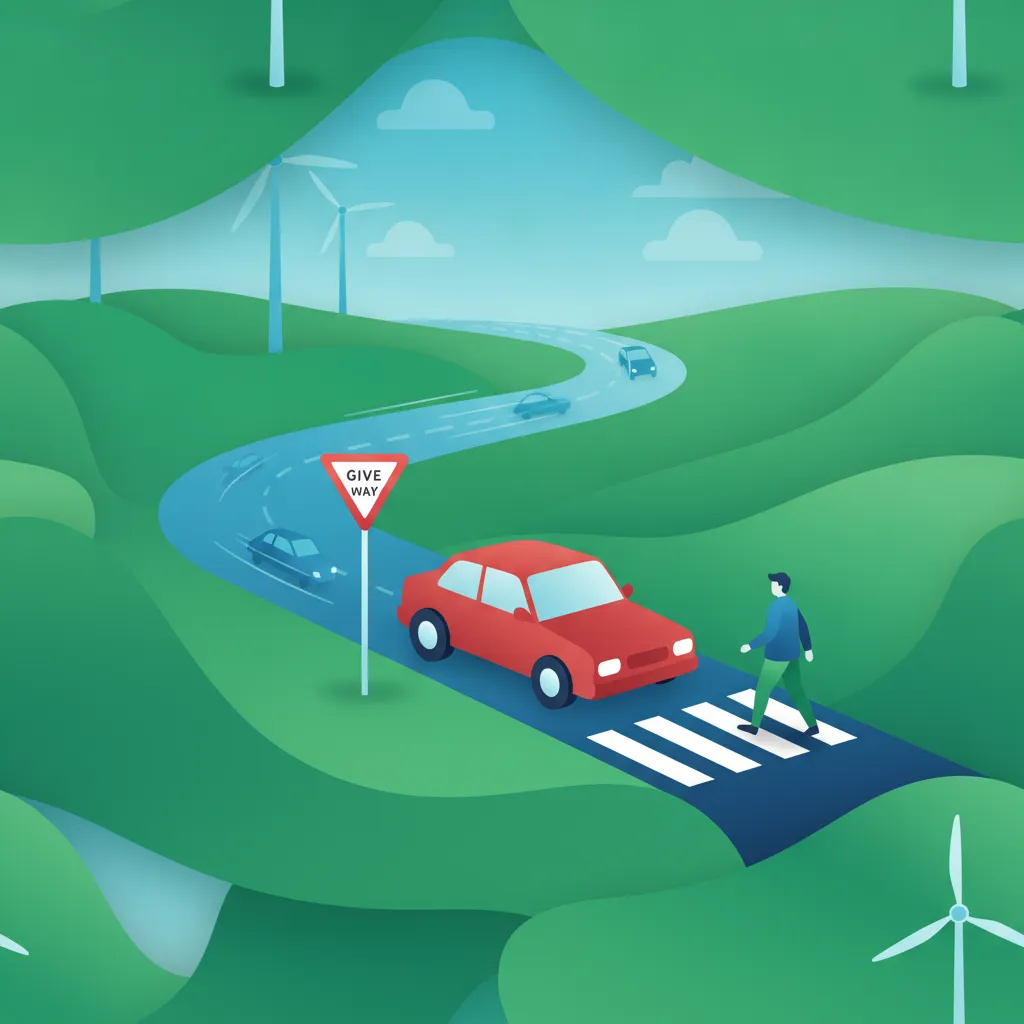
Fodgængerfelter)When approaching a marked pedestrian crossing (often a zebrastribet fodgængerfelt), you must give way to pedestrians who are either on the crossing or clearly intending to use it. This rule is strictly enforced in Denmark, reflecting a strong emphasis on pedestrian safety. Always be ready to stop.
Rundkørsler)In almost all Danish roundabouts, you must give way to traffic already circulating within the roundabout. There will typically be Vigepligt signs and triangular road markings at the entrance to reinforce this. You must also give way to cyclists on cycle paths around the roundabout, especially when entering or exiting, as they often have priority.
Motorvejsindkørsler)When entering a motorway (motorvej) from an acceleration lane (tilkørselsbane), you must give way to traffic already on the motorway. Your goal is to adjust your speed to match the motorway traffic and merge smoothly and safely into a suitable gap without forcing existing traffic to alter its speed or lane.
Vigepligt vs. Stop: Vigepligt means you must be prepared to stop and yield; Stop means you must stop, then yield. The Stop sign demands a full halt before proceeding cautiously.Højre Vigepligt vs. Sign-Regulated Priority: The right-hand rule is the default, but it is always overridden by traffic signs, lights, or road markings. Prioritise based on signs first, then the right-hand rule if no signs are present.Højre Vigepligt: You are driving in a Copenhagen residential area, approaching a small intersection with no signs. A car approaches from your right. You must slow down and be prepared to stop, allowing the vehicle from your right to proceed first.rundkørsel in Aarhus. You see the Vigepligt sign. You must check for traffic already in the roundabout and any cyclists on the cycle path circling it. You slow down, wait for a safe gap, and then enter.højre vigepligt rule.Højre Vigepligt: Overlooking the default right-hand priority rule on unmarked roads, leading to conflicts.Danish road law, particularly regarding vigepligt, places a high emphasis on clear communication and the protection of vulnerable road users. The prevalence of rundkørsler (roundabouts) and dedicated cykelstier (cycle paths) means that understanding how to interact safely with these elements is paramount. The Danish theory test will frequently challenge your ability to apply vigepligt in dynamic scenarios involving multiple road users. Always consider the safest outcome and never force another road user with priority to take evasive action.
The most important takeaway for vigepligt in Danish traffic is to drive defensively and be prepared to yield. Even when you think you have priority, anticipate that others might make a mistake. Look for signs, observe the entire traffic situation, correctly interpret priority rules, and be ready to slow down or stop to ensure safety and smooth traffic flow. Proactive decision-making at conflict points is key to mastering Danish give way rules.
In Danish traffic, vigepligt (giving way) is a fundamental safety principle requiring you to yield to other road users at conflict points. The inverted triangle sign means you must be ready to slow or stop, while the octagonal Stop sign requires a complete halt before proceeding. When no signs exist, højre vigepligt (right-hand priority) applies - give way to traffic from your right. Pedestrians on marked crossings, cyclists at cycle paths, and circulating traffic at roundabouts all have clear priority that you must respect. Mastering these rules is essential for both safe driving in Denmark and passing the Danish theory test.
A short set of high-value points that capture the most important ideas from this theory explanation.
Vigepligt means actively allowing priority traffic to proceed by slowing or stopping - you must ensure they can continue unimpeded
Traffic signs and markings always override the default højre vigepligt (right-hand priority) rule
Pedestrians on marked crossings have priority - you must stop and allow them to cross safely
At roundabouts, you must yield to all traffic already circulating, including cyclists on adjacent cycle paths
When merging onto a motorway, adjust your speed to fit into a gap without forcing existing traffic to brake
Vigepligt sign (inverted red-white triangle) = be prepared to slow/stop; Stop sign (octagonal) = complete halt is mandatory
Højre vigepligt applies only when no signs, lights, or markings indicate otherwise
Cyclists have priority when you turn across their path or at cycle crossings - always check before turning
The Stop sign demands a full, complete stop - a rolling stop is insufficient and dangerous
At any conflict point, prioritize: check signs first, then road markings, then apply højre vigepligt if needed
Assuming priority based on road size or feeling like you have the right of way instead of reading actual signs
Failing to scan thoroughly for cyclists and pedestrians before proceeding at intersections or crossings
Misjudging the speed or distance of approaching priority traffic, causing others to brake or swerve
Performing a rolling stop at a Stop sign instead of coming to a complete halt before the stop line
Overlooking højre vigepligt on unmarked roads, leading to conflicts with traffic approaching from the right
Start with a short, direct summary of Danish Give Way Rules before reading the full explanation below.
To give way means to yield to other road users, allowing them to proceed before you, often by slowing down or stopping. This ensures smooth traffic flow and prevents accidents, particularly at junctions, roundabouts, and pedestrian crossings in Denmark. You must always obey traffic signs, road markings, and general rules that indicate when you are required to give way.
Review the most important terms, rule signals, and traffic concepts linked to Danish Give Way Rules.
Explore related theory topic pages connected to Danish Give Way Rules and continue with the next useful rule explanation.
See the common search queries learners use when trying to understand Danish Give Way Rules in Denmark.

Dive into detailed explanations of Danish traffic legislation, road signs, and driving conventions. Solidify your understanding of key theory topics and prepare confidently for all sections of your official Danish driving license theory exam.
Explore Driving Theory TopicsTheory topic content overview
A short set of high-value points that capture the most important ideas from this theory explanation.
Vigepligt means actively allowing priority traffic to proceed by slowing or stopping - you must ensure they can continue unimpeded
Traffic signs and markings always override the default højre vigepligt (right-hand priority) rule
Pedestrians on marked crossings have priority - you must stop and allow them to cross safely
At roundabouts, you must yield to all traffic already circulating, including cyclists on adjacent cycle paths
When merging onto a motorway, adjust your speed to fit into a gap without forcing existing traffic to brake
Vigepligt sign (inverted red-white triangle) = be prepared to slow/stop; Stop sign (octagonal) = complete halt is mandatory
Højre vigepligt applies only when no signs, lights, or markings indicate otherwise
Cyclists have priority when you turn across their path or at cycle crossings - always check before turning
The Stop sign demands a full, complete stop - a rolling stop is insufficient and dangerous
At any conflict point, prioritize: check signs first, then road markings, then apply højre vigepligt if needed
Assuming priority based on road size or feeling like you have the right of way instead of reading actual signs
Failing to scan thoroughly for cyclists and pedestrians before proceeding at intersections or crossings
Misjudging the speed or distance of approaching priority traffic, causing others to brake or swerve
Performing a rolling stop at a Stop sign instead of coming to a complete halt before the stop line
Overlooking højre vigepligt on unmarked roads, leading to conflicts with traffic approaching from the right
Start with a short, direct summary of Danish Give Way Rules before reading the full explanation below.
To give way means to yield to other road users, allowing them to proceed before you, often by slowing down or stopping. This ensures smooth traffic flow and prevents accidents, particularly at junctions, roundabouts, and pedestrian crossings in Denmark. You must always obey traffic signs, road markings, and general rules that indicate when you are required to give way.
Review the most important terms, rule signals, and traffic concepts linked to Danish Give Way Rules.
Explore related theory topic pages connected to Danish Give Way Rules and continue with the next useful rule explanation.
See the common search queries learners use when trying to understand Danish Give Way Rules in Denmark.
Dive into detailed explanations of Danish traffic legislation, road signs, and driving conventions. Solidify your understanding of key theory topics and prepare confidently for all sections of your official Danish driving license theory exam.
Explore Driving Theory TopicsUse this exam-focused revision tip to understand how Danish Give Way Rules is likely to appear in theory questions for learners in Denmark. This section helps you identify the most testable part of the rule, avoid common traps, and remember the concept more effectively during Danish driving theory exam preparation.
During your Danish theory exam, pay close attention to the specific road user or direction that has priority. A common trap involves misjudging speeds or distances, leading to questions where you might impede priority traffic if you proceed. Always ensure you can complete your maneuver without forcing others to brake or swerve.
Read direct answers to the most common learner questions about Danish Give Way Rules in Denmark. This FAQ focuses on rule confusion, practical meaning, comparison with similar concepts, and the exact uncertainties that appear most often in Danish driving theory revision and exam preparation.
In Danish traffic, "giving way" (vigepligt) means you must allow other road users to proceed before you, slowing down or stopping as necessary to avoid obstructing their path or causing a dangerous situation.
You must give way at intersections when indicated by a "Give Way" (Vigepligt) sign (an inverted triangle), traffic lights, road markings like shark teeth, or the general right-of-way rule (højre vigepligt) if no other rules apply.
Pedestrians generally have priority at marked pedestrian crossings (fodgængerfelter) where you must stop if they intend to cross. However, they do not automatically have priority everywhere else; drivers must still be observant.
A "Give Way" sign (Vigepligt) requires you to yield to priority traffic, stopping only if necessary. A "Stop" sign (Stop) requires you to come to a complete stop before the stop line, even if no other traffic is visible, and then give way.
In Danish roundabouts, you must generally give way to traffic already circulating within the roundabout unless signs or markings indicate otherwise. You also give way to cyclists and pedestrians when exiting.
Failing to give way can lead to dangerous situations, collisions, and penalties such as fines or even a conditional disqualification of your driving license, depending on the severity and specific circumstances.
Give way rules are fundamental to safe driving and frequently appear in the Danish theory test because they assess your understanding of traffic priority, hazard perception, and decision-making in common traffic scenarios.
Use our powerful search tool to pinpoint specific Danish driving theory topics, road signs, or traffic situations you need to review. Start exploring relevant practice sets now to reinforce your knowledge and build confidence for your upcoming driving licence exam.