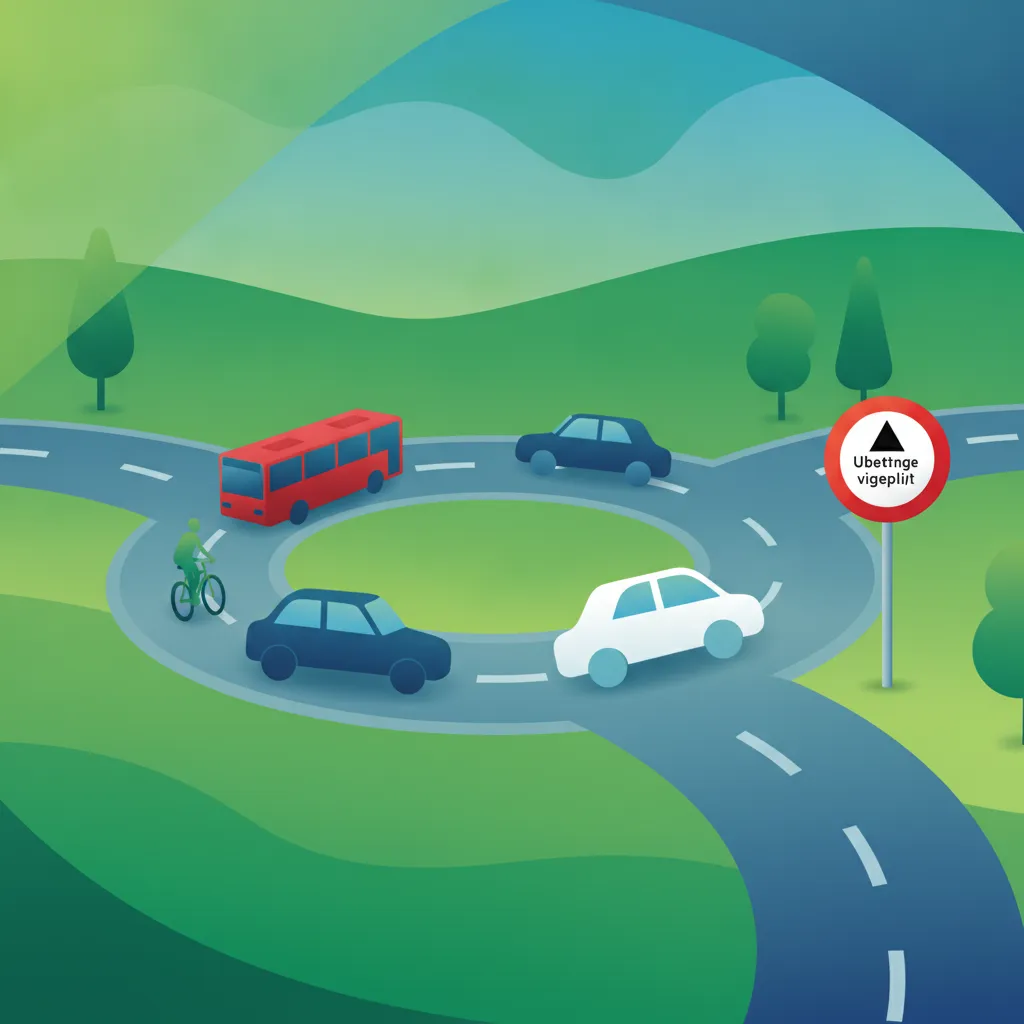
Roundabouts are designed to improve traffic flow and reduce accidents by replacing traditional intersections. In Denmark, specific rules dictate priority, primarily requiring vehicles entering a roundabout to yield to those already circulating. Correctly applying these rules, combined with proper signaling and observation, is crucial for safe and efficient navigation.
Theory topic content overview
Read the full theory topic guide for Roundabout Priority with structured, easy-to-scan content built for learners in Denmark. This detailed section explains the exact rule, meaning, traffic context, comparison points, and exam logic behind this Danish driving theory topic so you can study faster, understand the concept more clearly, and avoid common interpretation mistakes on the theory test.
Roundabouts are a common feature of Danish road networks, designed to improve traffic flow and reduce the severity of collisions compared to traditional intersections. Mastering the specific roundabout priority rules in Denmark is crucial for safe driving and a key requirement for passing your Danish driving theory test. The fundamental principle revolves around yielding to traffic already circulating within the roundabout, but with important nuances, especially concerning vulnerable road users.
Vigepligt in RoundaboutsIn Denmark, the term vigepligt translates to "priority" or "the duty to give way." When it comes to roundabouts, the primary vigepligt rule is clear: vehicles already in the roundabout have priority over vehicles wishing to enter it.
This means that as you approach a roundabout, you must be prepared to stop and yield to any vehicle (car, motorcycle, moped, or bicycle) that is already circulating inside. This rule is reinforced by specific road signs and markings you will always encounter at Danish roundabouts.
Understanding rundkørsel vigepligt is vital for several reasons:
Navigating a Danish roundabout safely involves a sequence of observations and actions:
Ubetinget VigepligtAs you approach a roundabout, you will encounter the following:
Rundkørsel (A 16): A triangular sign with three arrows forming a circle, indicating a roundabout ahead.Ubetinget vigepligt (B 11): A white triangle with a red border, pointing downwards. This sign means "unconditional give way."Vigelinje (S 11) / "Hajtænder": White triangular markings (often called "shark teeth") painted on the road surface, reinforcing the Ubetinget vigepligt sign.These signs and markings unequivocally instruct you to yield to all traffic already in the roundabout. You must:
Only enter the roundabout when there is a clear and safe gap in circulating traffic. You must not force any vehicle already inside to brake, swerve, or adjust their speed.
Once inside, you have priority over any new vehicles attempting to enter.
vognbanepile) painted on the road, as these override general guidelines.Exiting a roundabout in Denmark requires particular care, especially due to cyclists and pedestrians.
vigepligt distinction in Denmark. When you exit, you are essentially turning right across the path of any cyclists on an adjacent cycle path and pedestrians at a marked crossing (fodgængerfelt).
Ubetinget Vigepligt at Entry is Absolute: Unlike some countries where right-hand priority might apply at unmarked roundabouts, in Denmark, the Ubetinget vigepligt rule at entry is universal for all established roundabouts.Undervisningsplan kategori B) explicitly states that drivers must orient themselves regarding cyclists and moped riders as they would when making a right turn at an intersection.Learners and even experienced drivers often make these mistakes:
When approaching any roundabout in Denmark, remember the mantra: "Scan, Yield, and Signal."
Vigepligt): Unconditionally yield to all traffic already in the roundabout, indicated by the Ubetinget vigepligt sign and Hajtænder.By diligently applying these Danish vigepligt rules, you will navigate roundabouts safely and confidently.
Danish roundabout priority centers on the vigepligt principle: vehicles already circulating always have priority over those entering. Drivers approaching a roundabout must yield unconditionally (Ubetinget vigepligt) using signs and shark-teeth markings, reduce speed, and wait for a safe gap. A critical Danish nuance is cyclist priority at exits—drivers exiting must yield to cyclists on adjacent cycle paths, treating it like a right turn at an intersection. Proper lane selection based on intended exit and mandatory right signalling before exiting complete safe roundabout navigation in Denmark.
A short set of high-value points that capture the most important ideas from this theory explanation.
Vehicles already inside a roundabout always have priority over vehicles attempting to enter
Drivers must unconditionally yield at entry, indicated by the Ubetinget vigepligt (B 11) sign and Vigelinje (shark teeth) markings
Right-turn signalling before exiting is mandatory and warns cyclists and pedestrians of your intent
Cyclists on adjacent cycle paths have priority when you exit a roundabout and must be yielded to
Lane choice in multi-lane roundabouts depends on your intended exit: right lane for first/second exits, left lane for later exits
Rundkørsel (A 16) warning sign announces a roundabout ahead; Ubetinget vigepligt (B 11) requires unconditional yielding
Always scan left for circulating traffic and right for cyclists on cycle paths when approaching and exiting
You must not force any vehicle already circulating to brake or swerve when entering
When exiting, yield to cyclists continuing on adjacent cycle paths and pedestrians at crossings
Vognbanepile (lane arrows) on the road override general lane guidelines
Failing to yield to cyclists at exits because focusing only on car traffic in the roundabout
Not signalling right before exiting, or signalling too early which confuses other drivers
Entering the roundabout too fast, reducing ability to judge gaps safely
Choosing the wrong lane in multi-lane roundabouts, leading to dangerous late changes
Poor observation of the entire roundabout including all entry points and vulnerable road users
Start with a short, direct summary of Roundabout Priority before reading the full explanation below.
In Denmark, the general rule is that traffic already in the roundabout has priority over vehicles entering it. Drivers approaching a roundabout must slow down, observe circulating traffic (including cyclists and moped riders), and yield unconditionally before entering if required by signs like "Ubetinget vigepligt" (B 11) and "Vigelinje" (shark teeth). Proper lane choice and signaling are also vital for safe circulation and exit.
Review the most important terms, rule signals, and traffic concepts linked to Roundabout Priority.
Explore related theory topic pages connected to Roundabout Priority and continue with the next useful rule explanation.
See the common search queries learners use when trying to understand Roundabout Priority in Denmark.

Dive into detailed explanations of Danish traffic legislation, road signs, and driving conventions. Solidify your understanding of key theory topics and prepare confidently for all sections of your official Danish driving license theory exam.
Explore Driving Theory TopicsTheory topic content overview
A short set of high-value points that capture the most important ideas from this theory explanation.
Vehicles already inside a roundabout always have priority over vehicles attempting to enter
Drivers must unconditionally yield at entry, indicated by the Ubetinget vigepligt (B 11) sign and Vigelinje (shark teeth) markings
Right-turn signalling before exiting is mandatory and warns cyclists and pedestrians of your intent
Cyclists on adjacent cycle paths have priority when you exit a roundabout and must be yielded to
Lane choice in multi-lane roundabouts depends on your intended exit: right lane for first/second exits, left lane for later exits
Rundkørsel (A 16) warning sign announces a roundabout ahead; Ubetinget vigepligt (B 11) requires unconditional yielding
Always scan left for circulating traffic and right for cyclists on cycle paths when approaching and exiting
You must not force any vehicle already circulating to brake or swerve when entering
When exiting, yield to cyclists continuing on adjacent cycle paths and pedestrians at crossings
Vognbanepile (lane arrows) on the road override general lane guidelines
Failing to yield to cyclists at exits because focusing only on car traffic in the roundabout
Not signalling right before exiting, or signalling too early which confuses other drivers
Entering the roundabout too fast, reducing ability to judge gaps safely
Choosing the wrong lane in multi-lane roundabouts, leading to dangerous late changes
Poor observation of the entire roundabout including all entry points and vulnerable road users
Start with a short, direct summary of Roundabout Priority before reading the full explanation below.
In Denmark, the general rule is that traffic already in the roundabout has priority over vehicles entering it. Drivers approaching a roundabout must slow down, observe circulating traffic (including cyclists and moped riders), and yield unconditionally before entering if required by signs like "Ubetinget vigepligt" (B 11) and "Vigelinje" (shark teeth). Proper lane choice and signaling are also vital for safe circulation and exit.
Review the most important terms, rule signals, and traffic concepts linked to Roundabout Priority.
Explore related theory topic pages connected to Roundabout Priority and continue with the next useful rule explanation.
See the common search queries learners use when trying to understand Roundabout Priority in Denmark.
Dive into detailed explanations of Danish traffic legislation, road signs, and driving conventions. Solidify your understanding of key theory topics and prepare confidently for all sections of your official Danish driving license theory exam.
Explore Driving Theory TopicsUse this exam-focused revision tip to understand how Roundabout Priority is likely to appear in theory questions for learners in Denmark. This section helps you identify the most testable part of the rule, avoid common traps, and remember the concept more effectively during Danish driving theory exam preparation.
Pay close attention to roundabout scenarios in your Danish theory test. A common mistake is failing to yield to vehicles already in the roundabout, especially cyclists. Remember: traffic *in* the roundabout usually has priority, and signaling *before* exiting is mandatory. Always scan for vulnerable road users.
Read direct answers to the most common learner questions about Roundabout Priority in Denmark. This FAQ focuses on rule confusion, practical meaning, comparison with similar concepts, and the exact uncertainties that appear most often in Danish driving theory revision and exam preparation.
In Denmark, vehicles already circulating inside the roundabout always have priority over vehicles wishing to enter, unless otherwise indicated by traffic lights or specific signs. You must yield to all traffic already in the roundabout.
You will typically see the "Rundkørsel" (A 16) warning sign approaching a roundabout. More importantly, the "Ubetinget vigepligt" (B 11) sign, often combined with "Vigelinje" (S 11) or shark teeth markings on the road, indicates that you must yield to traffic in the roundabout.
You do not signal when entering a roundabout. You must signal when exiting the roundabout. If you are taking the first exit, signal right before entering. For all other exits, signal right just before you intend to leave the roundabout.
In many Danish roundabouts, cyclists and moped riders who are already circulating also have priority. Drivers must be especially attentive and yield to cyclists both when entering and exiting the roundabout, as they are vulnerable road users.
Your lane choice depends on your intended exit. Generally, if you plan to take the first exit (right turn), use the rightmost lane. For other exits (straight or left turn), use the left lane(s). Always follow road markings and signs, and ensure you are in the correct lane well before entering.
Always approach roundabouts at a reduced, appropriate speed. This gives you time to observe circulating traffic, make decisions about yielding, and select the correct lane. Once inside, maintain a safe, low speed to allow for smooth circulation and safe exiting.
Use our powerful search tool to pinpoint specific Danish driving theory topics, road signs, or traffic situations you need to review. Start exploring relevant practice sets now to reinforce your knowledge and build confidence for your upcoming driving licence exam.