
This lesson provides essential training on how to respond correctly when encountering a road accident in France. You will learn the mandatory Protect, Alert, and Rescue (PAS) protocol to ensure your safety and the safety of others while complying with official traffic laws.
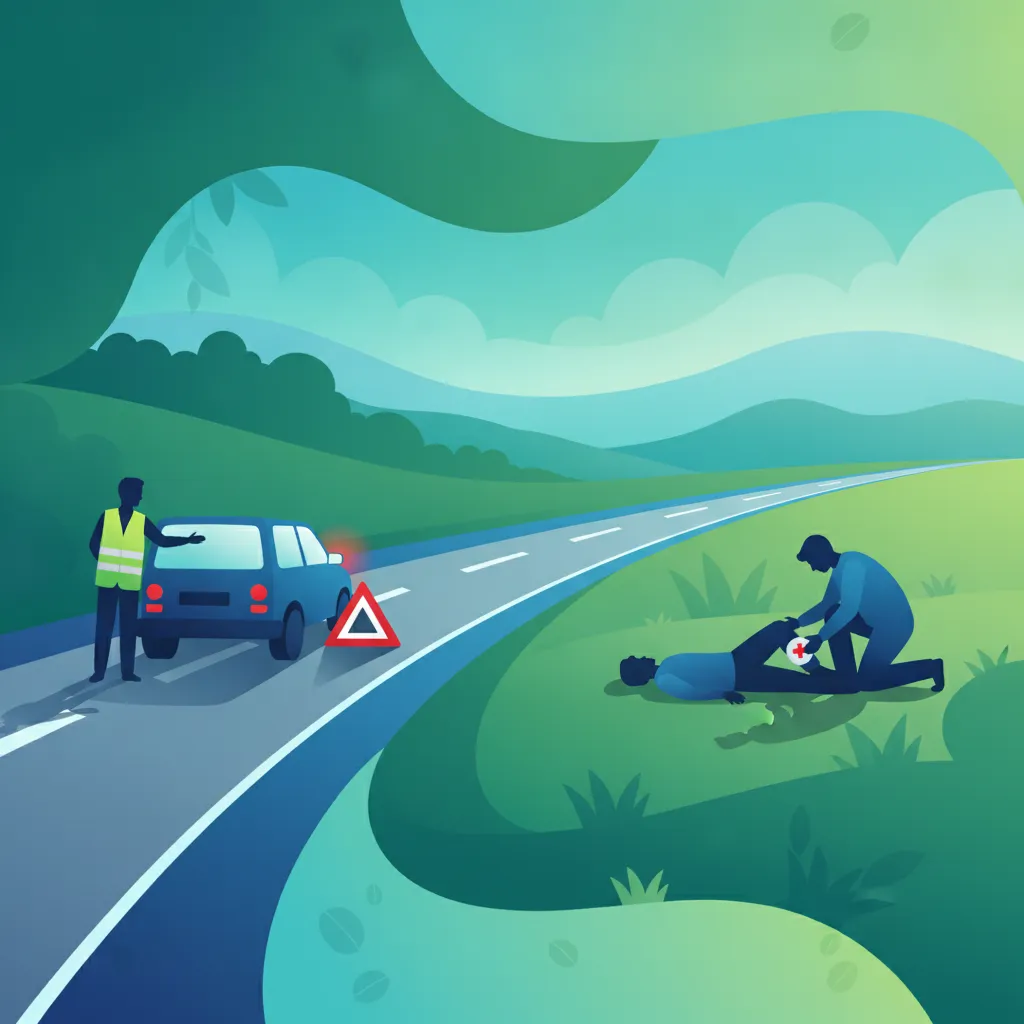
Lesson content overview
Encountering or being involved in a road traffic accident is one of the most stressful experiences a driver can face. On French roads, your response in these critical moments is not just a matter of safety—it is strictly regulated by the Code de la route (French Highway Code) and the French Penal Code.
This lesson covers the essential protocols, legal duties, and basic first-aid practices required for the French Category B driving theory exam (Examen de l'Éthique Générale or ETG). Mastering these rules will help you protect lives, prevent secondary collisions, and fulfill your civic and legal duties as a licensed driver.
In France, road safety is deeply rooted in mutual responsibility. If you witness or are involved in an accident, you have strict legal obligations.
Under French law, any driver involved in a road traffic accident must stop immediately. Failing to stop when you are aware that you have caused or been involved in an accident is classified as a hit-and-run (délit de fuite). This is a severe criminal offense.
A criminal offense in France occurring when a driver involved in an accident fails to stop, attempting to escape civil or criminal liability.
Even if you did not cause the accident, simply witnessing it binds you to a legal duty to assist under the French Penal Code (Non-assistance à personne en danger). If you see an accident with injured victims and there are no emergency services or other helpers already securing the site, you must stop and provide assistance, provided you can do so without endangering yourself or others.
To handle an emergency systematically, French road safety authorities mandate the PAS protocol: Protect (Protéger), Alert (Alerter), and Rescue (Secourir). This order must always be respected. You cannot rescue anyone if you fail to protect yourself first, as you risk becoming a victim yourself.
The primary objective of this step is to make the accident scene visible to oncoming traffic, preventing secondary collisions (suraccident), which are often more severe than the initial crash.
Under French law, a high-visibility yellow reflective vest (bearing the CE mark) must be stored within the passenger compartment of your vehicle, not in the boot. It must be accessible without exiting the car.
Turn off the engine and switch on your hazard warning lights (feux de détresse) immediately.
Put on your high-visibility yellow vest before unbuckling your seatbelt or opening your door.
Carefully exit the vehicle, preferably on the side away from active traffic (e.g., passenger side or toward the shoulder).
Instruct all passengers to exit the vehicle and move immediately behind the safety barriers (especially on motorways) or onto the grass verge.
Every Category B vehicle in France must carry a warning triangle. This triangle must be placed on the road to warn oncoming traffic of the hazard ahead.
Failing to have a high-visibility vest and a warning triangle inside your vehicle can result in a fine of up to 135€ per missing item.
Once the scene is secured and there is no immediate danger of a secondary crash, you must immediately contact professional rescue services.
In France, you can dial several emergency numbers, all of which are free of charge and accessible even from locked mobile phones or phones without a SIM card/credit:
On motorways, you should use the orange emergency phone booths (bornes d'appel d'urgence) placed every 2 kilometres. These calls are routed directly to the motorway operating company and police, automatically transmitting your precise location.
To ensure a rapid and appropriate response, be prepared to provide the following details clearly:
Never hang up first. Always wait for the emergency operator to instruct you to end the call, as they may need to guide you through life-saving procedures.
Providing immediate care to victims before professional help arrives can double their survival rate, particularly in cases of cardiac arrest or severe hemorrhaging.
Approach the victim safely. Speak to them loudly and shake their shoulders gently: "Can you hear me? Open your eyes if you can."
If the victim is unconscious but breathing normally, you must place them in the Recovery Position (known in France as the Position Latérale de Sécurité or PLS). This keeps their airway open and prevents them from choking on their tongue or fluids.
Align the victim's legs straight. Place the arm closest to you at a right angle to their body, elbow bent, palm facing upward.
Bring their other arm across their chest, placing the back of their hand against their cheek closest to you. Hold it there.
With your other hand, grasp the victim's far leg just above the knee and pull it up, keeping the foot flat on the ground.
Using the bent leg as a lever, gently roll the victim toward you onto their side.
Adjust the upper leg so that both the hip and knee are bent at right angles to stabilize the body.
Gently tilt their head back to keep the airway open, and open their mouth slightly to allow fluids to drain.
If the victim is unconscious and not breathing (or breathing with abnormal gasps), they are in cardiac arrest. You must initiate CPR (Massage Cardiaque) immediately.
If a victim is bleeding heavily, you must act fast to prevent hypovolemic shock.
In high-speed road accidents, always suspect a neck or spinal injury.
When a collision results only in minor material damage (no injuries), the police do not need to be dispatched. Instead, drivers must fill out a standardized European accident report form known in France as the Constat Amiable (Friendly Accident Report).
The constat amiable is a legally binding document used by insurance companies to determine liability. It is split into two main columns (one for Vehicle A, one for Vehicle B) and a central section for checking boxes that describe the circumstances.
You must submit the completed and signed constat amiable to your insurance company within 5 business days of the accident. If your vehicle was stolen or vandalized, the deadline to file a police report and notify insurance is typically shorter (2 days).
This lesson covers the mandatory PAS protocol for French Category B drivers, detailing how to protect an accident scene with a high-visibility vest and warning triangle, alert emergency services using 112 or other dedicated numbers, and provide basic first aid including the recovery position (PLS) and CPR. It explains critical legal duties under the Code de la route, including the obligation to stop and assist under Article L313-1, and outlines the proper procedure for completing a Constat Amiable accident report within the 5-day deadline. Learners must understand these procedures to pass the ETG exam and act legally and safely when encountering road emergencies in France.
A short set of high-value points that capture the most important learning from this lesson.
The PAS protocol (Protect, Alert, Rescue) must always be executed in this exact order to prevent secondary accidents and additional victims
High-visibility vest must be worn before unbuckling your seatbelt, and the warning triangle must be placed at least 30 metres behind the vehicle
Emergency number 112 is recommended across France as it routes calls automatically to the appropriate local service
The Constat Amiable must be submitted to your insurer within 5 business days; both drivers must sign the form before separation
Never give food or drink to injured victims as they may require emergency surgery under anesthesia
Explore all units and lessons included in this driving theory course.
Yellow vest must be stored inside the passenger compartment, not the boot, to be accessible while seated
On motorways, do not place the warning triangle if it endangers your life; stay behind the safety barrier instead
When calling emergency services, provide your name, precise location (road name and PK marker), number of victims, and their conditions
For unconscious but breathing victims, place them in the PLS (Recovery Position) to keep the airway clear
CPR requires 100-120 chest compressions per minute, compressing the chest 5-6 cm, alternating 30 compressions with 2 rescue breaths if trained
Keeping the high-visibility vest in the boot instead of the passenger cabin, making it inaccessible in an emergency
Placing the warning triangle after a bend or hill crest where oncoming drivers cannot see it in time to brake safely
Hanging up before the emergency operator ends the call, potentially losing critical life-saving guidance
Removing a motorcyclist's helmet unless they are not breathing and CPR is required, as incorrect removal can cause spinal injury
Signing the Constat Amiable without carefully checking the circumstances boxes, as no modifications can be made after both parties sign
Lesson content overview
A short set of high-value points that capture the most important learning from this lesson.
The PAS protocol (Protect, Alert, Rescue) must always be executed in this exact order to prevent secondary accidents and additional victims
High-visibility vest must be worn before unbuckling your seatbelt, and the warning triangle must be placed at least 30 metres behind the vehicle
Emergency number 112 is recommended across France as it routes calls automatically to the appropriate local service
The Constat Amiable must be submitted to your insurer within 5 business days; both drivers must sign the form before separation
Never give food or drink to injured victims as they may require emergency surgery under anesthesia
Explore all units and lessons included in this driving theory course.
Yellow vest must be stored inside the passenger compartment, not the boot, to be accessible while seated
On motorways, do not place the warning triangle if it endangers your life; stay behind the safety barrier instead
When calling emergency services, provide your name, precise location (road name and PK marker), number of victims, and their conditions
For unconscious but breathing victims, place them in the PLS (Recovery Position) to keep the airway clear
CPR requires 100-120 chest compressions per minute, compressing the chest 5-6 cm, alternating 30 compressions with 2 rescue breaths if trained
Keeping the high-visibility vest in the boot instead of the passenger cabin, making it inaccessible in an emergency
Placing the warning triangle after a bend or hill crest where oncoming drivers cannot see it in time to brake safely
Hanging up before the emergency operator ends the call, potentially losing critical life-saving guidance
Removing a motorcyclist's helmet unless they are not breathing and CPR is required, as incorrect removal can cause spinal injury
Signing the Constat Amiable without carefully checking the circumstances boxes, as no modifications can be made after both parties sign
Explore search topics learners often look for when studying Emergency Situations and First Aid Basics. These topics reflect common questions about road rules, driving situations, safety guidance, and lesson level theory preparation for learners in France.
Browse additional driving theory lessons that cover connected traffic rules, road signs, and common driving situations related to this topic. Improve your understanding of how different rules interact across everyday traffic scenarios.
Learn about the legal obligations of Category B drivers regarding accident reporting, the consequences of hit-and-run offenses, and the administrative points system in France. This guide explains how the Code de la route enforces road safety through penalties and official documentation procedures to help you understand your legal duties.

Traffic violations in France entail direct points deductions, financial fines, and administrative actions managed online. This lesson explains how traffic offenses are classified and how points are deducted from your total allowance of twelve. You will learn the process for paying fines, how to formally contest a citation via official channels, and the rules for attending points-recovery training.
Violating traffic regulations in France triggers strict administrative penalties, including point deductions and financial fines. This lesson examines the structure of the French point-based licence, specifically noting how probationary licences start with fewer points. It outlines the differences between fine categories, vehicle impoundment procedures, and options for recovering points through voluntary safety awareness courses.

This lesson examines the legal consequences, heavy monetary fines, and driver's licence point deductions resulting from traffic and transport safety violations. Learners will study specific infractions such as driving over legal hours, vehicle overloading, and ignoring passenger seatbelt laws. Understanding the strict enforcement systems in France ensures drivers actively avoid risky habits that could end their careers.

This lesson details the structure of the French points-based licensing system, explaining how points are deducted for specific traffic violations. You will learn about the special probation rules for novice licenses and the process of recovering lost points through safety courses. It also covers the fine structures, warning that ignoring basic safety laws like speed limits can lead to immediate vehicle impoundment and license suspension.
This lesson delves into the dual aspects of civil and criminal liability that professional goods vehicle drivers face in the event of traffic violations or accidents. Learners will explore the range of penalties, including fines, licence suspension, vehicle seizure, and potential imprisonment for severe offenses under French law. The discussion also covers the impact of negligence on insurance coverage, the accrual of penalty points, and the broader consequences for both the driver and their employer.
This lesson outlines the range of penalties that can be imposed for violations of traffic laws and administrative requirements specific to goods vehicles. Learners will understand the financial implications of fines, the potential for licence suspension or revocation, and the circumstances under which a vehicle may be seized. The content also addresses demerit points accumulation, administrative sanctions, and the importance of compliance.

Illegal narcotics and certain over-the-counter or prescription medications severely affect a driver's focus and neurological coordination. This lesson details drug screen procedures (saliva tests) and the zero-tolerance policy for driving under the influence of narcotics. You will also learn to read the standardized warning triangles on French pharmaceutical boxes, which classify medications from level one to three.

Alcohol consumption severely impairs coordination, visual depth perception, decision-making capabilities, and physical reaction times. This lesson outlines the legal Blood Alcohol Concentration limits in France: 0.5 grams per liter for standard drivers, and 0.2 grams per liter for probationary drivers. You will learn how alcohol levels are measured by police breath tests and the severe penalties for driving over the limit.

Driving safely involves a mutual social contract based on courtesy, safety awareness, and active risk mitigation. This lesson discusses the principles of defensive driving, prioritizing vulnerable road users like cyclists and pedestrians, and managing driver stress. It also highlights eco-driving strategies that help reduce fuel consumption and environmental emissions, fostering safer and cleaner shared roads.

Operating a passenger vehicle in France requires strict compliance with dynamic safety laws and maintenance rules. This lesson explains your duty of care toward other road users, mandatory child restraint and seatbelt laws, and strict prohibitions on phone use while driving. You will also learn about the required periodic technical vehicle inspections (controle technique) and third-party insurance mandates.
Explore the principles of hazard perception and proactive anticipation on French roads. This lesson details how to identify potential risks in various driving conditions, such as urban areas or motorways, and provides strategies to adapt your speed and distance to prevent accidents before they occur.

Proactive drivers scan the road constantly, detecting potential dangers before they turn into real-world emergency situations. This lesson teaches scanning techniques, the use of rear-view mirrors, and the interpretation of visual cues from other road users. You will learn to anticipate hazards like child play near roads, merging vehicles, and sudden lane changes, helping you drive defensively.

Learners will develop the ability to anticipate potential hazards on the road, enhancing reaction times and defensive riding strategies. The lesson emphasizes constant scanning, early identification of threats such as sudden stops, pedestrian crossings, or unexpected lane changes, and appropriate response measures. By cultivating proactive risk assessment, AM riders can significantly reduce accident likelihood.
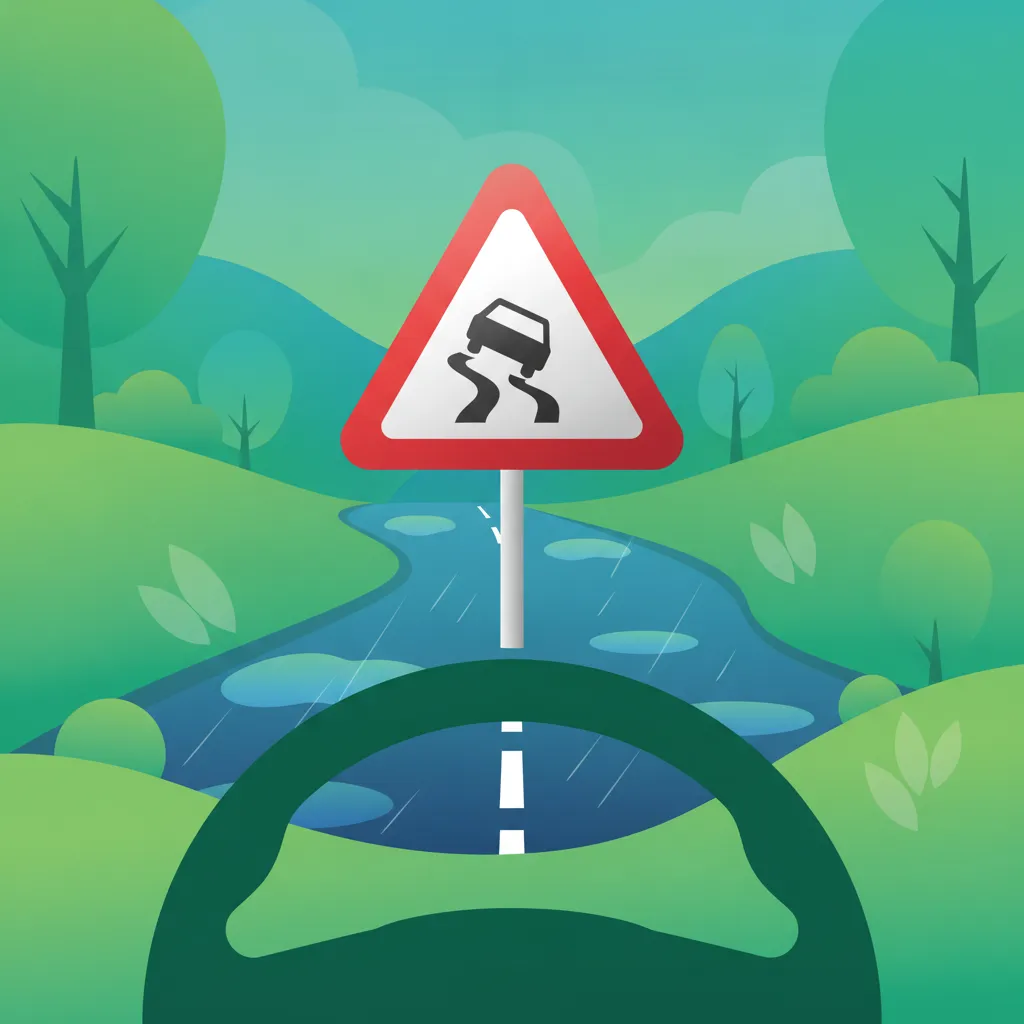
Warning signs on French roads are triangular with a red border, designed to alert drivers to upcoming dangers. This lesson teaches you how to interpret warnings for sharp curves, slippery surfaces, narrowing lanes, and wildlife or animal crossing hazards. You will understand the safety adjustments needed when approaching school zones, active roadworks, or crossings where vulnerable pedestrians are present.

This lesson focuses on French warning signs that alert drivers to potential hazards ahead, such as curves, animal crossings, or slippery surfaces, with particular attention to signs relevant to AM riders. Learners will examine how to interpret these signs, understand the associated risks, and adapt riding behavior accordingly. By mastering warning sign recognition, riders can proactively manage safety risks in diverse road conditions.

In this lesson, drivers will learn strategies to avoid conflicts with smaller vehicles, such as cars and vans, which may not be as visible in large vehicle blind spots. The content emphasizes maintaining adequate spacing, using proper lane discipline, and being aware of small vehicles' behavior during lane changes and turns. Learners will also be introduced to communication techniques, such as signalling and eye contact.

Rural roads account for a high percentage of severe accidents due to narrow widths, winding geometries, and sudden hazards. This lesson teaches strategies for negotiating sharp bends, handling agricultural machinery, and reacting to wildlife warning signs. You will learn to manage your vehicle's lane placement on roads with soft shoulders and understand speed limits on rural networks.

In this lesson, drivers will explore the specific challenges presented by rural road environments, including narrower lanes, shared space with agricultural vehicles, and frequent wildlife crossings. The content emphasizes adapting speed to road curvature, surface conditions, and visibility while navigating hills and bends. Learners will also learn to interpret rural road signage and understand the importance of maintaining vigilance.

Adverse weather reduces tyre traction and limits visibility, dramatically raising the risk of multi-car accidents on highways. This lesson details speed reductions required during rainfall, techniques for avoiding aquaplaning, and demisting windshields for visibility. You will learn how to maintain extra stopping distance on snow-covered roads and the correct headlight adjustments to make during fog.
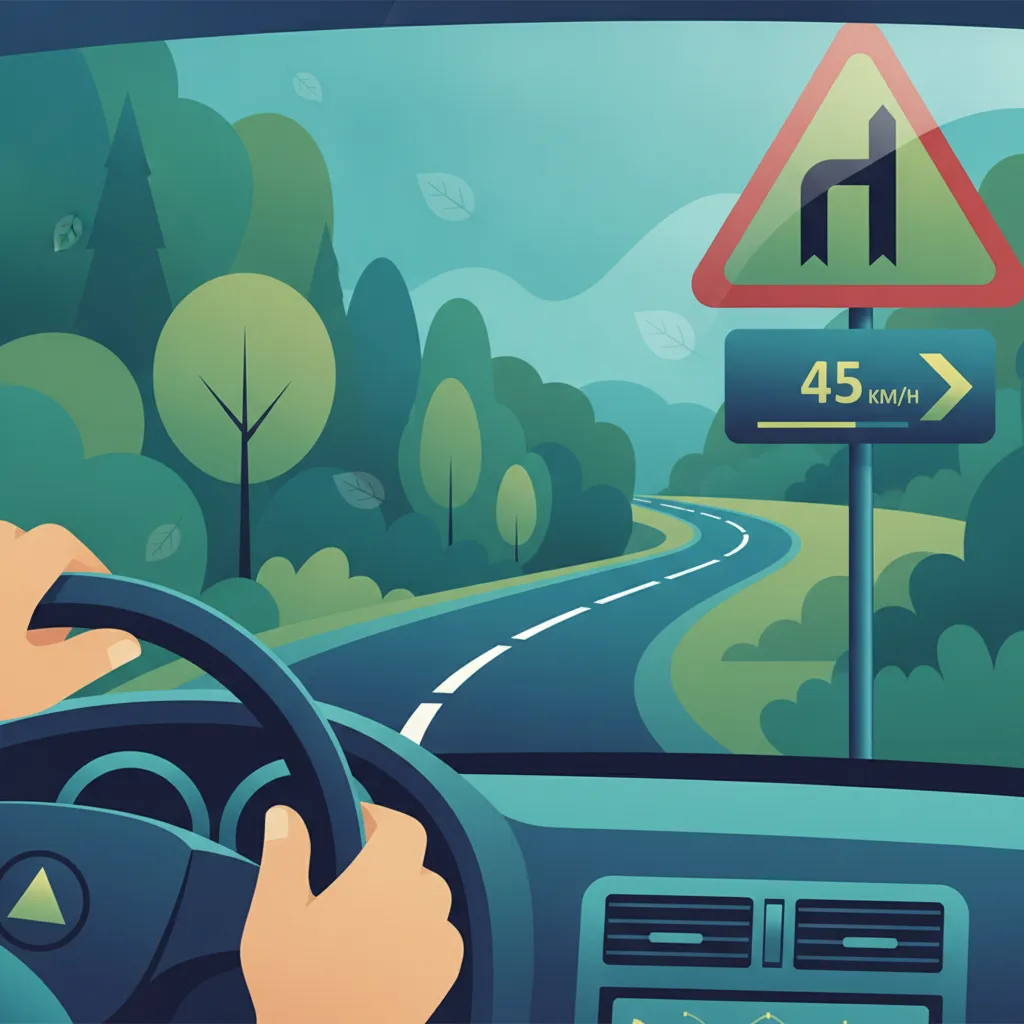
The legal speed limit is a maximum threshold, not a target speed that is always safe to maintain. This lesson teaches you how to select an appropriate, safe speed based on visibility, traffic congestion, and road topography. You will learn how to negotiate blind turns, approach summits with caution, and reduce speeds in heavy traffic to ensure you always maintain complete control of your vehicle.
Find clear answers to common questions learners have about Emergency Situations and First Aid Basics. Learn how the lesson is structured, which driving theory objectives it supports, and how it fits into the overall learning path of units and curriculum progression in France. These explanations help you understand key concepts, lesson flow, and exam focused study goals.
PAS stands for Protéger (Protect the scene), Alerter (Alert emergency services by calling 112), and Secourir (Rescue/assist the victims). This is the mandatory sequence of actions to ensure safety.
You must put on your high-visibility vest before stepping out of your vehicle to secure the area, such as placing your warning triangle. It makes you visible to other traffic and is a legal requirement.
While not strictly mandatory by law if other means of report exist, it is the standard document in France for documenting accidents with other vehicles to facilitate insurance processing.
You should never move a victim unless there is an immediate, life-threatening danger, such as a risk of fire or vehicle explosion. Moving an injured person can cause permanent physical damage.
Ready to focus your study? Use the practice search to find exactly the French driving theory questions you need for the Code de la route and permis de conduire ETG. Refine your knowledge on specific topics or challenging rules to boost your confidence and exam readiness.