
This lesson focuses on the critical observational skills required for safe moped and scooter operation in Germany. You will learn systematic scanning patterns and the life-saving habit of checking blind spots to interact safely with other road users.

Lesson content overview
Developing sharp visual perception and a keen awareness of blind spots is fundamental for every rider, especially those operating mopeds and scooters within the German road system. As an AM licence holder, your ability to observe, interpret, and react to the ever-changing traffic environment directly impacts your safety and the safety of others. This lesson provides a comprehensive guide to mastering these critical skills, ensuring you can navigate roads confidently and responsibly.
Effective visual perception involves more than just looking; it's about systematically scanning your surroundings, understanding the limitations of your mirrors, and actively performing head checks to eliminate hidden zones. Furthermore, recognizing the significant blind spots of larger vehicles like trucks and buses is paramount for safe interaction on shared roads. By integrating these techniques, you'll build a robust foundation for proactive and defensive riding.
Visual perception is your primary tool for anticipating hazards, understanding traffic flow, and making safe decisions on the road. For riders of mopeds and scooters, who are inherently more vulnerable than car occupants, an accurate and timely understanding of the traffic environment is not just good practice – it's a matter of survival. This involves continuously gathering information about other road users, road conditions, and potential dangers, then correctly interpreting that information to plan your actions.
Without strong visual perception skills, a rider might miss crucial cues, misjudge distances, or fail to detect vehicles in their blind spots, leading to dangerous situations during common maneuvers like lane changes, merging, or overtaking. This lesson will equip you with the systematic approaches necessary to maintain comprehensive situational awareness, significantly reducing your risk on German roads.
Systematic scanning is a structured, repetitive visual routine designed to ensure you consistently check all relevant areas around your moped or scooter. It's a proactive strategy to gather information about your surroundings, reducing the likelihood of overlooking critical details that could lead to an accident. Instead of just glancing around, a systematic scan involves a deliberate, predefined pattern of observation.
Systematic scanning is a continuous process that involves checking your forward view, rearview mirrors, and performing lateral checks (head checks) in a methodical sequence. The goal is to build a complete mental picture of the traffic environment, identifying potential hazards, the position of other vehicles, and the condition of the road ahead. This routine should be ingrained and performed before, during, and after any maneuver, as well as continuously while riding.
A robust scanning pattern typically involves a repetitive cycle that covers all zones around your vehicle. While riding, your eyes should constantly be moving, but in a structured way:
Forward View: Continuously scan the road ahead, looking for traffic signs, signals, road markings, potential hazards (pedestrians, cyclists, potholes), and the general flow of traffic. Look beyond the vehicle immediately in front of you.
Rearview Mirror: Glance at your rearview mirror every 5-8 seconds, or more frequently in heavy traffic, to monitor what is happening behind you. Note vehicles approaching or following.
Side Mirrors: Check your left and right side mirrors frequently to monitor adjacent lanes, vehicles attempting to overtake, or those in your immediate vicinity.
Head Checks (Blind Spots): Before any lateral maneuver (lane change, merge, turn, overtaking), perform a brief but decisive head check to visually inspect areas not covered by your mirrors. This is crucial for detecting vehicles in your blind spots.
Repeat: This cycle should be fluid and continuous, adapting to traffic density and road conditions.
Riders often make errors in their scanning habits that compromise safety. Be aware of these common mistakes:
Mirrors are indispensable tools for monitoring traffic behind and to the sides of your moped or scooter without requiring you to turn your head. Proper adjustment and continuous, effective use of your mirrors are critical components of maintaining full situational awareness.
Before you even start riding, it is essential to adjust all your mirrors to provide the best possible view of the road behind and beside you. Mirrors that are improperly adjusted can create larger blind spots and reduce your ability to react safely.
Rearview Mirror (if applicable): While seated in your normal riding position, adjust the rearview mirror so you can see as much of the road directly behind you as possible, with minimal view of your own shoulders or vehicle.
Left Side Mirror: Adjust this mirror so you can just barely see the left rear fender or edge of your scooter/moped. The rest of the mirror's view should be focused on the lane to your left and the road behind. This helps minimize the blind spot on your left side.
Right Side Mirror: Similar to the left, adjust the right side mirror so you can just barely see the right rear fender or edge of your scooter/moped. The majority of the view should cover the lane to your right and the road behind. This helps to reduce the blind spot on your right.
Always adjust your mirrors when the vehicle is stationary and you are in your typical riding position. If another person uses your vehicle or if you modify your riding gear, re-check your mirror adjustments.
Mirrors are not just for checking before a maneuver; they should be used continuously while riding. Regular glances in your rearview and side mirrors help you:
In busy urban environments or on multi-lane roads, increase your mirror checks. A quick glance every few seconds ensures you are always up-to-date with your immediate surroundings.
While mirrors provide an invaluable rearward view, they have inherent limitations. Due to the angle of reflection, there are areas around your moped or scooter that cannot be seen in any mirror. These are known as blind spots. Relying solely on mirrors is a common and dangerous mistake that can lead to collisions, especially during lane changes or turns. It is crucial to remember that what you can't see in your mirrors is just as important as what you can see. This limitation underscores the absolute necessity of performing head checks.
Head checks are a non-negotiable safety procedure for any rider. They are the final, decisive visual confirmation that your blind spots are clear before you commit to a lateral maneuver. Neglecting to perform a head check is a leading cause of collisions, particularly involving mopeds and scooters, as another vehicle can easily be hidden in the blind spot.
Your mirrors, even when perfectly adjusted, cannot provide a complete 360-degree view around your vehicle. The areas directly to the rear-sides of your moped or scooter, which are out of your direct line of sight and not reflected in your mirrors, are your blind spots. A vehicle, especially another moped, a bicycle, or even a car, can easily "hide" in this zone. A head check involves briefly turning your head to physically look into these areas, thereby eliminating the blind spot.
In Germany, performing a head check before changing lanes, merging, or turning is not just good practice; it is a mandatory requirement for safe riding, emphasized in the Straßenverkehrs-Ordnung (StVO). Failure to do so can have severe legal consequences and lead to dangerous situations.
A head check should be brief, decisive, and integrated seamlessly into your systematic scanning routine. It should not cause you to swerve or lose control of your moped.
Scan Mirrors: Before initiating the head check, perform your usual mirror checks (rearview, then side mirror in the direction of the intended maneuver). This gives you an initial assessment of the situation.
Brief Head Turn: Quickly turn your head to glance over your shoulder in the direction you intend to move. For a left lane change, glance over your left shoulder; for a right turn or merge, glance over your right shoulder.
Return Eyes Forward: Immediately return your gaze to the road ahead to monitor your path and traffic. The entire head check should take less than a second.
Act Decisively: If the blind spot is clear, proceed with your maneuver while continuously monitoring your surroundings. If it's not clear, do not proceed.
Head checks are vital for several common riding maneuvers:
Beyond your own vehicle's blind spots, it is critical for AM licence riders to understand and anticipate the blind spots of other vehicles, especially larger ones. These unseen areas represent significant risk zones, and knowing where they are can help you avoid dangerous situations.
Blind spots are simply areas around any vehicle that the driver or rider cannot see through their mirrors or by direct line of sight. Every vehicle, regardless of size, has them. For a moped or scooter, your blind spots are relatively small compared to a car, but they are still large enough to hide another moped, a cyclist, or even a smaller car.
As a moped rider, your blind spots are typically limited to the rear-quarter areas, just to the sides of your rear wheel. These are the zones that your side mirrors cannot fully cover. However, due to your exposed position and greater maneuverability, it's easier for other, larger vehicles to overlook you, making your own awareness of their blind spots even more important.
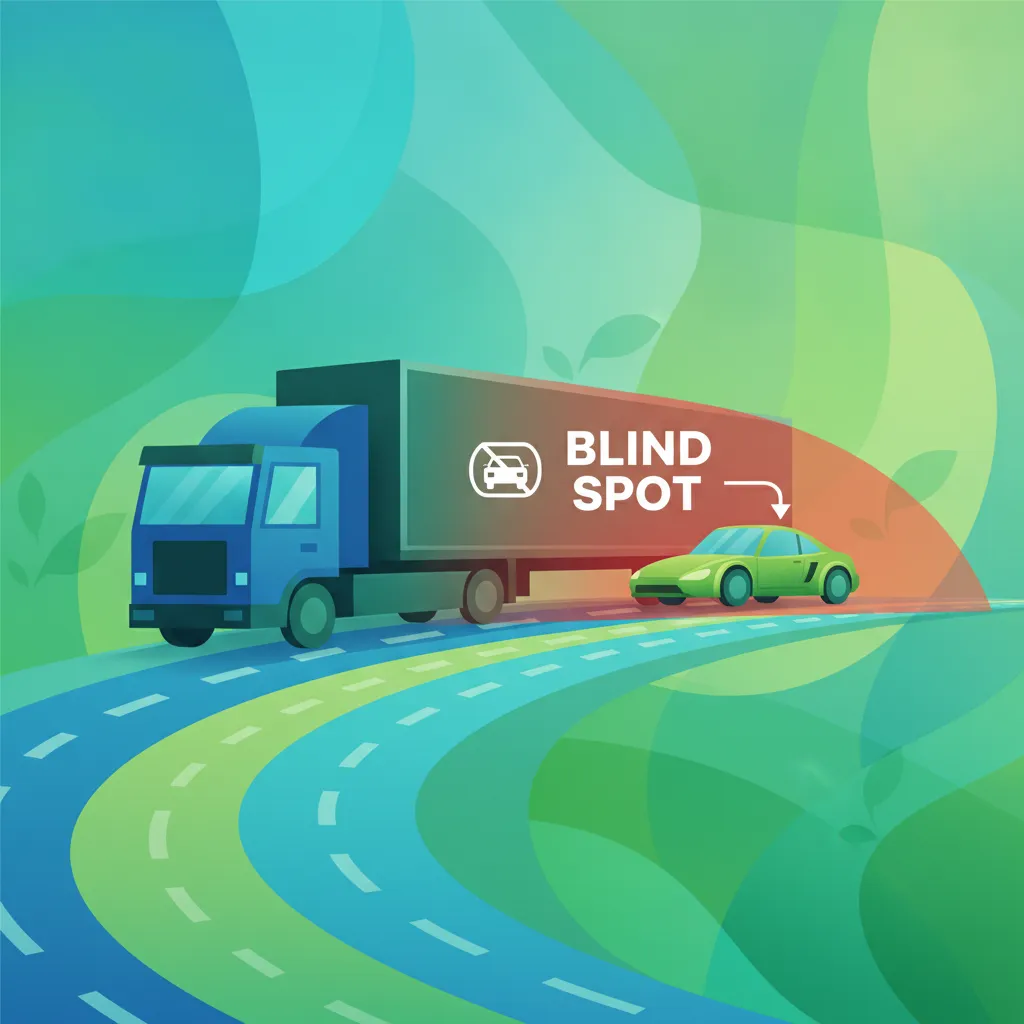
Trucks, buses, and other large commercial vehicles have significantly larger and more numerous blind spots than passenger cars or mopeds. These "no-zones" are critical areas to avoid. A driver of a large vehicle may genuinely not see you if you are in one of these areas.
The main blind spot areas for large vehicles include:
To ensure your safety when interacting with large vehicles:
In Germany, the Straßenverkehrs-Ordnung (StVO) sets out clear rules that reinforce the importance of visual perception and blind spot awareness for all road users, including AM licence riders. Adhering to these regulations is not only a legal obligation but also a fundamental aspect of safe driving.
The principles of visual perception and blind spot awareness remain constant, but their application needs to be adapted to varying environmental and traffic conditions.
Let's illustrate these concepts with practical examples relevant to AM licence riders:
Merging onto a Main Road:
Overtaking a Slower Vehicle on a Two-Lane Road:
Following a Bus in City Traffic:
Effective visual perception and diligent blind spot awareness are cornerstones of safe riding for AM licence holders. By consistently applying the principles outlined in this lesson, you significantly reduce your risk of accidents and contribute to safer German roads.
These practices are not isolated; they integrate seamlessly with other crucial riding skills such as correct road positioning, effective signaling, and safe interaction with all road users. By mastering visual perception, you become a more proactive, predictable, and safer rider.
This lesson teaches AM licence riders the critical observational skills needed for safe moped and scooter operation in Germany. It covers systematic scanning techniques that continuously monitor forward view, mirrors, and blind spots through head checks. Proper mirror adjustment and the mandatory head check procedure under StVO are emphasized as non-negotiable safety requirements. Riders must also understand that trucks and buses have much larger blind spots than smaller vehicles, making it essential to avoid these no-zones, pass large vehicles quickly on the left, and maintain greater following distances. These scanning habits must be intensified in challenging conditions such as rain, fog, darkness, or dense urban traffic.
A short set of high-value points that capture the most important learning from this lesson.
Adopt a systematic visual scanning pattern: forward view, rearview mirror, side mirrors, and head checks in a continuous cycle
Mirrors alone are insufficient; head checks are mandatory before any lateral maneuver to eliminate blind spots
Trucks and buses have extensive blind spots directly in front, on both sides, and directly behind their trailers
If you cannot see a truck driver's face in their side mirror, they cannot see you either
Increase scanning frequency and following distances in adverse weather, low light, or heavy traffic
Explore all units and lessons included in this driving theory course.
Head check (Blick über die Schulter) is mandatory under StVO before changing lanes, merging, turning, or overtaking
Mirror adjustment: rearview should show mostly road behind; side mirrors should show just a glimpse of your own vehicle's edge
Never overtake large vehicles on their right side; always pass on the left to remain in their visible zone
Maintain a significantly greater following distance behind trucks and buses than you would behind cars
A head check takes less than a second and should be brief, decisive, and integrated smoothly into your routine
Fixed gaze on the vehicle ahead, preventing awareness of the broader traffic environment
Skipping head checks entirely and relying solely on mirrors before lane changes or turns
Using improperly adjusted mirrors that create larger blind spots instead of reducing them
Lingering alongside trucks or buses in their extensive side blind spots
Failing to increase scanning frequency when visibility is reduced by weather or darkness
Lesson content overview
A short set of high-value points that capture the most important learning from this lesson.
Adopt a systematic visual scanning pattern: forward view, rearview mirror, side mirrors, and head checks in a continuous cycle
Mirrors alone are insufficient; head checks are mandatory before any lateral maneuver to eliminate blind spots
Trucks and buses have extensive blind spots directly in front, on both sides, and directly behind their trailers
If you cannot see a truck driver's face in their side mirror, they cannot see you either
Increase scanning frequency and following distances in adverse weather, low light, or heavy traffic
Explore all units and lessons included in this driving theory course.
Head check (Blick über die Schulter) is mandatory under StVO before changing lanes, merging, turning, or overtaking
Mirror adjustment: rearview should show mostly road behind; side mirrors should show just a glimpse of your own vehicle's edge
Never overtake large vehicles on their right side; always pass on the left to remain in their visible zone
Maintain a significantly greater following distance behind trucks and buses than you would behind cars
A head check takes less than a second and should be brief, decisive, and integrated smoothly into your routine
Fixed gaze on the vehicle ahead, preventing awareness of the broader traffic environment
Skipping head checks entirely and relying solely on mirrors before lane changes or turns
Using improperly adjusted mirrors that create larger blind spots instead of reducing them
Lingering alongside trucks or buses in their extensive side blind spots
Failing to increase scanning frequency when visibility is reduced by weather or darkness
Explore search topics learners often look for when studying Visual Perception and Blind Spot Awareness. These topics reflect common questions about road rules, driving situations, safety guidance, and lesson level theory preparation for learners in Germany.
Browse additional driving theory lessons that cover connected traffic rules, road signs, and common driving situations related to this topic. Improve your understanding of how different rules interact across everyday traffic scenarios.
Develop advanced observation techniques and learn to predict the actions of other road users. This lesson covers systematic scanning, anticipating hazards, and understanding vehicle dynamics for safer AM licence riding in Germany.

This lesson focuses on strategic road positioning to enhance safety and visibility. It explains where to ride within a lane under different circumstances, such as approaching intersections or riding alongside parked cars. A key skill covered is anticipating the potential actions of other drivers, cyclists, and pedestrians.

This lesson builds on defensive driving by focusing specifically on hazard perception ('Gefahrenerkennung'). It teaches you how to actively scan the driving environment for potential risks, not just immediate dangers. You will learn to anticipate the likely actions of other road users and identify clues that signal a developing hazardous situation, allowing you to react early and safely.

This lesson trains drivers to proactively identify vulnerable road users and anticipate their often unpredictable behavior. It highlights the specific risks posed by children, elderly pedestrians, cyclists, and e-scooter users, particularly near bus stops and crossings. The goal is to develop a heightened sense of risk perception and apply defensive driving techniques to protect those who are most at risk on the road.

This lesson teaches the essential observation techniques required for safe riding, focusing on the systematic use of mirrors and shoulder checks to manage blind spots. It emphasizes developing active scanning habits to maintain constant situational awareness of the surrounding traffic environment. Learners will understand how effective head movement and use of peripheral vision are critical for detecting potential hazards early.

This lesson teaches the systematic observation techniques required for safe driving, starting with how to scan the road far ahead, nearby, and to the sides. It details the correct frequency for checking interior and exterior mirrors to maintain situational awareness. The lesson highlights the indispensable over-the-shoulder check ('Schulterblick') to cover the vehicle's blind spot before any change in direction.

This lesson focuses on identifying and managing internal and external risk factors. It discusses the dangers of distractions like mobile phones, the influence of peer pressure in group riding scenarios, and the impairing effects of fatigue, alcohol, and drugs. The goal is to foster a mature and responsible attitude towards riding.

This lesson focuses on maintaining a safe buffer around the vehicle in traffic. It explains the 'two-second rule' as a simple method for ensuring adequate following distance and discusses how to adjust this for adverse conditions. A key focus is on developing hazard anticipation skills through continuous scanning and risk assessment.

This lesson focuses on the importance of strategic road positioning for enhancing safety and visibility. Learners explore different lane positions and understand when to use them to see, be seen, and create a safety buffer. The content emphasizes maintaining a long visual focus down the road to anticipate hazards and avoid target fixation, particularly when cornering.

This lesson provides a comprehensive guide to identifying and managing the significant blind spots around a large passenger vehicle. It covers the correct adjustment and use of all mirrors, supplemented by camera systems, to gain maximum visibility. The importance of performing physical checks ('shoulder checks') before turning or changing lanes is emphasized to detect smaller road users like cyclists and pedestrians who may be hidden from view.

This lesson focuses on identifying and safely managing various road surface imperfections and hazards. It provides techniques for riding over loose surfaces like gravel, dealing with the low traction of wet leaves or manhole covers, and safely crossing tram tracks. The key is to recognize these hazards early and adjust technique accordingly.
Understand the critical concept of blind spots for all vehicle types, including trucks and buses. Learn effective head checks and mirror usage techniques to ensure safe maneuvering and interaction with other traffic participants for the AM licence.

This lesson teaches the proper adjustment of all required mirrors to maximize the field of vision and minimize blind spots. It discusses the limitations of indirect vision and the importance of aligning mirrors based on the driver's seating position. The content also outlines the typical blind zones for heavy vehicles and strategies to mitigate them.
This lesson provides a comprehensive guide to identifying and managing the significant blind spots around a large passenger vehicle. It covers the correct adjustment and use of all mirrors, supplemented by camera systems, to gain maximum visibility. The importance of performing physical checks ('shoulder checks') before turning or changing lanes is emphasized to detect smaller road users like cyclists and pedestrians who may be hidden from view.
This lesson focuses on the blind spot zones specific to trucks and vehicle combinations, explaining where these zones are located. It covers the use of blind spot mirrors and other aids to enhance driver awareness during lane changes and turns. The content stresses the importance of maintaining safe distances from vulnerable road users.
This lesson teaches the essential observation techniques required for safe riding, focusing on the systematic use of mirrors and shoulder checks to manage blind spots. It emphasizes developing active scanning habits to maintain constant situational awareness of the surrounding traffic environment. Learners will understand how effective head movement and use of peripheral vision are critical for detecting potential hazards early.

This lesson provides a systematic approach to safely negotiating blind corners where visibility is limited. It teaches riders to control their entry speed, adopt a defensive lane position, and use visual scanning techniques to assess the road ahead. The content emphasizes adjusting lean angle and being prepared for unexpected hazards that may be hidden around the bend.
This lesson teaches the systematic observation techniques required for safe driving, starting with how to scan the road far ahead, nearby, and to the sides. It details the correct frequency for checking interior and exterior mirrors to maintain situational awareness. The lesson highlights the indispensable over-the-shoulder check ('Schulterblick') to cover the vehicle's blind spot before any change in direction.

This lesson focuses on how motorcyclists can clearly communicate their intentions to other road users to prevent misunderstandings and collisions. It covers the correct use of indicators, brake lights, and standardized hand signals for turning and stopping. The importance of making eye contact with other drivers to confirm they have seen you is also a key topic for enhancing safety.
This lesson focuses on strategic road positioning to enhance safety and visibility. It explains where to ride within a lane under different circumstances, such as approaching intersections or riding alongside parked cars. A key skill covered is anticipating the potential actions of other drivers, cyclists, and pedestrians.

This lesson covers safe reversing techniques for both rigid trucks and articulated combinations, emphasizing the use of mirrors and cameras. It discusses the risks of jackknifing during reversal and the importance of speed control and safety checks. The content outlines best practices for planning a safe reversing path, potentially with a guide person.
This lesson focuses on the importance of strategic road positioning for enhancing safety and visibility. Learners explore different lane positions and understand when to use them to see, be seen, and create a safety buffer. The content emphasizes maintaining a long visual focus down the road to anticipate hazards and avoid target fixation, particularly when cornering.
Find clear answers to common questions learners have about Visual Perception and Blind Spot Awareness. Learn how the lesson is structured, which driving theory objectives it supports, and how it fits into the overall learning path of units and curriculum progression in Germany. These explanations help you understand key concepts, lesson flow, and exam focused study goals.
Mirrors have inherent blind spots that cannot be eliminated by adjustment alone. A physical head check ensures that you confirm the space next to your vehicle is clear before changing lanes or turning, which is a critical safety habit required for both the exam and real riding.
Look for the vehicle's position relative to the truck's cab. Generally, the areas directly behind, to the immediate sides, and close to the front of a truck are considered high-risk blind zones. You should aim to pass large vehicles quickly or stay well clear of these areas.
A good scanning pattern involves frequently moving your eyes to check your mirrors, the dashboard, the road ahead, and scanning potential hazard points like intersections. This should be done constantly, not just when you are about to perform a maneuver.
Yes, hazard perception and observation are core components of the German theory test. You will likely face scenarios where you must identify if a rider has correctly observed their surroundings or if they are in a dangerous position relative to other traffic.
Begin your targeted revision now. Use our practice search to quickly find specific German driving theory questions. Filter by StVO rules, road signs, or hazard perception to create your focused study plan. Master challenging areas and prepare confidently for your theoretical driving test.