
This lesson provides a structured approach to identifying and navigating intersections, a crucial skill for every AM licence rider. By mastering these priority rules and visual scanning techniques, you will build the confidence needed to handle complex traffic scenarios safely in the German road environment.
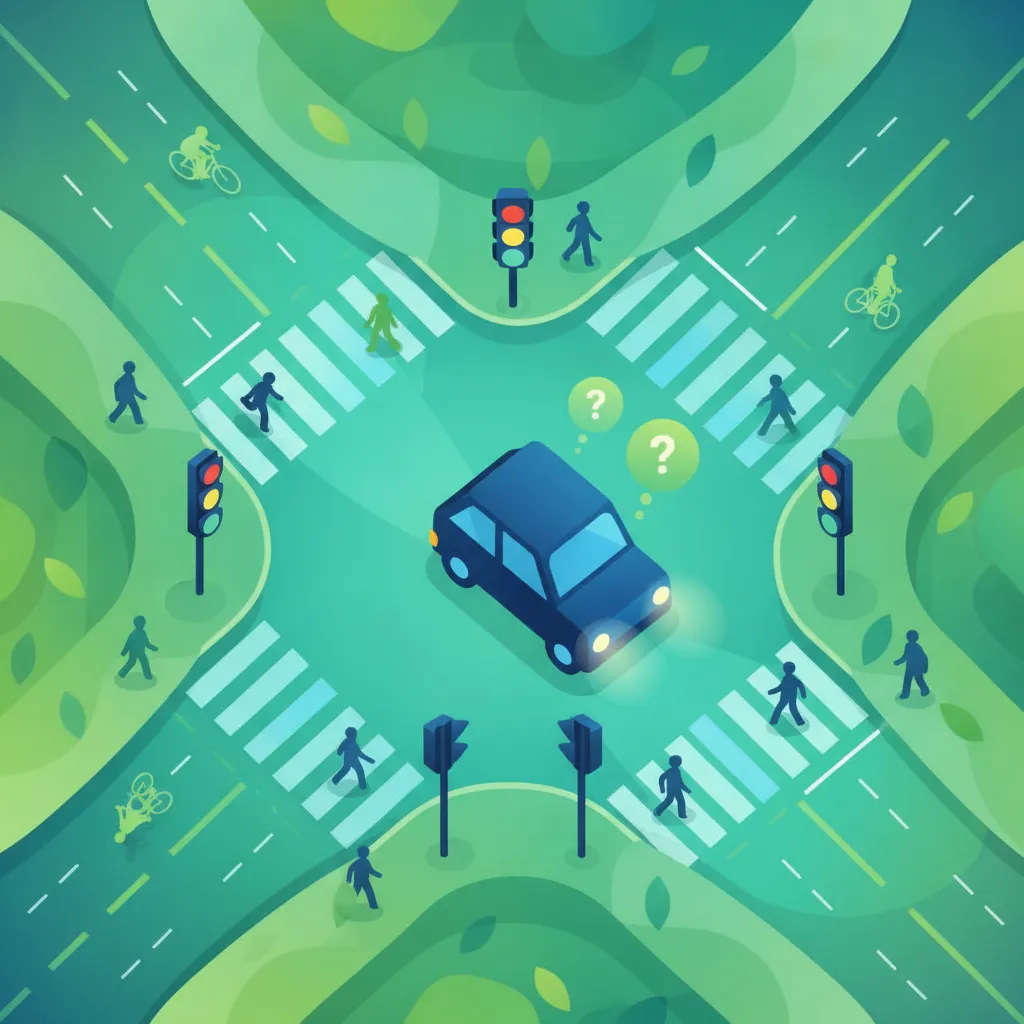
Lesson content overview
Navigating intersections is one of the most complex and critical tasks for any road user, particularly for those operating mopeds and scooters under an AM licence in Germany. These junctions are high-conflict zones where the risk of accidents is significantly elevated due to converging traffic flows and diverse road users. This lesson provides a structured, systematic method for approaching any intersection, empowering you to identify the type of junction, determine who has the right-of-way, and execute safe, decisive maneuvers. By mastering these principles, you will enhance your safety, reduce risks, and contribute to smoother traffic flow.
Intersections are points where two or more roads meet or cross, forming a junction. Recognizing the specific type of intersection you are approaching is the crucial first step in determining the applicable priority rules and preparing your response. The geometric configuration of these junctions directly influences how traffic flows and who must yield.
A T-junction occurs when one road ends by joining another through road, forming a shape resembling the letter 'T'. In many cases, the terminating road will have a yield or stop sign, indicating that traffic joining the through road must give way. If there are no signs, the general rule is that traffic on the through road has priority.
Crossroads are characterized by two roads intersecting, usually at a perpendicular or near-perpendicular angle, forming an 'X' shape. A four-way junction is a broader term encompassing any intersection where four roads meet at a single point, including typical crossroads. These junctions demand heightened awareness due to multiple potential conflict points. Priority here is most commonly determined by signs (such as yield or stop signs) or traffic signals. In their absence, the "right-before-left" rule generally applies.
Y-junctions are formed when two roads merge or diverge at an acute angle, resembling the letter 'Y'. These can sometimes be less intuitive than T-junctions or crossroads. Gradual merge or split intersections, where a road continuously widens or narrows to accommodate an additional lane or exit, also fall into this category. The key here is to observe signs carefully, as they will indicate whether you are merging onto a main road, entering a turning lane, or simply experiencing a lane adjustment. Special caution is needed when merging, requiring sufficient observation and appropriate speed adjustment to integrate smoothly into traffic.
Always assume that signs and signals override general rules. If no signs or signals are present, then general priority rules apply based on the intersection type and direction of traffic.
Establishing who has the right-of-way, or Vorfahrt, is paramount for safe intersection navigation. In Germany, this is governed by a strict hierarchy of sources, primarily traffic signals, followed by traffic signs, and then by general statutory rules outlined in the Straßenverkehrs-Ordnung (StVO). Misinterpreting or ignoring these rules is a leading cause of intersection accidents.
Traffic signals (Ampeln) are the highest authority for priority at an intersection. A green light means you may proceed, provided the intersection is clear and it is safe to do so. A yellow light means stop if safe to do so; if you are too close to stop safely, proceed with caution. A red light means stop before the stop line and remain stopped until the light changes to green. Flashing yellow lights typically indicate that the signals are out of order, or are operating on a reduced schedule (e.g., late at night), and general priority rules (signs or right-before-left) apply.
The most common way priority is assigned at many German intersections is through specific traffic signs.
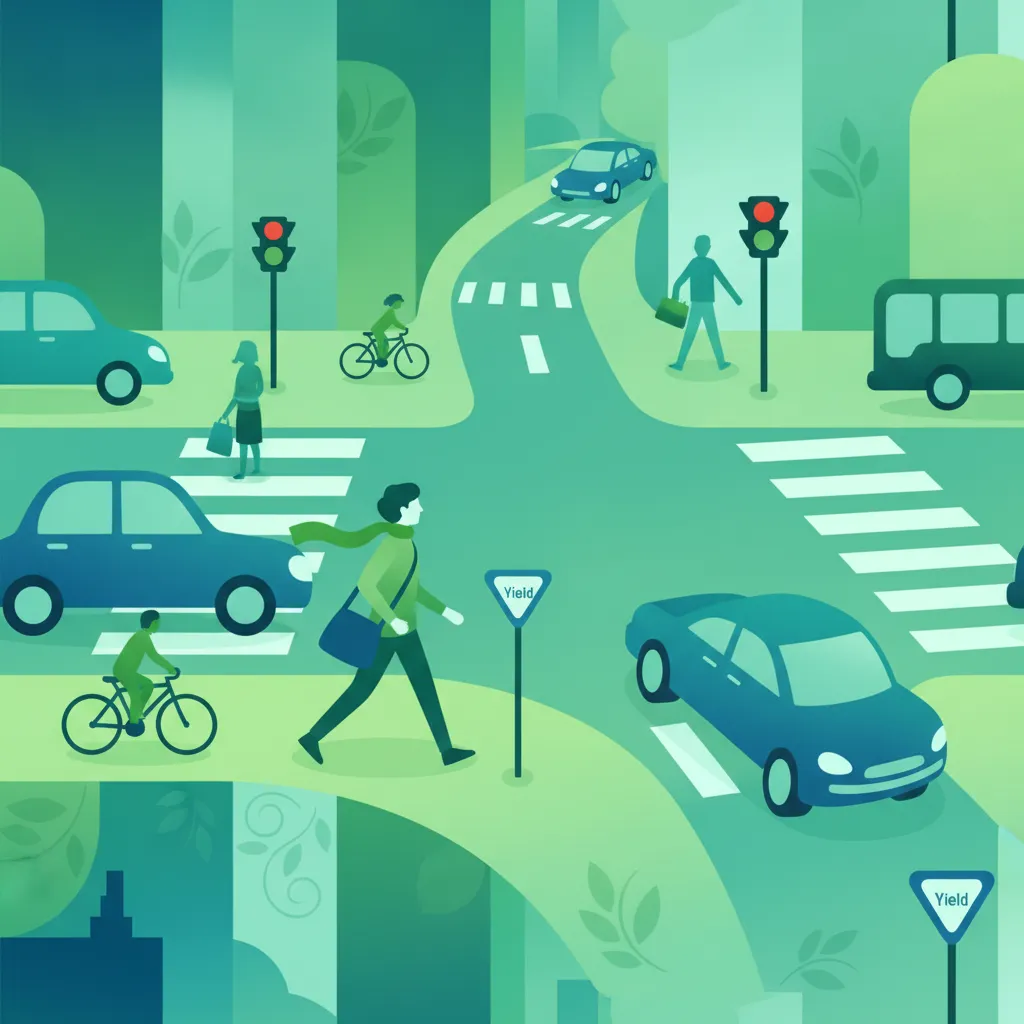
The Yield sign (Zeichen 205 - Vorfahrt gewähren) is an inverted white triangle with a red border. When approaching this sign, you must give way to traffic on the intersecting road. This means slowing down significantly, being prepared to stop, and only proceeding when you can do so without hindering or endangering other road users.
The Priority Road sign (Zeichen 306 - Vorfahrtstraße) is a yellow diamond shape with a white border. If you are on a road marked with this sign, you have priority over traffic entering from side roads unless otherwise indicated by other signs or signals at a specific junction. Conversely, if you are entering a road marked with this sign, you must yield to traffic already on it.
The Stop sign (Zeichen 206 - Halt. Vorfahrt gewähren) is an octagonal red sign with white lettering. This sign demands a complete stop before the stop line or, if no line is present, before the intersection entrance where you have a clear view of cross-traffic. Even if the way appears clear, you must come to a full halt. After stopping, you must yield to all cross-traffic before proceeding. Rolling through a stop sign is a serious violation.
Failing to come to a complete stop at a Stop sign is a serious traffic offense in Germany and carries significant penalties, including fines and potential points on your licence.
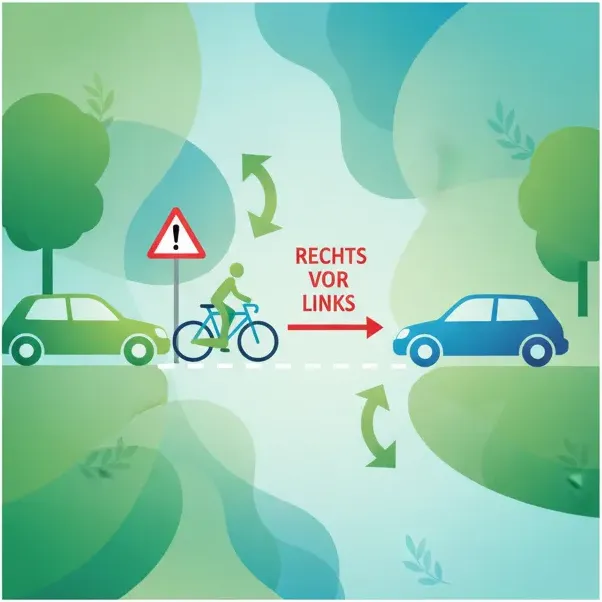
At intersections without traffic signals or specific priority signs, the general rule for priority in Germany is "Rechts vor Links" (right before left), as per StVO § 8 (2). This means that any vehicle approaching from the right has priority, regardless of the road's perceived importance. This rule applies unless specific exceptions are met (e.g., vehicles emerging from a dirt track, a private driveway, or across a curb).
In the scenario above, the red car approaching from the right of the blue moped has priority over the moped. If the red car and green car arrived simultaneously, the red car would have priority over the green car, as it is to the green car's right. It requires careful observation and clear communication if unsure.
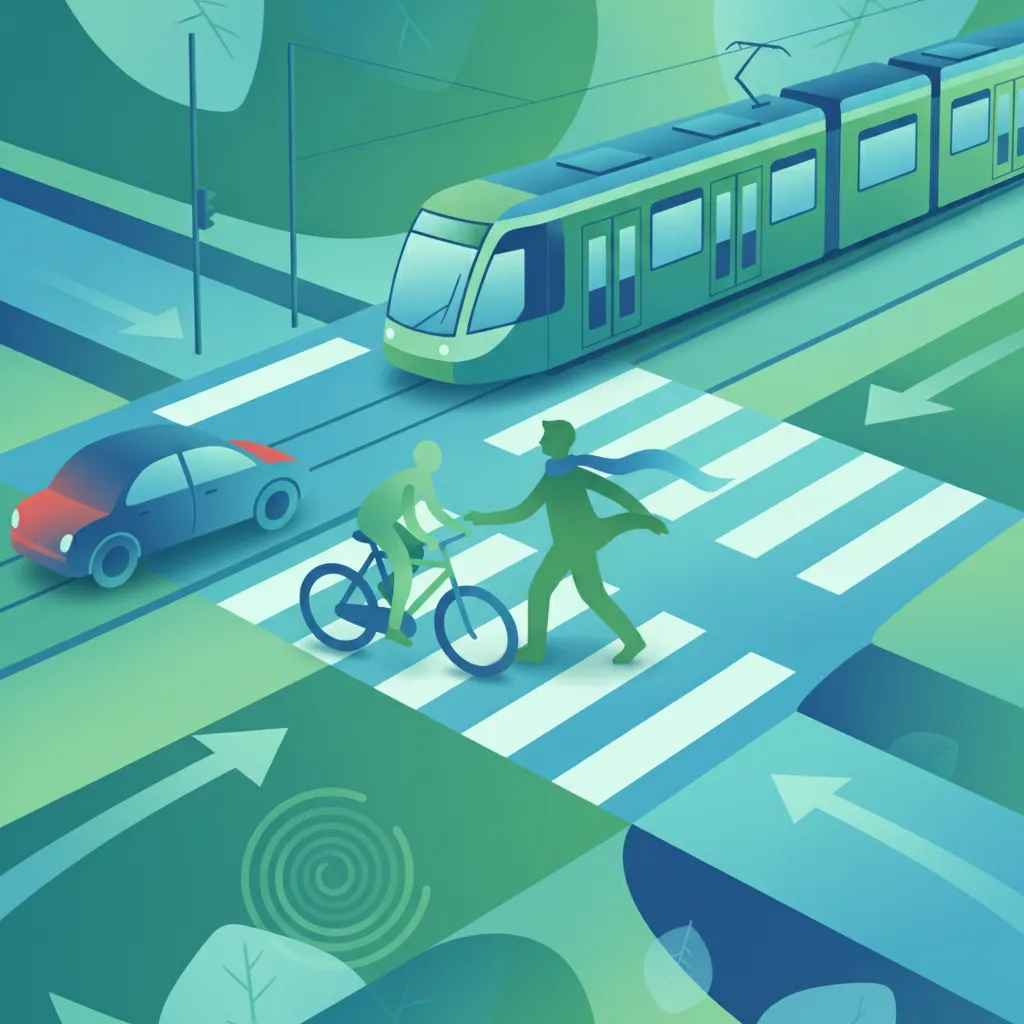
StVO § 13 grants specific priority to pedestrians, especially at marked pedestrian crossings (Zebra crossings). You must stop for pedestrians who are waiting to cross or are already crossing at such locations. Furthermore, cyclists and pedestrians often have priority when crossing side roads, particularly when turning. Always be vigilant for these vulnerable road users, as they are harder to see and more susceptible to serious injury in a collision. Even when you have the right-of-way, you must never endanger a pedestrian.
Effective visual scanning is a continuous and systematic process of observing the intersection and its surroundings to identify potential hazards and assess traffic flow. It significantly reduces the risk of collisions by providing you with the information needed to make timely and accurate decisions.
The systematic and comprehensive visual inspection of an intersection, encompassing lookahead, side quarters, and blind spot checks, to detect hazards and assess traffic flow.
As you approach an intersection, your initial focus should be on the far end of the junction. This lookahead observation allows you to gauge the overall traffic situation, identify potential queues, observe the speed of cross-traffic, and anticipate any immediate obstacles or situations that might affect your path. By looking further ahead, you give yourself more time to process information and adjust your approach speed and position.
After your initial lookahead, systematically scan to your left and right. This involves quick, repeated glances to check for approaching vehicles, cyclists, or pedestrians on the intersecting roads. Prioritize the direction from which traffic with potential priority might emerge, but do not neglect any direction. This side-to-side scanning should continue until you are clear of the intersection.
Blind spots are areas around your moped or scooter that are not visible through your mirrors. Before making any significant lateral movement (e.g., changing lanes, turning), it is absolutely critical to perform a shoulder check (a quick glance over your shoulder) to visually confirm that no other road user, especially a cyclist or another moped, is hidden in your blind spot. This is particularly vital at intersections where multiple users might converge. Failing to check blind spots is a common cause of side-swipe or turning collisions.
Approaching an intersection at the correct speed is fundamental to safety. It provides you with sufficient time to perceive hazards, react appropriately, and, if necessary, bring your vehicle to a complete stop safely. StVO § 3 emphasizes that drivers must only drive so fast that they can stop within the distance they can oversee.
Your stopping distance is the total distance your moped or scooter travels from the moment a hazard is perceived until it comes to a complete halt. This distance comprises three components:
All these factors are directly influenced by your speed. Doubling your speed roughly quadruples your braking distance. Therefore, reducing your speed significantly when approaching an intersection dramatically reduces your overall stopping distance and increases your safety margin.
For an AM licence holder, understanding the dynamics of stopping distance is crucial. Your moped or scooter, while nimble, still requires a significant distance to stop, especially from higher speeds or in adverse conditions.
Your approach speed must be adaptable. A busy, multi-lane intersection with complex signals demands a much slower approach than a quiet, rural T-junction. Factors such as:
Always approach an intersection at a speed that allows you to stop safely before the intersection if conditions suddenly change or a hazard emerges.
The Straßenverkehrs-Ordnung (StVO) is the legal framework governing road traffic in Germany. Several key paragraphs directly address behavior at intersections, forming the foundation of safe and lawful conduct.
This paragraph is central to understanding priority.
While largely focused on turning and maneuvering, StVO § 9 also reinforces the obligation to obey priority signs when turning into or out of intersecting roads. It also emphasizes the importance of proper signaling (indicators) before turning, which aids in communication at intersections.
This section contains rules that relate to visibility, ensuring drivers have a clear view of the road ahead and any road they intend to enter. This reinforces the need for proper positioning and avoiding obstructions that could block your view at intersections.
This paragraph includes the important rule regarding pedestrian priority. Drivers must stop for pedestrians at marked crossings (Zebra crossings) who are waiting to cross or are already crossing. It underscores the enhanced duty of care towards vulnerable road users.
This rule specifies that no stopping or parking is allowed within certain distances of intersections. Typically, this is within 5 meters from the intersection point on roads where priority applies, or 10 meters before and after a pedestrian crossing. These rules are in place to maintain clear visibility for all road users, preventing parked vehicles from obstructing views of approaching traffic or pedestrians.
Understanding rules is one thing; applying them consistently and correctly in dynamic traffic situations is another. Many accidents occur at intersections due to common mistakes that are entirely preventable.
Always be prepared to stop completely at a yield sign if cross-traffic is present or approaching. Better safe than sorry.
Driving conditions are rarely ideal. A skilled AM licence holder adapts their approach to intersections based on various contextual factors.
Adverse weather significantly impacts your ability to safely approach and navigate intersections.
At night, your field of vision is considerably reduced.
The environment of an intersection profoundly influences its complexity.
AM licence holders frequently share urban and suburban roads with cyclists and pedestrians.
Developing a systematic procedure for approaching intersections simplifies decision-making and enhances safety.
Identify the Intersection Type: As you approach, quickly assess if it's a T-junction, crossroads, Y-junction, or merge. This sets the stage for expected priority rules.
Determine Priority: Look immediately for traffic signals, then priority signs (Vorfahrtstraße, Yield, Stop). If none, anticipate the "Rechts vor Links" rule.
Adjust Speed: Begin reducing your speed well in advance. Match your speed to visibility, road conditions, traffic density, and the determined priority. Be prepared to stop comfortably.
Perform Comprehensive Visual Scanning: Look far ahead, check left and right quarters, and perform essential blind spot checks before any lateral movement (turning). Continuously scan until you are through the intersection.
Position Your Vehicle: Use your indicators to signal your intentions clearly. Position your moped or scooter appropriately for your intended direction (e.g., closer to the center line for left turns, to the right for right turns).
Yield or Proceed Decisively: If you must yield, wait until the path is clear and then proceed smoothly. If you have priority, continue with caution, always verifying that other road users are indeed yielding. Maintain a safe following distance if behind another vehicle.
Mastering intersections is fundamental to safe and confident driving, especially for AM licence holders who navigate a wide array of traffic environments. By consistently applying a structured approach—identifying the junction type, determining priority, executing thorough visual checks, and managing your speed effectively—you significantly reduce the risk of accidents. Remember that vigilance, adherence to StVO regulations, and an understanding of contextual variations are your strongest allies on the road. Drive decisively, but always with caution and respect for other road users, particularly the most vulnerable.
This lesson teaches AM licence holders a systematic approach to navigating German intersections safely by identifying junction types, determining priority through signals, signs, or the right-before-left rule, and executing thorough visual scans. Key regulations from the StVO establish that traffic signals override general rules, that yield and stop signs have specific positioning and behavior requirements, and that pedestrians at marked crossings must be given priority. Speed management is critical—doubling your speed roughly quadruples braking distance—making early speed reduction essential for safe stopping. The lesson also addresses common errors including rolling stops, blind spot failures, and misapplying priority rules, while emphasizing the need to adapt approach for weather conditions, urban versus rural environments, and vulnerable road users.
A short set of high-value points that capture the most important learning from this lesson.
Priority at German intersections follows a hierarchy: traffic signals override all other rules, followed by specific priority signs, then general StVO rules.
The 'Rechts vor Links' (right-before-left) rule applies only at unmarked intersections without signs or signals, requiring you to yield to traffic approaching from your right.
Different intersection types (T-junctions, crossroads, Y-junctions) each require specific visual scanning and speed adjustment strategies.
Stopping distance consists of three components—perception, reaction, and braking distance—all directly influenced by your approach speed.
StVO § 13 mandates that you must stop for pedestrians waiting at or crossing marked Zebra crossings, regardless of your right-of-way.
Explore all units and lessons included in this driving theory course.
The Yield sign (Zeichen 205) is an inverted white triangle with red border requiring you to slow and be prepared to stop.
The Stop sign (Zeichen 206) requires a complete halt before the stop line, even when no traffic is visible.
The Priority Road sign (Zeichen 306) is a yellow diamond with white border indicating the road you're on has priority.
Parking is prohibited within 5 meters of intersections and 10 meters of pedestrian crossings under StVO § 15.
Always perform a shoulder check for blind spots before turning, as cyclists and mopeds are easily hidden from mirrors.
Failing to come to a complete stop at a Stop sign, or stopping past the stop line, constitutes a serious traffic offense.
Approaching a yield sign too fast without being prepared to stop, leading to front-end collisions with cross-traffic.
Misapplying 'Rechts vor Links' at signed intersections where the rule does not apply, causing right-angle collisions.
Neglecting blind spot checks before turning, resulting in side-swipe collisions with cyclists or other mopeds.
Underestimating braking distance in adverse weather conditions and failing to adjust approach speed accordingly.
Lesson content overview
A short set of high-value points that capture the most important learning from this lesson.
Priority at German intersections follows a hierarchy: traffic signals override all other rules, followed by specific priority signs, then general StVO rules.
The 'Rechts vor Links' (right-before-left) rule applies only at unmarked intersections without signs or signals, requiring you to yield to traffic approaching from your right.
Different intersection types (T-junctions, crossroads, Y-junctions) each require specific visual scanning and speed adjustment strategies.
Stopping distance consists of three components—perception, reaction, and braking distance—all directly influenced by your approach speed.
StVO § 13 mandates that you must stop for pedestrians waiting at or crossing marked Zebra crossings, regardless of your right-of-way.
Explore all units and lessons included in this driving theory course.
The Yield sign (Zeichen 205) is an inverted white triangle with red border requiring you to slow and be prepared to stop.
The Stop sign (Zeichen 206) requires a complete halt before the stop line, even when no traffic is visible.
The Priority Road sign (Zeichen 306) is a yellow diamond with white border indicating the road you're on has priority.
Parking is prohibited within 5 meters of intersections and 10 meters of pedestrian crossings under StVO § 15.
Always perform a shoulder check for blind spots before turning, as cyclists and mopeds are easily hidden from mirrors.
Failing to come to a complete stop at a Stop sign, or stopping past the stop line, constitutes a serious traffic offense.
Approaching a yield sign too fast without being prepared to stop, leading to front-end collisions with cross-traffic.
Misapplying 'Rechts vor Links' at signed intersections where the rule does not apply, causing right-angle collisions.
Neglecting blind spot checks before turning, resulting in side-swipe collisions with cyclists or other mopeds.
Underestimating braking distance in adverse weather conditions and failing to adjust approach speed accordingly.
Explore search topics learners often look for when studying Approaching Intersections, Identifying Priority, and Decision-Making. These topics reflect common questions about road rules, driving situations, safety guidance, and lesson level theory preparation for learners in Germany.
Browse additional driving theory lessons that cover connected traffic rules, road signs, and common driving situations related to this topic. Improve your understanding of how different rules interact across everyday traffic scenarios.
Learn systematic methods for making safe decisions when approaching German intersections. This lesson focuses on identifying priority rules, conducting thorough visual checks, and understanding the StVO's requirements for safe passage.
This lesson covers the principles of effective route planning and the practical skills for navigating different types of junctions. It provides guidance on using navigation aids and understanding the specific challenges large vehicles face at roundabouts and complex intersections. Emphasis is placed on correct lane selection and positioning well in advance of a turn to execute the maneuver safely and without impeding other traffic.

This lesson details the correct procedure for executing left turns, right turns, and U-turns. It emphasizes the importance of proper signaling, correct lane positioning before the turn, and managing speed throughout the maneuver. The content also covers fundamental cornering techniques to maintain stability and control.
This lesson focuses on the interaction between heavy vehicles and vulnerable road users at crossings, particularly when turning right. It covers the need for heightened vigilance, the importance of properly using mirrors, and correct signaling to alert others. The content highlights legal responsibilities and safe distance requirements to prevent accidents.
This lesson details the safe approach and navigation of various intersection types, including those controlled by traffic lights, stop signs, and give-way signs. Emphasis is placed on comprehensive observation of traffic flow, establishing eye contact with other road users, and ensuring clear visibility before proceeding. The lesson also covers correct lane positioning for turning and the importance of anticipating pedestrian movements.
This lesson explains the function and meaning of traffic light signals, including standard cycles, flashing lights, and arrows. It also details how to interpret and obey hand signals given by police officers, which override all other signs and signals. Understanding these instructions is crucial for navigating controlled junctions and emergency situations.

This lesson provides a step-by-step guide to executing turns safely at intersections and other locations. It details the full observation sequence (mirrors, signal, blind spot check) required before initiating a turn. The lesson covers correct lane positioning for both left and right turns and explains the rules for performing U-turns or three-point turns where permitted.
This lesson provides clear instructions on how to navigate roundabouts in Germany. It explains the crucial rule of yielding to traffic already inside the circle, proper lane choice for your intended exit, and the correct use of signals. Safe interaction with cyclists and pedestrians at roundabout exits is also covered.
This lesson focuses on strategic road positioning to enhance safety and visibility. It explains where to ride within a lane under different circumstances, such as approaching intersections or riding alongside parked cars. A key skill covered is anticipating the potential actions of other drivers, cyclists, and pedestrians.
This lesson addresses the challenges of operating a small AM vehicle in dense, mixed traffic. It provides strategies for increasing visibility to other drivers, positioning oneself defensively, and safely sharing lanes with cyclists. The content emphasizes awareness of larger vehicles' blind spots and maintaining a safe space cushion.
This lesson provides a detailed guide to navigating various types of intersections safely and correctly. It explains how priority is determined by traffic signs (such as the priority road, yield, and stop signs) and traffic lights. The lesson also covers complex scenarios, including the rules for turning left across oncoming traffic, to ensure you can handle any junction with confidence.
Explore specific StVO regulations and sign interpretations for challenging intersection scenarios in Germany. This lesson clarifies right-of-way in situations with unclear markings or multiple conflicting traffic flows, building on basic intersection knowledge.
This lesson provides a detailed guide to navigating various types of intersections safely and correctly. It explains how priority is determined by traffic signs (such as the priority road, yield, and stop signs) and traffic lights. The lesson also covers complex scenarios, including the rules for turning left across oncoming traffic, to ensure you can handle any junction with confidence.
This lesson details the critical right-of-way regulations according to the German StVO. It covers the default 'right before left' rule, the meaning of priority road signs, and specific rules for roundabouts and yielding to pedestrians. A thorough understanding of these priority rules is fundamental for preventing accidents at junctions.
This lesson introduces the foundational concept of right-of-way ('Vorfahrt') in German traffic law. It explains the default priority rule, 'Rechts vor Links' (right before left), which applies at intersections without any regulating signs or signals. You will learn to identify situations where this rule applies and understand the basic principles of yielding to ensure safe passage at junctions.
This lesson explains the concept of a priority road ('Vorfahrtstraße'), where you have right-of-way over traffic from intersecting roads. You will learn to recognize the signs that mark the beginning and end of a priority road. The lesson also covers how priority is managed through signals, including standard traffic lights, the special 'Grünpfeil' (green arrow) sign, and the overriding authority of a police officer directing traffic.

This lesson explains the specific rules for driving in roundabouts ('Kreisverkehr'), a common feature on German roads. It covers the correct procedure for approaching and entering, the rule that traffic already in the circle has priority, and the requirement to signal before exiting. The lesson also addresses the unique characteristics of mini-roundabouts and how to interact with cyclists and pedestrians around them.
This lesson focuses on complex traffic environments where different types of road users share the same space. It provides guidance on situations like driving on streets with integrated tram tracks or where bus and bicycle lanes are part of the roadway. The content emphasizes understanding the specific priority rules and being extra vigilant to anticipate potential conflicts in these busy, shared zones.
This lesson provides a detailed explanation of the rules governing dedicated bus lanes, including how to interpret markings and adhere to time-based restrictions. It clarifies the priority rules that grant buses precedence in certain traffic situations, such as when pulling out from a stop. Understanding these regulations allows drivers to use bus infrastructure efficiently and legally to maintain schedules and improve traffic flow.
This lesson details the safe approach and navigation of various intersection types, including those controlled by traffic lights, stop signs, and give-way signs. Emphasis is placed on comprehensive observation of traffic flow, establishing eye contact with other road users, and ensuring clear visibility before proceeding. The lesson also covers correct lane positioning for turning and the importance of anticipating pedestrian movements.
This lesson focuses on the right-of-way rules that heavy vehicles must follow when interacting with cyclists and pedestrians, particularly at intersections and crossings. It emphasizes the need for trucks to yield appropriately and maintain safe distances. The content also covers the interpretation of traffic signs governing priority in urban areas.
This lesson provides a step-by-step guide to executing turns safely at intersections and other locations. It details the full observation sequence (mirrors, signal, blind spot check) required before initiating a turn. The lesson covers correct lane positioning for both left and right turns and explains the rules for performing U-turns or three-point turns where permitted.
Find clear answers to common questions learners have about Approaching Intersections, Identifying Priority, and Decision-Making. Learn how the lesson is structured, which driving theory objectives it supports, and how it fits into the overall learning path of units and curriculum progression in Germany. These explanations help you understand key concepts, lesson flow, and exam focused study goals.
In Germany, the 'right-before-left' rule (Rechts vor Links) applies at intersections without traffic signs or signals. You must yield to traffic coming from your right, provided no other traffic laws or specific signs dictate otherwise.
No, a Yield (Vorfahrt gewähren) sign does not mandate a full stop if the intersection is clear. You must slow down, be prepared to stop, and only proceed if you do not impede other road users who have priority.
Police traffic signals always override road signs, markings, and standard priority rules. If an officer is directing traffic, you must follow their hand signals and commands immediately, regardless of what the signs indicate.
AM vehicles are smaller and can be easily missed by car drivers. Systematic scanning helps you identify potential hazards early, verify that other drivers have seen you, and adjust your speed to ensure you remain visible and safe.
Begin your targeted revision now. Use our practice search to quickly find specific German driving theory questions. Filter by StVO rules, road signs, or hazard perception to create your focused study plan. Master challenging areas and prepare confidently for your theoretical driving test.