
This lesson explores the essential rules for safely sharing the road with vulnerable road users such as pedestrians and cyclists. As part of our comprehensive Category B course, you will learn how to anticipate their movements, understand your legal obligations at crossings, and communicate your intentions clearly to prevent accidents.
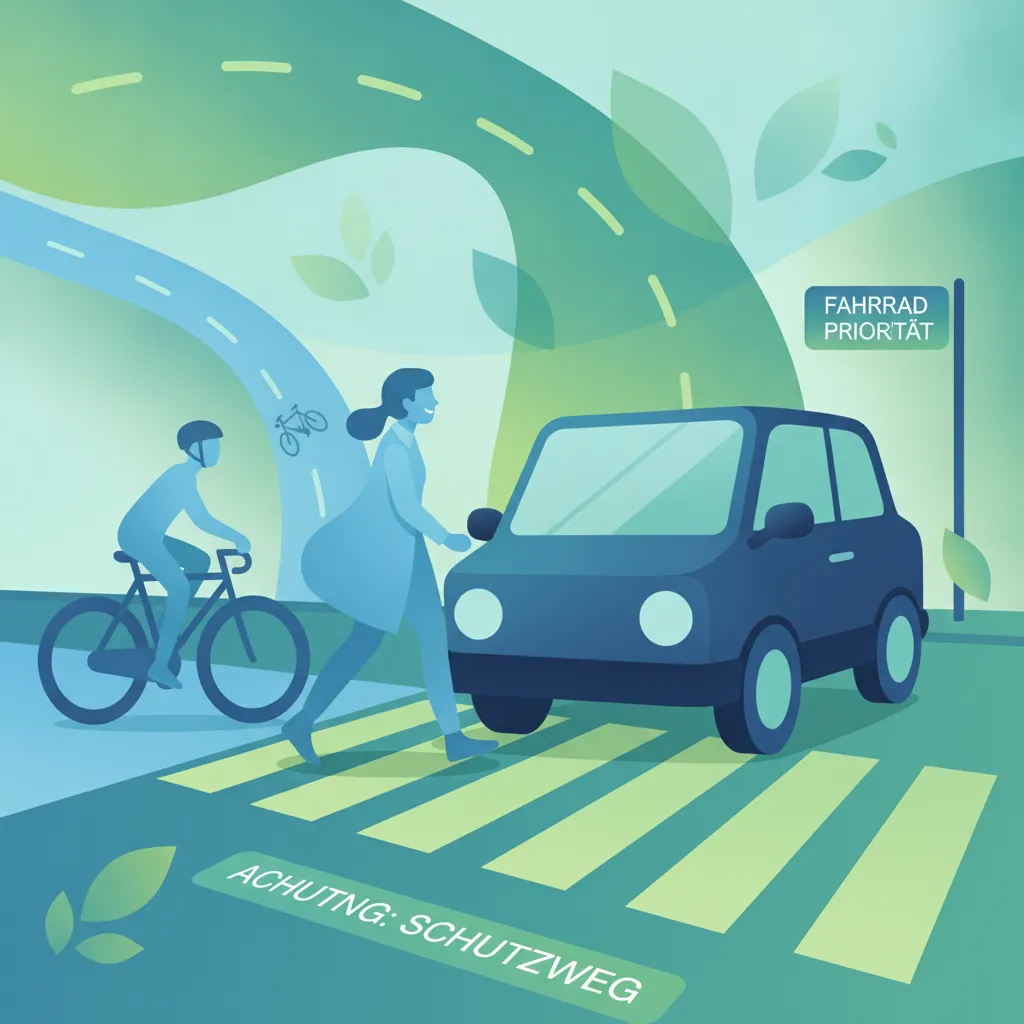
Lesson content overview
Welcome to this lesson for your German Driving License Theory – Comprehensive Category B Course. As a driver, you share the road with a diverse range of users, some of whom are significantly more vulnerable than occupants of motor vehicles. Pedestrians and cyclists, due to their lack of physical protection, require heightened awareness, respect, and adherence to specific rules to ensure their safety. This chapter provides essential guidance on how to interact responsibly and safely with these vulnerable road users, covering legal requirements, best practices, and correct behavior at critical points like zebra crossings, pedestrian traffic lights, and designated cycle lanes, as outlined by the German Road Traffic Regulations (StVO). Mastering these interactions is crucial for preventing accidents and fostering a harmonious traffic environment.
The inherent physical differences between motor vehicles and pedestrians or cyclists mean that in the event of a collision, the latter almost always bear the brunt of the impact. This fundamental disparity forms the basis of the Vulnerability Principle, a core concept in German traffic law and defensive driving.
The Vulnerability Principle highlights that certain road users—specifically pedestrians, cyclists, and motorcyclists—are more susceptible to severe injury or death in a collision because they lack the protective structures of a car. As a driver of a motor vehicle, you are operating a potentially dangerous machine, and therefore, a greater responsibility rests on your shoulders to protect those who are most exposed. This principle mandates that drivers anticipate the actions of vulnerable users, exercise extreme caution, and prioritize their safety above all else. This isn't just a recommendation; it's a foundational element of safe driving and legal responsibility under the StVO.
Adopting a defensive driving style is paramount when interacting with pedestrians and cyclists. This means constantly anticipating potential hazards, expecting the unexpected, and being prepared to react safely. Defensive drivers don't just react to current situations; they actively scan the environment, predict possible movements of vulnerable road users, and adjust their speed and position accordingly. For instance, children, the elderly, or individuals with disabilities may behave unpredictably or have slower reaction times. A defensive driver accounts for these possibilities by reducing speed, increasing observation, and being ready to stop immediately.
Specific rules govern interactions at designated pedestrian crossing points, designed to provide safe passage for those on foot. Understanding and strictly adhering to these rules is non-negotiable for driver safety and compliance with the StVO.
A pedestrian crossing marked by wide, parallel white stripes across the road, indicating that pedestrians have priority.
Zebra crossings, known in Germany as Zebrastreifen, are clearly marked sections of the road where pedestrians have an absolute right-of-way. These are denoted by thick white stripes painted on the road surface, often accompanied by blue and white signs depicting a pedestrian crossing.
When you approach a Zebrastreifen, you must reduce your speed significantly, be prepared to stop, and observe carefully for pedestrians who are either on the crossing or clearly intending to cross. It is a legal requirement to stop your vehicle and allow pedestrians to cross safely. You may only proceed once the crossing is completely clear and there is no risk to any pedestrian.
Always assume a pedestrian intends to cross at a Zebrastreifen if they are waiting nearby. Reduce speed and be prepared to stop. Never wave a pedestrian across if other lanes are not clear.
Traffic signals specifically for pedestrians, displaying a green 'walk' figure or a red 'stop' figure to indicate when it is safe to cross.
At intersections equipped with pedestrian traffic lights (Fußgängerampel), specific rules apply, particularly when vehicle traffic lights and pedestrian lights are green simultaneously. These signals typically show a green 'walking' figure or a red 'standing' figure. Some advanced signals may include countdown timers or auditory signals for visually impaired individuals.
If the pedestrian light is green, pedestrians have the right-of-way to cross. This is crucial even if your vehicle's traffic light is also green, for example, when turning right or left. When turning, you must yield to pedestrians who are crossing or intending to cross the road you are entering, provided their signal is green. Drivers must stop and allow pedestrians to clear the crossing before proceeding.
To ensure clear visibility for both drivers and pedestrians, the StVO prohibits stopping or parking too close to pedestrian crossings.
Generally, you are prohibited from stopping or parking within 5 meters before a zebra crossing. This distance ensures that approaching drivers have an unobstructed view of pedestrians waiting to cross and that pedestrians can clearly see oncoming traffic. Violating this rule can significantly reduce reaction time for all road users and is subject to fines.
Cyclists are another significant group of vulnerable road users who require special attention from drivers. Germany has an extensive network of infrastructure for cyclists, including various types of cycle lanes, each with specific rules of interaction.
Roadways or paths designated specifically for cyclists, which may be separated from motor traffic by markings, physical barriers, or shared with other traffic under specific conditions.
In Germany, cycle lanes (Radweg) come in several forms, each dictating how motor vehicles must interact with cyclists:
Within designated cycle lanes (Radweg or Radfahrstreifen), cyclists have priority. Drivers must yield to cyclists when crossing or merging into a lane where cyclists are present. For example, when turning right at an intersection, if there is a cycle lane parallel to the road you are turning from, you must yield to any cyclists proceeding straight through the intersection in their lane. It's essential to check your blind spots for cyclists, as they can be difficult to see.
Before making any turn, especially a right turn, always perform a "shoulder check" (Schulterblick) to ensure no cyclists are in your blind spot or approaching in a cycle lane.
Overtaking cyclists requires particular care and a strict adherence to minimum safe distances. This rule is critical for preventing side-swipes and ensuring cyclists feel safe.
When overtaking a cyclist on the road, you must maintain a minimum lateral safety distance of 1.5 meters. This distance provides a crucial buffer, protecting the cyclist from being pushed by air turbulence from your vehicle or from swerving due to road hazards. This rule applies in most conditions, but in scenarios such as narrow roads, poor visibility, or high speeds, an even greater distance should be maintained if possible. If the road is too narrow to maintain this distance safely, you must wait behind the cyclist until a safe opportunity arises to overtake.
Assess the situation: Check for oncoming traffic, road conditions, and the presence of any other hazards.
Signal your intention: Use your indicator to signal your intention to move left to overtake.
Maintain distance: Ensure you can maintain at least 1.5 meters (or more if conditions require) lateral distance from the cyclist.
Overtake smoothly: Pass the cyclist at a moderate speed, avoiding sudden acceleration or braking.
Return to lane: Once you have safely passed the cyclist and they are visible in your rearview mirror, signal and return to your lane, ensuring you do not cut them off.
Maintaining adequate safety distances isn't just about overtaking; it applies to passing all vulnerable road users, even those on sidewalks.
As detailed above, the minimum safe distance of 1.5 meters is legally required when overtaking cyclists. This rule underscores the significant vulnerability of cyclists and aims to prevent common accidents, such as those caused by insufficient clearance or a cyclist being forced off balance. This distance protects cyclists from the draft of your vehicle and gives them space to react to road imperfections without impacting your vehicle.
While less common to "overtake" pedestrians on a sidewalk with a motor vehicle, there are situations where you might pass close to them, for example, when driving very slowly next to a sidewalk or during specific maneuvers. In such rare instances, or if you encounter pedestrians walking on the road where no sidewalk exists, the StVO suggests maintaining a significantly larger distance to pedestrians on sidewalks: a minimum safe distance of 5 meters when passing. This considerable distance acknowledges the pedestrian's right to safety and comfort, particularly when they are not in a designated crossing area but still close to moving traffic. It also accounts for unpredictable movements.
Certain environmental and situational factors demand an even higher degree of vigilance and caution from drivers when interacting with pedestrians and cyclists.
Adverse weather conditions such as rain, fog, snow, or ice significantly reduce visibility and increase stopping distances. In these conditions:
Low-light conditions (dawn, dusk, night) also drastically reduce the visibility of pedestrians and cyclists, many of whom may not be adequately lit. Drivers must actively scan the road and surroundings, use appropriate headlights, and assume that vulnerable users might be present even if not immediately visible.
School zones and residential areas are places where children and pedestrians are highly likely to be present. In these zones:
In heavy traffic and urban environments, the density of vehicles, pedestrians, and cyclists is much higher. This requires constant situational awareness:
Violating the rules governing interaction with pedestrians and cyclists in Germany carries significant penalties under the StVO. These are not merely administrative offenses; they reflect the serious risk posed to vulnerable lives.
Adherence to these rules is not just about avoiding penalties; it is about upholding your responsibility as a driver and contributing to the safety of everyone on German roads.
The safe interaction with pedestrians and cyclists is a cornerstone of responsible driving in Germany. To summarize the critical principles:
By internalizing and applying these principles, you contribute to a safer, more respectful, and efficient traffic environment for all road users in Germany.
This lesson covers the essential StVO rules for safely interacting with vulnerable road users in Germany. Pedestrians have absolute priority at zebra crossings and pedestrian traffic lights, while cyclists must be given priority in designated lanes. The critical distances to remember are 1.5 meters when overtaking cyclists and 5 meters when passing pedestrians near sidewalks. Drivers bear greater responsibility under the Vulnerability Principle and must always scan for cyclists before turning, especially checking blind spots. Adapting behavior for adverse weather, school zones, and heavy traffic is essential for both exam success and real-world safety.
A short set of high-value points that capture the most important learning from this lesson.
Pedestrians have absolute priority at zebra crossings (Zebrastreifen) and when their traffic light (Fußgängerampel) is green, regardless of your own signal
Maintain a minimum 1.5-meter lateral distance when overtaking cyclists on the road
Drivers must yield to cyclists in designated cycle lanes (Radweg) when turning or crossing their path
The Vulnerability Principle places greater responsibility on drivers to protect less protected road users
Always perform a shoulder check (Schulterblick) before turning to detect cyclists in your blind spot
Explore all units and lessons included in this driving theory course.
Zebra crossings: stop before the crossing and yield to all pedestrians waiting or crossing
Minimum safe distances: 1.5m when overtaking cyclists, 5m when passing pedestrians near sidewalks
Do not stop or park within 5 meters before a zebra crossing to maintain visibility
At pedestrian lights, always yield to pedestrians crossing with a green signal, even when turning
Dedicated cycle lanes (Radfahrstreifen) marked with solid white lines are off-limits to motor vehicles
Failing to stop at zebra crossings or stopping beyond the crossing line, obstructing pedestrians
Assuming vehicle green light grants priority over pedestrians with green pedestrian signals
Not maintaining the 1.5m minimum distance when overtaking cyclists, especially on narrow roads
Rushing turns and cutting off pedestrians or cyclists who have priority
Forgetting to check blind spots for cyclists before turning, leading to blind-spot collisions
Lesson content overview
A short set of high-value points that capture the most important learning from this lesson.
Pedestrians have absolute priority at zebra crossings (Zebrastreifen) and when their traffic light (Fußgängerampel) is green, regardless of your own signal
Maintain a minimum 1.5-meter lateral distance when overtaking cyclists on the road
Drivers must yield to cyclists in designated cycle lanes (Radweg) when turning or crossing their path
The Vulnerability Principle places greater responsibility on drivers to protect less protected road users
Always perform a shoulder check (Schulterblick) before turning to detect cyclists in your blind spot
Explore all units and lessons included in this driving theory course.
Zebra crossings: stop before the crossing and yield to all pedestrians waiting or crossing
Minimum safe distances: 1.5m when overtaking cyclists, 5m when passing pedestrians near sidewalks
Do not stop or park within 5 meters before a zebra crossing to maintain visibility
At pedestrian lights, always yield to pedestrians crossing with a green signal, even when turning
Dedicated cycle lanes (Radfahrstreifen) marked with solid white lines are off-limits to motor vehicles
Failing to stop at zebra crossings or stopping beyond the crossing line, obstructing pedestrians
Assuming vehicle green light grants priority over pedestrians with green pedestrian signals
Not maintaining the 1.5m minimum distance when overtaking cyclists, especially on narrow roads
Rushing turns and cutting off pedestrians or cyclists who have priority
Forgetting to check blind spots for cyclists before turning, leading to blind-spot collisions
Explore search topics learners often look for when studying Interaction with Pedestrians and Cyclists. These topics reflect common questions about road rules, driving situations, safety guidance, and lesson level theory preparation for learners in Germany.
Browse additional driving theory lessons that cover connected traffic rules, road signs, and common driving situations related to this topic. Improve your understanding of how different rules interact across everyday traffic scenarios.
Explore practical driving theory scenarios in Germany focusing on pedestrian and cyclist right-of-way. Understand how to safely navigate intersections, zebra crossings, and cycle lanes, applying StVO rules to prevent misunderstandings and ensure the safety of vulnerable road users.

This lesson focuses on the particular care required when driving near pedestrians, with a special emphasis on children and the elderly, whose behavior can be unpredictable. It covers the rules for yielding at zebra crossings and the importance of reducing speed near schools, playgrounds, and residential areas. The goal is to instill a habit of constant vigilance and readiness to stop.

This lesson focuses on the right-of-way rules that heavy vehicles must follow when interacting with cyclists and pedestrians, particularly at intersections and crossings. It emphasizes the need for trucks to yield appropriately and maintain safe distances. The content also covers the interpretation of traffic signs governing priority in urban areas.
This lesson focuses on the interaction between heavy vehicles and vulnerable road users at crossings, particularly when turning right. It covers the need for heightened vigilance, the importance of properly using mirrors, and correct signaling to alert others. The content highlights legal responsibilities and safe distance requirements to prevent accidents.
This lesson details the critical right-of-way regulations according to the German StVO. It covers the default 'right before left' rule, the meaning of priority road signs, and specific rules for roundabouts and yielding to pedestrians. A thorough understanding of these priority rules is fundamental for preventing accidents at junctions.
This lesson addresses the critical skill of safely interacting with other road users, particularly vulnerable ones like pedestrians and cyclists. It covers rules for yielding at crosswalks, maintaining a safe passing distance, and being aware of the limited visibility of a moped to car drivers. The focus is on fostering a defensive and cooperative mindset in mixed traffic.
This lesson focuses on complex traffic environments where different types of road users share the same space. It provides guidance on situations like driving on streets with integrated tram tracks or where bus and bicycle lanes are part of the roadway. The content emphasizes understanding the specific priority rules and being extra vigilant to anticipate potential conflicts in these busy, shared zones.
This lesson covers the correct and safe way to interact with cyclists. It explains the different types of bicycle infrastructure, such as dedicated cycle paths and advisory bike lanes on the road. Key topics include maintaining the legally required minimum passing distance, checking for cyclists before turning right, and being aware of the risk of 'dooring' when parked.

This lesson teaches riders how to interact safely and predictably with pedestrians, cyclists, and public transport vehicles. It highlights the importance of yielding at designated crossings, maintaining a safe passing distance, and anticipating the movements of buses and trams. The content emphasizes using eye contact and clear signaling to foster safe and respectful interactions with all road users.
This lesson introduces the foundational concept of right-of-way ('Vorfahrt') in German traffic law. It explains the default priority rule, 'Rechts vor Links' (right before left), which applies at intersections without any regulating signs or signals. You will learn to identify situations where this rule applies and understand the basic principles of yielding to ensure safe passage at junctions.
This lesson focuses on the critical moments of interaction with pedestrians and cyclists near bus stops, a common location for accidents. It reinforces the importance of reducing speed, yielding right-of-way, and constantly monitoring blind spots during the stopping process. Learners will practice techniques like making eye contact and using signals to communicate intentions, creating a safer environment for everyone around the vehicle.
Learn about complex scenarios and advanced StVO rules for interacting with pedestrians and cyclists beyond basic crossings. This lesson clarifies specific situations like shared paths and priority nuances in German traffic law, crucial for safe driving and exam preparation.
This lesson focuses on the particular care required when driving near pedestrians, with a special emphasis on children and the elderly, whose behavior can be unpredictable. It covers the rules for yielding at zebra crossings and the importance of reducing speed near schools, playgrounds, and residential areas. The goal is to instill a habit of constant vigilance and readiness to stop.
This lesson addresses the critical skill of safely interacting with other road users, particularly vulnerable ones like pedestrians and cyclists. It covers rules for yielding at crosswalks, maintaining a safe passing distance, and being aware of the limited visibility of a moped to car drivers. The focus is on fostering a defensive and cooperative mindset in mixed traffic.
This lesson teaches riders how to interact safely and predictably with pedestrians, cyclists, and public transport vehicles. It highlights the importance of yielding at designated crossings, maintaining a safe passing distance, and anticipating the movements of buses and trams. The content emphasizes using eye contact and clear signaling to foster safe and respectful interactions with all road users.
This lesson focuses on the critical moments of interaction with pedestrians and cyclists near bus stops, a common location for accidents. It reinforces the importance of reducing speed, yielding right-of-way, and constantly monitoring blind spots during the stopping process. Learners will practice techniques like making eye contact and using signals to communicate intentions, creating a safer environment for everyone around the vehicle.
This lesson focuses on complex traffic environments where different types of road users share the same space. It provides guidance on situations like driving on streets with integrated tram tracks or where bus and bicycle lanes are part of the roadway. The content emphasizes understanding the specific priority rules and being extra vigilant to anticipate potential conflicts in these busy, shared zones.
This lesson focuses on the interaction between heavy vehicles and vulnerable road users at crossings, particularly when turning right. It covers the need for heightened vigilance, the importance of properly using mirrors, and correct signaling to alert others. The content highlights legal responsibilities and safe distance requirements to prevent accidents.
This lesson covers the correct and safe way to interact with cyclists. It explains the different types of bicycle infrastructure, such as dedicated cycle paths and advisory bike lanes on the road. Key topics include maintaining the legally required minimum passing distance, checking for cyclists before turning right, and being aware of the risk of 'dooring' when parked.
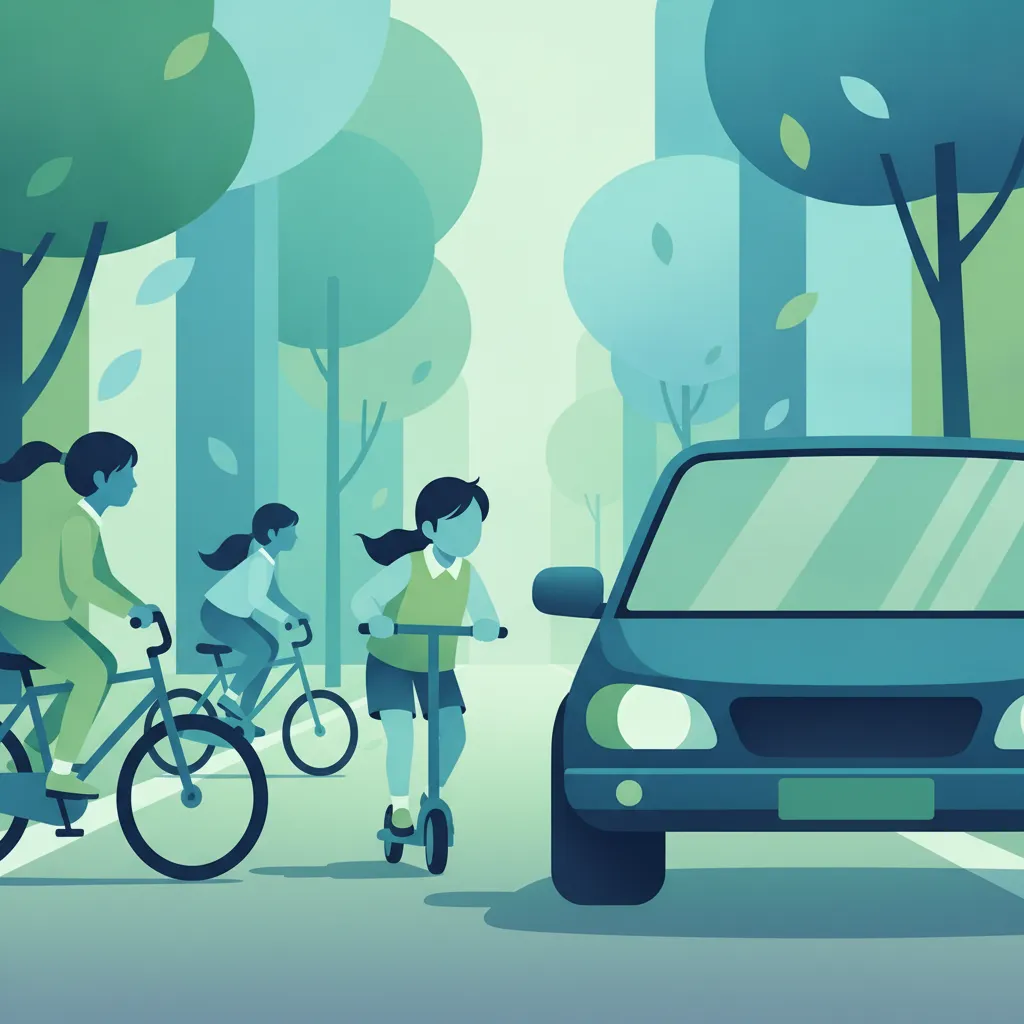
This lesson focuses on identifying road users who require special attention and caution, such as children, the elderly, and individuals with disabilities. It details the appropriate behavior when encountering school buses and public transport, which often involve unpredictable pedestrian movement. A critical topic covered is the legal requirement to form an emergency corridor ('Rettungsgasse') for responding emergency vehicles.
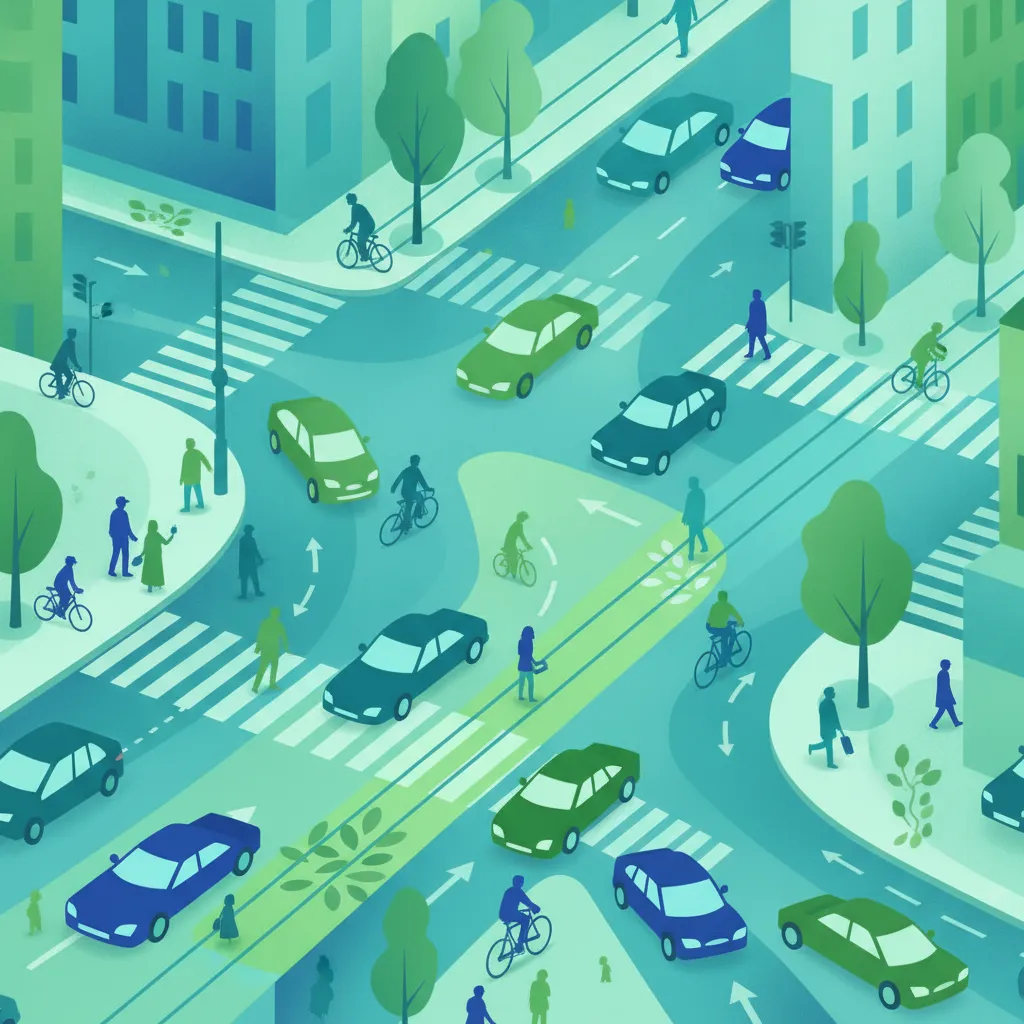
This lesson addresses the challenges of operating a small AM vehicle in dense, mixed traffic. It provides strategies for increasing visibility to other drivers, positioning oneself defensively, and safely sharing lanes with cyclists. The content emphasizes awareness of larger vehicles' blind spots and maintaining a safe space cushion.
This lesson focuses on the right-of-way rules that heavy vehicles must follow when interacting with cyclists and pedestrians, particularly at intersections and crossings. It emphasizes the need for trucks to yield appropriately and maintain safe distances. The content also covers the interpretation of traffic signs governing priority in urban areas.
Find clear answers to common questions learners have about Interaction with Pedestrians and Cyclists. Learn how the lesson is structured, which driving theory objectives it supports, and how it fits into the overall learning path of units and curriculum progression in Germany. These explanations help you understand key concepts, lesson flow, and exam focused study goals.
Yes, if a pedestrian or wheelchair user is clearly waiting to cross, you must stop and allow them to pass safely. You are not allowed to overtake or drive past a vehicle that has already stopped for a zebra crossing.
When passing a cyclist in urban areas, you must keep a lateral distance of at least 1.5 meters. Outside built-up areas on rural roads, this distance must be at least 2 meters to ensure safety.
Yes, but you must be extremely cautious. You must check your mirrors and perform a thorough shoulder check (Schulterblick) to ensure no cyclist is in your blind spot before you begin turning.
When a school bus has its hazard warning lights activated while approaching a stop, you must drive at a walking pace (max 4-7 km/h) if you are passing it. This applies to both directions of traffic if they are on the same road.
Begin your targeted revision now. Use our practice search to quickly find specific German driving theory questions. Filter by StVO rules, road signs, or hazard perception to create your focused study plan. Master challenging areas and prepare confidently for your theoretical driving test.