
This lesson explores critical strategies to ensure you remain visible to other road users while riding in Italy. By understanding the legal and practical use of fluorescent clothing, reflectors, and lighting, you will improve your safety buffer and prepare for important questions in your A1, A2, or A theory exam.
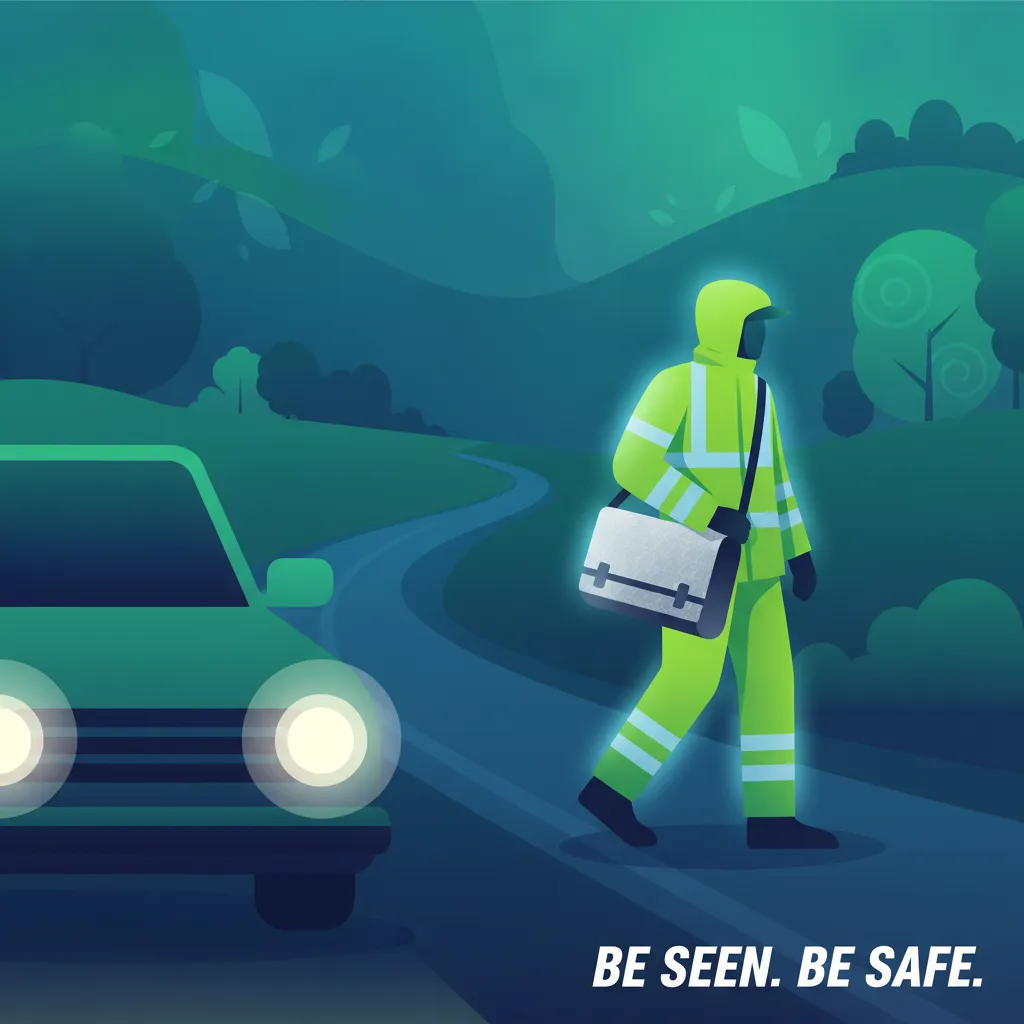
Lesson content overview
For motorcyclists, being seen by other road users is paramount for safety. This lesson delves into essential strategies and equipment designed to significantly improve your motorcycle's and your own conspicuity in traffic. Understanding and correctly utilizing high-visibility clothing, reflective materials, and proper lighting is not just a recommendation; it is a critical component of defensive riding and a legal requirement under the Italian Codice della Strada (Road Code).
Conspicuity refers to the degree to which a motorcyclist and their vehicle are easily noticed, detected, and recognized by other road users. This early detection is crucial for reducing the risk of collisions, as it provides other drivers with more time to react and adjust their driving behavior. Several factors contribute to conspicuity, encompassing both how light interacts with you and your motorcycle, and how the human brain processes visual information.
Photometric visibility is primarily concerned with the light that is either emitted by your motorcycle's lighting system or reflected from your gear. This principle highlights the importance of active lighting components, such as headlamps and Daytime Running Lights (DRL), which actively project light, and passive components, like reflectors and high-visibility clothing, which become visible by returning ambient light or light from other vehicles. Ensuring optimal photometric visibility means that you are detectable across various light conditions, from bright daylight to complete darkness, and in adverse weather.
Beyond simply being visible, you need to attract the psychological attention of other drivers. This involves making yourself stand out from the background through color contrast, motion, and distinct lighting cues. Bright, fluorescent colors create a strong contrast against typical road environments during the day, while strategically placed reflective elements create dynamic flashes of light at night, drawing the eye. The unique profile and movement of a motorcycle, combined with appropriate lighting and gear, help to register your presence more effectively in other drivers' peripheral vision.
High-visibility clothing is a crucial element in enhancing a motorcyclist's presence, particularly during daylight hours. Its effectiveness stems from the unique properties of the materials used, which make the rider stand out distinctly against various backgrounds.
The core of high-visibility clothing relies on fluorescent materials. These fabrics (commonly neon yellow, orange, or green) contain special dyes that absorb ultraviolet (UV) radiation from sunlight and re-emit it as visible light. This process makes them appear brighter and more luminous than non-fluorescent colors, especially in overcast conditions or at dawn and dusk. This enhanced brightness creates a strong color contrast, making the rider significantly more noticeable to other road users, allowing for earlier detection and recognition.
Under the Italian Codice della Strada, specific requirements are in place regarding the use of high-visibility materials on protective clothing for motorcyclists. While the exact surface area can vary, the general principle is that a significant portion of the garment must incorporate such materials to ensure adequate conspicuity. This typically applies to jackets, but can extend to other gear like trousers, gloves, and helmets. Always ensure your gear complies with current regulations.
While fluorescent colors are highly effective during daylight, their ability to stand out diminishes significantly in low-light conditions or at night, as they require ambient light to activate their luminous properties. For this reason, high-visibility clothing is almost always combined with reflective strips. These retro-reflective elements become critical once natural light fades, providing visibility under the illumination of vehicle headlights. It is a common mistake to assume that bright colors alone are sufficient for nighttime visibility; both elements are essential for comprehensive safety.
Reflectors are passive safety devices that play an indispensable role in making motorcyclists visible in low-light conditions, at night, or during adverse weather such as rain or fog. Unlike fluorescent materials, which rely on ambient light, reflectors actively return light from an external source back towards that source, making them highly effective when illuminated by headlights.
Reflectors utilize retro-reflective technology. This means that when light (such as from a car's headlights) strikes a retro-reflective surface, it is bounced directly back to the light source, rather than scattering in multiple directions. This property makes the reflector appear intensely bright to the driver whose headlights are illuminating it, even if the surrounding area remains dark. This focused reflection dramatically increases the distance at which a motorcyclist can be detected.
For maximum effectiveness, reflectors must be strategically placed on both the motorcycle itself and the rider's protective gear.
Motorcycles are legally required to have fixed reflectors on the front, rear, and sides.
Reflective materials should be integrated into your protective clothing to provide a moving, dynamic presence that draws attention.
The effectiveness of reflectors depends on their cleanliness and condition. Dirt, grime, mud, or even faded material can significantly reduce their retro-reflective properties. It is essential to:
Before every ride, especially if you anticipate riding in low light or at night, perform a quick check of your reflectors. Use a flashlight to verify they reflect brightly.
Beyond passive reflectors and high-visibility clothing, active lighting systems are indispensable for ensuring a motorcycle's visibility, both day and night, and for communicating your intentions to other road users.
Daytime Running Lights (DRL) are low-intensity lights specifically designed to be on whenever the motorcycle is in motion during daylight hours. In many European countries, including Italy, DRL use is compulsory for motorcycles.
Low-intensity lights automatically illuminated during daylight when the vehicle is in motion, designed to enhance the vehicle's presence without causing glare.
DRLs significantly increase a motorcycle's conspicuity by providing a constant, distinct light source that is easily noticed by other drivers, especially when viewed head-on or from the rear. They are engineered to be bright enough to be effective in daylight without being dazzling, unlike high-beam headlights. It is a common misconception that DRLs replace the need for dipped beam (low beam) headlights in low-light conditions like heavy rain or fog; DRLs are for daylight enhancement only.
In addition to DRLs, other lights are crucial for both visibility and communication:
These lights indicate the presence and width of your motorcycle.
Turn signals are essential for communicating your intentions to change direction, change lanes, or overtake.
Compliance with Italian traffic law is not just about avoiding penalties; it's fundamental for your safety and the safety of others. The Codice della Strada (Italian Road Code) sets clear mandates for motorcycle visibility equipment.
Failure to comply with these regulations can result in fines and, more importantly, significantly increase your risk of being involved in an accident due to reduced visibility.
A routine inspection of your motorcycle's visibility equipment before each ride is a simple yet vital habit that can prevent accidents. This pre-ride safety check ensures that all components designed to make you visible are fully functional.
Inspect Lights: Turn on the ignition and activate all lights: DRLs, dipped beam (low beam), high beam, front and rear position lamps, and turn signals (left and right). Ensure all bulbs are working, indicators flash at the correct rate, and lenses are clean and undamaged.
Check Reflectors: Visually inspect all fixed reflectors on your motorcycle (front, rear, sides) and reflective elements on your clothing (jacket, trousers, gloves, boots). Ensure they are clean, intact, and free from any obstructions like dirt or mud.
Assess High-Visibility Clothing: Quickly check your fluorescent gear for cleanliness, fading, or damage. Ensure it meets the required surface area for high-visibility material.
Clean Lenses and Reflectors: If any lights or reflectors are dirty, clean them with a soft cloth to ensure maximum light output and reflection.
Neglecting these checks is a common mistake that can lead to being unexpectedly invisible to other road users, especially at critical moments.
Even experienced riders can sometimes overlook critical aspects of visibility. Being aware of these common pitfalls can help you maintain optimal conspicuity.
Effective visibility is not a static concept; it requires dynamic adaptation based on prevailing environmental and road conditions.
The emphasis on visibility enhancements is rooted in fundamental principles of physics, human perception, and accident prevention statistics.
Retro-reflective materials work by efficiently redirecting incident light back to its source, creating a powerful visual signal. The human eye, especially in low-light conditions, is more adept at detecting changes in brightness and contrast than distinguishing subtle colors. Reflective strips provide this strong contrast against a dark background, making a rider pop out to an approaching driver. During daylight, fluorescent colors exploit the eye's sensitivity to specific wavelengths, making them appear brighter and drawing attention.
Increased visibility directly translates into an increased detection distance. When other drivers can see you earlier, they have more time to process your presence, anticipate your movements, and react appropriately. This extended reaction time is a critical safety buffer, allowing for smoother traffic flow and significantly reducing the likelihood of sudden braking, evasive maneuvers, or, critically, collisions. A few extra seconds of detection can be the difference between a near-miss and a serious accident.
Numerous studies and real-world accident data consistently demonstrate that motorcycles equipped with DRLs and riders wearing high-visibility gear have a significantly lower accident rate, particularly in conditions of low light or poor visibility. These enhancements are among the most cost-effective and proven methods for improving motorcycle safety by addressing the fundamental problem of "looked but didn't see" accidents, where drivers fail to register a motorcycle's presence.
Mastering the use of visibility enhancements is a cornerstone of safe motorcycle riding. By consistently wearing high-visibility clothing and reflective gear, ensuring all lights are functional, and adhering to the Italian Codice della Strada regulations, you significantly improve your chances of being seen and understood by every other road user. This proactive approach to conspicuity directly translates into greater safety margins, reduced risk of accidents, and a more confident riding experience on Italian roads. Always remember: "Be seen, be safe."
Motorcycle conspicuity depends on both active and passive visibility systems that must function across changing light and weather conditions. Fluorescent high-visibility clothing excels during daylight by creating color contrast, while retro-reflective materials become critical at night by bouncing headlight beams back to drivers. The Italian Codice della Strada mandates functional lighting equipment including DRLs for daytime use, position lamps, and reflectors on both the motorcycle and rider's protective gear. Turn signals must be used for all directional changes regardless of conditions. A pre-ride visibility check ensuring all lights work and reflectors are clean is essential for maintaining optimal conspicuity and road safety.
A short set of high-value points that capture the most important learning from this lesson.
Conspicuity is a critical safety factor for motorcyclists because early detection by other drivers provides more reaction time to avoid collisions
Fluorescent materials absorb UV light and re-emit it as visible light, making riders stand out during daylight and twilight conditions
Retro-reflective materials bounce light directly back to its source, making them highly effective for nighttime visibility when illuminated by headlights
Daytime Running Lights (DRL) are mandatory for motorcycles in Italy and are specifically designed for daytime conspicuity, not low-light conditions
Both fluorescent clothing for day and reflective elements for night are essential; neither alone provides comprehensive visibility protection
Explore all units and lessons included in this driving theory course.
DRLs are for daytime enhancement only and do not replace dipped beam headlights in low-light conditions like fog or heavy rain
Reflectors must be present on the front (amber/white), rear (red), and sides (amber) of the motorcycle and on rider gear including jacket, gloves, and boots
Fluorescent colors lose their effectiveness in complete darkness because they require ambient light to activate their luminous properties
Turn signals must be used for all directional changes, including minor lane adjustments and turns into side streets, regardless of conditions
Dirty, damaged, or faded reflectors significantly reduce retro-reflective performance and should be cleaned or replaced regularly
Assuming bright fluorescent colors alone are sufficient for nighttime visibility; reflective strips are essential once light fades
Relying solely on headlights during daytime without using DRLs or position lamps for consistent conspicuity
Obscuring reflectors with luggage, mud, or improper riding gear positioning that blocks the rider's visual profile
Neglecting high-visibility gear when starting a ride in daylight, forgetting that conditions may change before the ride ends
Turning off DRLs when using auxiliary lights; DRLs should remain active alongside additional lighting for maximum frontal visibility
Lesson content overview
A short set of high-value points that capture the most important learning from this lesson.
Conspicuity is a critical safety factor for motorcyclists because early detection by other drivers provides more reaction time to avoid collisions
Fluorescent materials absorb UV light and re-emit it as visible light, making riders stand out during daylight and twilight conditions
Retro-reflective materials bounce light directly back to its source, making them highly effective for nighttime visibility when illuminated by headlights
Daytime Running Lights (DRL) are mandatory for motorcycles in Italy and are specifically designed for daytime conspicuity, not low-light conditions
Both fluorescent clothing for day and reflective elements for night are essential; neither alone provides comprehensive visibility protection
Explore all units and lessons included in this driving theory course.
DRLs are for daytime enhancement only and do not replace dipped beam headlights in low-light conditions like fog or heavy rain
Reflectors must be present on the front (amber/white), rear (red), and sides (amber) of the motorcycle and on rider gear including jacket, gloves, and boots
Fluorescent colors lose their effectiveness in complete darkness because they require ambient light to activate their luminous properties
Turn signals must be used for all directional changes, including minor lane adjustments and turns into side streets, regardless of conditions
Dirty, damaged, or faded reflectors significantly reduce retro-reflective performance and should be cleaned or replaced regularly
Assuming bright fluorescent colors alone are sufficient for nighttime visibility; reflective strips are essential once light fades
Relying solely on headlights during daytime without using DRLs or position lamps for consistent conspicuity
Obscuring reflectors with luggage, mud, or improper riding gear positioning that blocks the rider's visual profile
Neglecting high-visibility gear when starting a ride in daylight, forgetting that conditions may change before the ride ends
Turning off DRLs when using auxiliary lights; DRLs should remain active alongside additional lighting for maximum frontal visibility
Explore search topics learners often look for when studying Visibility Enhancements: Reflectors and High-Visibility Clothing. These topics reflect common questions about road rules, driving situations, safety guidance, and lesson level theory preparation for learners in Italy.
Browse additional driving theory lessons that cover connected traffic rules, road signs, and common driving situations related to this topic. Improve your understanding of how different rules interact across everyday traffic scenarios.
Understand the mandatory requirements for motorcycle lighting and reflectors in Italy, including Daytime Running Lights (DRL) and how reflectors enhance visibility to meet Italian road safety standards.
This lesson focuses on the vital systems for visibility and communication: mirrors, lighting, and signals. It provides instruction on the proper adjustment of mirrors to minimize blind spots and the correct use of headlamps, indicators, and brake lights as per Italian regulations. The content underscores how maintaining these systems in full working order is crucial for being seen and signalling intentions clearly in traffic.
This lesson provides a comprehensive guide to a vehicle's lighting systems and their correct use according to the Codice della Strada. It explains the functions of low beams, high beams, fog lights, and daytime running lights, detailing when each should be used to ensure visibility for the driver and by other road users. Proper use of lighting is critical for safety during night driving and in conditions of poor visibility.
This lesson covers the complete set of lighting, reflective equipment, and protective guards mandated for heavy vehicles. It explains the function of each light, from headlights to side markers, and the importance of keeping them clean and operational to ensure the vehicle is visible to others. The lesson also details the legal requirements and safety purpose of side guards and rear underrun protection, which are designed to protect vulnerable road users in a collision.
This lesson details the essential protective equipment required for legal and safe moped operation in Italy. It covers legal standards for helmets, the benefits of wearing protective gloves and boots, and the importance of high-visibility clothing. You will also learn the correct use of your vehicle's lighting system for visibility during both day and night.

This lesson addresses the unique hazards associated with riding through tunnels. It focuses on the importance of adapting vision when entering and exiting, managing speed within the confined space, and maintaining a steady lane position. The content also covers awareness of emergency exits and procedures, as well as the potential for changes in air quality due to ventilation systems.
This lesson explains the function of Italian traffic light systems and the meaning of various road markings. You will learn the rules for red, amber, and green signals, including flashing lights and directional arrows. It also covers how to interpret lane lines, stop lines, and other surface markings that dictate correct vehicle positioning and movement.
Learn how fluorescent and reflective materials in motorcycle gear improve rider conspicuity in traffic, covering Italian regulations and essential tips for staying visible and safe on the road.
This lesson focuses on the vital systems for visibility and communication: mirrors, lighting, and signals. It provides instruction on the proper adjustment of mirrors to minimize blind spots and the correct use of headlamps, indicators, and brake lights as per Italian regulations. The content underscores how maintaining these systems in full working order is crucial for being seen and signalling intentions clearly in traffic.
This lesson details the essential protective equipment required for legal and safe moped operation in Italy. It covers legal standards for helmets, the benefits of wearing protective gloves and boots, and the importance of high-visibility clothing. You will also learn the correct use of your vehicle's lighting system for visibility during both day and night.
This lesson details the functions of specialized protective clothing designed for motorcyclists. It covers the essential qualities of jackets, pants, gloves, and boots, focusing on abrasion resistance and impact protection provided by CE-rated armor. The content explains the differences between materials like leather and textile and how they contribute to rider safety in the event of a fall or collision.
This lesson provides a comprehensive guide to a vehicle's lighting systems and their correct use according to the Codice della Strada. It explains the functions of low beams, high beams, fog lights, and daytime running lights, detailing when each should be used to ensure visibility for the driver and by other road users. Proper use of lighting is critical for safety during night driving and in conditions of poor visibility.
This lesson addresses the unique hazards associated with riding through tunnels. It focuses on the importance of adapting vision when entering and exiting, managing speed within the confined space, and maintaining a steady lane position. The content also covers awareness of emergency exits and procedures, as well as the potential for changes in air quality due to ventilation systems.
This lesson covers the complete set of lighting, reflective equipment, and protective guards mandated for heavy vehicles. It explains the function of each light, from headlights to side markers, and the importance of keeping them clean and operational to ensure the vehicle is visible to others. The lesson also details the legal requirements and safety purpose of side guards and rear underrun protection, which are designed to protect vulnerable road users in a collision.

This lesson explains the concept of using lane positioning as a proactive safety tool. It details how to select a position within the lane to maximize visibility to other drivers, especially at junctions, and to create a buffer of space from potential dangers. The content emphasizes the 'see and be seen' principle, teaching riders to constantly adjust their position based on traffic, road conditions, and potential escape routes.
This lesson teaches riders how to strategically position their vehicle within a lane for maximum visibility to others. It explains how to avoid riding in the blind spots of larger vehicles and how to maintain a safe buffer zone. Proper positioning enhances a rider's presence on the road and is a key component of defensive driving in mixed traffic.
This lesson explains how adverse weather conditions directly affect moped safety by reducing both tire grip and rider visibility. It covers the dangers of riding on wet roads, including the risk of hydroplaning, and provides strategies for managing these conditions. You will also learn techniques for enhancing your visibility to others during fog, rain, and nighttime riding.

This lesson provides an in-depth focus on sharing the road with the most vulnerable users. It teaches drivers to be acutely aware of pedestrians at crossings, cyclists filtering through traffic, and motorcyclists who may be in blind spots. The lesson emphasizes the importance of leaving extra space, signaling intentions clearly, and exercising extreme caution at junctions, where the majority of serious incidents occur.
Find clear answers to common questions learners have about Visibility Enhancements: Reflectors and High-Visibility Clothing. Learn how the lesson is structured, which driving theory objectives it supports, and how it fits into the overall learning path of units and curriculum progression in Italy. These explanations help you understand key concepts, lesson flow, and exam focused study goals.
High-visibility or fluorescent clothing significantly improves a rider's contrast against the background, making them easier for car drivers to detect, especially in heavy urban traffic or near intersections.
While specific garment requirements can vary, using reflective materials is a critical safety practice that aligns with the defensive riding principles required for the Italian theory exam to ensure visibility in low light.
Daytime running lights help distinguish a motorcycle from other vehicles at a distance, allowing car drivers to estimate the bike's speed and proximity more accurately, which is a frequent topic in safety exams.
The principles of visibility are universal for all motorcycle categories (A1, A2, A). Regardless of your engine size or power, the goal of being seen by others remains a fundamental requirement for road safety.
Start searching now to pinpoint exactly which Italian driving theory topics, road signs, or traffic rules you need to master. Use our advanced filters to build a custom practice session and ensure you're fully prepared for every aspect of your official driving licence exam.