
This lesson explains the critical physics behind countersteering, the primary method for initiating and maintaining a lean on a motorcycle. By understanding how a simple push on the handlebar directs your bike, you will build the intuitive control needed for the Italian motorcycle theory exam and safe road navigation. This topic serves as the foundation for the advanced cornering techniques taught later in the course.

Lesson content overview
Learning to ride a motorcycle effectively and safely, particularly for those preparing for the Italian Driving License Theory Course for Motorcycle Categories A1, A2, & A, involves understanding more than just operating the controls. It demands a deep appreciation for the physics that govern a motorcycle's movement and stability. This lesson delves into the crucial concepts of countersteering and the various forces that contribute to a motorcycle's remarkable balance and maneuverability, especially at speed.
At its core, understanding these dynamics allows a rider to make intuitive, precise, and safe directional changes. It moves beyond simply "turning the handlebars" and explains the subtle, yet powerful, inputs that dictate how a motorcycle leans into a turn and maintains stability, even through rapid changes in direction. Mastery of these principles is fundamental for confident riding on any road surface, from urban streets to winding mountain passes.
Motorcycles, unlike bicycles or cars, steer in a counter-intuitive way at speed. This phenomenon, known as countersteering, is the primary method for initiating a turn for any motorcycle moving faster than approximately 5-10 km/h. It’s a technique that riders often employ naturally, even if they aren't consciously aware of it, but understanding its mechanics allows for greater control and confidence.
Countersteering involves briefly pushing the handlebar on the side corresponding to the desired turn. For instance, to turn left, you gently push the left handlebar forward. This momentary input causes the front wheel to steer slightly to the right, which in turn causes the motorcycle to lean to the left. Once the lean is established, the bike naturally follows the curve.
Countersteering is the deliberate, brief application of force to the handlebars in the direction opposite to the desired turn. This initial opposing steering input momentarily pushes the front wheel away from the intended direction, which surprisingly initiates the motorcycle's lean into the turn. Once the motorcycle begins to lean, it naturally follows the curve dictated by that lean angle.
This technique is essential for controlled maneuvering, especially during quick direction changes, navigating around obstacles, performing lane shifts, and entering corners smoothly. Without understanding and applying countersteering, a rider would struggle to achieve the necessary lean and precise control at anything above a walking pace. It is a fundamental skill that underpins safe and efficient motorcycle handling.
The effectiveness and necessity of countersteering are directly related to the motorcycle's speed. At very low speeds, such as when maneuvering in a parking lot or at a standstill, countersteering is largely ineffective. In these situations, riders primarily use body weight shifts, gentle handlebar movements in the desired direction, and throttle/clutch control to maintain balance and change direction.
However, as speed increases (generally above 5-10 km/h), the gyroscopic forces generated by the rotating wheels become significant. These forces are what enable countersteering to work. A gentle push on the handlebar at speed harnesses these gyroscopic effects, translating a small steering input into a much larger lean angle. This allows for rapid and precise directional changes that would be impossible with direct steering alone.
The ability of a motorcycle to lean into a turn in response to a countersteering input is largely attributed to a fundamental physical principle known as gyroscopic precession. This force is generated by the motorcycle's rapidly spinning wheels and plays a critical role in its dynamic stability. Understanding this concept demystifies how a bike "wants" to stay upright and how a rider can manipulate that tendency to turn.
Gyroscopic forces are not unique to motorcycles; they are evident in anything that spins, from toy tops to spacecraft. On a motorcycle, these forces act on both the front and rear wheels, providing stability and influencing how the bike reacts to steering inputs. Without gyroscopic precession, countersteering as we know it would not be possible, and motorcycles would be far less stable at speed.
The tendency of a rotating body to respond to an applied torque by moving at right angles to the direction of the applied torque, rather than in the direction of the torque itself.
When a motorcycle wheel spins rapidly, it acts like a gyroscope. If you apply a force (a torque) to a gyroscope, it doesn't just fall over in the direction of the force. Instead, it responds by moving (precessing) at a right angle to the applied force. On a motorcycle, when you push the left handlebar forward (applying a torque that would normally turn the wheel right), the gyroscopic effect of the front wheel causes the motorcycle to lean left.
This lean is precisely what is needed to initiate a left turn. The front wheel, by momentarily resisting direct steering and instead causing the bike to lean, sets the entire motorcycle on its path. The harder or longer the push (within safe limits), the greater the initial precession and the deeper the lean angle achieved, allowing for tighter or faster turns.
The strength of gyroscopic forces is directly proportional to the speed of the rotating wheels. This means that at higher speeds, the gyroscopic effects are stronger, contributing significantly to the motorcycle's inherent stability. This is why a motorcycle feels more stable and easier to balance when moving quickly than when creeping along at a very low speed.
At high speeds, the gyroscopic forces help the motorcycle resist external disturbances, such as crosswinds or road imperfections, making it naturally want to maintain a straight line. This enhanced stability reduces the rider's effort in maintaining balance and allows for more subtle, precise countersteering inputs. Conversely, at low speeds, where gyroscopic forces are minimal, the rider must rely more on active balance, body shifts, and direct steering to control the bike.
Beyond gyroscopic forces, another critical design element that significantly contributes to a motorcycle's stability and handling characteristics is its trail geometry. Trail is a fundamental aspect of the front end's design, working in conjunction with gyroscopic precession to create a self-correcting steering mechanism, allowing the motorcycle to naturally want to travel in a straight line.
The trail effect provides a constant, subtle force that helps align the front wheel with the direction of travel. This "self-centering" action makes the motorcycle feel stable and predictable, reducing the need for constant, minute steering corrections from the rider. Understanding trail helps riders appreciate how motorcycle design contributes to safety and ease of control.
The horizontal distance between the point where the front wheel contacts the ground and the vertical projection of the steering axis onto the ground.
Imagine a line passing through the center of the steering head (where the front fork pivots) down to the ground. This is the steering axis. Now, imagine a vertical line from the center of the front wheel's contact patch (where the tire touches the ground) up to the steering axis. The distance between where the steering axis hits the ground and where the contact patch hits the ground, measured horizontally, is called the trail.
Most motorcycles are designed with "positive trail," meaning the contact patch is behind the point where the steering axis meets the ground. This geometric offset creates a lever arm. When the front wheel encounters any disturbance or is turned slightly off-center, the forces acting on the contact patch create a self-righting torque that pulls the wheel back into alignment with the direction of travel. This is analogous to the caster wheels on a shopping trolley that always orient themselves to follow the direction of movement.
The amount of trail in a motorcycle's design has a direct impact on its handling characteristics. Generally, a longer trail provides greater straight-line stability. Bikes designed for high-speed cruising, like touring motorcycles, often feature a longer trail, making them feel planted and less susceptible to twitchy steering. This enhanced stability is beneficial for long distances and maintaining a steady course.
Conversely, a shorter trail typically results in quicker, more responsive steering. Sportbikes, designed for agile maneuvering and rapid changes of direction, often have a shorter trail. While this makes them highly responsive, it can also make them feel more "twitchy" or less stable in a straight line at very high speeds, requiring more active rider input to maintain a precise course. The ideal trail is a balance between stability and responsiveness, carefully chosen by manufacturers to match the intended use of the motorcycle.
Having explored the physics, it's time to understand the practical application of countersteering. This technique, though seemingly complex, becomes intuitive with practice. It's not about wrestling the handlebars, but rather applying brief, precise inputs to achieve the desired lean and trajectory. Correct execution is vital for smooth, controlled, and safe cornering on Italian roads and beyond.
The method of countersteering can vary subtly depending on speed and the type of turn. What works for a gentle lane change on a motorway might not be appropriate for a tight hairpin turn in a mountain pass. Understanding these nuances allows a rider to adapt their technique for optimal performance and safety in diverse situations.
Executing a countersteering maneuver involves a sequence of actions that work together to guide the motorcycle through a turn. It begins well before the curve itself and continues until the bike is stable on its new path.
Prepare for the Turn: Before entering a curve, assess the road conditions, turn radius, and adjust your speed accordingly. Smooth speed management is critical.
Initial Input: To initiate a turn in a specific direction (e.g., left), briefly and gently push the handlebar on that side (the left handlebar forward). This causes the front wheel to momentarily turn right, initiating a lean to the left.
Lean and Look: As the bike begins to lean, maintain a relaxed grip on the handlebars and look through the turn to your exit point. Your gaze will naturally guide the motorcycle.
Maintain Throttle: Throughout the turn, maintain a steady or slightly increasing throttle. This keeps the suspension settled and the drive chain taut, which helps stabilize the bike and maintain traction.
Counter-Press (if needed): If you need to increase the lean mid-turn, apply a bit more pressure to the inside handlebar. If you need to reduce the lean and stand the bike up slightly, ease pressure or briefly push the outside handlebar.
Exit the Turn: As you approach the exit of the turn, gradually roll on the throttle to help the bike stand upright and accelerate out of the curve, preparing for the next straight or turn.
The key is to use brief, controlled inputs. Over-correction or excessive force can lead to instability or over-leaning, potentially causing a loss of traction.
The application of countersteering needs to be adapted to the riding speed. This adjustment is crucial for maintaining control and reacting appropriately to various traffic and road conditions.
High-Speed Countersteering: At higher speeds (e.g., above 60 km/h), gyroscopic forces are strong. This means that even a very subtle, light push on the handlebars is sufficient to initiate a lean and change direction. For instance, on a motorway, a gentle, brief push on the handlebar is all that's needed to smoothly execute a lane change. Excessive force at high speeds can lead to an abrupt and dangerous change in direction.
Low-Speed Countersteering: Below approximately 5-10 km/h, gyroscopic forces are minimal. Attempting to forcefully countersteer at these speeds often results in wobbling and instability rather than a controlled lean. Instead, at very low speeds, riders should rely more on shifting their body weight, using slight direct steering (turning the handlebars in the direction of the turn), and precise clutch and throttle control to maintain balance and maneuver. This is commonly seen when performing U-turns in a confined space or navigating slow-moving traffic.
Practice gentle countersteering inputs in a safe, open area to develop the "feel" for how your motorcycle responds at different speeds. The goal is smooth, controlled initiation of lean, not a wrestling match with the handlebars.
The lean angle is a critical factor in motorcycle cornering, representing the balance between the forces that keep the bike upright and those that pull it towards the center of the turn. Every turn requires a specific lean angle, and understanding how this angle is determined is vital for maintaining control and traction. Mastering lean angle determination helps riders avoid over-leaning, which can lead to a loss of grip, or under-leaning, which results in running wide in a turn.
The ability to accurately judge and achieve the correct lean angle, combined with appropriate speed management, is a hallmark of a skilled and safe motorcyclist. This knowledge is especially important when navigating the varied and sometimes challenging curves found on Italian roads.
The required lean angle for a motorcycle to successfully navigate a turn is determined by a simple physics principle, balancing centripetal force against gravitational force. The formula for this is:
tan θ = v² / (g * r)
Where:
θ (theta) is the lean angle.v is the motorcycle's speed.g is the acceleration due to gravity (approximately 9.81 m/s²).r is the radius of the turn.In practical terms, this means that for a given turn radius, a higher speed requires a greater lean angle. Conversely, for a given speed, a tighter turn (smaller radius) also demands a greater lean angle. While riders don't perform actual calculations in real-time, understanding this relationship allows them to intuitively adjust their speed before entering a turn to ensure the required lean angle remains within safe limits.
The primary purpose of achieving the correct lean angle is to ensure that the motorcycle's tires maintain sufficient traction with the road surface. Every tire has a "traction circle," which represents the maximum combined longitudinal (braking/acceleration) and lateral (cornering) forces it can withstand before losing grip. When a motorcycle leans, it uses a significant portion of its available lateral traction.
Exceeding the safe lean angle for a given speed and road condition puts the tires beyond their traction limits. On a dry, grippy surface, tires can accommodate significant lean. However, on wet, slippery, or gravelly surfaces, the available traction is drastically reduced, meaning even a moderate lean angle can become dangerous. This makes smooth, controlled lean initiation, combined with appropriate speed, absolutely critical for preventing tire slip and potential falls. Riders must always be mindful of surface conditions and adjust their lean angles accordingly.
Operating a motorcycle on Italian roads, like anywhere else, requires adherence to specific regulations designed to ensure safety for all road users. While the Codice della Strada (Italian Highway Code) may not explicitly mention "countersteering," it certainly mandates safe vehicle operation, which inherently includes the proper use of steering techniques and speed management to maintain control. Riders must understand their responsibilities to avoid fines and, more importantly, prevent accidents.
Maintaining control of the motorcycle at all times is a fundamental legal and safety requirement. This applies to all aspects of riding, including how a rider initiates turns and manages lean angles.
Riders operating motorcycles on Italian roads must at all times maintain full control of their vehicle. Any steering input, including countersteering, must be executed in a manner that does not compromise safety, stability, or predictability to other road users.
This overarching principle means that regardless of the specific technique used, the outcome must be a controlled maneuver. Abrupt or unpredictable steering actions that could endanger other vehicles or pedestrians are strictly prohibited. Before initiating any directional change, such as a lane change or turning into a curve, riders are legally obligated to check their mirrors, signal their intentions, and ensure the maneuver can be completed safely. Using countersteering effectively allows for smooth, controlled movements that comply with these regulations.
Motorcycle riders must avoid excessive lean angles that exceed the vehicle's traction limits under the prevailing road and weather conditions. Failure to do so can lead to loss of control, tire slip, and potential accidents.
While the Codice della Strada does not specify a maximum lean angle, it does impose speed limits and rules regarding safe driving practices, particularly when negotiating curves and turns. Riders are responsible for adjusting their speed and riding technique to suit the road geometry, surface conditions (e.g., wet, gravel, potholes), and visibility. Entering a curve too fast and subsequently requiring an excessive lean angle is considered dangerous and can lead to a loss of control, which may be deemed a violation of safe driving conduct.
Even with a theoretical understanding, practical application of countersteering can be challenging. Many common mistakes stem from either an over-application of the technique or a misunderstanding of how it interacts with other riding factors. Identifying and correcting these errors is crucial for improving safety and confidence on the road.
Avoiding these pitfalls requires conscious effort, practice, and a continuous assessment of riding inputs and conditions. Developing a smooth and intuitive countersteering technique is a process that improves with experience.
One of the most frequent errors is applying too much force or holding the countersteering input for too long. This can lead to an abrupt and excessive lean angle, potentially exceeding the tire's traction limits and causing a loss of grip.
Entering a curve at an inappropriate speed is a significant cause of accidents. If a rider enters a turn too fast, they will require an excessive lean angle to negotiate the curve, pushing the limits of tire traction. This often leads to running wide or, worse, a slide.
Attempting to apply significant countersteering inputs at very low speeds (e.g., parking lot maneuvers, U-turns at walking pace) is another common mistake. As discussed, at minimal speeds, gyroscopic forces are too weak for countersteering to be effective, leading to an unstable wobble or loss of balance.
Motorcycle riding is a dynamic activity, with conditions constantly changing. A skilled rider adapts their countersteering technique and overall approach to account for variations in weather, road surface, visibility, traffic, and even the motorcycle's load. Ignoring these contextual factors can turn a routine maneuver into a dangerous situation.
Being aware of how external factors influence the motorcycle's stability and traction is paramount for safe riding, requiring constant vigilance and adjusted inputs.
Understanding the dynamics of countersteering and bike stabilization is not merely academic; it is fundamental to becoming a safe, proficient, and confident motorcyclist. This lesson has explored the core principles that govern how a motorcycle turns and maintains its balance at speed.
Countersteering is the primary technique for initiating a turn for any motorcycle traveling above approximately 5-10 km/h. It involves a brief push on the handlebar in the direction of the desired turn, which counter-intuitively causes the motorcycle to lean into the turn. This phenomenon is largely due to gyroscopic precession, the tendency of a spinning wheel to respond to an applied force by moving at right angles to that force. At higher speeds, these gyroscopic forces become stronger, contributing significantly to the motorcycle's inherent stability.
Another crucial design element is trail geometry, which refers to the offset between the front wheel's contact patch and the steering axis projection onto the ground. A positive trail creates a self-centering force that helps the motorcycle maintain a straight line and recover from leans, enhancing stability. While longer trail promotes stability, shorter trail offers greater responsiveness.
The lean angle required for a turn is determined by the motorcycle's speed and the radius of the curve. Riders must adjust their speed before entering a turn to ensure the necessary lean angle remains within the tire's traction limits. Exceeding these limits, especially on poor or wet surfaces, can lead to a loss of grip and control.
Riders must always maintain control of their motorcycle, adhering to regulations such as the Italian Codice della Strada. This includes executing countersteering maneuvers smoothly, predictably, and with due regard for other road users and prevailing conditions. Conditional factors like weather, road surface, visibility, and vehicle load all necessitate adjustments to countersteering inputs and lean angles.
By mastering these dynamics, riders gain an intuitive understanding of their machine, enabling precise control, enhanced safety, and a more enjoyable riding experience on any road.
Countersteering is the essential technique for initiating motorcycle turns at speed, involving a brief push on the handlebar that, through gyroscopic precession, causes the bike to lean into the desired direction. The physics of spinning wheels and trail geometry work together to provide stability and self-centering behavior, while the required lean angle depends directly on speed and turn radius. Successful cornering requires adjusting speed before entering a curve to keep lean angles within tire traction limits, with particular care on wet or poor surfaces. Riders must apply smooth, controlled inputs and maintain appropriate throttle throughout the turn while remaining alert to conditions and load variations.
A short set of high-value points that capture the most important learning from this lesson.
Countersteering is the primary method for initiating turns at speeds above approximately 5-10 km/h, involving a brief push on the handlebar in the direction of the desired turn.
Gyroscopic precession causes the front wheel to respond to a steering input by moving at right angles, initiating lean through the bike's spinning wheels.
Lean angle required for a turn is determined by speed and turn radius; higher speed or tighter turns demand greater lean.
Trail geometry creates a self-centering effect that helps the motorcycle maintain straight-line stability and recover from leans.
Speed must be adjusted before entering curves to ensure the necessary lean angle remains within the tire's traction limits.
Explore all units and lessons included in this driving theory course.
Countersteering means pushing the handlebar in the direction you want to go, not turning it like a car steering wheel.
At low speeds (below 5-10 km/h), gyroscopic forces are too weak for countersteering; use body weight shifts and direct steering instead.
Maintain steady or slightly increasing throttle through turns to keep the suspension settled and the bike stable.
On wet, icy, or gravelly surfaces, drastically reduce speed because traction limits are significantly lowered.
Trail geometry acts like a shopping trolley caster, constantly aligning the front wheel with the direction of travel.
Applying excessive force or holding the countersteering input too long, causing abrupt and potentially dangerous lean angles.
Using direct steering (turning the handlebar in the direction of the turn) at speed, which is ineffective and destabilizing.
Entering curves at excessive speed and needing excessive lean that exceeds tire traction limits, risking a loss of grip.
Attempting to force countersteering at very low speeds, leading to wobble and loss of balance instead of controlled lean.
Abruptly releasing throttle mid-corner, which unloads the rear suspension and reduces traction.
Lesson content overview
A short set of high-value points that capture the most important learning from this lesson.
Countersteering is the primary method for initiating turns at speeds above approximately 5-10 km/h, involving a brief push on the handlebar in the direction of the desired turn.
Gyroscopic precession causes the front wheel to respond to a steering input by moving at right angles, initiating lean through the bike's spinning wheels.
Lean angle required for a turn is determined by speed and turn radius; higher speed or tighter turns demand greater lean.
Trail geometry creates a self-centering effect that helps the motorcycle maintain straight-line stability and recover from leans.
Speed must be adjusted before entering curves to ensure the necessary lean angle remains within the tire's traction limits.
Explore all units and lessons included in this driving theory course.
Countersteering means pushing the handlebar in the direction you want to go, not turning it like a car steering wheel.
At low speeds (below 5-10 km/h), gyroscopic forces are too weak for countersteering; use body weight shifts and direct steering instead.
Maintain steady or slightly increasing throttle through turns to keep the suspension settled and the bike stable.
On wet, icy, or gravelly surfaces, drastically reduce speed because traction limits are significantly lowered.
Trail geometry acts like a shopping trolley caster, constantly aligning the front wheel with the direction of travel.
Applying excessive force or holding the countersteering input too long, causing abrupt and potentially dangerous lean angles.
Using direct steering (turning the handlebar in the direction of the turn) at speed, which is ineffective and destabilizing.
Entering curves at excessive speed and needing excessive lean that exceeds tire traction limits, risking a loss of grip.
Attempting to force countersteering at very low speeds, leading to wobble and loss of balance instead of controlled lean.
Abruptly releasing throttle mid-corner, which unloads the rear suspension and reduces traction.
Explore search topics learners often look for when studying Dynamics of Countersteering and Bike Stabilisation. These topics reflect common questions about road rules, driving situations, safety guidance, and lesson level theory preparation for learners in Italy.
Browse additional driving theory lessons that cover connected traffic rules, road signs, and common driving situations related to this topic. Improve your understanding of how different rules interact across everyday traffic scenarios.
Explore the fundamental physics behind motorcycle steering, including gyroscopic precession and trail effect. Understand how these forces contribute to bike stability and control, crucial for Italian A license theory.

This lesson focuses on the rider's active role in controlling the motorcycle through body positioning and weight shifts. It explains how to maintain a relaxed yet engaged posture to absorb road imperfections and provide precise inputs to the handlebars and footpegs. The content covers how leaning with the bike in corners and shifting weight during braking and acceleration significantly impacts the vehicle's stability and performance.

This lesson addresses the dynamics of cornering and maintaining stability on an AM vehicle, especially at lower speeds. It explains the importance of selecting an appropriate entry speed, using the correct lean angle, and smoothly accelerating out of a turn. You will also learn how factors like road camber and tire pressure affect grip and control while navigating curves.
This lesson focuses on how to adapt riding techniques to maintain traction on compromised surfaces. It identifies common hazards such as wet leaves, manhole covers, gravel, and painted lines that can reduce the tyre's grip. Learners will understand how to use smooth and gentle throttle, brake, and steering inputs to prevent traction loss and maintain control in these challenging situations.

This lesson teaches riders how to maintain a safe following distance using the two-second rule, which accounts for reaction time and braking distance. It covers grip management, explaining how tire condition and road surfaces like wet asphalt affect traction. Mastering these concepts is essential for anticipating hazards and preventing rear-end collisions.

This lesson provides specific strategies for riding on narrow rural roads, which often feature poor surfaces and limited sightlines. It details the techniques for approaching and navigating hairpin bends, including selecting the correct line, managing speed before entry, and using appropriate gear selection. The content emphasizes anticipating oncoming traffic and potential hazards hidden around blind corners for enhanced safety.

This lesson focuses on the vital systems for visibility and communication: mirrors, lighting, and signals. It provides instruction on the proper adjustment of mirrors to minimize blind spots and the correct use of headlamps, indicators, and brake lights as per Italian regulations. The content underscores how maintaining these systems in full working order is crucial for being seen and signalling intentions clearly in traffic.

This lesson breaks down the process of cornering into three distinct phases: entry, apex, and exit. It teaches the importance of adjusting speed before entering the turn, selecting the appropriate line (often outside-inside-outside) to maximize visibility and smoothness. The content also explains how to use the throttle to maintain stability and traction throughout the cornering maneuver for a safe and controlled exit.

This lesson explains how to execute left turns, right turns, and U-turns safely while maintaining correct lane discipline. It covers interpreting road markings and arrows, selecting the proper vehicle position, and using signals in a timely manner. Performing shoulder checks to monitor blind spots before and during a turn is a key focus for preventing collisions.

This lesson provides an in-depth analysis of motorcycle braking systems, clearly defining the distinct roles of the front and rear brakes. It covers the mechanics of hydraulic disc brakes and explains the function and benefits of an Anti-lock Braking System (ABS). Learners will understand the principles of brake balance for achieving maximum stopping power and the importance of routine maintenance on pads, discs, and fluid.
This lesson explains the physical effects of different weather conditions on motorcycle safety. It details how rain reduces tyre adhesion and increases the risk of hydroplaning, while fog severely limits visibility, requiring a significant reduction in speed. The content also covers how extreme heat and cold can affect tyre pressure and compound performance, necessitating adjustments from the rider.
Learn advanced application of countersteering for different speeds and conditions, and discover common rider errors to avoid. Essential knowledge for safe motorcycle operation on Italian roads and theory exams.

This lesson addresses the increased complexity of overtaking in urban environments with dense traffic and frequent intersections. It stresses the importance of thorough observation, including mirror and blind spot checks, to ensure a safe gap is available. The content covers judging speed differentials and the necessity of clear signalling to execute the maneuver without causing conflict with other road users.
This lesson provides specific strategies for riding on narrow rural roads, which often feature poor surfaces and limited sightlines. It details the techniques for approaching and navigating hairpin bends, including selecting the correct line, managing speed before entry, and using appropriate gear selection. The content emphasizes anticipating oncoming traffic and potential hazards hidden around blind corners for enhanced safety.
This lesson explains how to execute left turns, right turns, and U-turns safely while maintaining correct lane discipline. It covers interpreting road markings and arrows, selecting the proper vehicle position, and using signals in a timely manner. Performing shoulder checks to monitor blind spots before and during a turn is a key focus for preventing collisions.

This lesson addresses high-risk behaviors often associated with young and inexperienced riders. It highlights the dangers of distractions like mobile phone use, the influence of peer pressure, and the severe consequences of speeding or riding under the influence of substances. Understanding these risks is the first step toward developing a mature and responsible approach to riding.

This lesson teaches the fundamental observation techniques required for proactive and defensive riding. It details a systematic approach to scanning the road environment, using mirrors effectively, and performing shoulder checks to cover blind spots before any maneuver. Developing strong situational awareness is presented as a key skill for anticipating potential hazards and reacting to them in a timely manner.

This lesson provides a comprehensive guide to riding on high-speed motorways, or autostrade. It details the correct procedures for safely merging into traffic from an entry ramp and exiting via a deceleration lane. The content reinforces strict lane discipline, rules for overtaking, and the importance of maintaining a significantly larger following distance to compensate for higher speeds and potential wind gusts.

This lesson addresses the specific challenges of sharing the road with two-wheeled motor vehicles like motorcycles and scooters. It highlights their reduced visibility and stability compared to cars, requiring drivers to double-check blind spots and maintain a greater following distance. The content also discusses common behaviors like lane filtering and the need for drivers to be predictable and signal intentions clearly.

This lesson equips riders to safely manage the challenges posed by road construction zones. It explains how to interpret temporary signage, navigate lane closures or diversions, and maintain heightened awareness for surface hazards like gravel or steel plates. The content emphasizes the need to reduce speed and increase following distances to safely share the road with large construction vehicles and workers.

This lesson focuses on the unique demands of mountain riding, from handling steep inclines and declines to understanding the impact of altitude on the motorcycle's engine performance. It covers the effective use of engine braking on descents to prevent brake overheating. The content also prepares riders for the rapidly changing weather conditions, such as wind and fog, that are common at higher elevations.
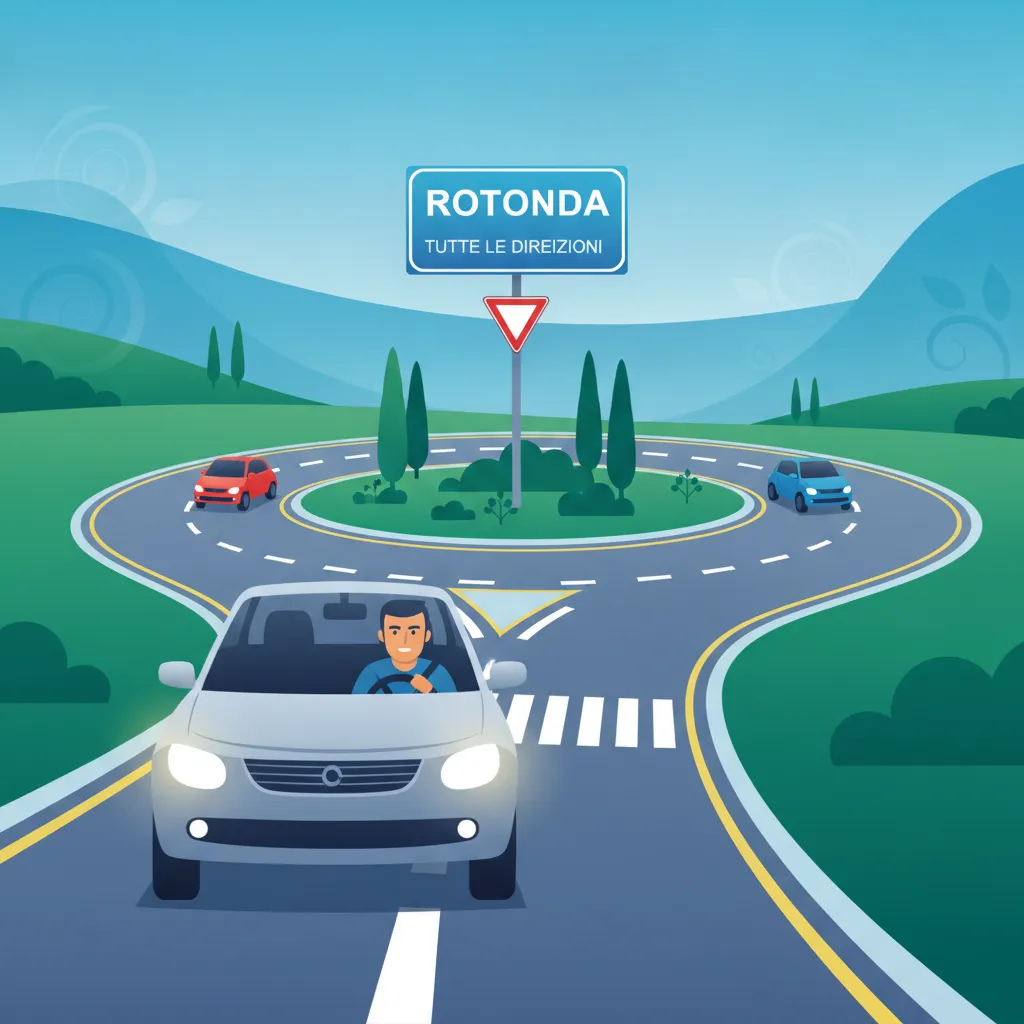
This lesson provides a step-by-step guide to safely navigating Italian roundabouts, known as rotatorie. It emphasizes the primary rule of yielding to traffic already circulating within the roundabout before entering. The content details correct lane positioning for different exits, the importance of signalling your intention to exit, and maintaining awareness of other vehicles.
Find clear answers to common questions learners have about Dynamics of Countersteering and Bike Stabilisation. Learn how the lesson is structured, which driving theory objectives it supports, and how it fits into the overall learning path of units and curriculum progression in Italy. These explanations help you understand key concepts, lesson flow, and exam focused study goals.
Countersteering is the primary method for initiating a lean on a motorcycle at any speed above walking pace. At very low speeds, such as in parking maneuvers, steering is primarily achieved through direct bar movement, but countersteering becomes essential for stability as soon as you gain momentum.
It feels counterintuitive because it involves pushing the handlebar in the opposite direction of the desired turn. Many beginners instinctively try to steer by leaning their body or pulling the bars, which is ineffective and slow for quick direction changes required in traffic.
Yes, body position works in tandem with countersteering. While the push on the bar initiates the turn, your body position and weight distribution help stabilize the bike through the corner, keeping the center of gravity aligned for better traction and safety.
The exam focuses on understanding the forces involved in steering and vehicle stability. You may be asked questions about how speed affects steering input, the physics of cornering, or the proper method for initiating a turn to avoid road hazards.
Start searching now to pinpoint exactly which Italian driving theory topics, road signs, or traffic rules you need to master. Use our advanced filters to build a custom practice session and ensure you're fully prepared for every aspect of your official driving licence exam.