
This lesson focuses on the technical and safety demands of riding on challenging rural and mountain roads in Italy. You will learn to manage your motorcycle through narrow paths and tight hairpins while preparing for specific hazard perception questions found in the Italian motorcycle theory exam.

Lesson content overview
Riding a motorcycle on narrow country roads and through challenging hairpin bends presents a unique set of demands for riders. These environments, often found in rural and mountainous regions of Italy, require heightened awareness, precise control, and specific riding techniques to ensure safety. This lesson provides an in-depth guide to navigating these intricate routes, building upon foundational skills of cornering, speed management, and observation.
Narrow country roads, particularly those featuring numerous curves and elevation changes, are inherently more challenging than well-maintained urban or motorway routes. The very nature of these roads necessitates a comprehensive understanding of their specific risks and the riding strategies required to mitigate them.
Unlike wider roads, narrow country lanes offer less margin for error. The reduced space means that errors in road positioning, speed management, or observation can quickly escalate into dangerous situations, especially when encountering oncoming traffic or unexpected hazards. The environment is less predictable; you might encounter slow-moving agricultural vehicles, parked cars, cyclists, pedestrians, or even animals, all demanding immediate and precise reactions.
A primary challenge on rural roads is limited sightlines. Many bends are "blind corners," where you cannot see the road ahead or potential oncoming traffic until you are already within the turn. This significantly reduces reaction time. Furthermore, road surfaces can be highly variable: asphalt might be cracked, potholed, covered in gravel, sand, mud, or fallen leaves, or even transition abruptly to dirt or unpaved sections. These suboptimal surfaces reduce tire grip and require constant vigilance and smoother control inputs.
Safe navigation of narrow country roads hinges on a few core riding principles. These are interconnected and must be applied in unison to maintain control and minimize risk.
Visibility and observation are paramount. On narrow and winding roads, especially those with blind corners, you must actively scan the road ahead as far as possible. This involves using both your focused attention to pinpoint the vanishing point of the road or the apex of a bend, and peripheral awareness to detect any movement or changes in the environment at the edges of your vision. Early detection of hazards, such as oncoming vehicles, allows crucial time for decision-making and adjustment. Remember that you must yield to oncoming traffic at blind corners, particularly where the road is too narrow for two vehicles to pass comfortably.
Look Through the Bend: Always try to look as far through the bend as possible. If you can't see the exit, assume there's an obstacle or oncoming traffic. This mental preparation is key to safe riding.
Speed management is critical before, during, and after a bend. The goal is to enter the bend at a speed that allows you to maintain full control, avoid sudden braking mid-turn, and smoothly accelerate out of it. This pre-bend speed should be carefully chosen based on the bend's radius, the road surface, traffic conditions, and your visibility.
The speed at which a rider approaches and begins to enter a curve, carefully adjusted to ensure safe negotiation without sudden braking or loss of control.
Decelerate before leaning into the turn. Once you are leaned over, traction is primarily dedicated to cornering, and aggressive braking can cause a loss of grip, especially on a motorcycle. Smooth throttle application is used to maintain mid-bend speed and accelerate gently upon exiting the bend.
Appropriate gear selection works hand-in-hand with speed management. Before entering a bend, downshifting to a lower gear helps in two ways:
Avoid Late Downshifting: Downshifting too late, while already leaned into a bend, can upset the motorcycle's balance, cause the rear wheel to lose traction (especially if the clutch is released abruptly), or lead to engine over-revving.
Line selection refers to the path you take through a bend. Choosing the optimal line is crucial for maximizing visibility, maintaining stability, and reducing steering input.
On narrow country roads and particularly for hairpin bends, the Outside-Inside-Outside (OIO) line is generally the safest and most effective strategy:
Approach Wide (Outside): Position your motorcycle towards the outer edge of your lane as you approach the bend. This gives you the best possible sightline into the turn and maximizes your available road space.
Clip the Apex (Inside): As you enter the bend and begin to see the exit, gently guide your motorcycle towards the inner edge, or "apex," of the curve. This is the tightest part of your turn.
Exit Wide (Outside): As you pass the apex and begin to straighten up, allow your motorcycle to drift towards the outer edge of your lane again. This prepares you for the next straight or bend and maximizes your visibility for any oncoming traffic.
The innermost point of a curve or bend where a rider aims to pass to optimize their line, reduce steering input, and maximize safety or speed.
This OIO technique effectively straightens out the bend, reducing the required lean angle and providing more stability. Another line, the Outside-Outside-Outside (OOO) line, maintains a wider arc throughout the bend, which can be useful on gentler curves with excellent visibility, but is less suitable for sharp, blind turns where you need to maximize your sightline into the bend.
Your road positioning on a narrow road directly impacts your visibility and the space you afford to other road users. On such roads, especially when approaching blind corners, it is generally safer to adopt far side positioning. This means riding closer to the edge of the lane that is opposite to the direction of oncoming traffic. For example, in a right-hand bend, you would position yourself towards the left side of your lane (but still within it) to see further around the corner.
Riding closer to the edge of the lane that is farthest from the direction of oncoming traffic, typically used on narrow or winding roads to improve visibility and create more space.
Conversely, near side positioning, riding close to the edge where oncoming traffic travels, significantly reduces your visibility and increases the risk of a head-on collision. Always aim to provide as much space as possible for oncoming vehicles, especially large ones like buses or trucks, which may need to encroach slightly into your lane.
Hairpin bends are exceptionally tight turns, often approaching 180 degrees, and are a common feature of mountainous and very winding rural roads. They demand even greater precision in technique due to their acute geometry and typically limited sightlines.
A hairpin bend is characterized by its extremely sharp radius and often steep approach or exit angles. Navigating these turns successfully requires a significant reduction in speed, precise gear selection, and a meticulous line. The challenge is not just the turn itself, but also the potential for reduced visibility and unexpected obstacles at the apex or exit, which might include gravel, debris, or a vehicle cutting the corner.
For a hairpin bend, the OIO line becomes even more critical.
Aggressive Speed Reduction: Decelerate significantly and early. Use a combination of engine braking and progressive application of both front and rear brakes before entering the turn. Select a very low gear (first or second, depending on the bend's severity and motorcycle's power delivery) to ensure powerful engine braking and immediate drive upon exit.
Wide Approach: Position yourself as far to the outer edge of your lane as safely possible. For a right-hand hairpin, hug the left side of your lane; for a left-hand hairpin, hug the right side. This widens your effective turning radius and allows you to see further into the bend.
Look to the Exit: Focus your vision on the very exit of the bend, even if it feels unnatural at first. Your motorcycle tends to go where your eyes are looking.
Smooth Steering and Lean: Initiate your turn smoothly, leaning the motorcycle into the bend. Maintain a steady throttle (or a very slight acceleration) through the apex to stabilize the chassis and prevent sudden weight transfer.
Clip the Apex: Aim to clip the apex of the bend as you begin to see the exit clearly.
Controlled Exit: As you pass the apex and the road begins to straighten, gradually reduce your lean angle and gently accelerate. Allow the motorcycle to drift towards the outer edge of your lane for a smooth and safe exit, preparing for the next section of road.
On extremely tight hairpins, it might feel like you're almost stopping before the turn. This is often the correct approach to ensure a safe, controlled passage.
The Codice della Strada (Italian Highway Code) governs all road use, and while it doesn't always specify "motorcycle" for every rule, the general principles of safe driving apply directly to motorcyclists, with particular emphasis on vulnerable road users.
Under Italian traffic law, drivers (including motorcyclists) are always expected to adjust their speed to the prevailing road, traffic, and weather conditions. This is particularly crucial on narrow, winding rural roads.
While specific regulations for "line selection" might not be detailed, the general rules regarding road positioning and safe overtaking directly impact these techniques.
Codice della Strada to never overtake on curves or bends where your sightline is limited. This prohibition is in place to prevent head-on collisions with unseen oncoming vehicles. Overtaking must only be attempted when you have a clear, unobstructed view of the road ahead and can complete the maneuver safely without impeding other traffic.The principles discussed are foundational, but they must be adapted to changing environmental and vehicle conditions.
On narrow country roads, you are more likely to encounter vulnerable road users such as cyclists and pedestrians.
Understanding common errors is crucial for safe motorcycle riding. Awareness allows you to consciously avoid these pitfalls:
Here are some real-world examples demonstrating the application of these principles.
Many of these techniques are rooted in the fundamental physics of motorcycle dynamics and human perception.
This lesson teaches essential techniques for navigating narrow country roads and hairpin bends, emphasizing the Outside-Inside-Outside (OIO) line selection, far side positioning to maximize visibility, and pre-bend speed management using engine braking before cornering. Key principles include downshifting early to a suitable gear, approaching hairpin bends with significant speed reduction, and yielding to oncoming traffic at blind corners as required by Italian road law. The content explains why these techniques work through fundamental physics of traction and centripetal force, and highlights common mistakes such as braking while leaned, late gear changes, and target fixation that learners should consciously avoid.
A short set of high-value points that capture the most important learning from this lesson.
Use the Outside-Inside-Outside (OIO) line technique: approach wide, clip the apex, exit wide within your lane to maximize visibility and stability through bends.
Adopt far side positioning (riding toward the edge opposite oncoming traffic) on narrow roads to improve your sightline into blind corners and appear earlier to approaching vehicles.
Manage speed before entering bends by decelerating early using engine braking; braking while leaned over reduces available traction for cornering.
Downshift to an appropriate lower gear before bends to utilize engine braking for smoother deceleration and ensure responsive power delivery for exiting the turn.
Hairpin bends require aggressive early speed reduction, low gear selection, and wide approach positioning to safely negotiate their acute geometry.
Explore all units and lessons included in this driving theory course.
On blind corners, always yield to oncoming traffic and assume a vehicle may be present even when you cannot see it.
Brake before leaning, not during the lean; mid-corner braking transfers traction away from cornering and risks a low-side crash.
Far side positioning increases your visibility to oncoming traffic and gives you more reaction time on narrow roads.
Overtaking on curves with limited sightlines is prohibited under the Codice della Strada and creates high collision risk.
Look where you want to go, not at hazards; target fixation draws your motorcycle toward the danger.
Entering hairpin bends at excessive speed, forcing wide lines, loss of control, or dangerous mid-lean braking.
Late downshifting while already leaned into a bend, which can upset chassis balance, cause rear wheel traction loss, or lead to engine over-revving.
Positioning near the center line or encroaching into the oncoming lane on blind bends, dramatically reducing reaction time for both riders.
Abruptly accelerating mid-curve while still leaned over, which can break rear tire traction especially on loose or wet surfaces.
Attempting to overtake vehicles on curves where sightlines are limited, violating both safe riding practice and the Codice della Strada.
Lesson content overview
A short set of high-value points that capture the most important learning from this lesson.
Use the Outside-Inside-Outside (OIO) line technique: approach wide, clip the apex, exit wide within your lane to maximize visibility and stability through bends.
Adopt far side positioning (riding toward the edge opposite oncoming traffic) on narrow roads to improve your sightline into blind corners and appear earlier to approaching vehicles.
Manage speed before entering bends by decelerating early using engine braking; braking while leaned over reduces available traction for cornering.
Downshift to an appropriate lower gear before bends to utilize engine braking for smoother deceleration and ensure responsive power delivery for exiting the turn.
Hairpin bends require aggressive early speed reduction, low gear selection, and wide approach positioning to safely negotiate their acute geometry.
Explore all units and lessons included in this driving theory course.
On blind corners, always yield to oncoming traffic and assume a vehicle may be present even when you cannot see it.
Brake before leaning, not during the lean; mid-corner braking transfers traction away from cornering and risks a low-side crash.
Far side positioning increases your visibility to oncoming traffic and gives you more reaction time on narrow roads.
Overtaking on curves with limited sightlines is prohibited under the Codice della Strada and creates high collision risk.
Look where you want to go, not at hazards; target fixation draws your motorcycle toward the danger.
Entering hairpin bends at excessive speed, forcing wide lines, loss of control, or dangerous mid-lean braking.
Late downshifting while already leaned into a bend, which can upset chassis balance, cause rear wheel traction loss, or lead to engine over-revving.
Positioning near the center line or encroaching into the oncoming lane on blind bends, dramatically reducing reaction time for both riders.
Abruptly accelerating mid-curve while still leaned over, which can break rear tire traction especially on loose or wet surfaces.
Attempting to overtake vehicles on curves where sightlines are limited, violating both safe riding practice and the Codice della Strada.
Explore search topics learners often look for when studying Riding on Narrow Country Roads and Hairpin Bends. These topics reflect common questions about road rules, driving situations, safety guidance, and lesson level theory preparation for learners in Italy.
Browse additional driving theory lessons that cover connected traffic rules, road signs, and common driving situations related to this topic. Improve your understanding of how different rules interact across everyday traffic scenarios.
Understand and avoid typical errors made by motorcyclists on narrow rural roads and sharp hairpin bends. This lesson focuses on critical mistakes related to speed, line selection, and hazard perception for Italian theory exam preparation.
This lesson provides a comprehensive guide to riding on high-speed motorways, or autostrade. It details the correct procedures for safely merging into traffic from an entry ramp and exiting via a deceleration lane. The content reinforces strict lane discipline, rules for overtaking, and the importance of maintaining a significantly larger following distance to compensate for higher speeds and potential wind gusts.

This lesson addresses the increased complexity of overtaking in urban environments with dense traffic and frequent intersections. It stresses the importance of thorough observation, including mirror and blind spot checks, to ensure a safe gap is available. The content covers judging speed differentials and the necessity of clear signalling to execute the maneuver without causing conflict with other road users.

This lesson focuses on the unique characteristics and challenges of driving on rural and mountain roads. It covers how to safely navigate sharp curves, steep inclines, and narrow lanes with limited visibility, often requiring the use of the horn to signal presence. The content also prepares drivers for potential hazards such as slow-moving agricultural vehicles, unexpected animal crossings, and variable road surface quality.

This lesson explains the principles of maintaining proper lane discipline and strategic positioning in an urban context. It covers how to adapt your position within the lane to enhance visibility, avoid road surface hazards, and prepare for turns or lane changes. The content also provides awareness of specific urban features like restricted traffic zones (ZTL) and how to navigate them legally and safely.

This lesson focuses on the unique demands of mountain riding, from handling steep inclines and declines to understanding the impact of altitude on the motorcycle's engine performance. It covers the effective use of engine braking on descents to prevent brake overheating. The content also prepares riders for the rapidly changing weather conditions, such as wind and fog, that are common at higher elevations.

This lesson explains how to execute left turns, right turns, and U-turns safely while maintaining correct lane discipline. It covers interpreting road markings and arrows, selecting the proper vehicle position, and using signals in a timely manner. Performing shoulder checks to monitor blind spots before and during a turn is a key focus for preventing collisions.

This lesson addresses two key aspects of defensive riding: maintaining a safe buffer and performing overtaking maneuvers. It details how to use time-based rules, such as the two-second rule, to ensure adequate following distance for reaction. The content also provides a structured approach to overtaking, covering observation, signalling, speed management, and ensuring sufficient clearance before returning to the lane.

This lesson focuses on the vital systems for visibility and communication: mirrors, lighting, and signals. It provides instruction on the proper adjustment of mirrors to minimize blind spots and the correct use of headlamps, indicators, and brake lights as per Italian regulations. The content underscores how maintaining these systems in full working order is crucial for being seen and signalling intentions clearly in traffic.
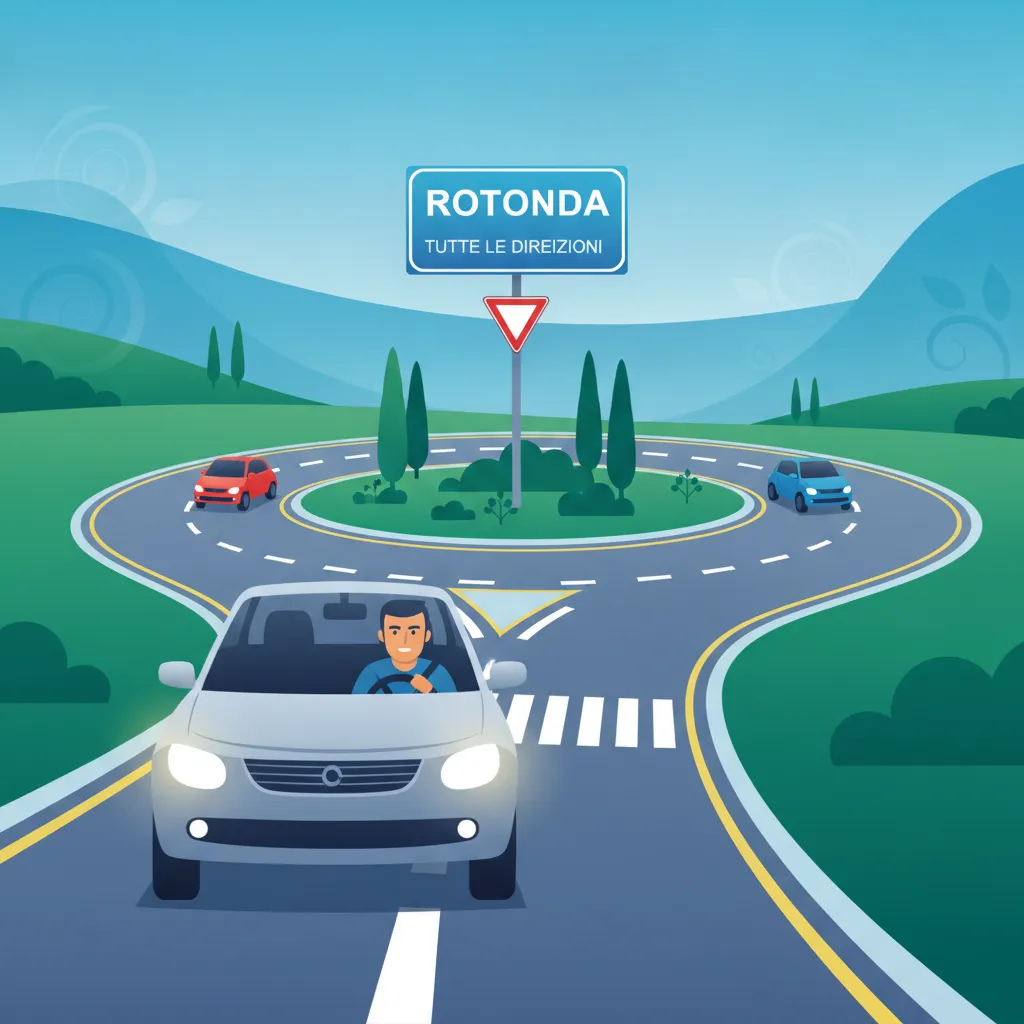
This lesson provides a step-by-step guide to safely navigating Italian roundabouts, known as rotatorie. It emphasizes the primary rule of yielding to traffic already circulating within the roundabout before entering. The content details correct lane positioning for different exits, the importance of signalling your intention to exit, and maintaining awareness of other vehicles.

This lesson addresses the specific challenges of sharing the road with two-wheeled motor vehicles like motorcycles and scooters. It highlights their reduced visibility and stability compared to cars, requiring drivers to double-check blind spots and maintain a greater following distance. The content also discusses common behaviors like lane filtering and the need for drivers to be predictable and signal intentions clearly.
Explore advanced strategies for navigating challenging rural roads and mountain passes in Italy. This lesson covers optimizing visibility, traction management on varied surfaces, and adapting techniques for specific Italian road conditions.
This lesson focuses on the unique demands of mountain riding, from handling steep inclines and declines to understanding the impact of altitude on the motorcycle's engine performance. It covers the effective use of engine braking on descents to prevent brake overheating. The content also prepares riders for the rapidly changing weather conditions, such as wind and fog, that are common at higher elevations.
This lesson focuses on the unique characteristics and challenges of driving on rural and mountain roads. It covers how to safely navigate sharp curves, steep inclines, and narrow lanes with limited visibility, often requiring the use of the horn to signal presence. The content also prepares drivers for potential hazards such as slow-moving agricultural vehicles, unexpected animal crossings, and variable road surface quality.
This lesson addresses the increased complexity of overtaking in urban environments with dense traffic and frequent intersections. It stresses the importance of thorough observation, including mirror and blind spot checks, to ensure a safe gap is available. The content covers judging speed differentials and the necessity of clear signalling to execute the maneuver without causing conflict with other road users.
This lesson provides a comprehensive guide to riding on high-speed motorways, or autostrade. It details the correct procedures for safely merging into traffic from an entry ramp and exiting via a deceleration lane. The content reinforces strict lane discipline, rules for overtaking, and the importance of maintaining a significantly larger following distance to compensate for higher speeds and potential wind gusts.

This lesson equips riders to safely manage the challenges posed by road construction zones. It explains how to interpret temporary signage, navigate lane closures or diversions, and maintain heightened awareness for surface hazards like gravel or steel plates. The content emphasizes the need to reduce speed and increase following distances to safely share the road with large construction vehicles and workers.

This lesson provides specialized instruction for driving in mountainous terrain. It teaches drivers how to select the correct gear for both climbing steep inclines to prevent engine strain and descending to maintain control without overheating the brakes. Techniques for navigating sharp hairpin bends, using passing places on narrow roads, and anticipating the effects of altitude on vehicle performance are also covered.
This lesson provides essential rules and techniques for driving on Italian motorways (autostrade) and major extra-urban roads. It explains how to safely merge onto the motorway from an entry ramp, the strict lane discipline required (drive right, overtake left), and how to exit correctly. The content also covers speed regulations, maintaining a safe following distance at high speed, and procedures for using service areas and handling emergencies.

This lesson provides an in-depth focus on sharing the road with the most vulnerable users. It teaches drivers to be acutely aware of pedestrians at crossings, cyclists filtering through traffic, and motorcyclists who may be in blind spots. The lesson emphasizes the importance of leaving extra space, signaling intentions clearly, and exercising extreme caution at junctions, where the majority of serious incidents occur.
This lesson explains how to execute left turns, right turns, and U-turns safely while maintaining correct lane discipline. It covers interpreting road markings and arrows, selecting the proper vehicle position, and using signals in a timely manner. Performing shoulder checks to monitor blind spots before and during a turn is a key focus for preventing collisions.
This lesson focuses on the vital systems for visibility and communication: mirrors, lighting, and signals. It provides instruction on the proper adjustment of mirrors to minimize blind spots and the correct use of headlamps, indicators, and brake lights as per Italian regulations. The content underscores how maintaining these systems in full working order is crucial for being seen and signalling intentions clearly in traffic.
Find clear answers to common questions learners have about Riding on Narrow Country Roads and Hairpin Bends. Learn how the lesson is structured, which driving theory objectives it supports, and how it fits into the overall learning path of units and curriculum progression in Italy. These explanations help you understand key concepts, lesson flow, and exam focused study goals.
On narrow, winding mountain roads, your road position determines how early you see potential hazards. By staying on your side of the lane but using the width to improve your sightline, you maximize the distance to oncoming traffic and allow more time to react.
Yes, selecting the correct gear before entering the turn is vital. You should be in a gear that allows you to maintain steady power throughout the bend to keep the bike balanced and provide immediate acceleration if needed.
Always look for signs of oncoming vehicles like headlight reflections, dust, or movement on the trees above the curve. On the Italian theory test, you must prove you can anticipate hidden hazards by adjusting your speed well before the curve is fully visible.
Rural and mountain roads often have loose gravel, debris, or wet spots. You must reduce your speed and avoid sudden braking or heavy acceleration to maintain traction and stay in control of your motorcycle.
Start searching now to pinpoint exactly which Italian driving theory topics, road signs, or traffic rules you need to master. Use our advanced filters to build a custom practice session and ensure you're fully prepared for every aspect of your official driving licence exam.