
This lesson provides vital training on managing emergency situations, ensuring you can act safely and legally as a motorcyclist in Italy. It covers the crucial steps of securing an accident scene, assessing casualties, and understanding the legal obligations of a road user in an emergency, essential for both your theory test and real-world safety.
Lesson content overview
Navigating the aftermath of a road accident is a critical responsibility for every driver, especially motorcyclists who are often more vulnerable. This lesson provides essential knowledge and practical guidance for managing the immediate consequences of an accident, focusing on securing the scene and providing basic first aid before professional emergency services arrive. Understanding these procedures can prevent further injuries, protect all involved, and significantly improve outcomes for casualties.
The ability to react calmly and effectively in an emergency is not just a moral obligation but also a legal requirement under the Italian Codice della Strada. Proper accident scene management and prompt, basic first aid can be decisive in preserving life, reducing the severity of injuries, and facilitating the work of emergency responders. This knowledge complements your understanding of general road safety, emergency procedures, and legal responsibilities outlined in other parts of the Italian Driving License Theory Course for Motorcycle Categories A1, A2, & A.
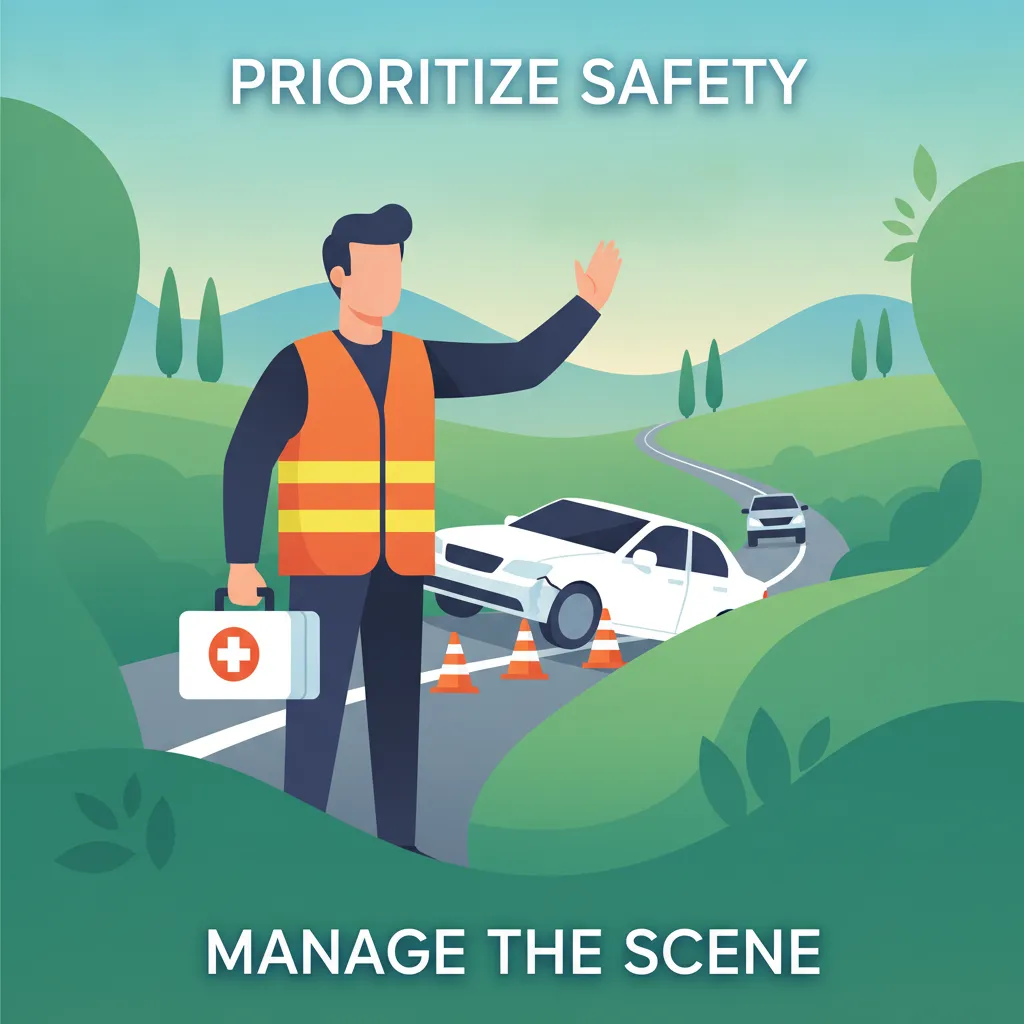
The first and most crucial step after any road incident is to secure the accident scene. This process aims to protect victims, other road users, and yourself from additional hazards, such as secondary collisions. Failing to properly secure an accident scene can lead to more serious incidents, turning a single collision into a multi-vehicle pile-up, particularly on high-speed roads or in conditions of poor visibility.
Upon realizing an accident has occurred, whether you are directly involved or a witness, your immediate priority is to stop safely and assess the situation without putting yourself in further danger. If your vehicle is operational, move it to the safest possible position, such as the hard shoulder on a motorway or the side of the road, ensuring it does not obstruct traffic more than necessary. Immediately activate your hazard warning lights to alert approaching drivers to the potential danger ahead.
Never put yourself at undue risk. Your safety is paramount. If the scene appears too dangerous to approach, call emergency services immediately and wait for them to secure the area.
Once your vehicle is safely positioned and hazard lights are on, if it is safe to do so, disembark cautiously. Before approaching any injured parties or damaged vehicles, take a moment to survey the environment for immediate dangers like spilled fuel, broken glass, or unstable vehicles. Remember that the scene might change rapidly, so constant vigilance is necessary.
Under Italian traffic law, drivers involved in or witnessing an accident causing danger to traffic are legally obliged to signal the accident site. Hazard lights, or indicators, are essential for making your stationary vehicle visible. They should be activated as soon as you stop near an accident scene or when your vehicle itself is stopped due to an accident or breakdown.
The reflective warning triangle is another critical device for scene safety. It must be placed at a specific distance from the accident site to provide adequate warning to approaching traffic. This distance varies depending on the type of road and speed limits.
Generally, on non-motorway roads, the warning triangle should be placed at least 30 meters behind the accident scene, or your vehicle if it is causing an obstruction. On motorways and extra-urban main roads where speeds are higher, this distance must be extended significantly, typically to at least 100 meters, or even 150 meters if visibility is poor. The triangle should be visible for a minimum of 100 meters to allow other drivers sufficient reaction time.
After placing warning devices, aim to create a safe zone around the accident. This might involve guiding other vehicles around the obstruction, if it can be done safely, or ensuring that bystanders remain at a safe distance. If there are multiple vehicles involved and it's safe to do so, ensure they are not impeding emergency vehicle access.
If traffic needs to be directed, use clear, unambiguous hand signals. However, only do this if you are clearly visible and confident in your actions, otherwise you might create more confusion and danger. Your primary role is to secure the scene for safety and ensure emergency services are called, not to act as a traffic warden unless absolutely necessary and safe.
Once the accident scene is secured and emergency services have been contacted, the next critical step is to provide basic first aid to any injured individuals. Your goal is not to replace professional medical care but to stabilize the casualty, prevent their condition from worsening, and provide immediate life-saving interventions until paramedics arrive. Remember, your duty to provide assistance is both a moral and legal obligation.
The initial assessment of a casualty's condition is known as the primary survey, which focuses on identifying and addressing immediate life-threatening issues. This systematic approach is often remembered by the acronym ABCs: Airway, Breathing, and Circulation.
Airway: Check if the casualty's airway is clear. If they are unconscious, their tongue might block their airway. Gently tilt their head back and lift their chin (head tilt-chin lift maneuver) to open the airway. Look for any obstructions like vomit or debris and remove them carefully if accessible.
Breathing: Once the airway is open, check for normal breathing. Look, listen, and feel for breathing for up to 10 seconds. Look for chest rise and fall, listen for breath sounds, and feel for breath on your cheek. Gasping or shallow breathing is not normal breathing. If the casualty is not breathing normally, prepare to initiate CPR if you are trained and it is safe to do so.
Circulation: Assess for signs of severe bleeding. Look for obvious wounds that are actively bleeding. Rapidly address any severe bleeding as it can quickly lead to life-threatening shock. If the casualty is conscious, check their skin for color and temperature (pale, cool skin can indicate shock).
If the casualty is conscious and responsive, you can proceed to a secondary survey, which involves a more detailed examination for other injuries, such as fractures, bruising, or deformities. Always prioritize life-threatening conditions identified during the primary survey.
An unconscious casualty requires immediate attention, as their airway can easily become obstructed. If an unconscious casualty is breathing normally and does not appear to have a spinal injury (which is always a possibility in a motorcycle accident), you should carefully place them in the recovery position. This position helps keep their airway open and prevents them from choking on vomit or fluids.
Always assume a potential spinal injury in a motorcycle accident. If placing an unconscious casualty in the recovery position, try to keep their head, neck, and spine aligned as much as possible, moving them as a single unit if multiple rescuers are present.
If an unconscious casualty is not breathing normally, and you are trained in CPR, you should begin chest compressions and rescue breaths as soon as possible. Emergency services should be advised of the casualty's condition, including whether they are conscious, breathing, and any visible injuries.
Severe bleeding is a life-threatening condition that must be addressed immediately. Rapid blood loss can lead to hypovolemic shock, where the body does not have enough blood to circulate, leading to organ failure. The most effective initial method to control severe bleeding is direct pressure.
Apply Direct Pressure: Use a clean cloth, sterile dressing, or even your hand (preferably gloved, if available) to apply firm, direct pressure over the wound. Maintain constant pressure. Do not remove the dressing or cloth if it becomes soaked; simply add more material on top and continue applying pressure.
Elevate the Injured Limb (if applicable): If the bleeding is from a limb and there is no suspected fracture, elevating the limb above the level of the heart can help reduce blood flow.
Consider Pressure Points: If direct pressure alone is insufficient, and you are trained, you might apply pressure to a main artery (a pressure point) proximal to the wound (closer to the heart). However, direct pressure remains the primary and most accessible technique for most rescuers.
Immobilize and Reassure: Keep the casualty as still as possible and reassure them while maintaining pressure. Monitor their condition closely for any changes.
Do not attempt to apply a tourniquet unless you are specifically trained in its use and the bleeding is uncontrollable by other means and life-threatening, as improper use can cause more harm than good. Your primary focus is to control the bleeding until professional medical help arrives.
A unique and critical consideration in motorcycle accidents is the handling of the rider's helmet. While the helmet offers vital protection during a crash, its presence after an impact can sometimes complicate first aid, particularly if the rider is unconscious or has breathing difficulties. However, improper removal carries a significant risk of worsening potential cervical (neck) spinal injuries.
The primary concern when dealing with a motorcyclist's helmet after an accident is the potential for a spinal injury. Any movement that twists or bends the neck could aggravate such an injury, leading to paralysis or even death. Therefore, the general rule is: if the rider is conscious, breathing normally, and shows no signs of neck or spinal injury, the helmet should remain in place. It continues to provide some level of immobilization and protection.
Never remove a helmet unnecessarily or without proper training. The risk of causing or aggravating a spinal injury is extremely high if done incorrectly.
There are specific, life-threatening circumstances where helmet removal becomes necessary to perform essential first aid, outweighing the risks of potential spinal injury aggravation:
In all other situations, especially if the rider is conscious and can communicate, it is safer to leave the helmet on and wait for emergency medical professionals, who have specialized training and equipment for safe helmet removal.
If helmet removal is absolutely necessary due to a life-threatening situation, it must be performed by at least two people, with one person dedicated solely to stabilizing the rider's head and neck throughout the entire process.
First Rescuer (Head Stabilization): Kneel at the rider's head. Place your hands firmly on either side of the helmet, with your fingers supporting the jawbone to prevent any head movement. Maintain this stabilization throughout.
Second Rescuer (Helmet Release): Gently unfasten the helmet strap.
Second Rescuer (Helmet Adjustment): Place one hand under the rider's neck, supporting the base of the skull. Place the other hand on the jaw to maintain traction and prevent the head from tilting backward as the helmet is moved.
First Rescuer (Helmet Removal): While the second rescuer maintains head and neck stabilization, gently pull the helmet straight back and off the rider's head, avoiding any twisting or bending.
Head Stabilization Maintained: Once the helmet is off, the second rescuer immediately takes over full stabilization of the head and neck, maintaining it in a neutral position until emergency services arrive and take over.
If only one rescuer is present, helmet removal is significantly more challenging and risky. In such a scenario, you might only attempt it if the rider is completely unresponsive, not breathing, and you need to perform CPR, and you cannot get assistance. Focus on maintaining head and neck alignment as best as possible.
Beyond the moral imperative, Italian law places specific responsibilities on drivers involved in or witnessing road accidents. Understanding these legal duties is crucial for every license holder, as failure to comply can lead to severe penalties.
The Codice della Strada (Italian Road Code) mandates that all drivers involved in an accident with injuries must stop immediately, assess the situation, and provide assistance to injured persons. This duty extends to reporting the accident to the authorities and remaining at the scene until law enforcement or emergency services arrive.
Even if you are not directly involved but witness an accident where people are injured, you have a duty to stop and provide reasonable assistance. This includes calling for emergency help and, if safe and appropriate, administering basic first aid as outlined above. Leaving the scene of an accident where injuries have occurred is considered a serious offense.
Failing to stop after an accident, or neglecting to provide assistance to injured persons, carries significant legal consequences in Italy. These can range from substantial fines and points deduction from your driving license to license suspension or even criminal charges, depending on the severity of the accident and the outcome for the injured parties. The law prioritizes the preservation of life and the safety of all road users.
Always carry a fully charged mobile phone to contact emergency services (112 in Italy) and keep basic first aid knowledge fresh. While you're not expected to be a medical professional, knowing the fundamentals can make a life-saving difference.
The specific actions you take to secure an accident scene and administer first aid must be adapted to the prevailing conditions. Road type, weather, visibility, and the presence of vulnerable road users all influence the best course of action.
Adverse weather conditions significantly increase the risk of secondary accidents. In rain, fog, snow, or at night, visibility is reduced, and road surfaces can become treacherous.
The characteristics of the road where the accident occurs will dictate specific safety measures.
When pedestrians, cyclists, or motorcyclists are involved, additional caution is needed. They are more exposed and likely to sustain serious injuries.
By understanding these contextual variations, you can apply the core principles of accident scene safety and first aid more effectively, thereby enhancing safety for everyone involved.
This lesson covers the critical procedures for managing a motorcycle accident scene in Italy, combining scene safety with basic first aid and legal obligations. Key skills include using hazard lights and warning triangles at correct distances, performing the ABCs primary survey to assess casualties, controlling severe bleeding through direct pressure, and knowing when helmet removal is medically necessary versus when it should be left in place to prevent spinal injury. The lesson also emphasizes that under the Codice della Strada, drivers have a legal duty to stop and assist injured persons, with significant penalties for failure to comply.
A short set of high-value points that capture the most important learning from this lesson.
Always secure the accident scene first using hazard lights and warning triangle before approaching casualties
The ABCs primary survey (Airway, Breathing, Circulation) is the systematic approach to identifying life-threatening conditions
Only remove a motorcyclist's helmet if there is an airway obstruction, breathing difficulty, or severe facial injury that prevents life-saving interventions
Control severe bleeding by applying firm direct pressure and never removing a soaked dressing
Italian law mandates stopping and rendering assistance at injury accidents; failure to do so carries serious penalties
Explore all units and lessons included in this driving theory course.
Warning triangle must be placed at least 30m on non-motorway roads and 100-150m on motorways
Assume spinal injury in all motorcycle accidents and stabilize head and neck during any casualty movement
If the rider is conscious and breathing normally with no neck injury symptoms, leave the helmet in place
Apply constant direct pressure to bleeding wounds and elevate the limb only if no fracture is suspected
Emergency number in Italy is 112; always call even if you are not the primary rescuer
Removing a motorcyclist's helmet unnecessarily when the rider is conscious and breathing normally
Placing the warning triangle too close to the accident, reducing reaction time for approaching drivers
Forgetting to activate hazard lights when stopping near an accident scene
Moving a casualty unnecessarily, potentially aggravating spinal or other injuries
Leaving the accident scene before emergency services or authorities arrive, which constitutes a serious offense
Lesson content overview
A short set of high-value points that capture the most important learning from this lesson.
Always secure the accident scene first using hazard lights and warning triangle before approaching casualties
The ABCs primary survey (Airway, Breathing, Circulation) is the systematic approach to identifying life-threatening conditions
Only remove a motorcyclist's helmet if there is an airway obstruction, breathing difficulty, or severe facial injury that prevents life-saving interventions
Control severe bleeding by applying firm direct pressure and never removing a soaked dressing
Italian law mandates stopping and rendering assistance at injury accidents; failure to do so carries serious penalties
Explore all units and lessons included in this driving theory course.
Warning triangle must be placed at least 30m on non-motorway roads and 100-150m on motorways
Assume spinal injury in all motorcycle accidents and stabilize head and neck during any casualty movement
If the rider is conscious and breathing normally with no neck injury symptoms, leave the helmet in place
Apply constant direct pressure to bleeding wounds and elevate the limb only if no fracture is suspected
Emergency number in Italy is 112; always call even if you are not the primary rescuer
Removing a motorcyclist's helmet unnecessarily when the rider is conscious and breathing normally
Placing the warning triangle too close to the accident, reducing reaction time for approaching drivers
Forgetting to activate hazard lights when stopping near an accident scene
Moving a casualty unnecessarily, potentially aggravating spinal or other injuries
Leaving the accident scene before emergency services or authorities arrive, which constitutes a serious offense
Explore search topics learners often look for when studying First Aid Basics and Accident Scene Safety. These topics reflect common questions about road rules, driving situations, safety guidance, and lesson level theory preparation for learners in Italy.
Browse additional driving theory lessons that cover connected traffic rules, road signs, and common driving situations related to this topic. Improve your understanding of how different rules interact across everyday traffic scenarios.
Learn essential first aid for accident casualties and crucial procedures for managing a motorcyclist's helmet. This lesson covers scene safety, basic life support, bleeding control, and the critical considerations for helmet removal to prevent further injury.

This lesson equips riders with the correct procedures to follow in the event of a breakdown or accident. It covers how to move the vehicle to a safe location, alert other traffic, and contact emergency services using the universal 112 number. You will also learn the basics of accident scene management and the necessary steps for reporting the incident to police and insurance.
This lesson outlines the mandatory legal procedures a rider must follow after being involved in a traffic accident. It covers the obligation to stop, render aid if necessary, and report the incident to the appropriate authorities. The content explains the process of exchanging information with other parties, documenting the scene for insurance purposes, and the potential legal and financial liabilities that may arise.
This lesson provides critical guidance on how to respond in the event of a traffic accident. It outlines the immediate steps to take, such as securing the scene with a warning triangle and hazard lights, and calling the emergency services. The content also covers the legal obligation to assist the injured and provides an introduction to basic first aid principles that can be applied until professional help arrives.

This lesson provides a clear, step-by-step guide for handling a mechanical breakdown on the road. It emphasizes the priority of moving the motorcycle to a safe location away from traffic flow and making oneself visible by using hazard lights and wearing a high-visibility vest. The content covers the correct procedure for contacting roadside assistance or emergency services and waiting for help in a secure position.

This lesson details the functions of specialized protective clothing designed for motorcyclists. It covers the essential qualities of jackets, pants, gloves, and boots, focusing on abrasion resistance and impact protection provided by CE-rated armor. The content explains the differences between materials like leather and textile and how they contribute to rider safety in the event of a fall or collision.

This lesson provides essential information on selecting the most critical piece of safety equipment: the helmet. It covers the various types, such as full-face and modular, and details the process for ensuring a correct and secure fit. Furthermore, it explains the legal requirements for helmet use in Italy, including the mandatory ECE certification standard that guarantees a minimum level of impact protection.
This lesson outlines the proper conduct when encountering emergency vehicles on the road or interacting with responders at an incident. It details the rules for yielding the right-of-way to ambulances, police, and fire services, ensuring they have a clear path. You will also learn how to provide clear and concise information to authorities to facilitate an effective emergency response.

This lesson teaches the critical skill of executing a rapid and controlled stop in an emergency. It covers the technique of applying firm, progressive pressure to the brakes to achieve maximum deceleration without locking the wheels, both in a straight line and while cornering. The content also explains how Anti-lock Braking Systems (ABS) function in these scenarios and the correct body posture to maintain stability.

This lesson teaches the fundamental observation techniques required for proactive and defensive riding. It details a systematic approach to scanning the road environment, using mirrors effectively, and performing shoulder checks to cover blind spots before any maneuver. Developing strong situational awareness is presented as a key skill for anticipating potential hazards and reacting to them in a timely manner.

This lesson equips riders to safely manage the challenges posed by road construction zones. It explains how to interpret temporary signage, navigate lane closures or diversions, and maintain heightened awareness for surface hazards like gravel or steel plates. The content emphasizes the need to reduce speed and increase following distances to safely share the road with large construction vehicles and workers.
Understand your legal obligations under the Italian Codice della Strada after a road accident. This lesson details the duty to stop, render assistance, and report incidents, covering potential penalties for non-compliance for motorcycle license holders.
This lesson outlines the mandatory legal procedures a rider must follow after being involved in a traffic accident. It covers the obligation to stop, render aid if necessary, and report the incident to the appropriate authorities. The content explains the process of exchanging information with other parties, documenting the scene for insurance purposes, and the potential legal and financial liabilities that may arise.
This lesson focuses on the comprehensive duties of a motorcyclist, from ensuring vehicle and equipment legality to following traffic regulations. It covers key obligations mandated by the Codice della Strada, such as mandatory insurance coverage and adherence to environmental rules. The material reinforces the importance of responsible road conduct and the legal consequences of non-compliance.
This lesson equips riders with the correct procedures to follow in the event of a breakdown or accident. It covers how to move the vehicle to a safe location, alert other traffic, and contact emergency services using the universal 112 number. You will also learn the basics of accident scene management and the necessary steps for reporting the incident to police and insurance.

This final lesson focuses on the administrative and legal procedures following an accident or incident. It explains how to correctly complete an accident report form (Constatazione Amichevole di Incidente - CAI), the information that must be exchanged with other parties, and the importance of accurate reporting. The lesson also provides guidance on how to interact calmly and professionally with police or other officials, providing required documentation and a clear account of events.
This lesson provides critical guidance on how to respond in the event of a traffic accident. It outlines the immediate steps to take, such as securing the scene with a warning triangle and hazard lights, and calling the emergency services. The content also covers the legal obligation to assist the injured and provides an introduction to basic first aid principles that can be applied until professional help arrives.
This lesson provides a clear, step-by-step guide for handling a mechanical breakdown on the road. It emphasizes the priority of moving the motorcycle to a safe location away from traffic flow and making oneself visible by using hazard lights and wearing a high-visibility vest. The content covers the correct procedure for contacting roadside assistance or emergency services and waiting for help in a secure position.
Find clear answers to common questions learners have about First Aid Basics and Accident Scene Safety. Learn how the lesson is structured, which driving theory objectives it supports, and how it fits into the overall learning path of units and curriculum progression in Italy. These explanations help you understand key concepts, lesson flow, and exam focused study goals.
Yes, under the Italian Codice della Strada, any road user involved in or witnessing an accident with injuries has a legal obligation to stop and provide necessary assistance to the victims.
You should only remove a helmet if the rider is in immediate danger of suffocation, if they are not breathing, or if they need urgent CPR. Otherwise, leave it on to avoid spinal injury.
Ensure your own safety first by moving to a safe area, then activate your hazard lights and use warning triangles to alert oncoming traffic, preventing secondary collisions.
Exam questions often present specific accident scenarios, asking you to choose the correct sequence of actions. They specifically target common mistakes like premature helmet removal.
Start searching now to pinpoint exactly which Italian driving theory topics, road signs, or traffic rules you need to master. Use our advanced filters to build a custom practice session and ensure you're fully prepared for every aspect of your official driving licence exam.