
This lesson teaches you the critical skills required to execute safe and rapid stops in emergency situations. You will explore the mechanics of motorcycle deceleration, including how to properly use front and rear brakes, the role of ABS, and how to maintain control while braking in both straight lines and curves. This knowledge is essential for both passing your theory test and ensuring your safety on Italian roads.

Lesson content overview
Executing a rapid and controlled stop is among the most critical skills for any motorcycle rider. This lesson provides an in-depth understanding of emergency braking techniques, covering both straight-line deceleration and the more complex art of braking while cornering. Mastery of these skills is not only vital for avoiding collisions but also for maintaining control in critical situations, directly impacting rider safety and compliance with Italian traffic regulations.
This instruction builds upon fundamental knowledge of motorcycle controls, including the throttle, clutch, and the independent front and rear brakes. It assumes an understanding of basic vehicle dynamics, such as weight transfer and tire traction, as well as an introduction to Anti-lock Braking Systems (ABS). Concepts from previous lessons, particularly those on front versus rear brake usage and braking distance calculations, are essential prerequisites for fully grasping the advanced techniques discussed here.
Emergency braking on a motorcycle involves more than just pulling levers; it's a precise application of physics, rider skill, and vehicle technology. The core objective is to achieve maximum deceleration without losing control or locking the wheels, regardless of whether you're traveling in a straight line or navigating a bend.
The underlying principle of braking relies on friction between the tires and the road surface. As you decelerate, the motorcycle's weight dynamically shifts forward, increasing the load on the front wheel and simultaneously reducing the load on the rear wheel. This weight transfer significantly impacts how much braking force each tire can safely handle, making the front brake the primary tool for stopping.
Progressive braking is the cornerstone of effective emergency stopping. It is defined as the method of gradually increasing brake pressure in a controlled manner, aiming to achieve the highest possible deceleration without causing the wheels to lock up. Riders must actively resist the natural urge to grab the brakes abruptly, as this often leads to a sudden loss of traction.
A braking technique involving the gradual and controlled increase of brake pressure to maximize deceleration while preventing wheel lock.
Instead, pressure should be applied smoothly, starting gently and then increasing firmly until the motorcycle is decelerating as quickly as possible without the tires losing grip. This technique allows the tires to adapt to the increasing load and utilize the available friction optimally.
On straight roads, this is often referred to as linear progressive braking. The goal is a steady, firm squeeze that quickly transitions to maximum pressure. When braking while navigating a bend, known as angular progressive braking, the technique is even more nuanced, requiring a delicate balance to avoid exceeding the limited traction available while cornering.
The effective distribution of braking force between the front and rear wheels is crucial for safe emergency stops. Due to the phenomenon of weight transfer, the front brake plays a far more significant role in stopping the motorcycle than the rear brake.
The front brake is your primary tool for deceleration, capable of providing up to 90% of the motorcycle's total stopping power in an emergency. As weight transfers forward during braking, the front tire gains significantly more traction, allowing it to withstand much greater braking forces. Therefore, in a straight-line emergency stop, the front brake should be applied firmly and progressively.
Always prioritize the front brake in an emergency. Begin with firm, progressive pressure on the front brake lever before introducing the rear brake.
Common misunderstandings include over-relying on the rear brake or neglecting the front brake entirely, both of which severely compromise stopping distance and control. The front brake, when applied correctly, provides superior stopping power and stability.
While less powerful, the rear brake still contributes to stability and can help shorten stopping distances, especially in low-traction conditions or when initiating the stop. Its role is often seen as supplementary to the front brake. However, because weight shifts away from the rear wheel during hard braking, the rear wheel is much more prone to locking up.
If the rear wheel locks, it can lead to a skid and loss of control, particularly if the motorcycle is leaned over. Therefore, the rear brake should be applied gently and progressively, complementing the front brake without causing a skid. On a straight road, a good guideline might be to apply about 70% of your braking force to the front and 30% to the rear, though this can vary based on the specific motorcycle, road conditions, and rider skill.
Modern motorcycles are often equipped with an Anti-lock Braking System (ABS), an electronic safety feature designed to prevent wheel lock-up during hard braking. ABS works by monitoring wheel speed sensors; if it detects that a wheel is about to lock, it rapidly modulates (pulses) the brake pressure to that wheel, allowing it to continue rotating just below the point of lock-up.
An electronic safety system that prevents motorcycle wheels from locking during braking by rapidly modulating brake pressure, thus maintaining steering control.
This pulsing action allows the rider to maintain steering control, which is critical for avoiding obstacles during an emergency stop. ABS is particularly beneficial on slippery surfaces, such as wet roads, gravel, or uneven pavement, where traction is limited. While ABS is a powerful safety aid, it is important not to view it as a replacement for proper braking technique. Riders should still practice progressive braking and anticipate hazards. ABS simply provides an additional layer of safety by preventing uncontrolled skids caused by wheel lock.
Never assume ABS eliminates all braking mistakes. While it significantly enhances safety, it does not replace the need for proper technique, hazard perception, and skillful brake application.
When braking on a bent road, ABS still functions to prevent wheel lock. However, a motorcycle's tires have a finite amount of grip, and this grip must be shared between cornering forces and braking forces. If the rider applies too much brake pressure while heavily leaned, even with ABS, the total available traction might be exceeded, potentially leading to a loss of grip. Some advanced ABS systems, known as "cornering ABS" or "lean-sensitive ABS," can account for the motorcycle's lean angle and adjust braking pressure accordingly, further enhancing safety in turns.
Correct body posture is essential for maintaining stability and control during emergency braking, whether in a straight line or on a bend. How a rider positions their body affects weight distribution and the motorcycle's balance.
For straight-line emergency braking, an upright posture is generally preferred. The rider should sit centered over the bike, using their core muscles to brace against the forward inertia. Squeezing the fuel tank with the knees can provide additional stability and help prevent the rider from sliding too far forward onto the handlebars. This posture helps keep the motorcycle balanced and ensures maximum tire contact with the road.
When braking on a bend, the rider's posture becomes more dynamic. While initiating braking, the rider should maintain their lean into the turn, even leaning slightly more towards the inside of the curve. This helps to maintain the motorcycle's balance and distribute weight effectively for the turn. However, excessive lean while braking hard should be avoided, as it reduces the available traction for braking and increases the risk of a slide. The goal is to keep the motorcycle balanced and the tires firmly planted, even as you decelerate.
Braking quickly and safely while navigating a curve, or on a bent road, is one of the most challenging aspects of motorcycle control. The finite amount of traction available to the tires must be carefully managed between the forces required to turn the motorcycle and the forces required to slow it down. Misjudgment can easily lead to a loss of grip and a fall.
When a motorcycle is leaned into a turn, a significant portion of the tire's grip is used to generate the cornering force needed to change direction. This leaves less available grip for braking. Applying brakes aggressively while leaned over can quickly overwhelm the tires' traction limits, especially the front tire, which is critical for steering.
The general rule for emergency braking on a bent road is to first reduce throttle and apply the front brake gently and progressively, while maintaining your lean into the curve. As the motorcycle begins to slow and some weight transfers, you can gradually increase front brake pressure. Only after the initial front brake application and as the weight shifts to the inside of the curve should you consider adding gentle, progressive pressure to the rear brake. This careful sequencing helps prevent a rear wheel lock-up while the bike is leaned, which is extremely dangerous.
Roll Off Throttle: Completely close the throttle to eliminate engine drive to the rear wheel.
Initial Front Brake: Gently and progressively apply the front brake while maintaining your lean angle. Avoid sudden, hard pressure.
Gradual Increase: As the motorcycle slows and weight transfers, gradually increase front brake pressure.
Introduce Rear Brake (Carefully): Only after initial front brake application and as weight shifts, gently add progressive pressure to the rear brake. Be extremely cautious to avoid lock-up.
Maintain Posture: Keep your body centered and brace against the tank with your knees, leaning slightly into the curve as needed for balance.
Monitor Traction: Feel for any signs of wheel slip or ABS activation, and be prepared to ease off pressure if needed.
One common and dangerous mistake is applying both brakes simultaneously and aggressively at the apex of a turn. This can quickly exceed the combined traction limits, causing both wheels to slide out. The technique requires practice and a keen sense of the motorcycle's feedback.
Understanding and adhering to the rules governing braking is critical for rider safety and legal compliance under the Italian Highway Code (Codice della Strada).
The use of the front brake as the primary stopping force is not just a technique; it is a fundamental principle mandated by the physics of motorcycle braking.
Preventing any wheel from locking up during braking is crucial for maintaining control.
For motorcycles equipped with ABS, the system must be functional and not be disabled during operation.
Reducing or closing the throttle completely before and during braking is a critical step for stability.
When braking on bent roads, the rear brake should only be engaged after the front brake has been applied and some weight transfer has occurred.
Mistakes during emergency braking can have severe consequences. Understanding common errors and how to manage challenging scenarios is vital for rider safety.
Braking techniques must be adapted to various environmental and road conditions:
These examples illustrate how emergency braking principles are applied in real-world situations.
Scenario: Straight Road, Dry Surface, Unexpected Obstacle.
Scenario: Bent Road, Wet Surface, Car Blocking Lane.
Scenario: Urban Intersection, Sudden Pedestrian.
Scenario: Gravel Road, Pothole Ahead.
Mastering emergency braking is a foundational skill for all motorcycle riders, especially within the context of the Italian Driving License Theory Course for Motorcycle Categories A1, A2, & A. The core takeaways from this lesson are:
By diligently practicing these techniques and understanding the underlying physics and safety principles, riders can significantly enhance their ability to react safely and effectively in critical situations, becoming more confident and responsible on Italian roads.
Emergency braking on motorcycles requires mastering progressive brake application to achieve maximum deceleration without wheel lock. The front brake provides the majority of stopping power due to weight transfer, while the rear brake offers supplementary stability when applied gently. ABS prevents wheel lock-up and maintains steering, especially on low-traction surfaces, but proper technique remains essential. Braking on curves demands careful sequencing—throttle closure first, then front brake progressively, with rear brake introduced only after weight transfer and stabilization—to avoid exceeding the limited available traction while leaned.
A short set of high-value points that capture the most important learning from this lesson.
Progressive braking is the essential technique—gradually increasing brake pressure to maximize deceleration without locking wheels
The front brake provides up to 90% of stopping power due to weight transfer during deceleration
ABS prevents wheel lock-up and maintains steering control, but it does not replace the need for proper braking technique
Correct body posture (upright on straight roads, maintaining lean on bends) is essential for stability during emergency stops
On bent roads, traction must be shared between cornering and braking forces, making careful modulation critical
Explore all units and lessons included in this driving theory course.
Always close the throttle completely before applying brakes to prevent rear wheel destabilization
Apply front brake first and firmly, then introduce rear brake gently after weight transfer occurs
On curves: roll off throttle → gentle front brake → gradual increase → cautious rear brake only after stabilization
Rear wheel locks more easily because weight transfers away from it during braking
Even with ABS, aggressive braking while leaned can exceed available traction and cause loss of control
Over-relying on the rear brake, which locks easily and extends stopping distance
Grabbing brakes abruptly instead of applying progressive pressure, causing wheel lock
Failing to close the throttle before braking, which destabilizes the motorcycle
Applying maximum front brake force while significantly leaned in a turn, risking front wheel slide
Disabling ABS if fitted, removing a critical safety net against wheel lock
Lesson content overview
A short set of high-value points that capture the most important learning from this lesson.
Progressive braking is the essential technique—gradually increasing brake pressure to maximize deceleration without locking wheels
The front brake provides up to 90% of stopping power due to weight transfer during deceleration
ABS prevents wheel lock-up and maintains steering control, but it does not replace the need for proper braking technique
Correct body posture (upright on straight roads, maintaining lean on bends) is essential for stability during emergency stops
On bent roads, traction must be shared between cornering and braking forces, making careful modulation critical
Explore all units and lessons included in this driving theory course.
Always close the throttle completely before applying brakes to prevent rear wheel destabilization
Apply front brake first and firmly, then introduce rear brake gently after weight transfer occurs
On curves: roll off throttle → gentle front brake → gradual increase → cautious rear brake only after stabilization
Rear wheel locks more easily because weight transfers away from it during braking
Even with ABS, aggressive braking while leaned can exceed available traction and cause loss of control
Over-relying on the rear brake, which locks easily and extends stopping distance
Grabbing brakes abruptly instead of applying progressive pressure, causing wheel lock
Failing to close the throttle before braking, which destabilizes the motorcycle
Applying maximum front brake force while significantly leaned in a turn, risking front wheel slide
Disabling ABS if fitted, removing a critical safety net against wheel lock
Explore search topics learners often look for when studying Emergency Braking in Straight Line and Bent Roads. These topics reflect common questions about road rules, driving situations, safety guidance, and lesson level theory preparation for learners in Italy.
Browse additional driving theory lessons that cover connected traffic rules, road signs, and common driving situations related to this topic. Improve your understanding of how different rules interact across everyday traffic scenarios.
Learn the critical theory and techniques for emergency braking while cornering on motorcycles. Understand how weight transfer and lean angle affect braking and how to maintain control on Italian roads.

This lesson provides specific strategies for riding on narrow rural roads, which often feature poor surfaces and limited sightlines. It details the techniques for approaching and navigating hairpin bends, including selecting the correct line, managing speed before entry, and using appropriate gear selection. The content emphasizes anticipating oncoming traffic and potential hazards hidden around blind corners for enhanced safety.

This lesson provides an in-depth analysis of motorcycle braking systems, clearly defining the distinct roles of the front and rear brakes. It covers the mechanics of hydraulic disc brakes and explains the function and benefits of an Anti-lock Braking System (ABS). Learners will understand the principles of brake balance for achieving maximum stopping power and the importance of routine maintenance on pads, discs, and fluid.
This lesson details correct braking techniques, emphasizing progressive application of both front and rear brakes for optimal stopping power. It explains the function of ABS in preventing wheel lock-up on slippery surfaces like wet roads or gravel. You will learn how different surfaces affect braking distance and how to adjust braking force to maintain control.
This lesson focuses on the factors that determine a motorcycle's total stopping distance: perception time, reaction time, and braking distance. It provides a clear understanding of how speed exponentially increases the distance required to come to a complete stop. Learners will be able to apply principles like the two-second rule to maintain a safe and appropriate following distance in various traffic situations.

This lesson explains how to execute left turns, right turns, and U-turns safely while maintaining correct lane discipline. It covers interpreting road markings and arrows, selecting the proper vehicle position, and using signals in a timely manner. Performing shoulder checks to monitor blind spots before and during a turn is a key focus for preventing collisions.

This lesson focuses on the unique demands of mountain riding, from handling steep inclines and declines to understanding the impact of altitude on the motorcycle's engine performance. It covers the effective use of engine braking on descents to prevent brake overheating. The content also prepares riders for the rapidly changing weather conditions, such as wind and fog, that are common at higher elevations.

This lesson breaks down the process of cornering into three distinct phases: entry, apex, and exit. It teaches the importance of adjusting speed before entering the turn, selecting the appropriate line (often outside-inside-outside) to maximize visibility and smoothness. The content also explains how to use the throttle to maintain stability and traction throughout the cornering maneuver for a safe and controlled exit.
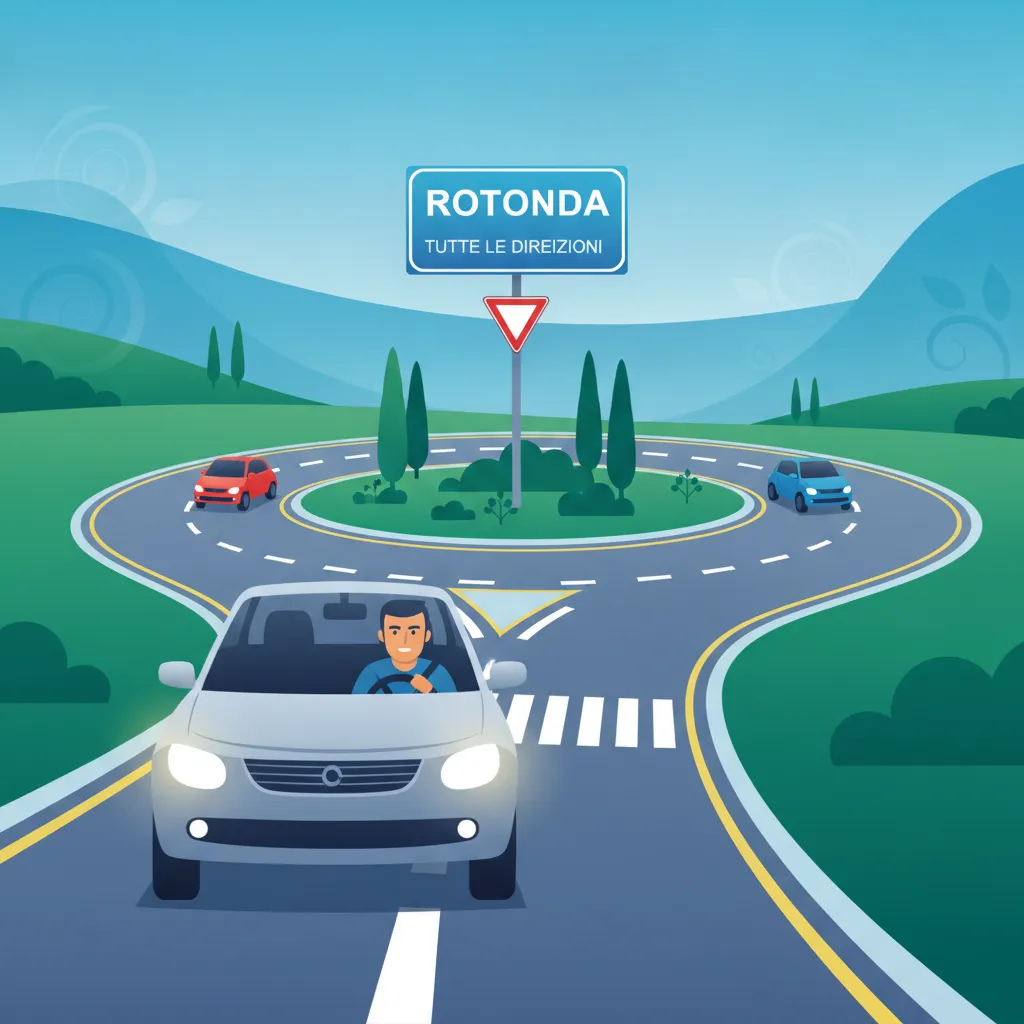
This lesson provides a step-by-step guide to safely navigating Italian roundabouts, known as rotatorie. It emphasizes the primary rule of yielding to traffic already circulating within the roundabout before entering. The content details correct lane positioning for different exits, the importance of signalling your intention to exit, and maintaining awareness of other vehicles.

This lesson demystifies the essential riding technique of countersteering, explaining how a gentle push on the handlebar initiates a lean and directs the motorcycle into a turn. It covers the physical principles at play, including gyroscopic forces, that contribute to the bike's stability at speed. Understanding this concept is crucial for smooth, controlled, and intuitive steering, especially when making quick directional changes.

This lesson focuses on how to adapt riding techniques to maintain traction on compromised surfaces. It identifies common hazards such as wet leaves, manhole covers, gravel, and painted lines that can reduce the tyre's grip. Learners will understand how to use smooth and gentle throttle, brake, and steering inputs to prevent traction loss and maintain control in these challenging situations.
Understand frequent mistakes riders make during emergency braking, both in straight lines and on bends. This lesson covers how to prevent loss of control and improve overall safety according to Italian driving theory.
This lesson provides an in-depth analysis of motorcycle braking systems, clearly defining the distinct roles of the front and rear brakes. It covers the mechanics of hydraulic disc brakes and explains the function and benefits of an Anti-lock Braking System (ABS). Learners will understand the principles of brake balance for achieving maximum stopping power and the importance of routine maintenance on pads, discs, and fluid.
This lesson focuses on the factors that determine a motorcycle's total stopping distance: perception time, reaction time, and braking distance. It provides a clear understanding of how speed exponentially increases the distance required to come to a complete stop. Learners will be able to apply principles like the two-second rule to maintain a safe and appropriate following distance in various traffic situations.

This lesson teaches riders how to maintain a safe following distance using the two-second rule, which accounts for reaction time and braking distance. It covers grip management, explaining how tire condition and road surfaces like wet asphalt affect traction. Mastering these concepts is essential for anticipating hazards and preventing rear-end collisions.

This lesson addresses the specific challenges of sharing the road with two-wheeled motor vehicles like motorcycles and scooters. It highlights their reduced visibility and stability compared to cars, requiring drivers to double-check blind spots and maintain a greater following distance. The content also discusses common behaviors like lane filtering and the need for drivers to be predictable and signal intentions clearly.

This lesson teaches the fundamental observation techniques required for proactive and defensive riding. It details a systematic approach to scanning the road environment, using mirrors effectively, and performing shoulder checks to cover blind spots before any maneuver. Developing strong situational awareness is presented as a key skill for anticipating potential hazards and reacting to them in a timely manner.
This lesson details correct braking techniques, emphasizing progressive application of both front and rear brakes for optimal stopping power. It explains the function of ABS in preventing wheel lock-up on slippery surfaces like wet roads or gravel. You will learn how different surfaces affect braking distance and how to adjust braking force to maintain control.

This lesson addresses two key aspects of defensive riding: maintaining a safe buffer and performing overtaking maneuvers. It details how to use time-based rules, such as the two-second rule, to ensure adequate following distance for reaction. The content also provides a structured approach to overtaking, covering observation, signalling, speed management, and ensuring sufficient clearance before returning to the lane.

This lesson focuses on the vital systems for visibility and communication: mirrors, lighting, and signals. It provides instruction on the proper adjustment of mirrors to minimize blind spots and the correct use of headlamps, indicators, and brake lights as per Italian regulations. The content underscores how maintaining these systems in full working order is crucial for being seen and signalling intentions clearly in traffic.

This lesson covers three critical risks associated with heavy vehicle braking systems. It explains 'brake lag' in air brake systems, the delay between pedal application and brake activation, and 'brake fade', the loss of braking efficiency due to overheating. Learners will be taught to recognize the warning signs and, more importantly, to use correct driving techniques, such as utilizing endurance brakes, to prevent these potentially catastrophic failures.

This lesson provides a clear, step-by-step guide for handling a mechanical breakdown on the road. It emphasizes the priority of moving the motorcycle to a safe location away from traffic flow and making oneself visible by using hazard lights and wearing a high-visibility vest. The content covers the correct procedure for contacting roadside assistance or emergency services and waiting for help in a secure position.
Find clear answers to common questions learners have about Emergency Braking in Straight Line and Bent Roads. Learn how the lesson is structured, which driving theory objectives it supports, and how it fits into the overall learning path of units and curriculum progression in Italy. These explanations help you understand key concepts, lesson flow, and exam focused study goals.
Using both brakes provides the most effective deceleration. The front brake provides the majority of the stopping power, while the rear brake helps keep the motorcycle stable and prevents excessive front-end dive.
ABS prevents the wheels from locking up during hard braking. This allows the rider to maintain steering control and prevents the motorcycle from sliding on various road surfaces common in Italy.
If possible, straighten the bike before applying maximum braking force. If you must brake while cornering, use the brakes gently and progressively to avoid destabilising the motorcycle.
Many riders either under-utilise the front brake due to fear or lock the rear wheel by pressing too hard. Practice and understanding weight transfer are key to avoiding these errors.
Start searching now to pinpoint exactly which Italian driving theory topics, road signs, or traffic rules you need to master. Use our advanced filters to build a custom practice session and ensure you're fully prepared for every aspect of your official driving licence exam.