
This lesson explores the severe impact of alcohol, drugs, and various medications on your physical and mental ability to operate a motorcycle. Understanding these effects is vital for passing your Italian theory exam and ensuring safety on the road. We cover the legal limits and responsibilities that every rider must follow to stay safe and compliant with the Codice della Strada.
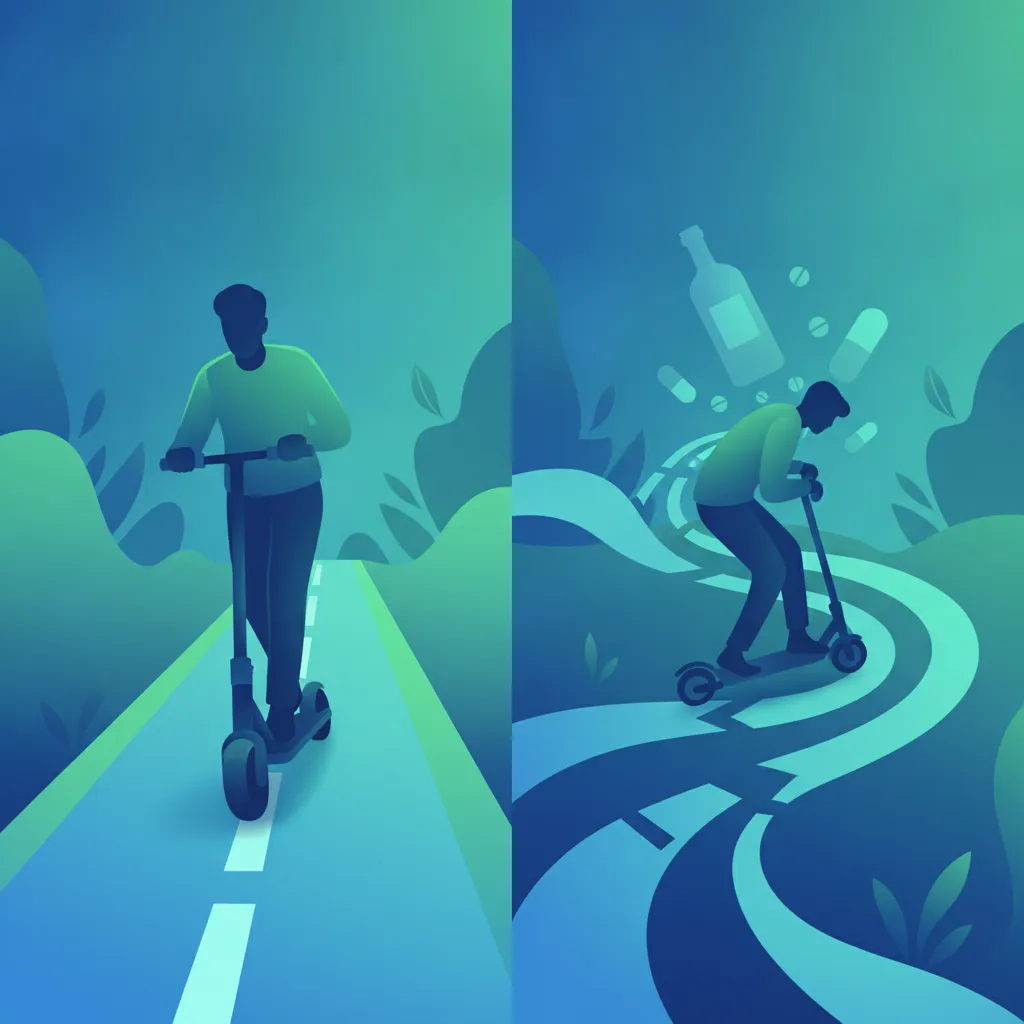
Lesson content overview
Operating a motorcycle demands a unique blend of physical dexterity, acute mental focus, and rapid decision-making. Any factor that compromises these abilities dramatically increases the risk of accidents. Among the most dangerous of these factors are psychoactive substances, including alcohol, illegal drugs, and even some commonly used prescription or over-the-counter medications. This lesson, essential for all aspiring riders undertaking the Italian Driving License Theory Course for Motorcycle Categories A1, A2, & A, delves into how these substances impair a rider's capacity to safely control a motorcycle, the strict legal limits in Italy, and the severe penalties for non-compliance.
Understanding these risks is not merely about legal compliance; it is fundamental to personal safety and the safety of all road users. Impairment from substances can degrade critical motor skills and mental processes, turning a routine ride into a high-risk situation.
Blood Alcohol Concentration (BAC) is the primary legal and physiological measure used to determine the level of alcohol in a person's system. It represents the mass of alcohol per liter of blood, typically expressed in grams per liter (g/L) or milligrams per 100 milliliters (mg/100 ml). In Italy, BAC is typically measured using approved breathalyzer devices during roadside tests or through more precise blood analysis.
The amount of alcohol present in a rider's bloodstream, expressed in grams per liter (g/L). This is the primary legal measure for intoxication.
BAC is crucial because it quantifies the extent to which alcohol has been absorbed into the bloodstream and is affecting the central nervous system. As BAC increases, so does the level of impairment. It is a more objective measure than subjective feelings of sobriety.
Several factors can influence a person's BAC and how quickly it rises and falls, including:
It's a common misunderstanding to believe that waiting a few hours after drinking automatically eliminates all risk or that consuming coffee will sober you up faster. The body metabolizes alcohol at a relatively constant rate, typically around 0.10 to 0.15 g/L per hour, which cannot be significantly accelerated. Only time can reduce BAC.
Alcohol is a central nervous system depressant, meaning it slows down brain activity. Even small amounts can significantly impair the complex skills required for safe motorcycle operation. The effects are systemic, impacting both cognitive functions and physical motor control.
Subjective feeling of sobriety is not an indicator of actual riding ability. Even if you "feel fine" after a drink, your cognitive and motor skills are likely impaired, putting you and others at risk.
Italian law, specifically the Codice della Strada (Road Code), sets strict Blood Alcohol Concentration (BAC) limits for all drivers and riders, with particular emphasis on motorcyclists due to their inherent vulnerability. These limits are designed to minimize the risk of accidents caused by impaired riding.
For experienced riders holding a Category A motorcycle license, the legal BAC limit is 0.5 g/L. This means that a rider's bloodstream must not contain more than 0.5 grams of alcohol per liter of blood. Even at this level, some impairment is present, but it is deemed acceptable under the law for experienced operators. Exceeding this limit constitutes a traffic violation with severe penalties.
The maximum legal blood alcohol concentration for experienced motorcycle riders (Category A) in Italy.
Italy enforces a zero-tolerance policy (0.0 g/L BAC) for specific categories of riders:
A policy where absolutely no detectable amount of alcohol is permitted in the bloodstream of novice riders (Category A1/A2) and professional riders in Italy.
The safest choice for any motorcyclist, regardless of experience or license category, is to completely abstain from alcohol if you plan to ride. There is no truly safe amount of alcohol when operating a vehicle.
Beyond alcohol, Italy enforces a strict zero-tolerance policy for illegal drugs when operating any vehicle, including motorcycles. This means that any detectable quantity of illicit psychoactive substances in a rider's system is prohibited. Unlike alcohol, there is no permissible limit for illegal drugs. This policy is enshrined in articles of the Codice della Strada (e.g., Article 187).
A strict policy in Italy where any detectable amount of illegal drugs (such as cannabis, cocaine, amphetamines, or opioids) is prohibited while riding a motorcycle.
Illegal drugs impair a rider's cognition, perception, and motor coordination in various ways, making safe motorcycle operation impossible.
Even if a rider believes they are accustomed to a particular drug or that its effects have worn off, residues can remain in the system and still cause impairment or be detected during roadside tests. The long-term detection windows for many drugs mean that even "occasional use" from the previous day can lead to a positive test and severe legal consequences.
It's not just alcohol and illegal drugs that pose a risk to motorcycle safety. Many legally prescribed or over-the-counter (OTC) medications can have side effects that significantly impair a rider's ability to operate a motorcycle safely. The Codice della Strada (Article 186) obliges riders to refrain from riding if they are under the influence of any medication that affects driving capacity.
Never assume a small dose of medication is safe or that a prescription exempts you from riding restrictions. Your safety, and that of others, is paramount.
Riding a motorcycle under the influence of alcohol or drugs in Italy carries severe legal penalties under the Codice della Strada, particularly Articles 186 and 187. These consequences are designed to deter unsafe behavior and protect road users. Penalties increase significantly with higher BAC levels, repeat offenses, or if an accident occurs.
Most initial offenses for riding under the influence result in administrative penalties:
For more serious offenses, such as very high BAC levels (e.g., above 1.5 g/L), repeated offenses, or causing an accident resulting in injury or death, criminal charges may apply.
Example Scenario: A rider with a BAC of 0.8 g/L is stopped by police. This could result in a fine ranging from approximately €800 to €3,200, a deduction of 6 points from their license, and a license suspension ranging from 6 months to 1 year. If the BAC is 1.5 g/L or higher, the fine increases substantially (e.g., €1,500-€6,000), along with longer license suspension (1-2 years) and possible imprisonment.
Law enforcement in Italy has the authority to conduct roadside tests to determine if a rider is under the influence of alcohol or drugs. This authority is crucial for maintaining road safety.
If a police officer detains a rider for a traffic violation, or if there is a reasonable suspicion of substance influence (e.g., erratic riding, smell of alcohol, slurred speech, visible signs of impairment), they can require the rider to undergo a test.
Under Italian law, refusal to undergo a mandatory breath, blood, or urine test constitutes an offense itself, which is treated as if the rider had the highest possible BAC or was under the influence of drugs.
Never refuse a request from law enforcement to undergo a breathalyzer, saliva, blood, or urine test if suspected of impaired riding. Refusal will lead to harsher penalties.
The responsibility for safe riding ultimately rests with each individual motorcyclist. Preventing impaired riding is about making conscious, informed choices before you ever get on your motorcycle.
Riding a motorcycle safely requires constant vigilance and peak performance. Prioritizing sobriety is a fundamental aspect of being a responsible motorcyclist and a considerate road user within the Italian traffic system. Adhering to these principles protects not only yourself but also your passengers and fellow road users.
The influence of alcohol, illegal drugs, and certain medications on motorcycle riding ability is a critical topic for all riders, particularly those preparing for their Italian motorcycle license. The physiological and cognitive impairments caused by these substances—ranging from slowed reaction times and poor judgment to loss of coordination and blurred vision—dramatically increase the risk of accidents.
Italy's strict legal framework, including the 0.5 g/L BAC limit for experienced Category A riders, the 0.0 g/L zero-tolerance policy for novice (A1/A2) and professional riders, and the absolute prohibition of illegal drugs, underscores the seriousness of this issue. Furthermore, riders must be acutely aware that many common prescription and over-the-counter medications can also impair their ability to ride safely.
Compliance with these rules is enforced through roadside testing, and refusal to comply carries severe penalties. Violations lead to substantial fines, significant deductions of points from the driving license, license suspension, and in serious cases, criminal charges and even imprisonment.
Ultimately, understanding the profound interaction between psychoactive substances, rider physiology, and the demands of vehicle control is essential. The safest and most responsible choice for any motorcyclist is always to ride sober and fully unimpaired. This commitment not only ensures legal compliance but, more importantly, safeguards lives and contributes to safer Italian roads for everyone.
This lesson covers how alcohol, illegal drugs, and certain medications impair the cognitive and motor skills essential for safe motorcycle riding, with a focus on Italian law under the Codice della Strada. Italy sets a 0.5 g/L BAC limit for experienced Category A riders but imposes strict 0.0 g/L zero-tolerance rules for novice riders (A1/A2) and professionals, while any detectable amount of illegal drugs is absolutely prohibited. The physiological effects of impairment—slowed reaction times up to 50 milliseconds, reduced coordination, impaired judgment, and balance loss—make motorcycles particularly vulnerable to accidents. Beyond alcohol and drugs, riders must also be aware that prescription medications like sedatives, strong painkillers, and some antidepressants can dangerously affect riding ability. Legal consequences for violations include substantial day-fines, points deductions, license suspension, and in serious cases criminal charges and imprisonment, with refusal to undergo testing resulting in the harshest penalties.
A short set of high-value points that capture the most important learning from this lesson.
Italy enforces a 0.5 g/L BAC limit for experienced Category A riders, but novice (A1/A2) and professional riders must maintain 0.0 g/L (zero tolerance)
Any detectable amount of illegal drugs is strictly prohibited under Italy's zero-tolerance policy per Codice della Strada Article 187
Alcohol impairs both cognitive functions (judgment, perception, information processing) and motor skills (coordination, balance, reaction time) essential for safe riding
Prescription and OTC medications—including antihistamines, sedatives, and strong painkillers—can severely impair riding ability and must be assessed before riding
Refusing a roadside breathalyzer, saliva, or blood test in Italy is treated as admission of guilt with harsher penalties than the offense itself
Explore all units and lessons included in this driving theory course.
For experienced Category A riders: legal BAC limit is 0.5 g/L; for A1/A2 and professional riders: absolute zero tolerance at 0.0 g/L
Alcohol is metabolized at a constant rate of approximately 0.10–0.15 g/L per hour—coffee, cold showers, or waiting a few hours cannot accelerate this process
Common impairing medications include benzodiazepines, first-generation antihistamines, opioids, and muscle relaxants—always read warning labels
Italy's day-fine system calculates fines based on offender income, and criminal charges apply for BAC above 1.5 g/L or causing accidents
Body weight, gender, food consumption, and individual metabolism all affect how quickly BAC rises and falls
Assuming that 'feeling fine' after drinking means safe riding ability—subjective sobriety does not reflect actual cognitive and motor impairment
Believing that coffee, food, or waiting a few hours will make you sober enough to ride—only time reduces BAC reliably
Overlooking that many common OTC medications (especially allergy and cold remedies containing diphenhydramine) cause significant drowsiness and slowed reactions
Assuming a prescription medication exempts you from riding restrictions—you are still responsible for assessing your fitness to ride
Thinking you can refuse a roadside test to avoid penalties—refusal is treated as evidence of guilt with worse consequences than the original offense
Lesson content overview
A short set of high-value points that capture the most important learning from this lesson.
Italy enforces a 0.5 g/L BAC limit for experienced Category A riders, but novice (A1/A2) and professional riders must maintain 0.0 g/L (zero tolerance)
Any detectable amount of illegal drugs is strictly prohibited under Italy's zero-tolerance policy per Codice della Strada Article 187
Alcohol impairs both cognitive functions (judgment, perception, information processing) and motor skills (coordination, balance, reaction time) essential for safe riding
Prescription and OTC medications—including antihistamines, sedatives, and strong painkillers—can severely impair riding ability and must be assessed before riding
Refusing a roadside breathalyzer, saliva, or blood test in Italy is treated as admission of guilt with harsher penalties than the offense itself
Explore all units and lessons included in this driving theory course.
For experienced Category A riders: legal BAC limit is 0.5 g/L; for A1/A2 and professional riders: absolute zero tolerance at 0.0 g/L
Alcohol is metabolized at a constant rate of approximately 0.10–0.15 g/L per hour—coffee, cold showers, or waiting a few hours cannot accelerate this process
Common impairing medications include benzodiazepines, first-generation antihistamines, opioids, and muscle relaxants—always read warning labels
Italy's day-fine system calculates fines based on offender income, and criminal charges apply for BAC above 1.5 g/L or causing accidents
Body weight, gender, food consumption, and individual metabolism all affect how quickly BAC rises and falls
Assuming that 'feeling fine' after drinking means safe riding ability—subjective sobriety does not reflect actual cognitive and motor impairment
Believing that coffee, food, or waiting a few hours will make you sober enough to ride—only time reduces BAC reliably
Overlooking that many common OTC medications (especially allergy and cold remedies containing diphenhydramine) cause significant drowsiness and slowed reactions
Assuming a prescription medication exempts you from riding restrictions—you are still responsible for assessing your fitness to ride
Thinking you can refuse a roadside test to avoid penalties—refusal is treated as evidence of guilt with worse consequences than the original offense
Explore search topics learners often look for when studying Influence of Alcohol, Drugs, and Medications on Riding Ability. These topics reflect common questions about road rules, driving situations, safety guidance, and lesson level theory preparation for learners in Italy.
Browse additional driving theory lessons that cover connected traffic rules, road signs, and common driving situations related to this topic. Improve your understanding of how different rules interact across everyday traffic scenarios.
Understand the strict legal framework in Italy regarding alcohol and drug impairment for motorcycle riders. This lesson details BAC limits, zero-tolerance policies, roadside testing, and severe penalties for violations under the Codice della Strada.
This lesson details the profound and dangerous effects of alcohol and drugs on driving ability, including impaired coordination, slowed reaction time, and poor judgment. It specifies the legal blood alcohol concentration (BAC) limits in Italy, including the strict zero-tolerance policy for beginner drivers. The content also outlines the severe legal consequences of a DUI conviction, which can include heavy fines, license revocation, and imprisonment.

This lesson provides a thorough examination of the Italian motorcycle theory test's structure and content. It details the number of questions, the multiple-choice format, and the minimum score required to pass for the A1, A2, and A license categories. The content is designed to prepare learners for the specific knowledge areas and administrative procedures involved in taking the official exam.

This lesson provides a clear overview of the legal penalties for traffic violations in Italy. It explains the structure of fines and the penalty point system that can lead to license suspension or revocation. The content also touches on more severe consequences, including criminal liability for incidents causing injury, to emphasize the importance of lawful riding.

This lesson outlines the mandatory legal procedures a rider must follow after being involved in a traffic accident. It covers the obligation to stop, render aid if necessary, and report the incident to the appropriate authorities. The content explains the process of exchanging information with other parties, documenting the scene for insurance purposes, and the potential legal and financial liabilities that may arise.
This lesson focuses on the comprehensive duties of a motorcyclist, from ensuring vehicle and equipment legality to following traffic regulations. It covers key obligations mandated by the Codice della Strada, such as mandatory insurance coverage and adherence to environmental rules. The material reinforces the importance of responsible road conduct and the legal consequences of non-compliance.
This lesson focuses on the vital systems for visibility and communication: mirrors, lighting, and signals. It provides instruction on the proper adjustment of mirrors to minimize blind spots and the correct use of headlamps, indicators, and brake lights as per Italian regulations. The content underscores how maintaining these systems in full working order is crucial for being seen and signalling intentions clearly in traffic.
This lesson provides a clear overview of the legal consequences for failing to comply with road transport regulations in Italy. It covers the system of fines for common offenses like speeding, overloading, and violations of driving hours. The lesson also explains the penalty point system that can lead to license suspension and touches upon the responsibilities and potential liability of the transport company.
This lesson provides a comprehensive guide to riding on high-speed motorways, or autostrade. It details the correct procedures for safely merging into traffic from an entry ramp and exiting via a deceleration lane. The content reinforces strict lane discipline, rules for overtaking, and the importance of maintaining a significantly larger following distance to compensate for higher speeds and potential wind gusts.

This lesson focuses on the legal obligations that first-time riders must meet to operate an AM vehicle safely and legally. It details the mandatory use of certified helmets and appropriate protective clothing. Furthermore, it outlines fundamental traffic laws new riders must know and the legal repercussions of non-compliance, such as fines and penalty points.
This lesson provides a comprehensive review of the legal consequences for violating traffic laws in Italy. It reinforces the workings of the points system, explaining how different offenses lead to deductions and how a total loss of points results in license revocation. The content also covers the scale of monetary fines for various infractions and the conditions under which a driver's license may be temporarily suspended.
Explore how common prescription and over-the-counter medications can impair a motorcycle rider's judgment, reaction time, and coordination in Italy. Learn about rider responsibilities and consulting healthcare professionals for safe riding.

This lesson explores the significant dangers of rider fatigue and dehydration, which can severely degrade concentration and slow reaction times. It teaches riders to recognize the early warning signs and implement proactive strategies to stay alert, such as taking regular breaks and maintaining proper hydration. The content stresses that managing one's physical and mental condition is a critical aspect of road safety.
This lesson equips riders to safely manage the challenges posed by road construction zones. It explains how to interpret temporary signage, navigate lane closures or diversions, and maintain heightened awareness for surface hazards like gravel or steel plates. The content emphasizes the need to reduce speed and increase following distances to safely share the road with large construction vehicles and workers.

This lesson addresses high-risk behaviors often associated with young and inexperienced riders. It highlights the dangers of distractions like mobile phone use, the influence of peer pressure, and the severe consequences of speeding or riding under the influence of substances. Understanding these risks is the first step toward developing a mature and responsible approach to riding.

This lesson provides specific strategies for riding on narrow rural roads, which often feature poor surfaces and limited sightlines. It details the techniques for approaching and navigating hairpin bends, including selecting the correct line, managing speed before entry, and using appropriate gear selection. The content emphasizes anticipating oncoming traffic and potential hazards hidden around blind corners for enhanced safety.

This lesson focuses on the unique demands of mountain riding, from handling steep inclines and declines to understanding the impact of altitude on the motorcycle's engine performance. It covers the effective use of engine braking on descents to prevent brake overheating. The content also prepares riders for the rapidly changing weather conditions, such as wind and fog, that are common at higher elevations.
Find clear answers to common questions learners have about Influence of Alcohol, Drugs, and Medications on Riding Ability. Learn how the lesson is structured, which driving theory objectives it supports, and how it fits into the overall learning path of units and curriculum progression in Italy. These explanations help you understand key concepts, lesson flow, and exam focused study goals.
For most motorcycle riders, the limit is 0.5 grams per liter of blood. However, for novice riders who have held a license for less than three years, the limit is 0.0 g/l, meaning zero tolerance.
Many cold or allergy medications contain antihistamines that cause drowsiness or impair reaction times. Always check the label for driving warnings, as being impaired by medication can still lead to legal penalties.
Exam questions often present scenarios asking you to identify the physical effects of impairment or the legal consequences of exceeding blood alcohol limits. Focus on how these factors increase the risk of accidents.
Both carry severe penalties under the Codice della Strada, including heavy fines, license suspension, or revocation, and potential criminal charges if an accident occurs. The law treats all forms of impairment as a serious safety violation.
Start searching now to pinpoint exactly which Italian driving theory topics, road signs, or traffic rules you need to master. Use our advanced filters to build a custom practice session and ensure you're fully prepared for every aspect of your official driving licence exam.