
This lesson teaches you the critical techniques for adjusting the diverse mirror systems required on heavy goods vehicles. Proper mirror placement is essential for navigating the complex traffic environments you will face as a professional driver and is a frequent topic in the official Italian C, C1, C1E, and CE theory exams.

Lesson content overview
Operating heavy goods vehicles (HGVs) in Italy, whether for a C, C1, C1E, or CE license, demands an unparalleled level of situational awareness. Mirrors are the primary tools allowing drivers to monitor the expansive surroundings of their vehicle without compromising focus on the road ahead. This lesson provides a detailed guide to understanding the various types of mirrors required on HGVs, their specific functions, and the systematic procedure for their correct placement and adjustment to ensure maximum visibility and minimize dangerous blind spots. Proper mirror setup is not just a recommendation; it is a fundamental aspect of safe observation, maneuvering, and compliance with the Italian Codice della Strada.
Mirrors are much more than simple reflective surfaces; they are sophisticated components engineered to overcome the natural limitations of human vision and the physical scale of heavy vehicles. They enable continuous rearward and lateral awareness, allowing drivers to perceive critical zones around the vehicle. This constant vigilance is vital for preventing collisions, especially during complex maneuvers such as lane changes, turns, and reversing.
For professional drivers, mirrors are indispensable. They provide the necessary field of view to safely navigate traffic, identify vulnerable road users, and position the vehicle accurately. Without a correctly adjusted mirror system, drivers would be forced to constantly turn their heads, diverting attention from the road ahead and significantly increasing reaction times. The careful arrangement of mirrors is a blend of optical physics, human perception considerations, and strict legal mandates designed to ensure comprehensive coverage of all critical zones around the vehicle. This topic directly connects with understanding Blind Spot Zones and Their Mitigation and Reversing Techniques for Rigid and Articulated Vehicles, as optimal mirror placement is the foundation for managing these challenges.
The Italian Codice della Strada, along with specific ministerial decrees (such as D.M. 30/12/08), mandates the minimum number and types of mirrors that must be present on a heavy goods vehicle. These regulations are in place to guarantee that critical zones—front, rear, and sides—are adequately covered, thereby enhancing overall road safety. Compliance with these legal requirements is essential not only for passing the theoretical examination but also for daily operational legality and safety. Vehicles must be equipped with at least one interior rear-view mirror (if applicable), two main side mirrors (right and left), and potentially additional mirrors to actively reduce blind spots, depending on the vehicle's category and dimensions.
Heavy goods vehicles employ a range of mirror types, each serving a distinct purpose in providing comprehensive visibility around the vehicle. Understanding the function of each mirror is crucial for proper adjustment and effective use.
Main side mirrors are the primary external mirrors, typically affixed to the driver's side door or body panel on both the left and right sides of the vehicle. These mirrors provide the driver with essential lateral and rearward views, covering the lane directly beside the vehicle and a portion of the lane behind. They are critical for monitoring traffic during lane changes, overtaking maneuvers, and general road awareness. Depending on the vehicle, these can be standard plane mirrors or slightly convex mirrors, and many modern HGVs feature adjustable side mirrors with tilt and telescopic mechanisms for fine-tuning.
When seated normally, these mirrors must be positioned to show the lane adjacent to the vehicle and a thin slice of the lane behind it. A common mistake is adjusting these mirrors too far inward or outward, requiring excessive head movement from the driver, which can lead to momentary loss of focus on the road ahead.
Wide-angle side mirrors, often referred to as extra mirrors, are additional convex mirrors designed to supplement the main side mirrors. They are particularly vital for heavy goods vehicles due to their size and the inherent blind zones created by their construction and length. These mirrors are usually mounted on the right side of the vehicle, extending the field of view to cover blind spots at the rear side corners that the main mirrors cannot capture.
Wide-angle mirrors typically have a higher degree of convexity (often around 30% or more) than main mirrors, allowing them to provide a much broader field of view, albeit with some image distortion where objects appear further away than they actually are. They are crucial for monitoring traffic approaching from the side and rear, especially during turns or when changing lanes with an articulated trailer or a long rigid body. Incorrect positioning can lead to redundant coverage, where the wide-angle mirror simply duplicates the view of the main mirror, failing to address true blind spots.
Close-proximity mirrors, commonly known as kerb mirrors, are small mirrors mounted on the inside (passenger side for right-hand traffic in Italy) near the vehicle’s kerb. Their purpose is to provide a specific, close-range view of the area immediately alongside the vehicle. These mirrors are critical for navigating narrow streets, maneuvering close to curbs, or aligning the vehicle next to roadside obstructions or parked cars.
Kerb mirrors allow the driver to monitor the immediate side area without significant head movement, which is particularly valuable in urban environments. Ignoring or improperly adjusting kerb mirrors can lead to costly collisions with curbs, pedestrians, or other vehicles in tight spaces.
The interior rear-view mirror provides a direct view of the vehicle’s interior and, if the vehicle design allows, the traffic behind through the rear window. While not always present or effective on all types of heavy goods vehicles (especially those with enclosed cargo areas or trailers), when fitted, it offers a plane (flat) reflection that shows a true, undistorted image. This mirror is primarily used to monitor rear traffic and, in some cases, the condition of the load or passengers within the vehicle's cab or passenger compartment. Its primary function is to supplement external mirrors by giving a quick, central reference point for what is directly behind.
The design of a mirror, particularly its curvature, significantly impacts its field of view and how it presents images to the driver. Understanding these optical properties is crucial for correctly interpreting mirror images and appreciating the legal standards governing their use.
Plane mirrors are flat and reflect light without magnification or distortion. They provide a precise, accurate representation of objects' size and distance. Their main limitation is a relatively narrow field of view compared to convex mirrors. Interior rear-view mirrors, when fitted, are typically plane mirrors due to the need for accurate distance perception.
Convex mirrors are curved outward, allowing them to capture a much larger angular area than plane mirrors. This wider field of view is invaluable for reducing blind spots around large vehicles. However, the trade-off is image distortion: objects viewed in a convex mirror appear smaller and further away than they truly are. Drivers must be trained to accurately interpret these distorted images, mentally adjusting for the perceived distance differences.
Legal specifications for mirrors on HGVs, including those under Italian law, dictate not only their minimum dimensions but also their curvature. For example, convex side mirrors must adhere to a minimum curvature radius (e.g., at least 570 mm for certain side mirrors), and their convexity must not exceed a particular percentage (e.g., a maximum of 30% convexity for side mirrors and up to 45% for wide-angle mirrors). These standards aim to ensure an adequate field of view while preventing excessive image distortion that could compromise safety by misleading the driver about actual distances and speeds.
Proper mirror adjustment is a critical pre-driving check that must be performed systematically and accurately. The goal is to maximize the field of view around the vehicle and minimize blind spots, all while ensuring the driver can access this information with minimal head movement. This procedure should always be performed from the driver’s normal seating position.
Adjust Seating Position: Before touching any mirrors, ensure your seat and steering wheel are adjusted for comfortable reach and correct posture. This is your "adjustment reference point" – the position from which all mirrors should be aligned.
Interior Rear-View Mirror (if fitted): If your HGV has an interior mirror, adjust it first. Center its view to capture as much of the road directly behind the vehicle as possible, typically through the rear window or cargo area access, if clear. Ensure it has an anti-glare setting for night driving.
Left Main Side Mirror: Lean slightly towards the left window. Adjust the mirror so that you can just barely see the left rear side of your own vehicle in the innermost part of the mirror's view. The rest of the mirror should show the left lane adjacent to your vehicle and a portion of the road further back.
Right Main Side Mirror: Lean slightly towards the center of the vehicle. Adjust this mirror so that you can just barely see the right rear side of your own vehicle in the innermost part of the mirror's view. The majority of the mirror should display the right lane beside your vehicle and a portion of the road behind.
Wide-Angle Mirrors: These mirrors should be positioned to cover the blind zones not visible in your main side mirrors. Typically, they are adjusted to show more of the area immediately to the side and rear corners of the vehicle, particularly beneficial for articulated vehicles or long rigid trucks. Ensure there's a slight overlap with the main mirror's view to eliminate gaps.
Close-Proximity (Kerb) Mirrors: Align these mirrors to provide a clear view of the immediate side area, especially near the tires and the ground. This is critical for monitoring curbs, parked vehicles, and pedestrians during low-speed maneuvers or urban driving.
Always adjust mirrors before starting to drive. Re-adjust them whenever your seating position changes or after loading/unloading, as vehicle height and angle can affect mirror alignment.
Compliance with legal requirements regarding mirrors is non-negotiable for heavy goods vehicle operations in Italy. These regulations ensure a baseline level of safety and visibility.
All heavy goods vehicles falling under categories C, C1, C1E, and CE must be equipped with a minimum set of mirrors. This typically includes at least two external side mirrors (left and right), one interior rear-view mirror (if the vehicle's design allows it to be effective), and additional specialized mirrors to cover specific blind zones as required by vehicle dimensions and type (e.g., articulated trailers). These rules are mandatory to provide the driver with a comprehensive view of the vehicle’s surroundings, significantly reducing collision risks. For instance, a long lorry missing its right-side wide-angle mirror would be non-compliant and create a significant blind spot at the rear side corner, making lane changes hazardous.
Beyond correct placement and adjustment, the physical condition of mirrors is also subject to legal requirements. Mirrors must be clean, free from cracks, damage, or obstructions that could impair visibility or distort the reflection. Their reflectivity must be sufficient for clear viewing in both day and night conditions. Furthermore, mirrors must be securely mounted to maintain structural integrity and prevent vibrations that could blur the image. Any objects or devices that obstruct the mirror's view (e.g., decorations, temporary covers) are prohibited. Non-compliance can lead to fines, traffic violations, and severely compromised safety. Regular cleaning and prompt replacement of damaged mirrors are essential maintenance tasks.
Even with correctly adjusted mirrors, specific behaviors or environmental conditions can compromise safety. Recognizing common pitfalls and adopting best practices is key.
Using side mirrors as a substitute for proper lane checking, without glancing over the shoulder, is a common and dangerous mistake that can lead to failure to detect vehicles in blind spots.
The relationship between mirror management and road safety is direct and undeniable:
This lesson covers the essential mirror systems required on Italian heavy goods vehicles (C, C1, C1E, CE categories), explaining the distinct functions of main side mirrors, wide-angle convex mirrors, and close-proximity kerb mirrors. Proper adjustment from the driver's seated position creates maximum visibility around the vehicle while minimizing blind spots. The content addresses legal requirements under the Italian Codice della Strada regarding mandatory mirror configurations, curvature limits, and mirror condition standards. Key safety implications include the need to combine mirror observation with shoulder checks, adapt settings to weather and load conditions, and maintain mirrors in clean, undamaged condition for both compliance and practical road safety.
A short set of high-value points that capture the most important learning from this lesson.
Heavy goods vehicles require multiple mirror types (main side, wide-angle, kerb, and interior) to overcome the natural blind spots created by their size
Main side mirrors provide lateral and rearward views of adjacent lanes, while wide-angle convex mirrors eliminate blind zones at rear side corners
Kerb mirrors are essential for urban environments, providing close-proximity views to prevent collisions with curbs, pedestrians, and parked vehicles
Convex mirrors widen the field of view but distort distance perception, requiring drivers to mentally adjust for objects appearing smaller and further away
All mirrors must be adjusted from the driver's normal seated position before driving, as seat changes or load shifts can alter alignment
Explore all units and lessons included in this driving theory course.
Wide-angle mirrors typically have higher convexity (up to 45%) than main side mirrors (max 30%), expanding view at the cost of image distortion
Adjust mirrors in this order: seating position first, then interior mirror, followed by left main, right main, wide-angle, and finally kerb mirrors
Re-adjust mirrors whenever seating position changes or after loading/unloading, as vehicle height and angle affect alignment
A brief shoulder check should always supplement mirror observation before lane changes, as no mirror eliminates all blind spots
Damaged, dirty, or obstructed mirrors are both safety hazards and legal violations under Italian Codice della Strada
Adjusting mirrors too far inward or outward, causing excessive head movement that diverts attention from the road ahead
Failing to re-adjust mirrors after loading or unloading, allowing changed vehicle height to alter the field of view
Positioning wide-angle mirrors to duplicate main mirror views instead of covering true rear corner blind spots
Over-relying on mirrors without performing shoulder checks before lane changes or turns
Using side mirrors as the sole reference for lane changes without glancing over the shoulder to confirm blind spots are clear
Lesson content overview
A short set of high-value points that capture the most important learning from this lesson.
Heavy goods vehicles require multiple mirror types (main side, wide-angle, kerb, and interior) to overcome the natural blind spots created by their size
Main side mirrors provide lateral and rearward views of adjacent lanes, while wide-angle convex mirrors eliminate blind zones at rear side corners
Kerb mirrors are essential for urban environments, providing close-proximity views to prevent collisions with curbs, pedestrians, and parked vehicles
Convex mirrors widen the field of view but distort distance perception, requiring drivers to mentally adjust for objects appearing smaller and further away
All mirrors must be adjusted from the driver's normal seated position before driving, as seat changes or load shifts can alter alignment
Explore all units and lessons included in this driving theory course.
Wide-angle mirrors typically have higher convexity (up to 45%) than main side mirrors (max 30%), expanding view at the cost of image distortion
Adjust mirrors in this order: seating position first, then interior mirror, followed by left main, right main, wide-angle, and finally kerb mirrors
Re-adjust mirrors whenever seating position changes or after loading/unloading, as vehicle height and angle affect alignment
A brief shoulder check should always supplement mirror observation before lane changes, as no mirror eliminates all blind spots
Damaged, dirty, or obstructed mirrors are both safety hazards and legal violations under Italian Codice della Strada
Adjusting mirrors too far inward or outward, causing excessive head movement that diverts attention from the road ahead
Failing to re-adjust mirrors after loading or unloading, allowing changed vehicle height to alter the field of view
Positioning wide-angle mirrors to duplicate main mirror views instead of covering true rear corner blind spots
Over-relying on mirrors without performing shoulder checks before lane changes or turns
Using side mirrors as the sole reference for lane changes without glancing over the shoulder to confirm blind spots are clear
Explore search topics learners often look for when studying Mirror Placement and Adjustment. These topics reflect common questions about road rules, driving situations, safety guidance, and lesson level theory preparation for learners in Italy.
Browse additional driving theory lessons that cover connected traffic rules, road signs, and common driving situations related to this topic. Improve your understanding of how different rules interact across everyday traffic scenarios.
Learn about the different types of mirrors on HGVs, their specific functions, and the critical importance of correct adjustment for minimizing blind spots. Essential knowledge for safe driving and maneuvering in Italy.

This lesson highlights the large blind spots—or 'no-zones'—that exist to the front, back, and sides of a heavy vehicle, where smaller vehicles, cyclists, and pedestrians can disappear from view. It teaches proactive scanning techniques, the importance of anticipating hazards, and how to use mirrors and direct vision effectively to manage these high-risk areas. Awareness and mitigation of blind spots are crucial for preventing collisions, especially in urban traffic.

This lesson introduces the various electronic driver aids designed to improve visibility and safety during low-speed maneuvering. It covers the use of reversing cameras, blind-spot monitoring systems, and ultrasonic proximity sensors that provide visual and audible warnings. Learners will understand that while these technologies are valuable tools, they are aids to—not replacements for—the driver's own diligent observation and skill.

This lesson covers the complete set of lighting, reflective equipment, and protective guards mandated for heavy vehicles. It explains the function of each light, from headlights to side markers, and the importance of keeping them clean and operational to ensure the vehicle is visible to others. The lesson also details the legal requirements and safety purpose of side guards and rear underrun protection, which are designed to protect vulnerable road users in a collision.

This lesson focuses on the vital systems for visibility and communication: mirrors, lighting, and signals. It provides instruction on the proper adjustment of mirrors to minimize blind spots and the correct use of headlamps, indicators, and brake lights as per Italian regulations. The content underscores how maintaining these systems in full working order is crucial for being seen and signalling intentions clearly in traffic.

This lesson explains the critical importance of a continuous and systematic visual scan for maintaining 360-degree awareness around the vehicle. It details the correct technique for using interior and exterior mirrors in conjunction with direct vision and shoulder checks to effectively identify hazards. The content emphasizes the need to be aware of blind spots before any maneuver, such as changing lanes or turning.

This lesson focuses on the specific regulations and techniques for operating a heavy vehicle on high-speed motorways. It covers mandatory lane discipline for trucks, the rules governing overtaking other heavy vehicles, and the specific speed limits that apply. Best practices for merging onto and exiting the motorway, maintaining safe following distances, and using the hard shoulder only in genuine emergencies are also detailed.

This lesson focuses on the correct use of mirrors to maintain situational awareness and the techniques required to manage blind spots. It explains how to adjust mirrors for the best possible view of surrounding traffic. You will also learn why shoulder checks are critical before changing lanes or turning to detect vehicles hidden in blind zones.

This lesson bridges the gap between general traffic laws and their specific application to heavy goods vehicles. It examines how rules regarding speed limits, lane discipline, overtaking, and priority are modified or have special considerations for trucks due to their size, weight, and reduced maneuverability. Drivers will learn to correctly interpret road signs and signals within the context of operating a large vehicle, ensuring safe and compliant integration with other traffic.
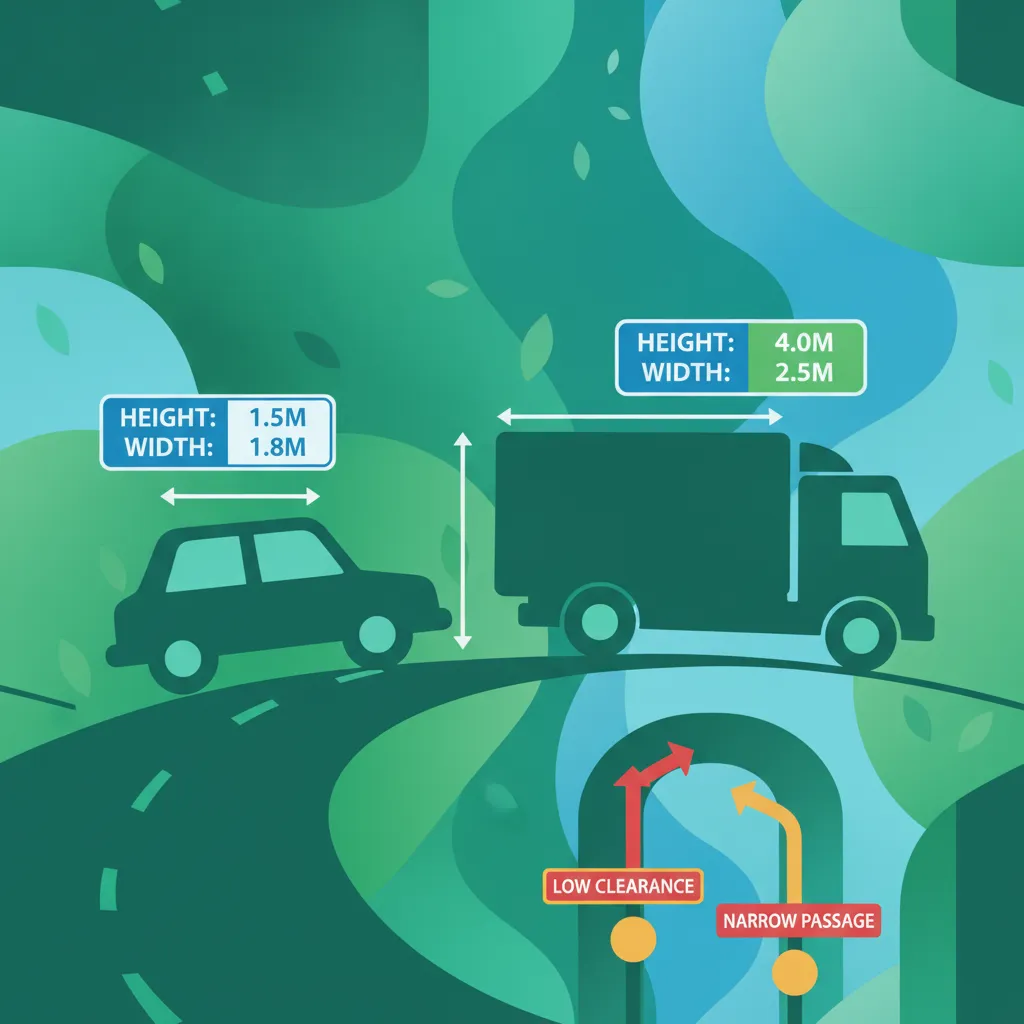
This lesson focuses on the specific dimensional limits that heavy goods vehicles must adhere to on Italian roads, as stipulated by the Codice della Strada. It covers the maximum permissible length, width, and height, explaining how these restrictions impact navigation through tunnels, under bridges, and within urban environments. Learners will also understand the conditions under which special permits for exceptional or oversized transport are required.

This lesson focuses on the steering mechanisms that enable drivers to control heavy vehicles, with a particular emphasis on power-assisted hydraulic systems. It covers the key components, from the steering wheel to the linkages connected to the wheels, and explains how to perform basic checks for responsiveness and fluid levels. Learners will understand how proper steering function is critical for maintaining directional control and overall vehicle safety.
Master the step-by-step process for correctly adjusting all mirrors on your heavy goods vehicle from the driver's seat. This guide ensures maximum visibility and covers legal requirements for drivers in Italy.
This lesson covers the complete set of lighting, reflective equipment, and protective guards mandated for heavy vehicles. It explains the function of each light, from headlights to side markers, and the importance of keeping them clean and operational to ensure the vehicle is visible to others. The lesson also details the legal requirements and safety purpose of side guards and rear underrun protection, which are designed to protect vulnerable road users in a collision.
This lesson focuses on the vital systems for visibility and communication: mirrors, lighting, and signals. It provides instruction on the proper adjustment of mirrors to minimize blind spots and the correct use of headlamps, indicators, and brake lights as per Italian regulations. The content underscores how maintaining these systems in full working order is crucial for being seen and signalling intentions clearly in traffic.
This lesson explains the critical importance of a continuous and systematic visual scan for maintaining 360-degree awareness around the vehicle. It details the correct technique for using interior and exterior mirrors in conjunction with direct vision and shoulder checks to effectively identify hazards. The content emphasizes the need to be aware of blind spots before any maneuver, such as changing lanes or turning.
This lesson highlights the large blind spots—or 'no-zones'—that exist to the front, back, and sides of a heavy vehicle, where smaller vehicles, cyclists, and pedestrians can disappear from view. It teaches proactive scanning techniques, the importance of anticipating hazards, and how to use mirrors and direct vision effectively to manage these high-risk areas. Awareness and mitigation of blind spots are crucial for preventing collisions, especially in urban traffic.
This lesson focuses on the correct use of mirrors to maintain situational awareness and the techniques required to manage blind spots. It explains how to adjust mirrors for the best possible view of surrounding traffic. You will also learn why shoulder checks are critical before changing lanes or turning to detect vehicles hidden in blind zones.
This lesson focuses on the specific dimensional limits that heavy goods vehicles must adhere to on Italian roads, as stipulated by the Codice della Strada. It covers the maximum permissible length, width, and height, explaining how these restrictions impact navigation through tunnels, under bridges, and within urban environments. Learners will also understand the conditions under which special permits for exceptional or oversized transport are required.
This lesson focuses on the specific regulations and techniques for operating a heavy vehicle on high-speed motorways. It covers mandatory lane discipline for trucks, the rules governing overtaking other heavy vehicles, and the specific speed limits that apply. Best practices for merging onto and exiting the motorway, maintaining safe following distances, and using the hard shoulder only in genuine emergencies are also detailed.
This lesson introduces the various electronic driver aids designed to improve visibility and safety during low-speed maneuvering. It covers the use of reversing cameras, blind-spot monitoring systems, and ultrasonic proximity sensors that provide visual and audible warnings. Learners will understand that while these technologies are valuable tools, they are aids to—not replacements for—the driver's own diligent observation and skill.

This lesson provides a structured, step-by-step guide to conducting a thorough pre-drive inspection. It outlines a systematic walk-around procedure, covering critical checks of tyres, wheels, lights, brakes, fluid levels, mirrors, and load security before starting any journey. Emphasizing this daily routine helps instill the professional habit of verifying vehicle roadworthiness and identifying potential issues before they become dangerous on the road.
This lesson bridges the gap between general traffic laws and their specific application to heavy goods vehicles. It examines how rules regarding speed limits, lane discipline, overtaking, and priority are modified or have special considerations for trucks due to their size, weight, and reduced maneuverability. Drivers will learn to correctly interpret road signs and signals within the context of operating a large vehicle, ensuring safe and compliant integration with other traffic.
Find clear answers to common questions learners have about Mirror Placement and Adjustment. Learn how the lesson is structured, which driving theory objectives it supports, and how it fits into the overall learning path of units and curriculum progression in Italy. These explanations help you understand key concepts, lesson flow, and exam focused study goals.
The close-proximity (kerb) mirror is vital because it eliminates the massive blind spot immediately to the front and left of the cabin, which is a high-risk area for cyclists and pedestrians in urban environments.
You must check and adjust your mirrors every time you sit in the driver's seat before starting the engine, and perform a quick check whenever your seating position changes or after any maintenance work.
Yes, you may be tested on the different classes of mirrors (I to VI) required by European and Italian legislation, and how each specific type contributes to the total field of vision.
While essential, mirrors have limitations. The Italian theory emphasizes that they must be supplemented by direct vision, shoulder checks, and, where equipped, camera systems or turn-assist technology.
Start searching now to pinpoint exactly which Italian driving theory topics, road signs, or traffic rules you need to master. Use our advanced filters to build a custom practice session and ensure you're fully prepared for every aspect of your official driving licence exam.