
This lesson is a vital component of the Observation, Visibility, Positioning, and Communication unit for the Patente AM licence. You will learn how to correctly set your mirrors and master the essential shoulder check technique to identify vehicles hidden in blind zones, ensuring you are fully prepared for the defensive riding scenarios in your theory exam.

Lesson content overview
Driving an AM category vehicle, such as a moped or scooter, requires constant vigilance and precise control. One of the most fundamental aspects of safe riding involves effectively using your vehicle's mirrors and being acutely aware of blind spots. This lesson will equip you with the knowledge and techniques necessary to maintain comprehensive visual coverage of your surroundings, anticipate hazards, and execute maneuvers safely on Italian roads.
Maintaining situational awareness is paramount for every driver, but it takes on particular importance for riders of AM category vehicles. These vehicles are often smaller and less visible than cars or trucks, making them more susceptible to being overlooked by other road users. Proper mirror adjustment and the consistent practice of checking blind spots are critical for preventing collisions and navigating mixed traffic environments safely.
By mastering these skills, you can create a mental map of the traffic around you, allowing you to anticipate potential conflicts and react preemptively. This proactive approach significantly reduces the risk of accidents, especially during critical maneuvers like changing lanes, merging, or turning. The Italian Codice della Strada (Road Code) explicitly mandates that drivers verify the safety of any maneuver before performing it, underscoring the legal and practical necessity of these observation techniques.
Vehicle mirrors are designed to extend a rider's field of vision beyond what can be seen directly. They provide vital information about traffic approaching from behind and from the sides. For AM category vehicles, mirrors are typically external.
These mirrors are mounted on the handlebars or side panels of your scooter or moped. Their primary function is to provide a view of the lanes immediately to your left and right, as well as traffic approaching from behind on either side. Proper adjustment of these mirrors is essential to minimize the areas that remain unseen, commonly known as blind spots. Unlike cars, many AM vehicles do not have an interior rear-view mirror; therefore, the external side mirrors are your main tools for rearward visibility.
In Italy, as per the Codice della Strada, all vehicles, including AM category vehicles, must be equipped with mirrors that provide an adequate view of the road behind. Furthermore, these mirrors must be correctly adjusted before the vehicle is set in motion. This regulation is in place to ensure that riders have optimal situational awareness from the very start of their journey, contributing to overall road safety.
Correctly adjusting your mirrors is a fundamental step toward safe riding. This procedure ensures that you maximize your field of view and reduce blind spots as much as possible, allowing for quicker situational assessment and safer maneuvers.
Before you begin adjusting your mirrors, ensure your riding position is correct. Sit comfortably in your normal riding posture, with both feet flat on the ground if stationary, and your hands on the handlebars. Your arms should have a slight bend at the elbows, and you should be able to reach all controls easily. This consistent starting position is crucial, as any change in your posture will affect your mirror view.
The goal for side mirror adjustment is to show as much of the adjacent lanes as possible, with minimal view of your own vehicle.
Left External Mirror: Adjust this mirror so that you can just barely see a sliver of your vehicle's left side. The majority of the mirror's view should be of the lane beside you and behind you on the left. This positioning maximizes your view of traffic approaching from the left rear.
Right External Mirror: Similarly, adjust the right external mirror so that only a tiny portion of your vehicle's right side is visible. The rest of the mirror's surface should show the lane beside you and behind you on the right. This setup helps you monitor traffic flow on your right-hand side.
A common mistake is setting mirrors too wide, showing too much of the road directly behind and not enough of the adjacent lanes. Conversely, mirrors set too narrow might show too much of your own vehicle, creating larger blind spots. Another error is failing to adjust mirrors after a change in rider posture, vehicle load, or when a passenger boards. Always perform these adjustments while stationary, before starting your ride.
Even with perfectly adjusted mirrors, there will always be areas around your vehicle that remain invisible. These areas are known as blind spots. Understanding what blind spots are and how to effectively check them is non-negotiable for safe riding.
Blind spots are specific zones immediately to the sides and slightly behind your vehicle that cannot be seen using any of your mirrors. They are a physiological limitation of human vision and the physical placement of mirrors. For AM category vehicles, these blind spots can be particularly problematic due to their smaller size, which makes them easier for other, larger vehicles to completely obscure within their own blind zones.
For vehicles in Italy, which drive on the right-hand side of the road, you will typically have a blind spot on your left (driver's side) and one on your right (passenger's side).
Relying solely on your mirrors for situational awareness is a dangerous practice. While mirrors provide an expanded field of view, they do not offer complete coverage. Without an additional check, you might initiate a lane change or turn directly into the path of another road user who is traveling in your blind spot, leading to a serious collision. This is why the shoulder check becomes an indispensable technique.
The shoulder check is the critical technique used to verify that your blind spots are clear before making any lateral movement. It directly addresses the limitations of your vehicle's mirrors.
A shoulder check is a brief, rapid head turn to physically look over your shoulder into the blind spot area. This direct visual inspection provides confirmation that the adjacent lane or path is clear of other vehicles, cyclists, or pedestrians before you commit to a maneuver.
Shoulder checks are mandatory before any lateral movement that might cross into a blind spot. This includes:
A shoulder check must be quick and decisive, ensuring you do not deviate from your path or lose control of your vehicle.
Scan Mirrors First: Before turning your head, quickly scan your mirrors to get a general idea of the traffic situation.
Quick Head Turn: Turn your head rapidly over the shoulder corresponding to the direction you intend to move. For a left lane change, glance over your left shoulder; for a right turn or lane change, look over your right shoulder.
Return Eyes to Front: Immediately return your gaze to the road ahead. The entire process should take no more than a second to avoid losing sight of the forward path.
Maintain Control: Keep your hands firmly on the handlebars and maintain your direction of travel during the check.
Practice shoulder checks regularly, even when not strictly necessary, to make it a natural and seamless part of your riding routine.
Failing to perform a shoulder check, or performing it too late, is a leading cause of side-swipe collisions. A vehicle or a vulnerable road user could be traveling in your blind spot, completely hidden from your mirrors. Ignoring this crucial step can lead to severe accidents, legal penalties, and points on your Patente AM license.
Safe driving is a systematic process. Before executing any lateral maneuver (lane change, turn, merge), you must follow a consistent sequence to ensure the path is clear and your intentions are communicated to other road users. This sequence can be remembered as "Mirror, Signal, Shoulder, Maneuver."
The first step is always to gather information. This involves a quick, systematic scan of your mirrors:
This initial scan gives you a broader picture of the traffic situation around you.
After scanning your mirrors and confirming the general area is clear, the next step is to communicate your intentions. Activate your turn signal (indicator) on the side you intend to move towards. This gives other road users sufficient warning of your planned action, allowing them to adjust their speed or position accordingly.
In Italy, the Codice della Strada (Article 176) mandates that drivers must signal their intention to turn or change lanes well in advance, typically a minimum of 5 seconds before initiating the maneuver. This timeframe is crucial for safety, as it provides other drivers enough time to perceive your signal and react. Activating your indicator too late, or worse, not at all, is a common violation that can lead to confusion and accidents.
Mirror: Scan your mirrors (side mirrors) to get an overview of surrounding traffic.
Signal: Activate your turn indicator at least 5 seconds before your intended maneuver to communicate your intentions.
Shoulder Check: Perform a quick, decisive shoulder check on the side of your intended maneuver to verify the blind spot is clear.
Maneuver: Only if the path is clear and safe, smoothly execute your lane change, turn, or merge.
Never start the maneuver before completing all steps, especially the shoulder check. If the path is not clear, abort the maneuver and wait for a safe opportunity.
Mirror adjustment isn't a one-time task; it's a dynamic process that may require readjustment based on changing conditions. Neglecting these adjustments can compromise your visibility and increase blind spots.
The presence of a passenger or heavy cargo can significantly alter the effective width and weight distribution of your AM vehicle. This can lead to:
If you add a passenger or load heavy cargo, it is essential to re-adjust your external side mirrors. You will likely need to push them slightly further outward to compensate for the increased width and ensure you still have a clear view of the adjacent lanes and beyond. This is a critical step to maintain optimal visibility and compensate for altered vehicle dimensions.
Always be mindful of any changes to your vehicle's state. If you are riding with a passenger for the first time, take a moment to practice your mirror and shoulder checks in a safe, controlled environment to understand how your field of view has changed. Regularly check your mirrors to ensure they haven't shifted due to vibrations or bumps.
Compliance with the Codice della Strada is fundamental for all drivers in Italy. Several articles directly or indirectly relate to mirror use and blind spot awareness.
Statement: Before moving the vehicle, the driver must adjust mirrors to obtain the best possible view. Applicability: All driving situations before starting motion. Rationale: Ensures optimal situational awareness from the outset, allowing the rider to monitor surrounding traffic effectively. Correct Example: A rider sits on their scooter and, before starting the engine, adjusts both side mirrors to ensure maximum visibility of the road behind and to the sides. Incorrect Example: A rider starts their scooter and immediately pulls into traffic without checking or adjusting the mirrors.
Statement: The driver must signal intention to turn or change lane well in advance (minimum 5 seconds) using indicators. Applicability: Turns, lane changes, merging. Rationale: Allows other road users to anticipate the maneuver, reducing the risk of collision. Correct Example: Before changing lanes on a busy street, a rider activates the turn signal at least 5 seconds beforehand, allowing cars behind to react. Incorrect Example: A rider suddenly swerves into an adjacent lane and then activates the turn signal as they are already moving.
Statement: The driver must keep a safe distance from other vehicles, considering road conditions, speed, and vehicle capabilities. Applicability: All driving situations. Rationale: Provides adequate time to react to hazards detected via mirrors or shoulder checks, especially when needing to brake or maneuver suddenly. Correct Example: A rider maintains a two-second following distance behind the vehicle in front, allowing time to see and react to traffic changes observed in mirrors. Incorrect Example: A rider follows too closely behind a car, making it impossible to see upcoming traffic conditions through their mirrors or react to sudden braking.
Statement: At intersections, drivers must check mirrors and surroundings before proceeding, especially when turning across lanes. Applicability: Intersections, turns. Rationale: Prevents collisions by ensuring the driver has assessed all directions, including potential traffic in blind spots, before committing to a turn. Correct Example: Approaching a left turn at a crossroads, the rider checks the left side mirror, performs a left shoulder check, and then signals before turning. Incorrect Example: A rider turns left at an intersection without checking the right side mirror, potentially cutting off a vehicle or cyclist.
Statement: When changing lanes, the driver must verify that the maneuver can be performed safely, respecting traffic flow. Applicability: Lane changes on any road type. Rationale: Explicitly calls for thorough observation (mirror checks and shoulder checks) to ensure the intended lane is clear and that the maneuver will not impede or endanger other road users. Correct Example: A rider performs a mirror scan, signals, and executes a shoulder check before smoothly moving into an open lane on a motorway. Incorrect Example: A rider changes lanes based solely on a quick glance in the interior mirror, narrowly missing a vehicle in their blind spot.
Even experienced riders can make mistakes related to mirror use and blind spot awareness. Understanding these common errors can help you avoid them.
Description: The rider only glances at mirrors before moving laterally. Why It’s Wrong: A vehicle, cyclist, or pedestrian might be completely hidden in the blind spot, leading to a collision. Correct Behavior: Always perform a quick and deliberate shoulder check after checking mirrors and signaling. Potential Consequence: Side collision, severe injury, fines, and points on your license.
Description: Mirrors show too much of the road directly behind, and little of the adjacent lanes or sides. Why It’s Wrong: This creates larger blind spots directly beside the vehicle, forcing the rider to turn their head excessively and potentially losing sight of the road ahead. Correct Behavior: Adjust side mirrors so that only a sliver of your vehicle's side is visible, maximizing the view of adjacent lanes. Potential Consequence: Inadequate response time to sudden events in adjacent lanes, near misses.
Description: The rider begins to move into an adjacent lane and then activates the turn signal. Why It’s Wrong: Other drivers are unaware of your intentions and cannot react safely, increasing the risk of a collision. Correct Behavior: Activate your turn signal at least 5 seconds before beginning any lateral movement, providing clear communication. Potential Consequence: Rear-end collisions, side collisions, penalties, and points on your license.
Description: The rider primarily checks only the interior mirror. Why It’s Wrong: An interior mirror cannot show vehicles in adjacent lanes or blind spots. Correct Behavior: Use a systematic scan: interior mirror (if present), left side mirror, right side mirror, followed by shoulder checks. Potential Consequence: Side collisions, especially at intersections or during lane changes, fines.
Description: The rider carries heavy cargo or a passenger but does not readjust mirrors. Why It’s Wrong: The added width and weight can create new or expanded blind spot zones, as the mirrors are no longer optimally positioned. Correct Behavior: Re-position side mirrors slightly outward to compensate for the increased width and altered view, before moving. Potential Consequence: Hidden hazards may go unnoticed, leading to unsafe maneuvers.
Description: The rider starts to move into a lane and only then performs a shoulder check. Why It’s Wrong: There is insufficient time to correct the action if a vehicle is already present in the blind spot, making a collision highly probable. Correct Behavior: Perform the shoulder check before starting any lateral movement, after signaling. Potential Consequence: Collision due to delayed reaction, loss of control.
The techniques for mirror use and blind spot awareness need to be adapted to various driving conditions, including weather, road type, and interaction with different road users.
Vulnerable road users, such as cyclists, pedestrians, and even other motorcyclists, are particularly susceptible to being hidden in your blind spots due to their smaller size.
Let's illustrate these concepts with practical examples that you might encounter on Italian roads.
Situation: You are on a side street, preparing to merge left onto a busy main road in an urban setting during the daytime. Relevant Rules: Codice della Strada Art. 172 (safe lane change), Art. 176 (indicator use). Correct Behavior:
Situation: You are riding on a two-lane rural road and want to overtake a slower scooter ahead of you. Relevant Rules: Codice della Strada Art. 173 (maintaining safe distance), Art. 172 (lane change safety). Correct Behavior:
Situation: You are carrying a passenger on your scooter in city traffic, and it begins to rain. You need to make a right turn at an intersection. Relevant Rules: Codice della Strada Art. 175 (mirror adjustment before moving), Art. 176 (signaling intent). Correct Behavior:
Mastering mirror use and blind spot awareness is a continuous process that significantly enhances your safety on the road. Here's a summary of the essential principles:
By consistently applying these techniques, you will significantly reduce your risk on the road, ride with greater confidence, and contribute to safer traffic flow for everyone.
This lesson covers essential observation techniques for safe moped and scooter riding in Italy, emphasizing that mirrors alone cannot eliminate blind spots and that shoulder checks are mandatory before any lateral maneuver. Proper mirror adjustment involves positioning them to show minimal own vehicle and maximum adjacent lanes, with re-adjustment required when carrying passengers or cargo. The Codice della Strada explicitly requires pre-trip mirror adjustment (Art. 175) and advance signaling of at least 5 seconds (Art. 176). The systematic Mirror-Signal-Shoulder-Maneuver sequence must be followed consistently, with increased vigilance in adverse weather, urban traffic, and around vulnerable road users like cyclists and pedestrians.
A short set of high-value points that capture the most important learning from this lesson.
Mirrors must be adjusted before moving so only a sliver of your own vehicle is visible, maximizing view of adjacent lanes
Shoulder checks are mandatory supplements to mirrors because blind spots cannot be eliminated by mirror positioning alone
Always follow the Mirror, Signal, Shoulder, Maneuver sequence before any lateral movement
Indicators must be activated at least 5 seconds before turning or changing lanes per Codice della Strada Article 176
Re-adjust mirrors when carrying passengers or cargo to compensate for increased vehicle width and blocked views
Explore all units and lessons included in this driving theory course.
Art. 175 requires mirrors to be adjusted before starting; Art. 176 mandates 5-second advance signaling for turns and lane changes
Left and right blind spots exist where mirrors cannot see, typically to each shoulder and slightly behind the vehicle
Shoulder checks must be performed after scanning mirrors and signaling, but before initiating any lateral maneuver
In Italy (right-hand traffic), left blind spot is driver's side and right blind spot is passenger's side
Adverse weather (rain, fog, night) requires increased frequency of mirror cleaning and shoulder checks
Relying on mirrors alone without performing a shoulder check before lane changes or turns, risking collision with hidden vehicles
Setting mirrors too far outward, showing too much road behind and insufficient adjacent lane coverage
Activating turn signals only after beginning a lane change instead of 5 seconds beforehand
Failing to readjust mirrors when carrying a passenger, creating larger blind spots from increased vehicle width
Performing the shoulder check too late—after already starting to move into the adjacent lane
Lesson content overview
A short set of high-value points that capture the most important learning from this lesson.
Mirrors must be adjusted before moving so only a sliver of your own vehicle is visible, maximizing view of adjacent lanes
Shoulder checks are mandatory supplements to mirrors because blind spots cannot be eliminated by mirror positioning alone
Always follow the Mirror, Signal, Shoulder, Maneuver sequence before any lateral movement
Indicators must be activated at least 5 seconds before turning or changing lanes per Codice della Strada Article 176
Re-adjust mirrors when carrying passengers or cargo to compensate for increased vehicle width and blocked views
Explore all units and lessons included in this driving theory course.
Art. 175 requires mirrors to be adjusted before starting; Art. 176 mandates 5-second advance signaling for turns and lane changes
Left and right blind spots exist where mirrors cannot see, typically to each shoulder and slightly behind the vehicle
Shoulder checks must be performed after scanning mirrors and signaling, but before initiating any lateral maneuver
In Italy (right-hand traffic), left blind spot is driver's side and right blind spot is passenger's side
Adverse weather (rain, fog, night) requires increased frequency of mirror cleaning and shoulder checks
Relying on mirrors alone without performing a shoulder check before lane changes or turns, risking collision with hidden vehicles
Setting mirrors too far outward, showing too much road behind and insufficient adjacent lane coverage
Activating turn signals only after beginning a lane change instead of 5 seconds beforehand
Failing to readjust mirrors when carrying a passenger, creating larger blind spots from increased vehicle width
Performing the shoulder check too late—after already starting to move into the adjacent lane
Explore search topics learners often look for when studying Mirror Use and Blind Spot Awareness. These topics reflect common questions about road rules, driving situations, safety guidance, and lesson level theory preparation for learners in Italy.
Browse additional driving theory lessons that cover connected traffic rules, road signs, and common driving situations related to this topic. Improve your understanding of how different rules interact across everyday traffic scenarios.
Learn essential driving theory on effective observation, including mirror use and blind spot checks, combined with safe techniques for executing maneuvers like lane changes and turns. Crucial for Italian Patente AM.

This lesson explains how to execute left turns, right turns, and U-turns safely while maintaining correct lane discipline. It covers interpreting road markings and arrows, selecting the proper vehicle position, and using signals in a timely manner. Performing shoulder checks to monitor blind spots before and during a turn is a key focus for preventing collisions.

This lesson teaches the fundamental observation techniques required for proactive and defensive riding. It details a systematic approach to scanning the road environment, using mirrors effectively, and performing shoulder checks to cover blind spots before any maneuver. Developing strong situational awareness is presented as a key skill for anticipating potential hazards and reacting to them in a timely manner.

This lesson introduces the philosophy and techniques of defensive driving, a proactive approach focused on anticipating and mitigating potential hazards. It teaches drivers to maintain constant situational awareness by scanning the road ahead, behind, and to the sides. The content covers how to manage the space around the vehicle, identify potential escape routes, and predict the actions of other road users to prevent dangerous situations from developing.

This lesson teaches riders how to maintain a safe following distance using the two-second rule, which accounts for reaction time and braking distance. It covers grip management, explaining how tire condition and road surfaces like wet asphalt affect traction. Mastering these concepts is essential for anticipating hazards and preventing rear-end collisions.

This lesson explains the critical importance of a continuous and systematic visual scan for maintaining 360-degree awareness around the vehicle. It details the correct technique for using interior and exterior mirrors in conjunction with direct vision and shoulder checks to effectively identify hazards. The content emphasizes the need to be aware of blind spots before any maneuver, such as changing lanes or turning.

This lesson provides detailed instruction on performing effective shoulder checks to supplement mirror use, ensuring a clear path before turning or changing lanes. It covers the proper and timely use of electronic indicators and hand signals to communicate your intentions to other drivers. Correct signaling is crucial for preventing misunderstandings and collisions on the road.
This lesson emphasizes the importance of clear communication and cooperative behavior among all road users to prevent conflicts and enhance safety. It details the proper and legal use of vehicle signals, such as turn indicators and hazard lights, as well as the appropriate use of the horn. The content also explores the role of non-verbal cues like eye contact and courtesy gestures in creating a predictable and safe driving environment.

This lesson teaches the correct and safe technique for reversing a vehicle. It emphasizes the importance of performing a full 360-degree check for hazards before starting and maintaining slow, controlled movement. The content covers how to use mirrors and direct observation effectively, how to steer accurately while looking backward, and the increased need for caution regarding pedestrians and cyclists in the vehicle's blind areas.

This lesson addresses the significant risk posed by parked vehicles, particularly the hazard of drivers opening their doors into traffic. You will learn to maintain a safe lateral distance when passing parked cars and to actively scan for signs of occupancy. This proactive approach helps prevent dangerous "dooring" incidents and ensures safe passage in urban environments.
This lesson provides detailed instructions on how to correctly execute various turning maneuvers, including right turns, left turns, and U-turns where permitted. It emphasizes the importance of early signaling to communicate intentions, selecting the correct lane in advance, and adjusting speed before entering the turn. The content also covers the visual checks required before and during the maneuver to ensure it is safe to proceed.
Understand Italian traffic laws and conventions regarding signaling, lane discipline, and safe interaction with diverse road users. Essential theory for Patente AM riders navigating mixed traffic environments.
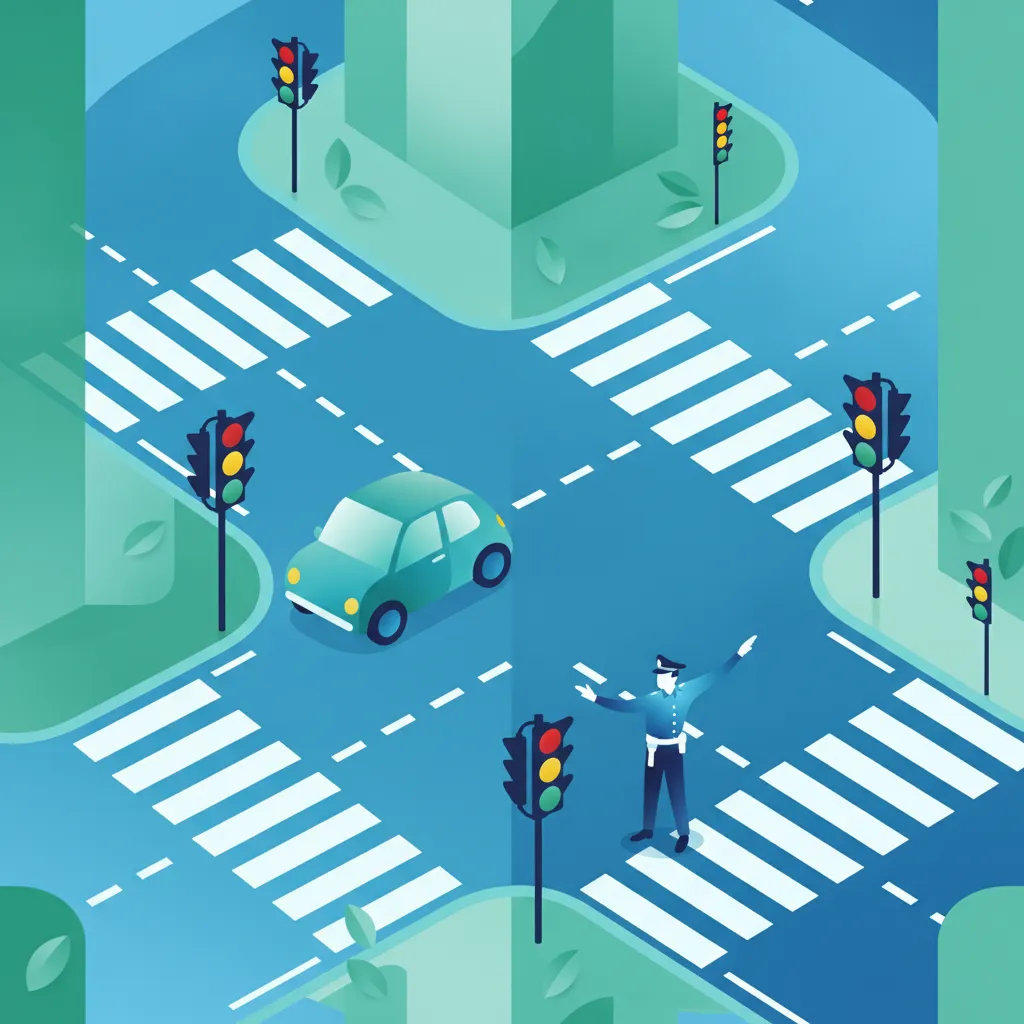
This lesson explains the function of Italian traffic light systems and the meaning of various road markings. You will learn the rules for red, amber, and green signals, including flashing lights and directional arrows. It also covers how to interpret lane lines, stop lines, and other surface markings that dictate correct vehicle positioning and movement.

This lesson focuses on non-verbal communication techniques essential for safe riding. It covers how to use eye contact, headlights, and hand signals to convey intentions to drivers, pedestrians, and cyclists. Understanding how to interact and negotiate space in traffic through clear communication helps prevent accidents and promotes a smoother traffic flow.

This lesson details how to safely approach and enter intersections by correctly interpreting traffic lights, stop signs, and give-way rules. It emphasizes the importance of scanning for hazards, checking blind spots, and anticipating the actions of other road users. You will learn to adjust your speed and position your vehicle correctly to navigate crossings without incident.
This lesson provides detailed instruction on performing effective shoulder checks to supplement mirror use, ensuring a clear path before turning or changing lanes. It covers the proper and timely use of electronic indicators and hand signals to communicate your intentions to other drivers. Correct signaling is crucial for preventing misunderstandings and collisions on the road.
This lesson explains how to execute left turns, right turns, and U-turns safely while maintaining correct lane discipline. It covers interpreting road markings and arrows, selecting the proper vehicle position, and using signals in a timely manner. Performing shoulder checks to monitor blind spots before and during a turn is a key focus for preventing collisions.
This lesson emphasizes the importance of clear communication and cooperative behavior among all road users to prevent conflicts and enhance safety. It details the proper and legal use of vehicle signals, such as turn indicators and hazard lights, as well as the appropriate use of the horn. The content also explores the role of non-verbal cues like eye contact and courtesy gestures in creating a predictable and safe driving environment.

This lesson provides a detailed explanation of the priority rules that govern Italian intersections and roundabouts. You will learn to identify priority roads and correctly apply the rules for stop and give way signs. It also covers the specific procedures for entering, navigating, and exiting roundabouts, emphasizing when to yield to circulating traffic.
This lesson outlines the proper conduct when encountering emergency vehicles on the road or interacting with responders at an incident. It details the rules for yielding the right-of-way to ambulances, police, and fire services, ensuring they have a clear path. You will also learn how to provide clear and concise information to authorities to facilitate an effective emergency response.
This lesson focuses on the specific regulatory and warning signs that Patente AM riders must understand and obey. It details signs related to speed limits, no-entry zones, and mandatory directions that directly impact moped operation. You will also learn to recognize warning signs for potential hazards like sharp curves, slippery surfaces, and pedestrian areas.
This lesson explores the specific speed limits applicable to AM vehicles across various zones, including urban, residential, and rural roads. Emphasis is placed on understanding the signage that indicates both permanent and temporary speed restrictions. Learners will also examine the rationale behind these limits and the importance of adapting speed to road conditions and traffic density.
Find clear answers to common questions learners have about Mirror Use and Blind Spot Awareness. Learn how the lesson is structured, which driving theory objectives it supports, and how it fits into the overall learning path of units and curriculum progression in Italy. These explanations help you understand key concepts, lesson flow, and exam focused study goals.
Mirrors on mopeds and scooters have physical limitations and cannot cover the entire area around the vehicle. There is always a blind spot to the sides where other vehicles can be hidden, which is why a physical shoulder check is mandatory before any change in direction.
You should check your mirrors frequently as part of a continuous scanning routine. You must check them before every change of speed, before signaling, and before any change in lateral position or turning.
Yes, even if your mirrors seem clear, performing a shoulder check is the only way to be 100% certain that your intended path is free of other vehicles, especially when dealing with cyclists or smaller vehicles that are easily missed.
The exam often uses images or situational diagrams asking you to identify the correct moment to perform a shoulder check or to select the appropriate action to take when a vehicle is approaching from your side. Focusing on defensive awareness will help you identify the safest course of action.
Start searching now to pinpoint exactly which Italian driving theory topics, road signs, or traffic rules you need to master. Use our advanced filters to build a custom practice session and ensure you're fully prepared for every aspect of your official driving licence exam.