
This lesson provides specialized training for navigating mountainous terrain in heavy vehicles, focusing on safety and technical control. It builds on your understanding of vehicle mechanics to ensure you can manage steep gradients and complex road layouts safely, which is a critical competency for your C, C1, C1E, or CE license.
Lesson content overview
Driving a heavy goods vehicle (HGV) through mountainous terrain presents a unique set of challenges that demand specialized skills, careful planning, and a deep understanding of vehicle dynamics. For professional drivers aiming for their C, C1, C1E, or CE license in Italy, mastering these techniques is not just about efficiency, but paramount for safety. This lesson provides detailed instruction on how to safely navigate steep ascents, controlled descents, tight bends, and the varying conditions found on mountain roads.
Mountain roads are characterized by steep gradients, numerous sharp turns, narrow sections, and often significant altitude changes. These conditions place considerable stress on heavy goods vehicles, impacting engine performance, braking systems, and overall vehicle stability. Unlike driving on flat terrain or motorways, a driver's actions on a mountain road directly affect the vehicle's ability to maintain control, prevent mechanical failure, and ensure the safety of all road users.
Understanding how vehicle mass, engine torque, and brake capability interact with road gradients is crucial. Proper technique minimizes risks such as loss of control, brake fade, and potential accidents. This knowledge builds upon foundational lessons concerning heavy-vehicle dimensions, braking systems, load distribution, and basic manoeuvring.
Effective gear management is the cornerstone of safe and efficient mountain driving for heavy goods vehicles. The transmission's gears must be selected strategically to either provide sufficient power for climbing or to harness the engine's natural resistance for controlled descents, thereby reducing reliance on the service brakes.
When climbing a steep incline with a heavy load, the engine requires substantial torque to overcome gravity and maintain momentum. Selecting too high a gear will cause the engine to struggle, lose power, potentially stall, and risk overheating. Conversely, selecting the correct low gear allows the engine to operate within its optimal RPM (revolutions per minute) range, providing maximum torque without excessive strain or fuel consumption.
When approaching an ascent, anticipate the gradient and downshift before the climb begins. This helps maintain momentum and reduces the sudden demand on the engine.
For instance, an HGV tackling a 10% gradient might need to be in second or third gear to keep the engine RPM stable and within safe operating limits. It is vital not to rely on the clutch to hold the vehicle on steep gradients, as this causes rapid clutch wear and overheating. The Italian Codice della Strada (Art. 150) implicitly reinforces this by prohibiting actions that lead to a loss of vehicle control.
Descending a mountain road requires even greater care regarding gear selection. The principle here is to use the engine's compression resistance—known as engine braking—to control the vehicle's speed. By engaging a lower gear, the engine effectively acts as a retarder, slowing the vehicle without using the service brakes.
The technique of using a vehicle's engine compression to slow its speed, typically by downshifting to a lower gear, thereby reducing reliance on the service brakes.
The general rule is to descend in the same gear you would use to climb the same slope, or one gear lower, depending on the load and gradient. For example, if you would climb a particular section in third gear, you should descend that same section in third gear or even second. This prevents the vehicle from gaining excessive speed and minimizes the need for continuous use of the service brake, which is critical for preventing overheating.
Anticipate the descent well in advance, observing road signs indicating steep gradients.
Reduce your speed before entering the descent.
Select a lower gear (e.g., if you were in 5th, shift to 3rd) that allows the engine to control the vehicle's speed without accelerating.
Allow the vehicle to decelerate using engine resistance, applying light, intermittent service brake applications only if speed needs further reduction.
The most critical concern during prolonged descents is brake management. Continuous use of the service brake generates immense heat, which can lead to brake fade or, in extreme cases, complete brake failure. Professional drivers must employ strategies that preserve brake temperature and effectiveness.
Brake fade is the reduction in braking efficiency due to excessive heat build-up. When brake components overheat, their ability to absorb and dissipate energy diminishes rapidly, leading to a dangerous reduction in stopping power. To counteract this, a technique called "snubbing" is highly recommended.
A technique for braking on long descents involving light, intermittent applications of the service brake combined with engine braking, allowing the brakes to cool between applications.
Instead of continuous braking, snubbing involves applying the service brake firmly for a few seconds to reduce speed, then releasing it completely for a longer period to allow the brakes to cool, all while maintaining speed control primarily with engine braking. This cycle is repeated as necessary to keep the vehicle at a safe, controlled speed.
The Italian Codice della Strada (Art. 150) explicitly prohibits continuous use of service brakes on long descents.
This rule is designed to ensure brake integrity and prevent serious accidents.
Many heavy goods vehicles are equipped with auxiliary braking systems, such as exhaust brakes, engine brakes (Jake brakes), or hydraulic/electric retarders. These systems are specifically designed to assist in controlling speed on descents, further reducing the strain on the primary service brakes.
If your vehicle is equipped with a retarder, use it proactively on descents. Retarders provide continuous braking power without generating heat in the wheel brakes, making them ideal for long, steep downgrades.
Drivers should be proficient in using these auxiliary systems in conjunction with engine braking and intermittent service brake applications. Understanding the different types of retarders and how to engage them effectively is part of comprehensive mountain driving training.
Mountain roads are synonymous with sharp turns, including hairpin bends—extremely tight, often 180-degree curves that demand precise vehicle control. Mishandling these bends can lead to veering off the road, loss of traction, or collisions with oncoming traffic.
The key to safely navigating hairpin bends and tight curves is to reduce speed significantly before entering the bend. This allows for a smoother turn and provides more time to react to unexpected obstacles or oncoming vehicles. Entering a bend too quickly, especially with a heavy load, increases the risk of understeer (where the vehicle continues in a straighter line than intended) or even rolling over due to centrifugal force.
Proper lane positioning is equally vital. Heavy vehicles, particularly those with trailers, require a wider turning radius. On tight bends, drivers might need to approach from the outside of the curve to allow the trailer to track properly through the inside of the turn, avoiding the curb or rock face. However, this must be done while staying within your lane as much as possible and being extremely vigilant for oncoming traffic, which may also need to utilize the full road width. The Italian Codice della Strada (Art. 149) mandates that vehicles stay within lane boundaries.
Never attempt to overtake on blind curves or hairpin bends. Visibility is severely limited, and such maneuvers are extremely dangerous and illegal.
Many mountain curves are "blind," meaning you cannot see through them to detect oncoming traffic or obstructions. In such situations, speed reduction must be even more pronounced, and drivers should be prepared to stop if necessary. Using acoustic signals (horn) on blind corners is generally advisable, especially if specified by local regulations or indicated by road signs.
Narrow mountain roads often make it impossible for two large vehicles to pass each other comfortably, or for one vehicle to overtake another safely. Designated passing places (or pull-out areas) are provided for this purpose.
A designated pull-out or widened section on a narrow road designed to allow vehicles to stop or pull aside to permit other traffic to pass.
These areas are critical for maintaining traffic flow and safety. Drivers must be prepared to use them to either let faster vehicles overtake or to allow oncoming traffic to pass when the road is too narrow for two-way flow. Always look far ahead to anticipate these situations and react early.
On narrow mountain roads, overtaking is generally prohibited where no passing place is visible, or where road conditions (like blind curves) make it unsafe (Codice della Strada Art. 148). When meeting oncoming traffic on a narrow section, one vehicle typically must yield. On steep gradients, the vehicle descending generally yields to the vehicle ascending, as it is often more difficult for a loaded HGV to restart on an incline. However, this rule can vary, and drivers must be prepared to communicate (e.g., with headlights) and use common sense to ensure safe passage.
Driving at high altitudes introduces additional factors that can affect both the vehicle and the driver. Reduced air density at higher elevations can significantly alter vehicle performance and even influence driver physiological responses.
Internal combustion engines, particularly naturally aspirated ones, lose power as altitude increases due to lower oxygen levels in the air. This reduction in engine power can be substantial, sometimes up to 10% for every 1,000 meters above sea level. For heavy goods vehicles, this means less torque for climbing and less engine braking power on descents. Drivers must compensate by selecting even lower gears and being more proactive with speed management.
Cooling efficiency can also be affected, as thinner air is less effective at dissipating heat from the engine and brakes. This increases the risk of engine overheating on long climbs and exacerbates the potential for brake fade on descents. Drivers should closely monitor temperature gauges and be prepared to take breaks if vehicle temperatures rise too high.
Lower oxygen levels at high altitudes can also affect drivers, leading to increased fatigue, reduced concentration, and slower reaction times. The demanding nature of mountain driving, coupled with potential altitude sickness symptoms (headache, dizziness), further compounds these risks.
At higher altitudes, plan more frequent rest stops. Stay hydrated and be extra vigilant for signs of fatigue in yourself and your vehicle.
These physiological effects mean that drivers must allow for longer reaction times and anticipate situations even earlier. Longer stopping distances should be factored in, not only due to vehicle performance changes but also due to the driver's potentially reduced capacity to react quickly.
Adherence to specific traffic regulations for mountain roads in Italy is mandatory for all drivers, especially those operating heavy goods vehicles. These rules are designed to mitigate the inherent dangers of such challenging environments.
The Italian Codice della Strada contains several articles relevant to safe mountain driving:
Strict compliance with these regulations is not just a legal requirement but a fundamental safety practice that protects the driver, the vehicle, and other road users.
Ignoring specialized mountain driving techniques can lead to severe consequences. Being aware of common pitfalls helps in adopting correct behaviors.
Driving heavy goods vehicles on mountain roads demands a holistic approach to safety. Every decision, from gear selection to braking strategy and speed control, must be informed by an understanding of physics, vehicle dynamics, environmental conditions, and legal requirements.
Mastering these techniques and principles is fundamental for any professional driver navigating Italy's challenging mountain routes. It ensures not only compliance with the law but, more importantly, the safe and efficient transport of goods.
Mastering mountain road driving for heavy goods vehicles requires proactive gear selection before gradients rather than during them. Engine braking must be the primary descent control technique, supplemented by intermittent snubbing to prevent brake overheating, with retarders used whenever available. Drivers must also account for altitude effects, which reduce engine power and cooling efficiency by approximately 10% per 1,000 meters, necessitating lower gear selection and more frequent rest stops. Italian traffic law (Codice della Strada Articles 148-150) mandates these practices and explicitly prohibits continuous braking on steep descents.
A short set of high-value points that capture the most important learning from this lesson.
Select the correct low gear before an ascent begins to keep engine RPM in the optimal torque range and prevent stalling.
Use engine braking as the primary method to control speed on descents, not continuous service braking.
Snubbing (intermittent light brake applications combined with engine braking) prevents dangerous brake overheating on long downgrades.
Altitude reduces engine power by approximately 10% per 1,000 meters above sea level, requiring earlier downshifts and lower gears.
Always reduce speed significantly before entering hairpin bends; entering too fast risks understeer or rollover with heavy loads.
Explore all units and lessons included in this driving theory course.
Descend in the same or one gear lower than you would use to climb the same slope to maintain engine braking control.
Continuous service braking on long descents is prohibited by Italian Codice della Strada (Art. 148-150) and causes brake fade.
Retarders provide heat-free braking power and should be used proactively on steep descents to preserve wheel brake effectiveness.
On narrow mountain roads, the descending vehicle typically yields to the ascending vehicle, especially loaded HGVs.
Monitor temperature gauges closely at altitude as reduced air density diminishes both engine and brake cooling efficiency.
Staying in too high a gear on steep ascents, causing engine strain, power loss, and potential overheating.
Continuous service brake application on long descents, which can lead to brake fade and complete brake failure.
Attempting to overtake on blind curves or narrow sections without passing places, creating serious head-on collision risks.
Ignoring the impact of altitude on vehicle performance, resulting in misjudged stopping distances and insufficient climbing power.
Entering hairpin bends at excessive speed due to failing to slow down before the curve begins.
Lesson content overview
A short set of high-value points that capture the most important learning from this lesson.
Select the correct low gear before an ascent begins to keep engine RPM in the optimal torque range and prevent stalling.
Use engine braking as the primary method to control speed on descents, not continuous service braking.
Snubbing (intermittent light brake applications combined with engine braking) prevents dangerous brake overheating on long downgrades.
Altitude reduces engine power by approximately 10% per 1,000 meters above sea level, requiring earlier downshifts and lower gears.
Always reduce speed significantly before entering hairpin bends; entering too fast risks understeer or rollover with heavy loads.
Explore all units and lessons included in this driving theory course.
Descend in the same or one gear lower than you would use to climb the same slope to maintain engine braking control.
Continuous service braking on long descents is prohibited by Italian Codice della Strada (Art. 148-150) and causes brake fade.
Retarders provide heat-free braking power and should be used proactively on steep descents to preserve wheel brake effectiveness.
On narrow mountain roads, the descending vehicle typically yields to the ascending vehicle, especially loaded HGVs.
Monitor temperature gauges closely at altitude as reduced air density diminishes both engine and brake cooling efficiency.
Staying in too high a gear on steep ascents, causing engine strain, power loss, and potential overheating.
Continuous service brake application on long descents, which can lead to brake fade and complete brake failure.
Attempting to overtake on blind curves or narrow sections without passing places, creating serious head-on collision risks.
Ignoring the impact of altitude on vehicle performance, resulting in misjudged stopping distances and insufficient climbing power.
Entering hairpin bends at excessive speed due to failing to slow down before the curve begins.
Explore search topics learners often look for when studying Mountain Road Driving Techniques. These topics reflect common questions about road rules, driving situations, safety guidance, and lesson level theory preparation for learners in Italy.
Browse additional driving theory lessons that cover connected traffic rules, road signs, and common driving situations related to this topic. Improve your understanding of how different rules interact across everyday traffic scenarios.
Explore advanced strategies for heavy goods vehicles on steep mountain roads. Covers complex gear selection, prolonged descent braking, and hazard management specific to challenging Italian terrain. Essential for C, C1, C1E, and CE license holders.

This lesson provides essential strategies for safely navigating long, steep downgrades. It teaches the principle of selecting a low gear before starting the descent, allowing the engine's natural resistance to help control the vehicle's speed. Learners will understand how to combine correct gear selection with the judicious use of engine brakes and retarders to maintain a steady, safe speed and keep the service brakes cool and ready for emergency use.
This lesson focuses on the unique demands of mountain riding, from handling steep inclines and declines to understanding the impact of altitude on the motorcycle's engine performance. It covers the effective use of engine braking on descents to prevent brake overheating. The content also prepares riders for the rapidly changing weather conditions, such as wind and fog, that are common at higher elevations.

This lesson focuses on the unique characteristics and challenges of driving on rural and mountain roads. It covers how to safely navigate sharp curves, steep inclines, and narrow lanes with limited visibility, often requiring the use of the horn to signal presence. The content also prepares drivers for potential hazards such as slow-moving agricultural vehicles, unexpected animal crossings, and variable road surface quality.

This lesson focuses on the specific regulations and techniques for operating a heavy vehicle on high-speed motorways. It covers mandatory lane discipline for trucks, the rules governing overtaking other heavy vehicles, and the specific speed limits that apply. Best practices for merging onto and exiting the motorway, maintaining safe following distances, and using the hard shoulder only in genuine emergencies are also detailed.
This lesson provides a step-by-step guide for managing a vehicle breakdown safely. It reinforces the procedure for stopping on the hard shoulder, activating hazard lights, and placing a warning triangle at the correct distance. The lesson emphasizes the importance of wearing high-visibility clothing, exiting the vehicle from the side away from traffic, and waiting in a safe location before contacting a roadside assistance service.

This lesson provides specific strategies for riding on narrow rural roads, which often feature poor surfaces and limited sightlines. It details the techniques for approaching and navigating hairpin bends, including selecting the correct line, managing speed before entry, and using appropriate gear selection. The content emphasizes anticipating oncoming traffic and potential hazards hidden around blind corners for enhanced safety.
This lesson details the specific rules and safety considerations for driving through the extensive tunnels and high viaducts common in Italy. It covers pre-entry checks, maintaining a safe following distance, and the correct procedures to follow in case of a breakdown or fire inside a tunnel. The lesson also addresses the hazard of strong crosswinds on exposed viaducts and how to maintain vehicle control.
This lesson provides essential rules and techniques for driving on Italian motorways (autostrade) and major extra-urban roads. It explains how to safely merge onto the motorway from an entry ramp, the strict lane discipline required (drive right, overtake left), and how to exit correctly. The content also covers speed regulations, maintaining a safe following distance at high speed, and procedures for using service areas and handling emergencies.

This lesson provides essential guidance on how to adjust driving techniques for a range of hazardous weather conditions. It covers reducing speed and increasing following distances in rain to prevent aquaplaning, using lights correctly in fog, and understanding the vehicle's reduced traction on snow and ice. It also explains how to anticipate and counteract the effects of strong crosswinds on high-sided vehicles.
Understand the specific Italian Codice della Strada regulations and common dangers encountered on mountain roads. Learn about speed limits, overtaking rules, and how altitude affects vehicle performance for professional drivers.
This lesson focuses on the unique characteristics and challenges of driving on rural and mountain roads. It covers how to safely navigate sharp curves, steep inclines, and narrow lanes with limited visibility, often requiring the use of the horn to signal presence. The content also prepares drivers for potential hazards such as slow-moving agricultural vehicles, unexpected animal crossings, and variable road surface quality.
This lesson focuses on the specific regulations and techniques for operating a heavy vehicle on high-speed motorways. It covers mandatory lane discipline for trucks, the rules governing overtaking other heavy vehicles, and the specific speed limits that apply. Best practices for merging onto and exiting the motorway, maintaining safe following distances, and using the hard shoulder only in genuine emergencies are also detailed.
This lesson details the specific rules and safety considerations for driving through the extensive tunnels and high viaducts common in Italy. It covers pre-entry checks, maintaining a safe following distance, and the correct procedures to follow in case of a breakdown or fire inside a tunnel. The lesson also addresses the hazard of strong crosswinds on exposed viaducts and how to maintain vehicle control.

This lesson bridges the gap between general traffic laws and their specific application to heavy goods vehicles. It examines how rules regarding speed limits, lane discipline, overtaking, and priority are modified or have special considerations for trucks due to their size, weight, and reduced maneuverability. Drivers will learn to correctly interpret road signs and signals within the context of operating a large vehicle, ensuring safe and compliant integration with other traffic.
This lesson focuses on the unique demands of mountain riding, from handling steep inclines and declines to understanding the impact of altitude on the motorcycle's engine performance. It covers the effective use of engine braking on descents to prevent brake overheating. The content also prepares riders for the rapidly changing weather conditions, such as wind and fog, that are common at higher elevations.
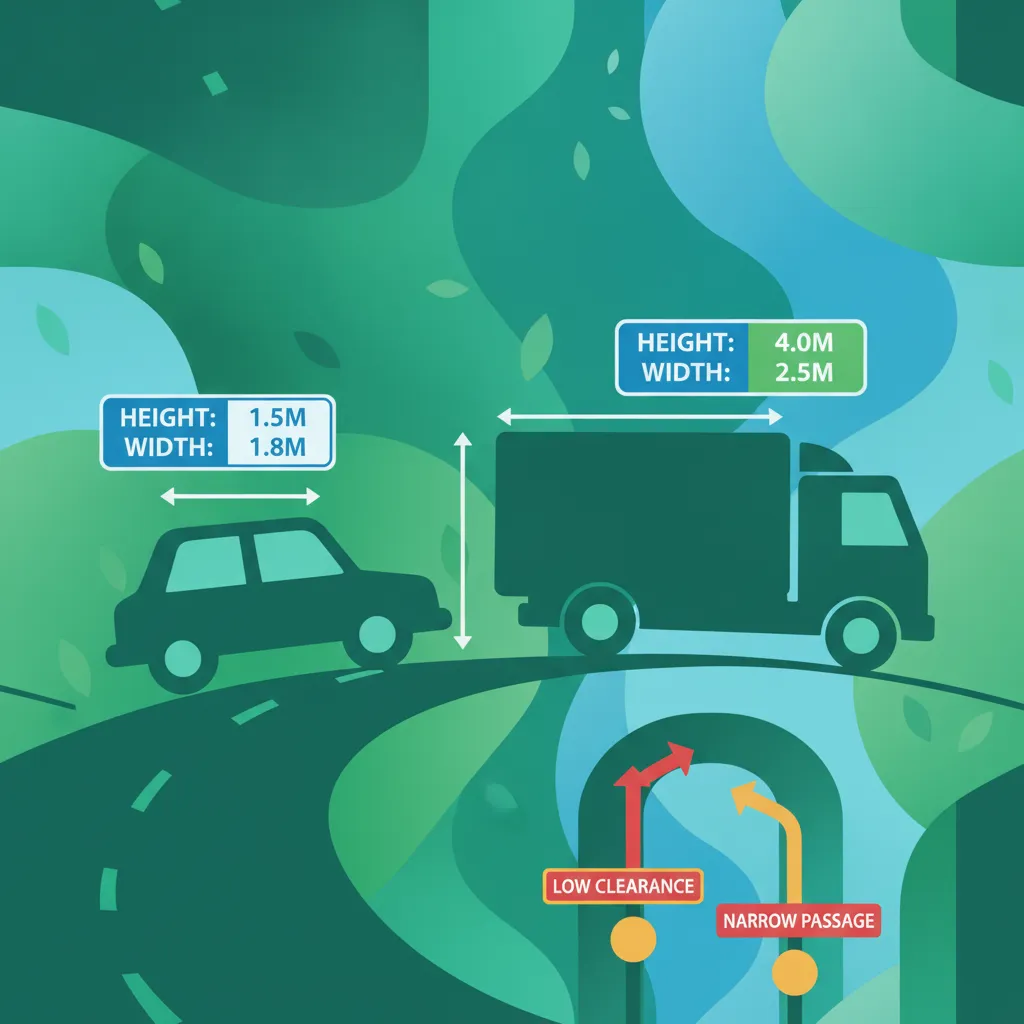
This lesson focuses on the specific dimensional limits that heavy goods vehicles must adhere to on Italian roads, as stipulated by the Codice della Strada. It covers the maximum permissible length, width, and height, explaining how these restrictions impact navigation through tunnels, under bridges, and within urban environments. Learners will also understand the conditions under which special permits for exceptional or oversized transport are required.
This lesson provides essential guidance on how to adjust driving techniques for a range of hazardous weather conditions. It covers reducing speed and increasing following distances in rain to prevent aquaplaning, using lights correctly in fog, and understanding the vehicle's reduced traction on snow and ice. It also explains how to anticipate and counteract the effects of strong crosswinds on high-sided vehicles.
This lesson provides essential rules and techniques for driving on Italian motorways (autostrade) and major extra-urban roads. It explains how to safely merge onto the motorway from an entry ramp, the strict lane discipline required (drive right, overtake left), and how to exit correctly. The content also covers speed regulations, maintaining a safe following distance at high speed, and procedures for using service areas and handling emergencies.

This lesson provides an in-depth focus on sharing the road with the most vulnerable users. It teaches drivers to be acutely aware of pedestrians at crossings, cyclists filtering through traffic, and motorcyclists who may be in blind spots. The lesson emphasizes the importance of leaving extra space, signaling intentions clearly, and exercising extreme caution at junctions, where the majority of serious incidents occur.
This lesson provides a step-by-step guide for managing a vehicle breakdown safely. It reinforces the procedure for stopping on the hard shoulder, activating hazard lights, and placing a warning triangle at the correct distance. The lesson emphasizes the importance of wearing high-visibility clothing, exiting the vehicle from the side away from traffic, and waiting in a safe location before contacting a roadside assistance service.
Find clear answers to common questions learners have about Mountain Road Driving Techniques. Learn how the lesson is structured, which driving theory objectives it supports, and how it fits into the overall learning path of units and curriculum progression in Italy. These explanations help you understand key concepts, lesson flow, and exam focused study goals.
Using the correct low gear helps the engine provide resistance, which prevents your service brakes from overheating. Over-reliance on brakes on long descents leads to brake fade, which is a major safety hazard for heavy vehicles.
You must use a wider entry point to ensure your rear wheels do not cut the corner or mount the curb. Always maintain a slow, steady speed and check your mirrors constantly to monitor the trailer position throughout the turn.
Yes, high altitude results in lower air density, which can reduce engine power. You may need to shift gears earlier than usual when climbing to keep the engine within its optimal performance band.
Passing places are widened sections on narrow roads that allow vehicles to pass each other safely. As a professional driver, you must be prepared to use them to allow oncoming traffic to pass, especially when the road is too narrow for two heavy vehicles.
Start searching now to pinpoint exactly which Italian driving theory topics, road signs, or traffic rules you need to master. Use our advanced filters to build a custom practice session and ensure you're fully prepared for every aspect of your official driving licence exam.