
Welcome to the lesson on Securing Cargo: Tying Down and Restraint Methods. As part of the Load Management and Cargo Securement unit for your Polish Category C license, this lesson is crucial for understanding how to safely secure different types of freight. Mastering these techniques is essential for both passing your theory exam and ensuring road safety.

Lesson content overview
Securing cargo effectively is a fundamental skill for every professional truck driver, particularly for those operating Category C heavy goods vehicles (HGVs) in Poland and across Europe. This lesson provides a detailed guide to the principles, methods, and legal requirements for ensuring your load remains stable and safe throughout its journey. Proper cargo securement is not merely a legal obligation; it is a critical safety measure that prevents accidents, protects cargo from damage, and safeguards all road users.
Unsecured or improperly secured loads can lead to catastrophic consequences, including load shift, vehicle instability, increased braking distances, and even loss of control. These risks are amplified in HGVs due to the sheer weight and momentum involved. By mastering the techniques of tying down and restraining cargo, you will significantly enhance road safety, comply with stringent European and Polish transport regulations, and maintain your vehicle's optimal performance. This knowledge builds upon your understanding of load types, weight limits, and center of gravity, which are crucial for effective cargo management.
Effective cargo securement is a systematic process that integrates mechanical restraints, fundamental physics, and strict legal compliance. Its primary goal is to ensure that freight remains stationary under all anticipated driving conditions, including acceleration, deceleration, sudden braking, and turns.
At the heart of cargo securement are several interconnected principles:
The total tension applied by straps, chains, or ropes to counteract the forces that would cause cargo to move. This force prevents movement under typical driving conditions.
The angle formed between a restraining device (such as a tie-down strap) and the direction of potential cargo movement. Optimising this angle is crucial for maximising the effectiveness of the restraint force.
The use of rigid physical barriers, like wooden blocks or metal wedges, to physically limit cargo movement by creating a fixed impediment.
Placement of high-friction material, typically rubber mats, between the cargo and the vehicle floor to significantly increase resistance to sliding.
The strategic placement of cargo relative to the vehicle's axles to maintain a stable center of gravity and prevent overloading of any single axle. This principle directly influences the type and number of restraints needed.
Adherence to specific European Union and national regulations (e.g., EU Directive 2009/40/EC and Polish transport regulations) that mandate specific restraint methods, inspection protocols, and documentation requirements.
Failure to comply can result in severe penalties, including fines, vehicle immobilisation, and even invalidation of insurance coverage.
One of the most critical aspects of cargo securement is determining the correct number and strength of restraining devices. This is governed by the concept of the restraint ratio.
The restraint ratio defines the minimum required number of restraints based on the cargo's weight and the forces it might experience. While specific ratios can vary slightly based on cargo type and national regulations, a common guideline is a 1:1.5 to 1:2 ratio. This means that for every tonne of cargo, the total restraint capacity provided by the tie-downs should be at least 1.5 to 2 times the cargo's weight.
Always consult the latest EU and Polish regulations for precise restraint ratio requirements for different cargo types. A higher ratio might be required for goods prone to shifting or those transported on challenging routes.
For instance, if you are transporting a 2-tonne (2,000 kg) load, and the required ratio is 1:1.5, the total combined lashing capacity of your tie-downs should be at least 3 tonnes (2 tonnes × 1.5). This might mean using two straps, each rated for at least 1.5 tonnes of lashing capacity, or more if the restraint angles are not optimal.
Polish regulations, specifically Rozporządzenie Ministra Infrastruktury (Regulation of the Minister of Infrastructure) – § 53, often stipulate minimums such as two independent tie-downs for cargo up to 1 tonne, with one additional tie-down for each subsequent tonne or fraction thereof. Always check the current legislation for the exact wording and calculations.
Common misunderstandings include believing that one strap is sufficient for any load, or confusing the cargo's weight with the required total lashing capacity of the restraints. Each restraint device contributes to the overall securement, and their combined effect must exceed the forces the cargo will exert.
Various tools and equipment are available for cargo securement, each suited for different types of loads and situations. Understanding their proper application is key to safe transport.
Tie-down straps are the most common and versatile form of cargo restraint. They are typically made from flexible, high-strength webbing (often polyester) and equipped with tensioning mechanisms.
Practical Application: Tie-down straps are typically draped over the cargo, passed through or around it, and then attached to designated anchor points on the vehicle frame or trailer rails. The ratchet or cam buckle mechanism is then used to apply tension, pulling the cargo down and preventing movement.
Associated Rules and Best Practices:
For extremely heavy, rugged, or irregularly shaped cargo, chains and specialized ropes offer superior strength and durability compared to webbing straps.
Practical Application: Chains are typically anchored to strong points on the cargo and the vehicle, often using specialized grab hooks that securely lock into chain links. Ropes are tied using specific knots designed for load securement, ensuring they do not slip or loosen.
Associated Rules and Best Practices:
Never use chains or ropes that show signs of wear, deformation, kinks, or damaged links/strands. Such equipment can fail catastrophically under load.
Beyond direct tie-downs, other methods play a crucial role in preventing cargo movement, especially for loads that are prone to sliding or rolling.
Blocking and bracing involve using rigid physical barriers to directly prevent cargo from moving. These elements create a fixed obstacle, significantly reducing the reliance on tension alone.
Practical Application: Blocking materials must be securely attached to the vehicle's structure (e.g., bolted to the trailer floor) to prevent them from shifting themselves. They should be positioned to counteract potential movement in all directions (forward, backward, sideways).
Associated Rules and Best Practices:
Friction matting involves placing high-friction sheets, typically made of rubber or non-slip composites, underneath cargo items. This significantly increases the coefficient of friction between the load and the vehicle floor, making it much harder for the cargo to slide.
Practical Application: Friction mats are laid directly on the trailer bed before the cargo is loaded. They are particularly effective for smooth-bottomed cargo, such as steel plates, concrete blocks, or palletised goods with plastic wrapping.
Associated Rules and Best Practices:
The effectiveness of tie-down straps is heavily dependent on the angle at which they are applied. Understanding restraint angles and basic geometry is crucial for optimising your securement strategy.
The ideal restraint angle is 45 degrees or less (≤ 45°) relative to the direction of potential cargo movement. This angle maximises the component of tension that acts directly against the sliding or tipping force of the cargo.
Practical Implications:
By strategically placing straps at optimal angles, drivers can efficiently use their equipment, ensuring the load is restrained against forces from all directions.
Effective cargo securement begins long before straps are tightened. The initial load distribution and its impact on the vehicle's centre of gravity (CoG) are foundational to stability and safe transport.
The theoretical point where the entire weight of the cargo (or vehicle plus cargo) is concentrated. Its position significantly influences a vehicle's stability, handling, and susceptibility to roll-over.
Practical Meaning:
Associated Rules and Best Practices:
Consider the sequence of deliveries. If multiple drops are planned, try to load in reverse order of delivery or ensure that removing cargo during the route does not significantly destabilize the remaining load.
Compliance with legal regulations is non-negotiable for Category C drivers operating in Poland and throughout the European Union. These laws are designed to ensure the highest standards of safety.
This overarching directive sets the minimum standards for roadworthiness and safety checks for vehicles operating within the EU. Annex II specifically addresses cargo securement.
While the EU Directive provides general guidelines, individual member states enact their own detailed regulations. In Poland, Rozporządzenie Ministra Infrastruktury (Regulation of the Minister of Infrastructure) specifies precise requirements for cargo securement.
Proper documentation is as important as physical securement.
All cargo securing equipment is subject to regular inspection to ensure its integrity and functionality.
It is the driver's responsibility to ensure that all cargo is correctly secured before commencing a journey and to periodically check the securement during breaks. Ignorance of the law is not a defence.
Despite clear regulations and best practices, common mistakes persist in cargo securement. Understanding these pitfalls is crucial for avoiding legal penalties and ensuring safety.
Cargo securement is not a one-size-fits-all approach. Drivers must consider various contextual factors that can influence the stability of their load and adjust securement methods accordingly.
While not directly affecting securement mechanics, ensuring cargo does not pose a hazard to vulnerable road users (pedestrians, cyclists) is paramount, especially in urban areas.
By anticipating these variations and adjusting securement practices, Category C drivers can maintain a high standard of safety and compliance under all operational conditions.
Securing cargo is a critical responsibility for every Polish Category C HGV driver, impacting vehicle stability, braking efficiency, and overall road safety. This lesson has covered the essential principles and practical methods required for effective load management.
By integrating this comprehensive knowledge, you will be equipped to secure diverse cargo types safely and legally, confidently navigating Polish and European roads.
This lesson covers the essential techniques for securing cargo on Polish Category C heavy goods vehicles, including tie-down straps, chains, blocking, and friction matting. Key principles include the 1:1.5 to 1:2 restraint ratio requirement, optimal restraint angles of 45 degrees or less, and proper weight distribution to maintain a low centre of gravity. Compliance with EU Directive 2009/40/EC and Polish Rozporządzenie Ministra Infrastruktury § 53 is mandatory, with specific minimum tie-down requirements based on cargo weight. Drivers must adapt securement methods to weather, road conditions, and vehicle state while maintaining proper documentation including load securing certificates for commercial freight over 500 kg.
A short set of high-value points that capture the most important learning from this lesson.
The restraint ratio requires total lashing capacity of 1.5 to 2 times the cargo weight, not equal to it
Optimal restraint angles must be 45 degrees or less relative to the direction of potential movement to maximise effective force
Proper load distribution keeps heavy items low and centrally located to maintain a stable centre of gravity
Blocking and bracing create physical barriers that complement but do not replace tie-down straps
EU Directive 2009/40/EC and Polish regulations mandate specific minimum tie-downs based on cargo weight
Explore all units and lessons included in this driving theory course.
Polish § 53 requires minimum two independent tie-downs for loads up to 1 tonne, plus one additional for each subsequent tonne
Restraint angles exceeding 45 degrees significantly reduce effective horizontal restraint force
All securing equipment must be inspected at least every six months for cuts, fraying, or damage
Friction mats increase surface resistance but must be used alongside, not instead of, proper tie-downs
A valid securement certificate is legally required for commercial freight exceeding 500 kg under the Polish Road Transport Act Article 45
Confusing cargo weight with required lashing capacity—restraints must exceed, not match, the load weight
Installing straps at steep angles (nearly vertical) which maximises downward pressure but provides minimal horizontal restraint
Relying on friction alone to hold blocking materials in place instead of securing them to the vehicle structure
Using worn or damaged straps, chains, or hooks that may fail catastrophically under load
Loading heavy items high in the trailer, raising the centre of gravity and increasing rollover risk
Lesson content overview
A short set of high-value points that capture the most important learning from this lesson.
The restraint ratio requires total lashing capacity of 1.5 to 2 times the cargo weight, not equal to it
Optimal restraint angles must be 45 degrees or less relative to the direction of potential movement to maximise effective force
Proper load distribution keeps heavy items low and centrally located to maintain a stable centre of gravity
Blocking and bracing create physical barriers that complement but do not replace tie-down straps
EU Directive 2009/40/EC and Polish regulations mandate specific minimum tie-downs based on cargo weight
Explore all units and lessons included in this driving theory course.
Polish § 53 requires minimum two independent tie-downs for loads up to 1 tonne, plus one additional for each subsequent tonne
Restraint angles exceeding 45 degrees significantly reduce effective horizontal restraint force
All securing equipment must be inspected at least every six months for cuts, fraying, or damage
Friction mats increase surface resistance but must be used alongside, not instead of, proper tie-downs
A valid securement certificate is legally required for commercial freight exceeding 500 kg under the Polish Road Transport Act Article 45
Confusing cargo weight with required lashing capacity—restraints must exceed, not match, the load weight
Installing straps at steep angles (nearly vertical) which maximises downward pressure but provides minimal horizontal restraint
Relying on friction alone to hold blocking materials in place instead of securing them to the vehicle structure
Using worn or damaged straps, chains, or hooks that may fail catastrophically under load
Loading heavy items high in the trailer, raising the centre of gravity and increasing rollover risk
Explore search topics learners often look for when studying Securing Cargo: Tying Down and Restraint Methods. These topics reflect common questions about road rules, driving situations, safety guidance, and lesson level theory preparation for learners in Poland.
Browse additional driving theory lessons that cover connected traffic rules, road signs, and common driving situations related to this topic. Improve your understanding of how different rules interact across everyday traffic scenarios.
Explore advanced techniques for securing unusual or heavy cargo, including irregular shapes and machinery. Understand specialized restraints and Polish regulations beyond standard tie-downs for Category C drivers. Learn to handle complex load types safely and compliantly on Polish roads.
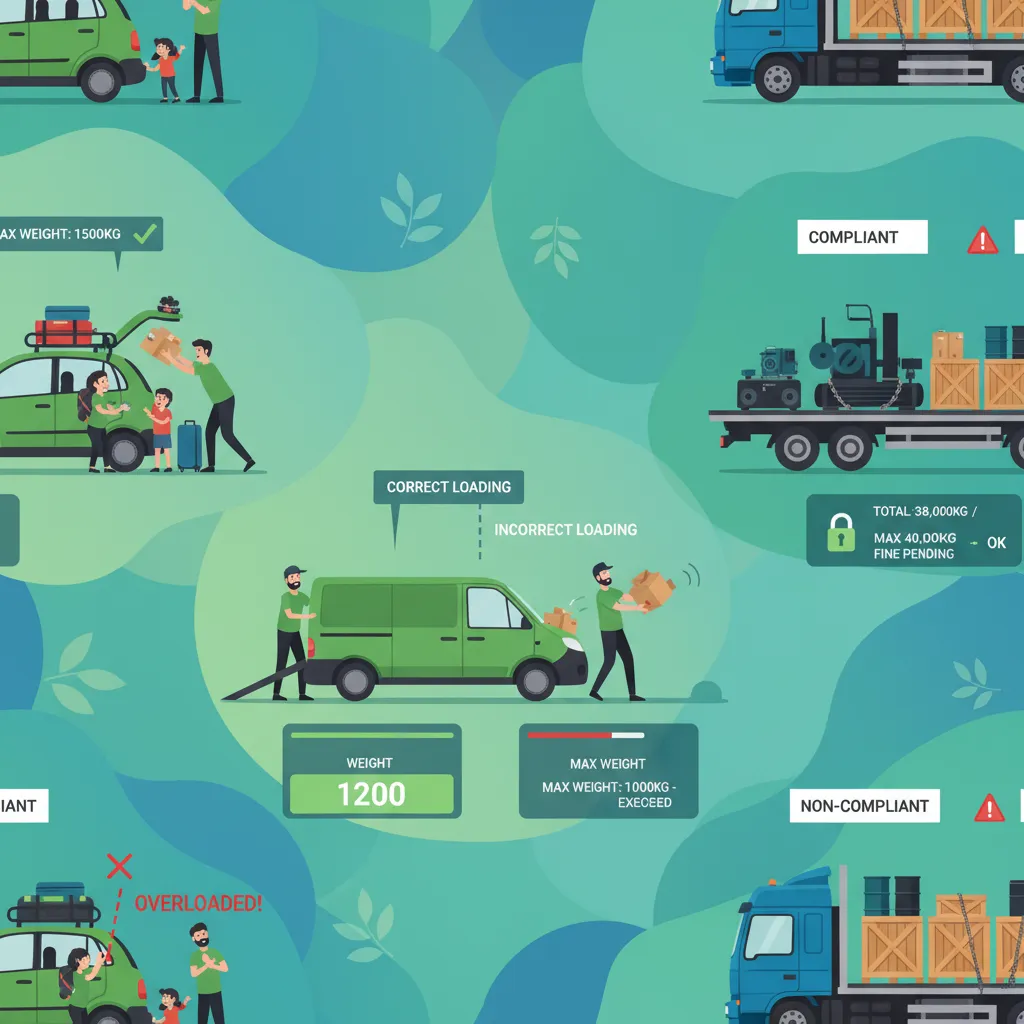
This lesson introduces the legal framework governing vehicle and axle weight limits in Poland and the EU. Learners will understand how to determine a vehicle's maximum permissible payload and interpret official load charts and documentation. The content covers the importance of correct weight distribution to avoid exceeding individual axle limits and explains the serious legal and safety consequences of operating an overloaded vehicle.

This lesson explains the specialized techniques required for initiating movement and bringing a heavy, loaded truck to a halt. It emphasizes fine clutch and throttle control to overcome inertia without causing driveline stress or cargo shift. Learners will also study methods for smooth, gradual braking that account for the vehicle's significant momentum, ensuring safety, passenger comfort, and the integrity of the cargo while minimizing wear on the braking system.

This lesson outlines the essential legal paperwork associated with freight transport. It details the purpose and content of key documents like the load manifest, cargo declaration, and official weight certificates. Learners will understand their legal responsibility to verify that all documentation is accurate and complete before departure, and the importance of maintaining proper records for potential inspections by transport authorities or for cross-border customs procedures.

This lesson concentrates on the specific road signs that are of utmost importance to HGV drivers. It details how to interpret signs indicating maximum permissible weight, axle load, vehicle height, and overall length. Understanding these restrictions is crucial for effective route planning to avoid bridges with low clearance, roads with weight limits, or tunnels that cannot accommodate the vehicle's dimensions, thus preventing accidents and infrastructure damage.

This lesson provides comprehensive guidelines for safely transporting agricultural equipment, focusing on proper load securing techniques and weight distribution calculations. It discusses route planning that accounts for road conditions, bridge weight capacities, and seasonal obstacles like mud or snow. The lesson also emphasizes the use of protective equipment and regular compliance verification for safe operations.

This lesson delves into the physics of load management, teaching learners how to calculate payloads, locate the center of gravity, and distribute weight to preserve stability. The lesson addresses methods for securing cargo using straps and tie-downs, while also covering the effect of load shift on braking. Proper load planning ensures compliance with legal regulations and mitigates risks associated with trailer sway.

This lesson provides essential knowledge for responding to sudden and dangerous vehicle malfunctions. It outlines step-by-step procedures for handling a catastrophic tire blowout, managing a loss of braking power, and reacting to a shift in cargo that destabilizes the vehicle. The focus is on maintaining as much control as possible, bringing the vehicle to a safe stop away from traffic, and activating hazard warnings to protect the scene and other road users.

This lesson explores the dynamic relationship between cargo weight and a vehicle's performance. It explains how increased mass raises kinetic energy, significantly lengthening braking distances and requiring earlier, more gradual brake application. Learners will also analyze how a heavy or poorly distributed load alters the vehicle's handling characteristics, particularly during cornering, and understand the necessity of adjusting speed and driving style to compensate for these effects.

This lesson focuses on the critical procedures for executing an emergency stop with an air-braked vehicle. It explains how to apply firm, steady pressure to the brake pedal to achieve maximum braking force without locking the wheels, which could lead to a loss of control. The content also discusses the response time of air brake systems and how to manage the significant forces of deceleration when the vehicle is fully loaded, ensuring the quickest possible stop in a crisis situation.

This lesson provides a detailed breakdown of vehicle classifications relevant to the Category C licence. It explains the concept of 'dopuszczalna masa całkowita' (permissible total weight) and how it defines a vehicle's category. Learners will identify different truck types, such as rigid vehicles, based on their axle configurations and understand the specific roadworthiness and registration requirements for each class, ensuring correct vehicle operation under the law.
Understand the legal framework for cargo securement in Poland, including EU directives and specific Polish regulations. Learn about common violations, the role of the securement certificate, and the consequences of non-compliance for Category C drivers.
This lesson outlines the essential legal paperwork associated with freight transport. It details the purpose and content of key documents like the load manifest, cargo declaration, and official weight certificates. Learners will understand their legal responsibility to verify that all documentation is accurate and complete before departure, and the importance of maintaining proper records for potential inspections by transport authorities or for cross-border customs procedures.
This lesson introduces the legal framework governing vehicle and axle weight limits in Poland and the EU. Learners will understand how to determine a vehicle's maximum permissible payload and interpret official load charts and documentation. The content covers the importance of correct weight distribution to avoid exceeding individual axle limits and explains the serious legal and safety consequences of operating an overloaded vehicle.
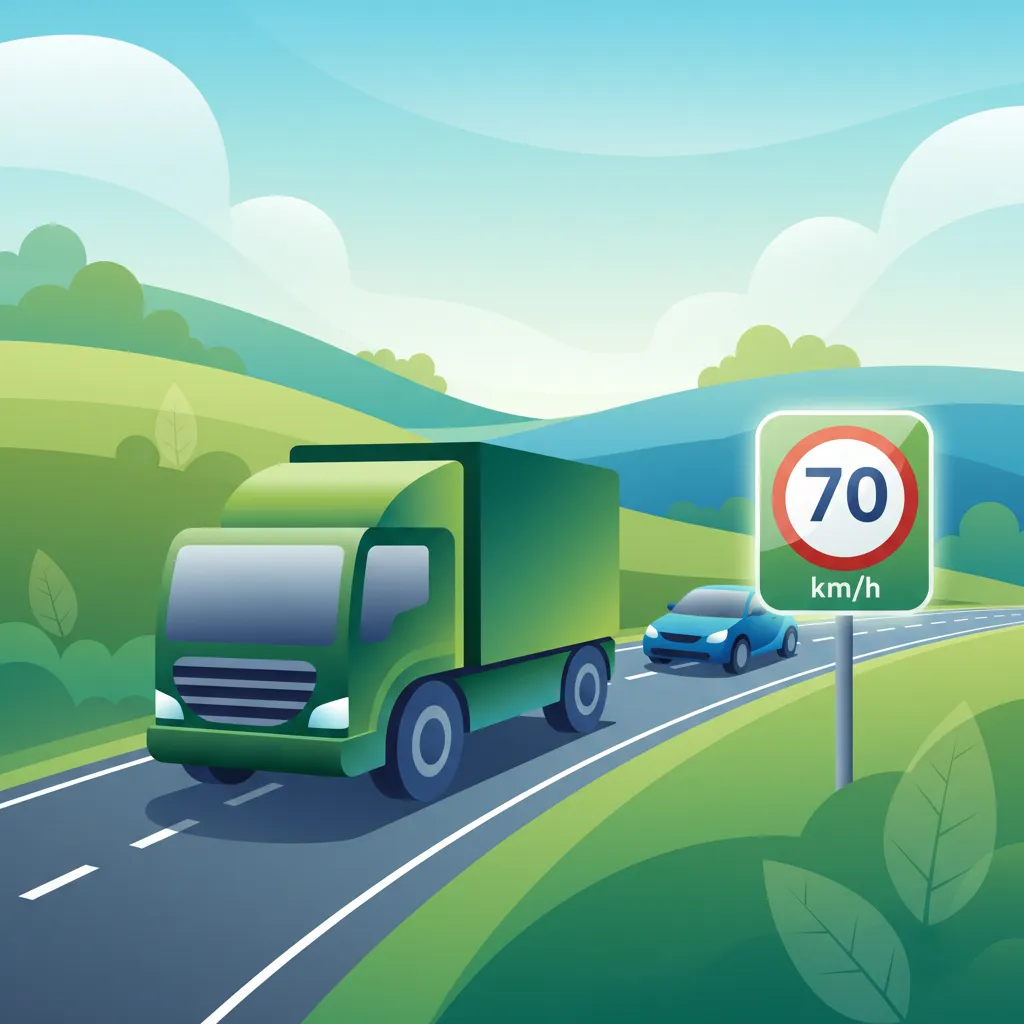
This lesson outlines the statutory speed limits that professional drivers of Category C vehicles must adhere to on Polish roads. It clearly distinguishes the maximum permitted speeds in built-up areas, on single carriageways, and on motorways. The content also explains how to interpret road signs that may indicate temporary or vehicle-specific speed restrictions, ensuring drivers remain compliant with the law and avoid penalties from speed enforcement measures.
This lesson concentrates on the specific road signs that are of utmost importance to HGV drivers. It details how to interpret signs indicating maximum permissible weight, axle load, vehicle height, and overall length. Understanding these restrictions is crucial for effective route planning to avoid bridges with low clearance, roads with weight limits, or tunnels that cannot accommodate the vehicle's dimensions, thus preventing accidents and infrastructure damage.
This lesson provides comprehensive guidelines for safely transporting agricultural equipment, focusing on proper load securing techniques and weight distribution calculations. It discusses route planning that accounts for road conditions, bridge weight capacities, and seasonal obstacles like mud or snow. The lesson also emphasizes the use of protective equipment and regular compliance verification for safe operations.
This lesson provides a detailed breakdown of vehicle classifications relevant to the Category C licence. It explains the concept of 'dopuszczalna masa całkowita' (permissible total weight) and how it defines a vehicle's category. Learners will identify different truck types, such as rigid vehicles, based on their axle configurations and understand the specific roadworthiness and registration requirements for each class, ensuring correct vehicle operation under the law.
Find clear answers to common questions learners have about Securing Cargo: Tying Down and Restraint Methods. Learn how the lesson is structured, which driving theory objectives it supports, and how it fits into the overall learning path of units and curriculum progression in Poland. These explanations help you understand key concepts, lesson flow, and exam focused study goals.
Tying down uses straps or chains to pull the load directly against the vehicle, using tension to hold it in place. Blocking and bracing involves using physical barriers, like wooden chocks or braces, to prevent the load from moving in any direction. Both methods are often used together for maximum security.
Friction mats are highly recommended, especially for loads that are prone to sliding. They significantly increase the friction between the cargo and the vehicle's floor, reducing the need for as much tension from tie-down straps and preventing sideways movement. They are a key component in many securement strategies.
While specific calculations depend on the strap's rating (LC or Lashing Capacity) and the type of load, the principle is to apply enough tension to prevent movement under normal driving conditions, including acceleration, braking, and cornering. The securing method used must prevent the load from shifting in any direction.
Improperly secured cargo can shift during transit, affecting the vehicle's stability, braking distance, and steering response. This can lead to loss of control, accidents, damage to the cargo and vehicle, and severe legal penalties. It poses a significant risk to the driver, other road users, and the public.
Yes, the Polish Category C theory exam includes questions based on European guidelines for cargo securement. Understanding principles like the Direct Tension Indicator (DTI) and proper use of lashing equipment is crucial for passing. This lesson covers the essential aspects required.
Build custom practice sessions tailored precisely to your needs. Focus on areas requiring improvement, review specific Polish road signs, or master complex traffic rules to ensure full preparation for your official driving license exam.