
This lesson delves into how the weight and distribution of your cargo significantly influence your heavy goods vehicle's braking performance and handling characteristics. Understanding these dynamics is crucial for safe driving and is a key topic for the Polish Category C driving theory exam.

Lesson content overview
Operating a heavy goods vehicle (HGV) requires a deep understanding of how its load affects every aspect of driving dynamics. The mass of the cargo, its total weight, and its distribution are critical factors that directly influence a vehicle’s kinetic energy, stopping distances, braking technique, and overall handling performance. For professional drivers preparing for the Polish Category C theory exam, an accurate assessment of load impact is not just a theoretical exercise; it is essential for safe operation, compliance with legal limits, preventing loss of control, and minimizing wear on vital vehicle systems.
This lesson explores the fundamental principles governing the dynamic relationship between cargo and vehicle performance. We will analyze how increased mass elevates kinetic energy, significantly extending braking distances and demanding proactive, gradual brake application. Furthermore, we will delve into how a heavy or poorly distributed load alters the vehicle’s handling characteristics, especially during cornering, lane changes, and emergency maneuvers, and underscore the necessity of adjusting driving style to compensate for these effects.
Kinetic energy is the energy a moving body possesses due to its motion. For any vehicle, this energy is determined by its mass (m) and its velocity (v), represented by the formula: KE = ½ ⋅ m ⋅ v². This equation reveals two crucial relationships: kinetic energy increases linearly with mass and quadratically with speed.
When an HGV carries a load, its total mass significantly increases. Consequently, at any given speed, a loaded truck stores considerably more kinetic energy than an empty one. For example, a truck loaded with 25 tonnes of cargo traveling at 90 km/h will have substantially higher kinetic energy than the same vehicle empty. This elevated energy must be dissipated, primarily through the braking system, to bring the vehicle to a stop. Neglecting this linear relationship between mass and kinetic energy is a common misunderstanding that can lead to misjudgments of necessary stopping distances.
Polish regulations, such as the Rozporządzenie Ministra Infrastruktury, strictly enforce permissible total mass (Gross Vehicle Weight - GVW) limits. Exceeding these limits not only leads to legal penalties but also drastically compromises a vehicle's designed braking distance and overall safety.
Braking distance is defined as the distance a vehicle travels from the moment the driver initiates brake application until the vehicle comes to a complete stop. This is a critical safety parameter that is directly influenced by the vehicle's kinetic energy.
The total stopping distance consists of two main components:
Since a loaded HGV has greater kinetic energy, its brakes must perform more work to dissipate this energy as heat, resulting in a significantly longer braking distance compared to an empty vehicle at the same speed. This effect is compounded by road conditions; braking distances are further elongated on wet, slippery, or uneven surfaces. For instance, an HGV descending a steep gradient while fully loaded must apply brakes much earlier and utilize engine braking to prevent overloading the service brakes and to ensure a safe stop.
The stopping distance achieved on a dry, level road surface under optimal conditions. This distance significantly increases when the vehicle is loaded.
The stopping distance on wet or icy road surfaces, which is considerably longer than dry braking distance due to reduced tyre-road friction, especially critical for heavy loads.
EU Directive 2009/40/EC mandates that braking distance tests for heavy vehicles must be performed under maximum permissible load conditions. This ensures that a vehicle's braking system is certified to perform adequately even in its most challenging operational state. Drivers must never assume that the same brake pedal travel will provide the same deceleration regardless of the load being carried.
Brake force distribution refers to how braking torque is allocated between the front and rear axles of a vehicle. This is typically expressed as a percentage, for example, 70% front and 30% rear. The primary purpose of this distribution is to prevent axle lock-up, reduce brake fade, ensure even wear of braking components, and maintain stable deceleration.
The distribution of a heavy load can significantly alter a vehicle's dynamic weight distribution, which in turn affects the optimal brake force balance. For instance, a rigid truck with a trailer that is heavily loaded at the rear axle may require a more front-biased braking approach to maintain stability during hard stops. Applying equal brake force to all wheels, irrespective of load distribution, is a common error. This can lead to excessive rear braking causing rear-wheel lock-up, especially with rear-heavy loads, leading to loss of control.
Modern HGVs often incorporate sophisticated braking systems, such as Anti-lock Braking Systems (ABS) and Electronic Stability Programs (ESP), which dynamically adjust brake bias based on real-time conditions. However, these systems are designed to assist the driver, not to compensate for fundamental misjudgments of load impact. Progressive brake application, where pressure is gradually increased, is crucial for allowing the vehicle’s systems to adapt and for the driver to feel the vehicle’s response.
In Poland, the "Regulation of Road Transport" specifies that braking systems must be designed to ensure stable deceleration even under the maximum permissible load. Drivers must be aware that effective braking relies on understanding their vehicle's laden characteristics.
The Centre of Gravity (CoG) is the theoretical point where the entire weight of a vehicle and its cargo is concentrated. It is defined by three-dimensional coordinates: longitudinal (front-to-back), lateral (side-to-side), and vertical (up-and-down). The position of the CoG is a fundamental determinant of a vehicle's stability and handling characteristics.
When cargo is added to an HGV, the CoG inevitably shifts. The direction and magnitude of this shift depend entirely on the placement and weight of the cargo:
The Polish Road Traffic Act (Prawo o ruchu drogowym) explicitly requires that load distribution must not exceed specified permissible axle loads and that the CoG must remain within manufacturer-specified limits. Drivers often mistakenly assume that any distribution is acceptable as long as the total weight is under the limit, ignoring the profound torque effects on handling. A simple example is a container stacked three pallets high on a flatbed; this significantly raises the CoG, demanding a reduction in cornering speed by approximately 10% compared to an empty vehicle to maintain a similar safety margin.
Ignoring CoG rise by stacking cargo too high dramatically reduces roll stability and increases the risk of a rollover, especially during sharp turns or emergency evasive actions.
Load transfer is the redistribution of weight within a vehicle caused by inertial forces during acceleration, braking, or cornering. This dynamic shift of weight profoundly impacts tyre grip and vehicle stability.
In a heavily loaded HGV, these load transfers are amplified. For example, when braking with a rear-heavy load, a large proportion of weight rapidly transfers forward, potentially unloading the rear wheels to a degree that reduces their traction, leading to instability or even rear-wheel lock-up. Similarly, during cornering, amplified lateral load transfer can quickly exceed the grip limits of the outside tyres, increasing the risk of skidding or rollover.
Drivers commonly underestimate load transfer, assuming it is negligible for large trucks, and fail to compensate for it by adjusting their speed and inputs. The EU Standard EN 12873 (Brake performance test) includes specific tests under maximum load to assess these load transfer effects, reinforcing their importance. Braking on a downhill curve while fully loaded, for instance, requires careful management to prevent rear-wheel lift and a loss of steering control.
Tyre load-sensitivity describes the phenomenon where a tyre’s maximum friction coefficient (its ability to grip the road) decreases as the vertical load per tyre increases beyond its optimal operating range. In simpler terms, an overloaded tyre has less grip than it should, even if the total vehicle weight is within limits but unevenly distributed on one axle.
Maintaining correct tyre pressure is paramount for HGVs. Tyre pressure must be adjusted according to the specific load carried, not just the vehicle's unladen weight. Under-inflated tyres, especially when heavily loaded, can lead to:
Conversely, over-inflating tyres can reduce the contact patch with the road, also diminishing grip and ride comfort. Polish tyre regulations (Rozporządzenie Ministra Infrastruktury) explicitly require that tyre pressure be adjusted as per the vehicle’s load chart. Drivers must therefore re-check and adjust tyre pressures every time there is a significant change in cargo weight or distribution, and definitely before a long journey with a new load.
A graphical representation showing how a tyre's optimal grip and performance relate to the vertical load it carries and its inflation pressure.
Perhaps the most critical practical application of understanding load impact is appropriate speed management. Given that load increases kinetic energy and braking distances, and alters handling characteristics, a fully loaded truck must invariably travel at a lower speed than an empty one to maintain the same margin of safety.
Speed management encompasses several aspects:
On a 100 km/h highway, the legal speed for a 30-tonne loaded truck in Poland may be limited to 90 km/h. Drivers must always adhere to truck-specific speed limits, which are often lower than general limits, and adjust further for conditions.
Drivers often make the mistake of assuming general speed limit signs apply equally regardless of load, or they ignore the specific speed limits set for heavy vehicles. Polish Regulations on Speed Limits for Trucks explicitly reduce speed limits for heavy vehicles (over 12 tonnes) by 10 km/h on highways and by 20 km/h in urban areas compared to standard limits. Failing to adapt speed is a leading cause of accidents involving heavy vehicles, often resulting from insufficient stopping distance or loss of control in turns.
Several Polish and European Union regulations directly address the safe management of load in heavy goods vehicles, emphasizing the importance of understanding its impact on braking and handling.
These regulations are not mere bureaucratic hurdles; they are safety frameworks designed to prevent accidents, protect infrastructure, and ensure the well-being of all road users.
Ignoring the impact of load can lead to severe consequences, ranging from legal penalties to catastrophic accidents. Understanding common violations and adopting best practices is fundamental for safe HGV operation.
Pre-Trip Load Assessment: Always verify cargo weight, distribution, and securement before starting a journey. Ensure axle loads are within limits.
Tyre Pressure Checks: Regularly check and adjust tyre pressures according to the vehicle's load chart, especially after significant changes in cargo.
Progressive Braking: Apply brakes smoothly and progressively, allowing the vehicle’s dynamic systems to adapt to load transfer. Avoid sudden, harsh braking.
Engine Braking and Retarders: Utilize engine braking and auxiliary braking systems (retarders) on long descents to prevent overheating of service brakes.
Reduced Cornering Speed: Significantly lower entry speeds into curves and corners, especially with high or uneven loads, to maintain roll stability.
Increased Following Distance: Maintain a much greater following distance than for lighter vehicles, especially when heavily loaded, to account for longer braking distances.
Load Documentation: Always carry and be prepared to present up-to-date load documentation at checkpoints.
Common Violations and Their Consequences:
The impact of load on braking and handling is not static; it varies significantly with external conditions and vehicle configuration.
Understanding the direct cause-and-effect relationships is key to mastering safe HGV operation.
The principles discussed in this lesson are underpinned by fundamental physics and validated by extensive accident data.
Applying these concepts in real-world scenarios is vital for developing safe driving habits.
Scenario: Highway Exit with Full Load
Scenario: Urban Intersection Turn with a Partially Loaded Trailer
Scenario: Long Downhill Gradient with Full Load
Scenario: Wet Road with Heavy Load
The impact of load on a heavy goods vehicle's braking and handling characteristics is a multifaceted yet critical area of study for all professional drivers. At its core, increasing the vehicle's mass through cargo directly elevates its kinetic energy, requiring significantly longer braking distances. This elongation is a combination of both an extended perception-reaction distance and a substantially longer kinetic-energy-based braking distance.
Proper brake force distribution must be considered, as front brakes typically bear more load during deceleration, and inappropriate application can lead to instability. Furthermore, the placement of cargo directly influences the vehicle's Centre of Gravity (CoG), and a higher or shifted CoG reduces roll stability and magnifies dynamic load transfer. Load transfer, whether forward during braking or lateral during cornering, places immense stress on tyres and suspension, necessitating smoother, more controlled driver inputs.
Tyre load-sensitivity is another crucial factor, emphasizing the need for correct inflation pressures according to load charts to maintain optimal grip and prevent overheating. Critically, speed must be reduced proportionally to the load and prevailing road conditions to ensure adequate safety margins.
The legal framework in Poland and the EU mandates strict load limits, documented cargo weight, specific tyre pressure standards, and reduced speed limits for heavy vehicles, all designed to counteract the adverse effects of load. Drivers must internalize these principles and translate them into concrete actions: thorough pre-trip load assessments, diligent tyre pressure checks, strategic use of engine braking on grades, progressive brake application, reduced cornering speeds, and significantly increased following distances. Failure to comply can lead to dangerous consequences such as brake fade, loss of steering control, rollovers, legal penalties, and ultimately, an increased risk of accidents.
This lesson explains how cargo weight and distribution fundamentally alter heavy goods vehicle dynamics, primarily by increasing kinetic energy, which extends braking distances and demands proactive brake application. It covers Centre of Gravity shifts that reduce roll stability during cornering, brake force distribution requirements that vary with load transfer, tyre load-sensitivity that requires correct inflation according to load charts, and the critical necessity of speed reduction for loaded vehicles. Polish and EU regulations mandate specific speed limits, axle load restrictions, and brake testing at maximum load to ensure safety, making load-aware driving essential for both exam success and real-world professional operation.
A short set of high-value points that capture the most important learning from this lesson.
Kinetic energy increases linearly with mass and quadratically with speed, meaning loaded trucks require significantly longer braking distances at any given speed.
Load distribution directly shifts the vehicle's Centre of Gravity, which can reduce roll stability and amplify handling problems during cornering.
Brake force distribution must account for dynamic load transfer; harsh braking with a rear-heavy load can cause rear-wheel lock-up and loss of control.
Tyre load-sensitivity means overloaded tyres lose grip even when total vehicle weight is within legal limits.
Speed must be reduced proportionally for loaded vehicles to maintain adequate safety margins and stopping distances.
Explore all units and lessons included in this driving theory course.
A loaded truck stores considerably more kinetic energy than an empty one at the same speed, requiring earlier and more gradual brake application.
Raising the CoG by stacking cargo high reduces roll stability and demands lower cornering speeds to prevent rollover.
Tyre pressure must be adjusted according to the vehicle's load chart; under-inflation with heavy loads causes overheating and blow-out risk.
In Poland, heavy vehicles over 12 tonnes face specific reduced speed limits (e.g., 90 km/h on highways instead of 100 km/h) and axle load restrictions.
Engine braking and retarders must be used on long downgrades to prevent service brake fade and potential runaway scenarios.
Assuming braking distance scales proportionally with load rather than understanding that kinetic energy grows with mass, requiring earlier braking.
Believing any load distribution is acceptable as long as total GVW is under the limit, ignoring how uneven axle loads affect grip and stability.
Entering curves at speeds suitable for an empty truck, leading to excessive lateral load transfer and rollover risk with heavy loads.
Ignoring truck-specific speed limits and assuming general speed limit signs apply equally regardless of load or vehicle category.
Using only service brakes on long downhill grades, causing brake fade and loss of braking capability.
Lesson content overview
A short set of high-value points that capture the most important learning from this lesson.
Kinetic energy increases linearly with mass and quadratically with speed, meaning loaded trucks require significantly longer braking distances at any given speed.
Load distribution directly shifts the vehicle's Centre of Gravity, which can reduce roll stability and amplify handling problems during cornering.
Brake force distribution must account for dynamic load transfer; harsh braking with a rear-heavy load can cause rear-wheel lock-up and loss of control.
Tyre load-sensitivity means overloaded tyres lose grip even when total vehicle weight is within legal limits.
Speed must be reduced proportionally for loaded vehicles to maintain adequate safety margins and stopping distances.
Explore all units and lessons included in this driving theory course.
A loaded truck stores considerably more kinetic energy than an empty one at the same speed, requiring earlier and more gradual brake application.
Raising the CoG by stacking cargo high reduces roll stability and demands lower cornering speeds to prevent rollover.
Tyre pressure must be adjusted according to the vehicle's load chart; under-inflation with heavy loads causes overheating and blow-out risk.
In Poland, heavy vehicles over 12 tonnes face specific reduced speed limits (e.g., 90 km/h on highways instead of 100 km/h) and axle load restrictions.
Engine braking and retarders must be used on long downgrades to prevent service brake fade and potential runaway scenarios.
Assuming braking distance scales proportionally with load rather than understanding that kinetic energy grows with mass, requiring earlier braking.
Believing any load distribution is acceptable as long as total GVW is under the limit, ignoring how uneven axle loads affect grip and stability.
Entering curves at speeds suitable for an empty truck, leading to excessive lateral load transfer and rollover risk with heavy loads.
Ignoring truck-specific speed limits and assuming general speed limit signs apply equally regardless of load or vehicle category.
Using only service brakes on long downhill grades, causing brake fade and loss of braking capability.
Explore search topics learners often look for when studying Impact of Load on Braking and Handling. These topics reflect common questions about road rules, driving situations, safety guidance, and lesson level theory preparation for learners in Poland.
Browse additional driving theory lessons that cover connected traffic rules, road signs, and common driving situations related to this topic. Improve your understanding of how different rules interact across everyday traffic scenarios.
Explore the physics behind how cargo weight and distribution affect braking distances and vehicle stability. Understand kinetic energy, load transfer, and center of gravity shifts for safer heavy vehicle operation in Polish theory.

This lesson focuses on how different passenger loads alter a vehicle's dynamics. It explains the shift in the center of gravity and its effect on suspension, acceleration, and braking. Learners will study techniques to anticipate and compensate for these handling changes, ensuring speed and cornering are adjusted for passenger comfort and safety.

This lesson focuses on the critical procedures for executing an emergency stop with an air-braked vehicle. It explains how to apply firm, steady pressure to the brake pedal to achieve maximum braking force without locking the wheels, which could lead to a loss of control. The content also discusses the response time of air brake systems and how to manage the significant forces of deceleration when the vehicle is fully loaded, ensuring the quickest possible stop in a crisis situation.

This lesson teaches the essential skill of calculating a heavy vehicle's total stopping distance. It breaks the calculation into two key parts: the driver's perception-reaction distance and the vehicle's braking distance. Learners will understand how factors such as vehicle mass, speed, road gradient, and the friction coefficient of the road surface dramatically influence the distance required to come to a complete and safe stop, emphasizing the need for large safety margins.

This lesson explains the specialized techniques required for initiating movement and bringing a heavy, loaded truck to a halt. It emphasizes fine clutch and throttle control to overcome inertia without causing driveline stress or cargo shift. Learners will also study methods for smooth, gradual braking that account for the vehicle's significant momentum, ensuring safety, passenger comfort, and the integrity of the cargo while minimizing wear on the braking system.
Analyze practical scenarios and key Polish regulations governing how cargo weight influences braking and handling. Learn to adapt speed and driving style to manage load dynamics safely and legally.

This lesson explores the environmental impact of HGV operations and the regulations designed to mitigate it. It covers modern emission control systems and standards (e.g., Euro 6), and the importance of compliance with rules governing noise pollution. The content reinforces eco-driving techniques as a primary method for reducing fuel consumption and emissions, promoting the driver's role in achieving more sustainable and environmentally friendly logistics operations.

This lesson provides an overview of the key EU regulations that harmonize the road transport industry across member states. It focuses on the standardized rules for drivers' hours and rest periods, which are designed to combat fatigue and enhance safety. The content also explains the principles of cabotage—the transport of goods within one member state by a haulier from another—and the necessary documentation for smooth and legal cross-border operations.
This lesson outlines the statutory speed limits that professional drivers of Category C vehicles must adhere to on Polish roads. It clearly distinguishes the maximum permitted speeds in built-up areas, on single carriageways, and on motorways. The content also explains how to interpret road signs that may indicate temporary or vehicle-specific speed restrictions, ensuring drivers remain compliant with the law and avoid penalties from speed enforcement measures.

This lesson outlines the essential legal paperwork associated with freight transport. It details the purpose and content of key documents like the load manifest, cargo declaration, and official weight certificates. Learners will understand their legal responsibility to verify that all documentation is accurate and complete before departure, and the importance of maintaining proper records for potential inspections by transport authorities or for cross-border customs procedures.
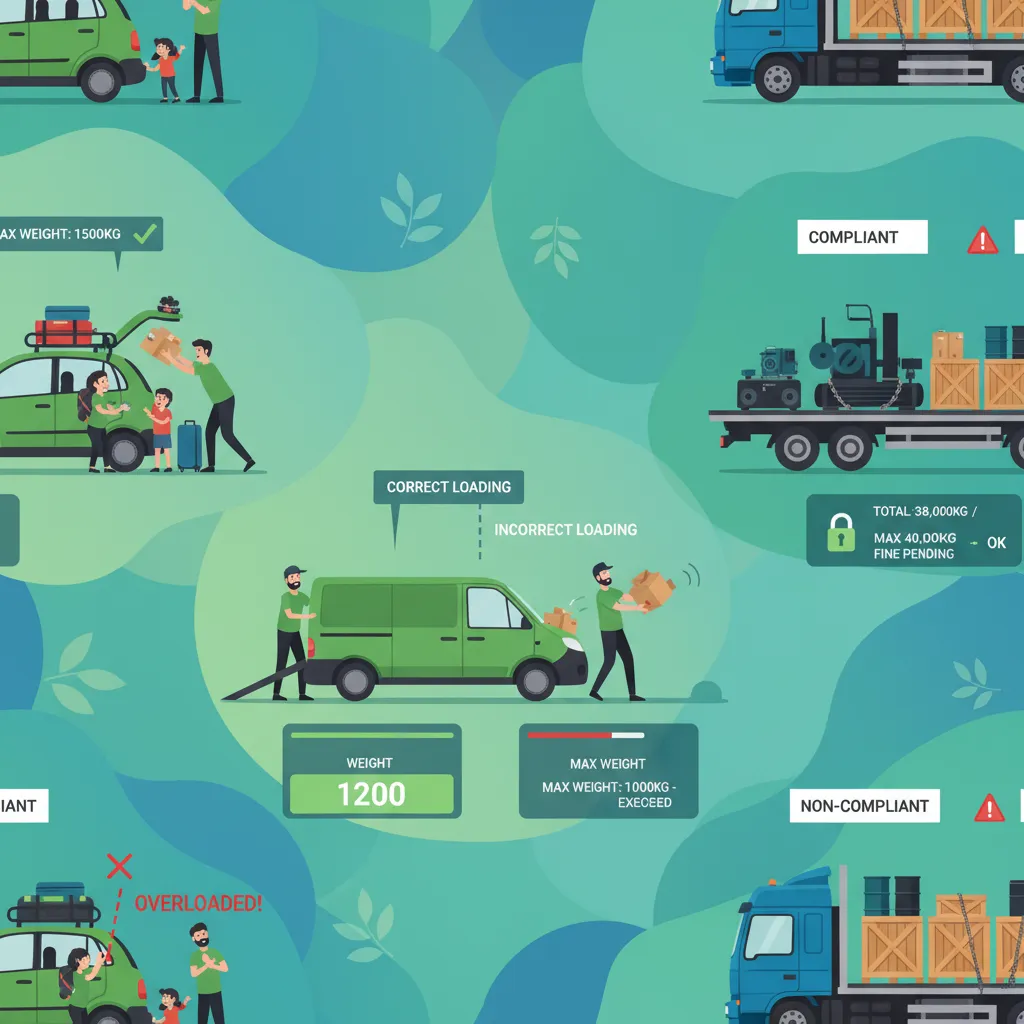
This lesson introduces the legal framework governing vehicle and axle weight limits in Poland and the EU. Learners will understand how to determine a vehicle's maximum permissible payload and interpret official load charts and documentation. The content covers the importance of correct weight distribution to avoid exceeding individual axle limits and explains the serious legal and safety consequences of operating an overloaded vehicle.

This lesson examines the signs that convey dimensional and weight restrictions, which are vital for safe tractor and trailer operation. It outlines how to read width, height, and weight limit signs and the legal implications of exceeding these limits. The lesson provides guidance on planning loads to comply with bridge and road classification restrictions found across Polish rural networks.

This lesson concentrates on the specific road signs that are of utmost importance to HGV drivers. It details how to interpret signs indicating maximum permissible weight, axle load, vehicle height, and overall length. Understanding these restrictions is crucial for effective route planning to avoid bridges with low clearance, roads with weight limits, or tunnels that cannot accommodate the vehicle's dimensions, thus preventing accidents and infrastructure damage.

This lesson addresses the increasingly common restrictions on HGV access to urban areas and designated low-emission zones. It explains how to identify these zones through specific signage and understand the criteria for entry, which may be based on the vehicle's emission standard or subject to time-of-day limitations. Learners will become familiar with the necessity of obtaining special permits for city center deliveries and the legal consequences of violating these access regulations.

This lesson focuses on the stringent health standards mandated for operating heavy goods vehicles. It details the required medical assessments, including vision, cardiovascular, and neurological checks, that prospective drivers must pass. Learners will understand the process of obtaining a medical certificate, the requirements for periodic renewals to ensure ongoing fitness for duty, and the legal implications of failing to meet these essential health criteria for professional driving.

This lesson examines real-world case studies of harvest traffic, where multiple tractors and trailers share limited road space during peak agricultural periods. Learners explore strategies for coordinating speed, maintaining safe distances, and using signaling to communicate intentions. The content also addresses the challenges of field access points and the need for cooperation with other drivers.
Find clear answers to common questions learners have about Impact of Load on Braking and Handling. Learn how the lesson is structured, which driving theory objectives it supports, and how it fits into the overall learning path of units and curriculum progression in Poland. These explanations help you understand key concepts, lesson flow, and exam focused study goals.
While specific percentages vary greatly with speed, load weight, and braking system efficiency, an increased load significantly increases kinetic energy. This means a heavier truck requires considerably more distance to stop. The rule of thumb is to always anticipate longer braking distances and brake much earlier and more smoothly than you would with an empty vehicle.
The most common issue is understeer or oversteer during cornering, depending on the load's position. A high center of gravity can also lead to increased body roll and instability. A poorly distributed load can cause the vehicle to feel 'lazy' or unpredictable when steering inputs are applied, making it harder to maintain a controlled line through turns.
You must reduce your speed significantly before entering the corner. Braking should be done well in advance, and smooth, controlled steering inputs are essential. Avoid sudden acceleration or deceleration while in the turn, as this can upset the load and compromise vehicle stability. Maintain a steady, slower speed throughout the manoeuvre.
Yes, absolutely. The exam frequently includes questions about how load affects braking distance, vehicle stability, and safe maneuvering. Understanding concepts like kinetic energy, center of gravity, and the need for adaptive driving techniques is vital for correctly answering these questions.
The center of gravity (CG) is the average location of the weight of an object. For a truck, a higher CG means the vehicle is more prone to tipping or rolling over, especially during cornering or sudden maneuvers. A load placed high up significantly raises the CG, making the vehicle less stable. Distributing weight lower and evenly is crucial for maintaining a stable CG.
Build custom practice sessions tailored precisely to your needs. Focus on areas requiring improvement, review specific Polish road signs, or master complex traffic rules to ensure full preparation for your official driving license exam.