
Welcome to the Hazard Perception for Agricultural Vehicles lesson. This crucial module, part of Unit 6: Safety, Hazard Perception, and Environmental Conditions, will equip you with the skills to anticipate and react to dangers on rural roads, preparing you for the Category T driving theory exam.
Lesson content overview
Operating agricultural vehicles, such as tractors, trailers, and other farm machinery, on public roads demands a heightened level of awareness and predictive skill. Unlike passenger cars, these vehicles present unique challenges due to their size, weight, slower speeds, and specific operational environments. This lesson, part of your Polish Driving License Theory – Category T curriculum, delves into the critical area of hazard perception, equipping you with the knowledge to identify, assess, and react to potential dangers effectively, ensuring safety for yourself and other road users.
Hazard perception is a core competency for all drivers, but it holds particular significance for those operating agricultural vehicles. It involves the ability to continuously observe the driving environment, identify potential dangers before they escalate, and make timely decisions to avoid accidents. For Category T drivers, this skill directly influences accident avoidance, compliance with Polish traffic law (Prawo o ruchu drogowym), and overall safety.
The dynamics of agricultural vehicles, including larger blind spots, longer braking distances, and reduced maneuverability, amplify the need for early hazard detection. A systematic approach to visual scanning, accurate risk evaluation, and proactive decision-making becomes paramount. This lesson builds upon foundational knowledge from earlier units, such as basic Polish traffic law, vehicle controls and dimensions (Lesson 2), and road signs and markings (Lesson 3), providing the crucial link to applying these concepts in real-world hazard scenarios.
The unique characteristics of agricultural vehicles necessitate a specialized approach to hazard perception. Their substantial momentum, rolling resistance, and varied load distributions significantly impact stopping distances and handling. Early hazard detection mitigates these factors, providing more time to react. Polish law explicitly mandates all road users to exercise due care, and for Category T drivers, this extends to additional obligations arising from the vehicle's specific attributes, such as load limits and speed restrictions. Developing a keen sense of hazard perception is thus not just about safety, but also about legal compliance and responsible operation.
Effective hazard perception is built upon several foundational principles that guide a driver's observation, assessment, and response. These principles are especially critical when operating large and often slow-moving agricultural machinery.
Scanning involves both a horizontal sweep, covering adjacent lanes and the roadside, and a vertical sweep, focusing on the near-field (immediate path) and far-field (upcoming road features like bends or intersections). This anticipatory scanning is crucial, for instance, when approaching a country road intersection to watch for oncoming traffic, turning cyclists, or potential animal crossings before proceeding. This aligns with Polish regulation § 37, which requires drivers to keep the vehicle under full control, implying anticipatory scanning. A common misunderstanding is believing that merely focusing on the vehicle ahead is sufficient; neglecting peripheral hazards, such as a slowly moving combine cutter on a side road, can lead to serious incidents.
For example, a slow-moving tractor entering your lane ahead poses a higher immediate risk than a stationary fence at the roadside. Your assessment determines whether to maintain speed, adjust trajectory, or stop. This principle is directly tied to Article 5 of the Polish Road Traffic Act, which states that drivers must yield to vehicles already on the road. A common misunderstanding is assuming a slow vehicle will always yield; in some cases, a tractor may have the right-of-way due to its larger turning radius or specific road conditions. Recognizing the limited overtaking space when a tractor with a loaded trailer approaches a narrow two-lane road, and reducing speed preemptively, is a practical application of threat assessment.
TTC can be categorized:
For a loaded tractor traveling at 40 km/h, a TTC of 3 seconds with a crossing bicycle demands a significant reduction in speed. This aligns with Polish speed limitation rule § 41, which mandates adjusting speed to road and traffic conditions. Developing instinctive TTC judgment through practice is essential. A common misunderstanding is over-reliance on the speedometer rather than integrating visual TTC cues, especially on undulating farm roads where speeds might fluctuate. For instance, when descending a hill and noticing a cyclist 50 metres ahead, a driver’s TTC calculation might indicate 4 seconds, prompting a gentle brake to increase the real TTC to 6 seconds, ensuring safety.
Speed adaptation involves adhering to legal speed limits, such as the 40 km/h maximum for unladen tractors on public roads (as per Polish law), and operational speed control, which means adjusting speed for road curvature, gradient, weather, and load. For example, reducing speed to 30 km/h when approaching a rural intersection with limited sight distance is a crucial adaptation. Article 53 of the Polish Road Traffic Act obligates drivers to adapt speed to ensure safe stopping within the visual range. A common misunderstanding is assuming the vehicle's maximum speed is always permissible; ignoring mandatory lower limits for tractors on certain road sections can be dangerous and illegal. For instance, a farmer driving a semi-trailer tractor on a country road must adhere to a speed limit of 30 km/h when the trailer is fully loaded.
Key aspects include:
Practical application includes recognizing that a fully loaded combine cutter requires a significantly longer stopping distance than an empty tractor. This principle is reinforced by Article 71 of the Polish Road Traffic Act, which states that "vehicles must not exceed braking distances appropriate to the load." Common misunderstandings include treating loaded and unloaded tractors identically in hazard perception or neglecting increased blind spots due to tall equipment. When descending a steep hill with a loaded trailer, for instance, a driver must anticipate a longer braking lane and begin decelerating much earlier.
Building on the core principles, several key concepts provide the practical framework for hazard perception in real-world driving situations for agricultural vehicles.
Systematic visual scanning is a repeatable, structured observation pattern performed continuously while driving. It ensures that no critical areas of the driving environment are overlooked.
Horizontal Sweep: Regularly scan left-right-left across the entire road width, including shoulders, adjacent lanes, and the roadside verges for unexpected movement (e.g., animals, pedestrians, other farm vehicles emerging from fields).
Vertical Sweep (Near-field vs. Far-field): Focus your vision on the immediate path ahead (near-field) for potholes, debris, or immediate obstacles, then shift your gaze far ahead (far-field) to anticipate upcoming road features like curves, hills, intersections, and distant traffic. This helps in planning maneuvers well in advance.
Mirror Checks: Integrate frequent checks of all mirrors (rearview, side mirrors) to monitor traffic behind and to the sides, especially for smaller vehicles that might be in your blind spots. Remember that agricultural vehicles often have larger and dynamic blind spots depending on their load configuration.
Blind Spot Checks: Before any lane change, turn, or merging maneuver, always perform over-the-shoulder checks to confirm no vulnerable road users (cyclists, pedestrians, motorcyclists) are hidden in your blind spots.
Practical Example: While approaching a country road intersection, a driver meticulously scans the junction for oncoming traffic, turning cyclists, and potential animal crossings, looking not just at the road but also at the verges and field entrances, before committing to the intersection.
Threat assessment involves more than just identifying an object; it's about predicting its potential danger. This requires evaluating the behavior, speed, and trajectory of all detected elements.
Practical Example: A tractor with a loaded trailer approaches a narrow two-lane road with oncoming traffic. The driver recognizes the limited overtaking space and the potential for a head-on collision or forced off-road maneuver. The threat assessment leads to a preemptive reduction in speed, giving oncoming vehicles more space and time to pass safely.
Accurate TTC estimation is a crucial skill for preventing collisions. It moves beyond simply noticing a hazard to understanding when you need to react.
Practical Example: While descending a hill, a driver notices a cyclist approximately 50 meters ahead. Through quick visual cues, they estimate a TTC of around 4 seconds. Knowing that a loaded tractor needs more time to slow down, the driver initiates gentle braking immediately to increase the actual TTC to a safer 6 seconds, allowing ample room and time to pass the cyclist safely.
The correct speed is not just the legal limit; it's the safest speed for the current conditions.
Practical Example: A farmer drives a tractor with a fully loaded semi-trailer on a country road. Despite the legal speed limit allowing 40 km/h for unladen tractors on public roads, the driver restricts their speed to 30 km/h due to the substantial load, ensuring better control and a shorter braking distance if an unexpected hazard appears.
Understanding how your load affects your vehicle is critical for safe operation.
Practical Example: When preparing to descend a steep hill with a heavily loaded trailer, the driver proactively shifts into a lower gear and begins braking much earlier than they would with an empty tractor. They maintain a slower, controlled speed throughout the descent, acknowledging the increased momentum and longer braking distance of the loaded vehicle.
Adherence to specific Polish traffic laws is not just about avoiding fines; it's about systematically managing hazards. Several articles from the Polish Road Traffic Act (Prawo o ruchu drogowym) are particularly relevant to hazard perception for agricultural vehicles.
Article 5: Right-of-Way Rules
Article 41: Speed Limits for Agricultural Vehicles
Article 53: Speed Adjustment to Conditions
Article 71: Braking Distance Compliance
Understanding common mistakes helps in actively avoiding them. For Category T drivers, these often relate to misjudging the unique capabilities and limitations of agricultural vehicles.
Hazard perception is not a static skill; it must be dynamically adapted to changing environmental and operational conditions.
Every action, or inaction, in hazard perception has direct consequences. Understanding these relationships is fundamental to safe driving.
Hazard perception is an indispensable skill for every Category T driver in Poland. It integrates systematic visual scanning, precise Time-to-Collision (TTC) estimation, and dynamic adaptation of speed and braking based on the vehicle’s load and current road conditions. Adherence to legal obligations, as outlined in the Polish Road Traffic Act (Prawo o ruchu drogowym), including specific speed limits, yielding rules, and signaling requirements, is fundamental.
Critically, understanding load-related vehicle dynamics—such as increased braking distance, expanded blind spots, and heightened rollover risk—must be integrated into every driving decision. Environmental factors, including weather, lighting, and road surface, necessitate continuous conditional adjustments to scanning frequency and speed. Furthermore, heightened awareness and early signaling are vital when interacting with vulnerable road users.
The core principles—systematic scanning, threat assessment, TTC estimation, speed adaptation, and load-related perception—form a robust decision-making framework. Underlying safety reasoning connects the physics of motion (momentum, braking distance) with human factors (reaction time, perception bias), providing a comprehensive rationale for every rule and practice. Mastering these aspects will not only prepare you for the hazard perception tests but, more importantly, ensure your safety and the safety of others on the road.
This lesson covers hazard perception skills essential for Category T drivers operating agricultural vehicles on Polish roads. Key skills include systematic visual scanning techniques that account for larger blind spots, Time-to-Collision (TTC) estimation to determine when to act, and threat assessment to prioritize dangers. The content emphasizes that agricultural vehicles require adjusted driving behavior based on load, as loaded tractors have longer braking distances, higher centres of gravity, and expanded blind spots. Polish traffic law (Prawo o ruchu drogowym) provides the legal framework, mandating speed limits, signaling requirements, and the obligation to stop within visible distance. Mastering these principles prepares learners for both the Category T theory exam hazard perception component and real-world rural driving safety.
A short set of high-value points that capture the most important learning from this lesson.
Agricultural vehicles require systematic visual scanning (horizontal and vertical sweeps) to compensate for larger blind spots compared to passenger cars.
Time-to-Collision (TTC) estimation is critical for Category T drivers because slower acceleration and longer braking distances demand earlier decision-making.
Load significantly alters vehicle dynamics, increasing braking distance, raising the centre of gravity, and expanding blind spots—all requiring adjusted driving behavior.
Polish law mandates that drivers must be able to stop within their visible range, accounting for load and road conditions (Article 53).
Early signaling (at least 5 seconds or 30 metres before maneuvers) is essential given the size and slower movement of agricultural vehicles.
Explore all units and lessons included in this driving theory course.
Maximum speed for agricultural vehicles on public roads is generally 40 km/h unless otherwise sign-posted, and loaded vehicles often require lower speeds.
TTC categories: Immediate (<2 seconds) needs urgent action, Intermediate (2-5 seconds) allows moderate adjustment, Long-range (>5 seconds) enables planning.
When descending with a loaded trailer, shift to a lower gear early and begin braking much sooner than with an empty vehicle.
Static threats (roadworks, parked equipment) require less immediate attention than dynamic threats (moving vehicles, pedestrians, animals).
Hazard warning lights must be activated when moving slowly on public roads or when stationary and obstructing traffic.
Underscanning at intersections by focusing only on oncoming traffic and neglecting side roads and field entrances where other farm equipment may emerge.
Maintaining flat-road speed on slopes, especially with heavy loads, which dramatically reduces control and increases stopping distance.
Signaling turns or lane changes only a few metres before the maneuver, giving insufficient reaction time to other road users.
Treating loaded and unloaded tractors identically in hazard perception, neglecting the significantly longer braking distances of loaded vehicles.
Failing to perform thorough over-the-shoulder checks before turns or lane changes, underestimating the enlarged blind spots created by high-mounted or wide trailers.
Lesson content overview
A short set of high-value points that capture the most important learning from this lesson.
Agricultural vehicles require systematic visual scanning (horizontal and vertical sweeps) to compensate for larger blind spots compared to passenger cars.
Time-to-Collision (TTC) estimation is critical for Category T drivers because slower acceleration and longer braking distances demand earlier decision-making.
Load significantly alters vehicle dynamics, increasing braking distance, raising the centre of gravity, and expanding blind spots—all requiring adjusted driving behavior.
Polish law mandates that drivers must be able to stop within their visible range, accounting for load and road conditions (Article 53).
Early signaling (at least 5 seconds or 30 metres before maneuvers) is essential given the size and slower movement of agricultural vehicles.
Explore all units and lessons included in this driving theory course.
Maximum speed for agricultural vehicles on public roads is generally 40 km/h unless otherwise sign-posted, and loaded vehicles often require lower speeds.
TTC categories: Immediate (<2 seconds) needs urgent action, Intermediate (2-5 seconds) allows moderate adjustment, Long-range (>5 seconds) enables planning.
When descending with a loaded trailer, shift to a lower gear early and begin braking much sooner than with an empty vehicle.
Static threats (roadworks, parked equipment) require less immediate attention than dynamic threats (moving vehicles, pedestrians, animals).
Hazard warning lights must be activated when moving slowly on public roads or when stationary and obstructing traffic.
Underscanning at intersections by focusing only on oncoming traffic and neglecting side roads and field entrances where other farm equipment may emerge.
Maintaining flat-road speed on slopes, especially with heavy loads, which dramatically reduces control and increases stopping distance.
Signaling turns or lane changes only a few metres before the maneuver, giving insufficient reaction time to other road users.
Treating loaded and unloaded tractors identically in hazard perception, neglecting the significantly longer braking distances of loaded vehicles.
Failing to perform thorough over-the-shoulder checks before turns or lane changes, underestimating the enlarged blind spots created by high-mounted or wide trailers.
Explore search topics learners often look for when studying Hazard Perception Tests for Agricultural Vehicles. These topics reflect common questions about road rules, driving situations, safety guidance, and lesson level theory preparation for learners in Poland.
Browse additional driving theory lessons that cover connected traffic rules, road signs, and common driving situations related to this topic. Improve your understanding of how different rules interact across everyday traffic scenarios.
Explore realistic rural road scenarios and their specific hazards for agricultural vehicles. Learn to anticipate dangers like livestock, narrow lanes, and unexpected farm equipment movements, enhancing your hazard perception skills for Polish Category T theory.
This lesson introduces defensive driving principles for rural settings, teaching learners how to continually scan the environment and anticipate potential hazards. It discusses the unique challenges posed by slow-moving agricultural traffic, field entrances, and unpredictable farm equipment maneuvers. The lesson emphasizes proactive decision-making and early brake application to avoid collisions in mixed traffic.
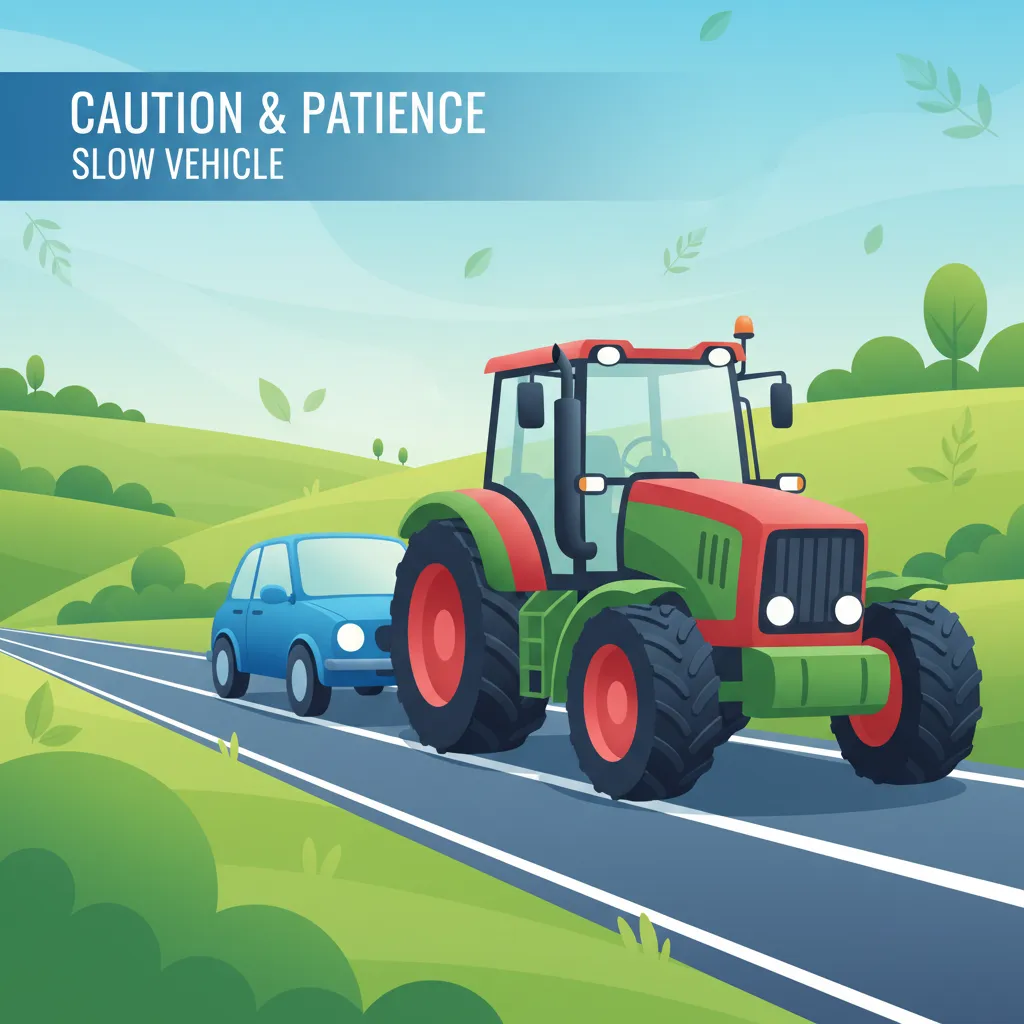
This lesson addresses encounters with slow-moving vehicles, such as tractors, which are common on rural roads. It teaches drivers to be patient, maintain a safe following distance, and only overtake when it is absolutely safe and legal to do so. Recognizing the large size and limited maneuverability of such vehicles is crucial for avoiding accidents.

This lesson examines how a tractor driver should interact with a variety of road users, focusing on right-of-way rules at intersections and with cars, trucks, cyclists, and pedestrians. It discusses safe overtaking practices, appropriate signaling to communicate intentions, and the importance of checking blind spots. The lesson highlights the need for heightened caution near schools, villages, and areas with high pedestrian activity.
This lesson examines real-world case studies of harvest traffic, where multiple tractors and trailers share limited road space during peak agricultural periods. Learners explore strategies for coordinating speed, maintaining safe distances, and using signaling to communicate intentions. The content also addresses the challenges of field access points and the need for cooperation with other drivers.
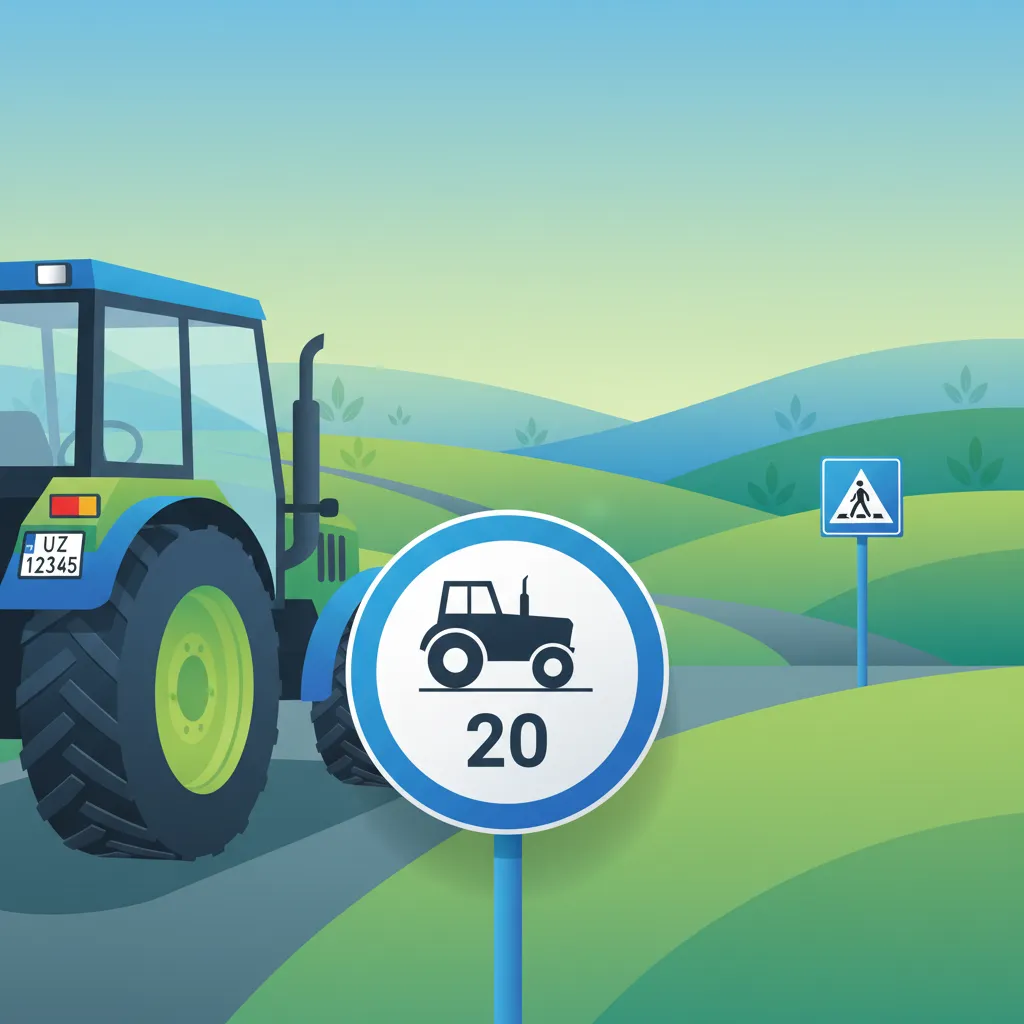
This lesson reviews the core set of regulatory and warning signs that all road users must obey, emphasizing those that affect agricultural tractors such as speed limits, stop, and give-way signs. It clarifies the colour and shape conventions used in Polish signage, enabling drivers to quickly recognize and react to sign information. The lesson also addresses the placement of signs in rural environments where visibility may be compromised.

This lesson explores the correct lane and road positioning for tractors, emphasizing the use of the right-hand lane or shoulder where appropriate. It clarifies how speed limits differ between road types and provides guidelines for adjusting speed based on vehicle load, road condition, and traffic density. Proper positioning improves safety for both the tractor driver and other road users sharing the same space.

In this lesson, learners explore riding on rural and countryside roads, where road markings may be sparse and surface conditions varied. The content covers safe overtaking in single-lane sections, interaction with agricultural vehicles and animals, and the handling of gravel or uneven surfaces. Learners will also study the importance of anticipating curves and adjusting speed to light conditions, equipping them with the skills needed for safe countryside travel.

This lesson explores the unique characteristics of driving on rural roads. It highlights potential hazards such as sharp, unbanked curves, poor road surfaces, and limited visibility due to hills and vegetation. The content teaches drivers to anticipate these conditions and adjust their speed and position to navigate safely.

This lesson focuses on the specific hazards introduced by seasonal weather, such as mud, snow, ice, fog, and heavy rain. It explains how these conditions affect traction, braking, and driver visibility, and provides guidance on adjusting speed and using appropriate tires. The lesson also covers the proper use of lights and reflectors to improve visibility in low-light conditions.

This lesson outlines the emergency procedures a tractor driver must follow in case of a breakdown, trailer detachment, or accident. It covers immediate actions such as pulling over safely, deploying warning triangles, and using hazard lights to alert other road users. The lesson details the steps for reporting the incident, providing first aid, and securing the scene to prevent further hazards.
Identify and understand common hazard perception errors made by agricultural vehicle drivers in Poland. Learn from these mistakes to improve risk assessment, defensive driving, and timely decision-making on rural roads for Category T theory.
This lesson introduces defensive driving principles for rural settings, teaching learners how to continually scan the environment and anticipate potential hazards. It discusses the unique challenges posed by slow-moving agricultural traffic, field entrances, and unpredictable farm equipment maneuvers. The lesson emphasizes proactive decision-making and early brake application to avoid collisions in mixed traffic.
This lesson focuses on the specific hazards introduced by seasonal weather, such as mud, snow, ice, fog, and heavy rain. It explains how these conditions affect traction, braking, and driver visibility, and provides guidance on adjusting speed and using appropriate tires. The lesson also covers the proper use of lights and reflectors to improve visibility in low-light conditions.
This lesson addresses encounters with slow-moving vehicles, such as tractors, which are common on rural roads. It teaches drivers to be patient, maintain a safe following distance, and only overtake when it is absolutely safe and legal to do so. Recognizing the large size and limited maneuverability of such vehicles is crucial for avoiding accidents.
This lesson explores the unique characteristics of driving on rural roads. It highlights potential hazards such as sharp, unbanked curves, poor road surfaces, and limited visibility due to hills and vegetation. The content teaches drivers to anticipate these conditions and adjust their speed and position to navigate safely.
This lesson examines how a tractor driver should interact with a variety of road users, focusing on right-of-way rules at intersections and with cars, trucks, cyclists, and pedestrians. It discusses safe overtaking practices, appropriate signaling to communicate intentions, and the importance of checking blind spots. The lesson highlights the need for heightened caution near schools, villages, and areas with high pedestrian activity.

This lesson introduces defensive driving strategies tailored for bus operation, emphasizing hazard perception and risk management. Learners will study techniques for continuous situational awareness and maintaining safe following distances for adequate reaction time. The content covers emergency maneuvers and interaction with vulnerable road users to reduce accident likelihood.
This lesson examines real-world case studies of harvest traffic, where multiple tractors and trailers share limited road space during peak agricultural periods. Learners explore strategies for coordinating speed, maintaining safe distances, and using signaling to communicate intentions. The content also addresses the challenges of field access points and the need for cooperation with other drivers.
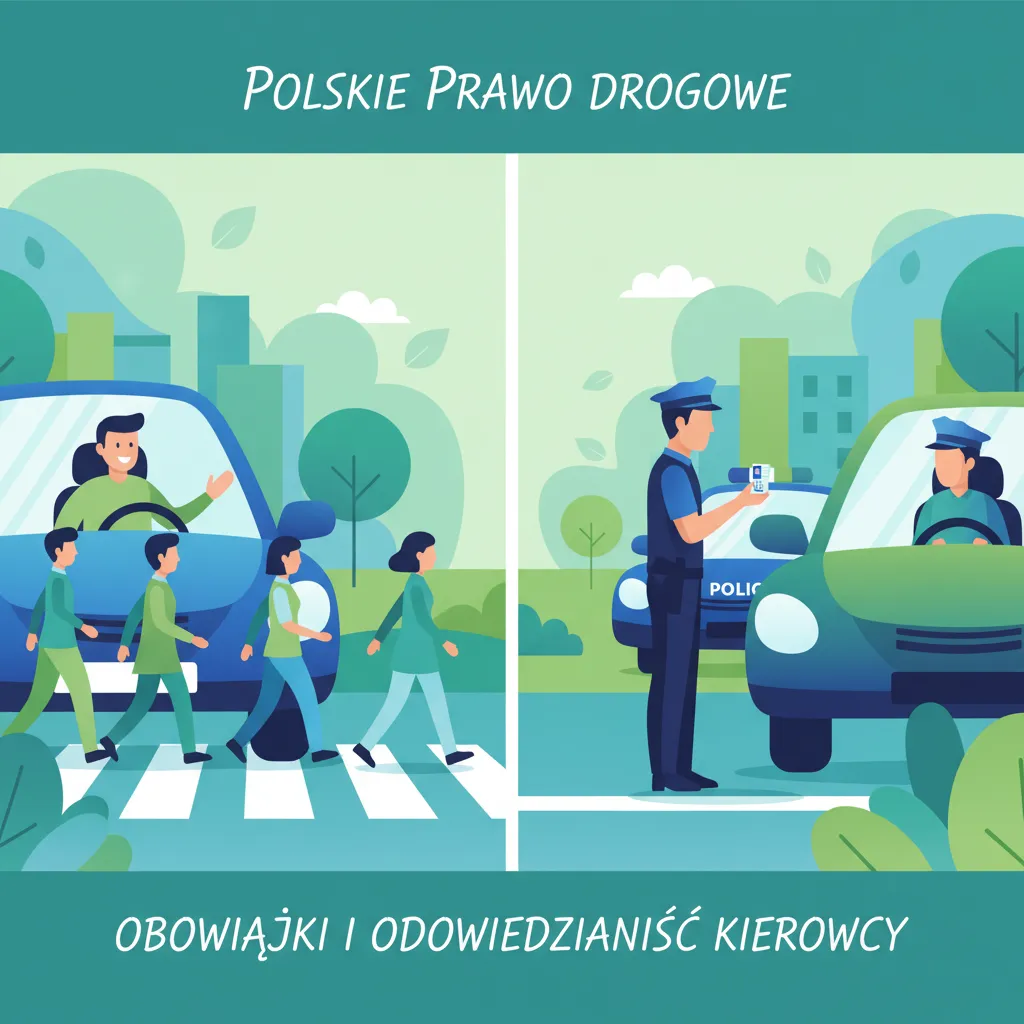
This lesson outlines the legal responsibilities of tractor drivers as stipulated by Polish traffic law, emphasizing the duty to comply with all rules of the road. It discusses the liability framework for accidents involving agricultural vehicles, including the need for appropriate insurance and potential penalties. The lesson also explains the importance of maintaining accurate documentation, such as registration papers and a driver’s licence.
This lesson explores the correct lane and road positioning for tractors, emphasizing the use of the right-hand lane or shoulder where appropriate. It clarifies how speed limits differ between road types and provides guidelines for adjusting speed based on vehicle load, road condition, and traffic density. Proper positioning improves safety for both the tractor driver and other road users sharing the same space.
This lesson reviews the core set of regulatory and warning signs that all road users must obey, emphasizing those that affect agricultural tractors such as speed limits, stop, and give-way signs. It clarifies the colour and shape conventions used in Polish signage, enabling drivers to quickly recognize and react to sign information. The lesson also addresses the placement of signs in rural environments where visibility may be compromised.
Find clear answers to common questions learners have about Hazard Perception Tests for Agricultural Vehicles. Learn how the lesson is structured, which driving theory objectives it supports, and how it fits into the overall learning path of units and curriculum progression in Poland. These explanations help you understand key concepts, lesson flow, and exam focused study goals.
Unique hazards include wide/slow-moving machinery, potential for trailer sway, mud or debris on roads from field access, reduced visibility in dust clouds during harvest, and interactions with other vehicles on narrow rural roads. Understanding these specifics is key for the Polish Category T theory exam.
Tractors have larger blind spots, are slower, and often pull trailers, affecting braking distances and maneuverability. The Polish theory exam for Category T emphasizes these differences, requiring you to anticipate how your vehicle's characteristics impact potential hazards on rural roads.
Focus on scanning for developing situations like approaching vehicles, pedestrians on verges, animals, road surface changes (mud, gravel), and junctions where other vehicles might not expect you. Timely responses to these visual cues are crucial for passing.
Use the practice simulations within this app, paying close attention to the visual cues presented. Analyze why certain situations are deemed hazardous and how a driver should react. Regularly review Polish road rules related to slow-moving vehicles.
Build custom practice sessions tailored precisely to your needs. Focus on areas requiring improvement, review specific Polish road signs, or master complex traffic rules to ensure full preparation for your official driving license exam.