
This lesson introduces crucial defensive driving principles specifically for rural settings in Poland, vital for Category T licence holders. You will learn to continually scan the environment and anticipate potential hazards unique to operating agricultural vehicles. Understanding these strategies is key to passing your Polish theory exam and ensuring safety on mixed rural roads.
Lesson content overview
Rural roads present unique challenges for all drivers, especially for those operating agricultural vehicles under the Polish Driving License Theory – Category T. Unlike urban environments with predictable traffic flows and clear infrastructure, the countryside demands a proactive and highly adaptive approach to driving. This lesson introduces the fundamental principles of defensive driving specifically tailored for rural settings, equipping you with the knowledge to anticipate hazards, make informed decisions, and ensure safety for yourself and other road users.
Driving tractors, combines, and other farm machinery on public roads requires a deep understanding of defensive techniques. Accidents in rural areas often occur due to limited visibility, the unexpected movements of farm equipment, and inadequate speed control, particularly when managing heavy loads. By mastering defensive driving, you can significantly reduce the risk of collisions and enhance road safety for everyone sharing the Polish countryside roads.
Operating agricultural vehicles in rural environments differs significantly from driving standard cars. Rural roads often feature longer stretches between junctions, fewer traffic signals, and a diverse mix of road users, including other slow-moving farm machinery, pedestrians, and cyclists. Recognizing these unique characteristics is the first step towards effective defensive driving.
A key difference is the presence of non-standard maneuvers. Agricultural vehicles frequently turn into unpaved field entrances, reverse into farmyards, or operate at significantly slower speeds than other traffic. These actions can be unpredictable to drivers unfamiliar with agricultural operations. Your role as a Category T operator is to constantly anticipate these possibilities and adjust your driving accordingly.
Defensive driving is a proactive mindset where you anticipate potential hazards, maintain a safe operating margin, and make early, deliberate decisions to avoid unsafe situations. It's about taking responsibility for your safety and the safety of others, rather than merely reacting to events as they unfold. In a rural context, this means being acutely aware of farm-specific risks and adapting your driving to the capabilities and limitations of your agricultural vehicle.
The underlying logic of defensive driving for Category T vehicles integrates several factors. From a physics perspective, heavier agricultural vehicles require significantly increased stopping distances, especially at the higher speeds sometimes reached on open rural roads. Human factors also play a crucial role; other drivers may not expect sudden movements from farm equipment, demanding that Category T operators allow more reaction time. Legally, the Polish traffic code, known as Prawo o ruchu drogowym, mandates that all drivers, including Category T operators, take reasonable measures to anticipate and avoid collisions.
Mastering defensive driving for agricultural vehicles involves adopting several core principles that guide your decisions and actions on rural roads. These principles are interconnected, working together to create a comprehensive safety strategy.
| Principle | Definition | Purpose / Rationale | Implications |
|---|---|---|---|
| Continuous Scanning | Systematic visual sweep of the road ahead, sides, and rear, at least every 5‑7 seconds. | Detect hazards early before they become imminent. | Promotes early brake application, lane adjustment, and speed modulation. |
| Safe Following Distance | Maintaining a gap that allows full stop without collision, calculated as 2‑3 seconds at typical rural speeds for tractors, longer for loaded combos. | Ensures enough reaction time for unexpected farm equipment maneuvers. | Dictates speed selection and braking anticipation. |
| Early Decision‑Making | Making braking, steering, or speed adjustments well before the hazard becomes immediate. | Reduces abrupt maneuvers that can destabilize heavy agricultural vehicles. | Encourages smooth deceleration, controlled lane changes, and use of “soft” braking. |
| Anticipatory Speed Control | Adjusting speed proactively based on known hazards (e.g., approaching field entrances, visible farm work). | Balances travel efficiency with safety margins. | Influences gear selection, engine braking, and engine load management. |
| Hazard Perception Zones | Recognizing zones of risk: approach (far), observation (mid‑range), response (close). | Provides structured time for scanning and reaction. | Guides when to start braking and how sharply to steer. |
| Positional Awareness | Using lane positioning to maximize sight lines and avoid blind spots of large farm equipment. | Reduces collision risk with slower aggregates and turning tractors. | Calls for staying on the left side of the lane, allowing overtaking only when safe. |
| Communication of Intent | Using audible (horn) and visual (headlights, turn signals) cues to convey actions to other road users. | Clarifies intentions to slow‑moving or reversing farm machinery. | Requires proper use of signals before lane changes or turns. |
| Load‑Sensitive Handling | Adjusting driving style according to vehicle weight, center of gravity, and load distribution. | Heavier loads increase stopping distance and reduce steering response. | Mandates earlier braking, gentler steering input, and careful cornering. |
Always remember that your agricultural vehicle's size and weight make it behave differently than a passenger car. Give yourself extra time and space for every maneuver.
To effectively implement the core principles, you need to understand and practice specific techniques. These techniques form the practical foundation of defensive driving for Category T license holders.
Continuous scanning is the repeated, purposeful observation of the entire traffic environment. This means constantly checking ahead, to the sides, and using your mirrors to monitor what's behind you. For Category T drivers, this systematic visual sweep should occur at least every 5-7 seconds. Its purpose is to detect hazards early, giving you maximum time to react.
To aid scanning, think of the road ahead in terms of Hazard Perception Zones:
For example, while driving a tractor on a country road, you notice a farmer preparing to exit a field entrance 200 metres ahead (Approach Zone). You begin to assess their likely actions (Observation Zone) and prepare to reduce speed and brake gently as you enter the Response Zone, even before the farmer moves. A common misunderstanding is to only begin braking when a hazard is already in the Response Zone, which often leads to insufficient stopping distance for heavy vehicles.
Safe following distance is the minimum gap you should maintain behind the vehicle ahead. This distance is crucial for allowing enough time to stop without collision, especially given the longer braking distances of agricultural vehicles. It's best measured as a time gap rather than a fixed distance.
To calculate your following distance, choose a fixed point on the road (e.g., a signpost). When the vehicle ahead passes that point, start counting "one thousand one, one thousand two, one thousand three..." If you reach the point before finishing your count for the required seconds, you are too close. Polish law (Art. 32 of Prawo o ruchu drogowym) explicitly requires drivers to maintain a safe distance that allows for stopping without collision, emphasizing its legal importance.
Never assume a wider lane automatically grants safety. Even with ample road width, maintaining a safe time-based gap is essential due to the extended stopping distances of heavy vehicles.
Early decision-making means initiating braking, steering, or speed adjustments well before a hazard becomes immediate. This is vital for heavy agricultural vehicles, as abrupt maneuvers can destabilize them.
Anticipatory speed control involves adjusting your vehicle speed based on predicted road conditions and likely hazards before they fully materialize.
For instance, when approaching a series of tight bends on a winding country road, reduce your speed well in advance, even if you can't see around the corner. This allows you to maintain control and avoid sudden braking. Polish traffic regulations set maximum speed limits for Category T vehicles (e.g., 40 km/h on public roads unless signs permit up to 50 km/h), but defensive driving often requires you to drive well below these limits to ensure safety.
Positional awareness is the conscious selection of your lane position to maximize sight lines and minimize blind-spot exposure, both for your vehicle and for other road users. This is particularly important when operating large farm machinery.
When overtaking a slow-moving combine harvester, position your tractor near the left edge of your lane to maintain a clear sight of the combine's rear and potential hazards ahead. Avoid the common misunderstanding of staying in the exact center of the lane; for large farm machinery, slight positioning adjustments can significantly improve safety and visibility for all.
Communication of intent involves using your vehicle's signals and cues to clearly convey your planned actions to other road users. This is crucial for preventing misunderstandings and collisions, especially with slow-moving or unexpectedly maneuvering farm equipment.
For example, before turning left onto a narrow farm road, activate your left turn signal for at least 5 seconds. This gives oncoming traffic and following vehicles ample warning of your intention. Never assume other drivers can guess your next move, especially when operating large or slow machinery.
Load-sensitive handling is the practice of adjusting your driving inputs based on your vehicle's load weight, its center of gravity, and how the load is distributed. Heavy loads significantly alter a tractor's dynamics.
When descending a hill with a fully laden trailer, rely heavily on engine braking in a lower gear and avoid sudden acceleration. Polish law (Art. 71-2) stipulates load limits for Category T vehicles, and if these are exceeded (which should be avoided), you must reduce your speed by 10 km/h below the standard limit. Never treat a loaded agricultural vehicle the same as an unloaded one; overconfidence can lead to a loss of control.
Understanding the specific Polish traffic laws (Prawo o ruchu drogowym) applicable to Category T vehicles is fundamental for safe and legal operation. These regulations are designed to address the unique characteristics and potential hazards associated with agricultural machinery on public roads.
Speed limits for agricultural vehicles are often lower than for other traffic due to their size, weight, and reduced maneuverability.
At non-signalized rural intersections where a field entrance meets a public road, specific right-of-way rules apply:
Visibility is paramount, especially for large, slow-moving vehicles.
Hazard warning lights serve a very specific purpose: to indicate an obstruction or danger.
Do not use hazard warning lights when driving at normal speeds, even if you are moving slower than other traffic. This can confuse other drivers about your intentions.
While no specific numerical braking distances are codified for Category T vehicles, the principle of stopping within the visible distance ahead is legally mandated under "safe distance" obligations (Art. 32). This implicitly accounts for vehicle load and road conditions.
Overtaking Restrictions:
Adhering to legal load limits is crucial for vehicle stability, braking performance, and road safety.
Even experienced drivers can make mistakes, but understanding common pitfalls can help Category T operators avoid them. Rural driving, with its unique challenges, often exposes these vulnerabilities.
Setting: Two-lane country road, clear day, speed limit 40 km/h. Actors: You, driving a tractor, and another farmer turning a combine onto the same road from a field entrance 200 m ahead. Correct Behavior: You scan early, identifying the combine in your Approach Zone. You begin to reduce your speed to 30 km/h in the Observation Zone, anticipating its maneuver. As the combine begins its turn, you use gentle, controlled braking, potentially flashing your headlights to ensure the combine operator sees you, and allow it to complete its turn. Incorrect Behavior: You maintain 40 km/h, only braking abruptly when the combine is already in your Response Zone, leading to a dangerous near-miss or collision.
Setting: Rural road at night, dense fog limiting visibility to approximately 30 m. Actors: You, driving a tractor-trailer, and an oncoming cyclist on the road shoulder. Correct Behavior: You immediately activate low-beam headlights and fog lights. You increase your following distance to at least 4 seconds, and reduce your speed to a very safe 20 km/h, well below the usual limit. As you carefully approach and pass the cyclist, you might briefly sound your horn to alert them to your presence, ensuring you give ample lateral clearance. Incorrect Behavior: You travel at 40 km/h with only standard headlights, drastically limiting your reaction time and risking a severe collision with the cyclist or other unseen hazards.
Defensive driving is dynamic. Your techniques must constantly adapt to changing environmental conditions, road types, and the specific state of your agricultural vehicle.
Defensive driving is not merely a set of rules; it's a philosophy that underpins safety on the road. For Category T operators, understanding the "why" behind these principles reinforces their importance.
Human reaction time averages about 1.5 seconds. This seemingly short duration becomes critical at speed, as a vehicle travels a considerable distance before a driver even begins to react. Therefore, continuous scanning and early hazard detection must start well before any hazard enters the immediate response zone.
The physics of braking reveals that braking distance is proportional to the square of your speed. Heavier loads, like those of agricultural vehicles, significantly increase inertia, effectively demanding even greater braking distances. This means that for a loaded tractor, simply reducing speed by a small amount can lead to a disproportionately larger reduction in stopping distance, reinforcing the need for anticipatory speed control and early braking.
Drivers often rely on a "psychology of expectation," anticipating that other road users will follow conventional patterns. However, farm equipment frequently deviates from these patterns with slow speeds, wide turns, and unexpected maneuvers into fields. This necessitates heightened vigilance from Category T operators, as other drivers may not anticipate their actions.
Statistically, rural accidents involving agricultural vehicles account for a notable percentage of total fatal collisions in Poland. A significant majority of these incidents are attributed to late braking, insufficient following distance, and misjudgment of vehicle speed and capabilities. Embracing defensive driving principles directly addresses these common causes, leading to a substantial reduction in accident likelihood.
Defensive driving for Category T vehicles in rural settings is a proactive and systematic approach to road safety. It revolves around continuous vigilance, informed decision-making, and adapting to the unique demands of agricultural operations on public roads.
By internalizing and consistently applying these principles, you will not only comply with Polish traffic law but also become a safer, more confident, and more responsible Category T operator on all rural roads.
This lesson covers defensive driving principles specifically for Polish Category T agricultural vehicles on rural roads, emphasizing proactive hazard detection through continuous scanning and hazard perception zones. Key techniques include maintaining appropriate following distances (3+ seconds unloaded, 4+ loaded), early decision-making to avoid destabilizing heavy vehicles, and effective communication with other road users. The lesson details Polish traffic regulations including speed limits, right-of-way at field entrances, mandatory headlight use, and load restrictions, while also addressing common mistakes such as late braking, tailgating, and improper signaling. Learners should understand that defensive driving for farm machinery requires constant adaptation to weather, road conditions, vehicle load, and interaction with vulnerable road users.
A short set of high-value points that capture the most important learning from this lesson.
Defensive driving for Category T requires continuous environmental scanning using three hazard perception zones (Approach >150m, Observation 30-150m, Response <30m) to allow early reaction time
Agricultural vehicles require minimum 3-second following distances for unloaded tractors and 4+ seconds when loaded or in adverse conditions
Early decision-making and proactive braking well before hazards become immediate prevents destabilizing heavy farm machinery
Polish law mandates Category T vehicles maintain 40 km/h on public roads (50 km/h where permitted) and 20 km/h in built-up areas
Communication of intent through turn signals, headlights, and horn use is legally required and essential for safety with slow-moving agricultural equipment
Explore all units and lessons included in this driving theory course.
Field entrances require vehicles on the main public road to have priority; tractors entering from fields must yield (Prawo o ruchu drogowym Art. 48-1)
Headlights are mandatory during daytime on rural roads when visibility is below 100m and always at night (Art. 23)
Hazard warning lights are only for stopped vehicles or those moving ≤10 km/h, combined with a warning triangle placed 30m behind
Load limits for Category T are generally 3 tonnes for tractors and 8 tonnes for tractor-trailer combinations; overloaded vehicles require 10 km/h below standard limits
When passing cyclists on rural roads, maintain at least 1.5 metres of lateral clearance
Late braking at field entrances by not reducing speed until an agricultural vehicle is already turning, leading to abrupt deceleration
Maintaining insufficient following distance behind slow-moving tractors, leaving inadequate reaction time
Entering public roads from field entrances without signaling, depriving other road users of crucial information
Overloading trailers and maintaining normal speed, extending stopping distances beyond safe limits
Using hazard warning lights while moving at normal speed, confusing other drivers about vehicle status
Lesson content overview
A short set of high-value points that capture the most important learning from this lesson.
Defensive driving for Category T requires continuous environmental scanning using three hazard perception zones (Approach >150m, Observation 30-150m, Response <30m) to allow early reaction time
Agricultural vehicles require minimum 3-second following distances for unloaded tractors and 4+ seconds when loaded or in adverse conditions
Early decision-making and proactive braking well before hazards become immediate prevents destabilizing heavy farm machinery
Polish law mandates Category T vehicles maintain 40 km/h on public roads (50 km/h where permitted) and 20 km/h in built-up areas
Communication of intent through turn signals, headlights, and horn use is legally required and essential for safety with slow-moving agricultural equipment
Explore all units and lessons included in this driving theory course.
Field entrances require vehicles on the main public road to have priority; tractors entering from fields must yield (Prawo o ruchu drogowym Art. 48-1)
Headlights are mandatory during daytime on rural roads when visibility is below 100m and always at night (Art. 23)
Hazard warning lights are only for stopped vehicles or those moving ≤10 km/h, combined with a warning triangle placed 30m behind
Load limits for Category T are generally 3 tonnes for tractors and 8 tonnes for tractor-trailer combinations; overloaded vehicles require 10 km/h below standard limits
When passing cyclists on rural roads, maintain at least 1.5 metres of lateral clearance
Late braking at field entrances by not reducing speed until an agricultural vehicle is already turning, leading to abrupt deceleration
Maintaining insufficient following distance behind slow-moving tractors, leaving inadequate reaction time
Entering public roads from field entrances without signaling, depriving other road users of crucial information
Overloading trailers and maintaining normal speed, extending stopping distances beyond safe limits
Using hazard warning lights while moving at normal speed, confusing other drivers about vehicle status
Explore search topics learners often look for when studying Defensive Driving in Rural Settings. These topics reflect common questions about road rules, driving situations, safety guidance, and lesson level theory preparation for learners in Poland.
Browse additional driving theory lessons that cover connected traffic rules, road signs, and common driving situations related to this topic. Improve your understanding of how different rules interact across everyday traffic scenarios.
Learn to identify unique rural road hazards specific to agricultural vehicles in Poland. This lesson explains how to proactively apply defensive driving techniques to anticipate and avoid collisions in mixed traffic environments, focusing on common rural scenarios.

This lesson explores the unique characteristics of driving on rural roads. It highlights potential hazards such as sharp, unbanked curves, poor road surfaces, and limited visibility due to hills and vegetation. The content teaches drivers to anticipate these conditions and adjust their speed and position to navigate safely.

In this lesson, learners explore riding on rural and countryside roads, where road markings may be sparse and surface conditions varied. The content covers safe overtaking in single-lane sections, interaction with agricultural vehicles and animals, and the handling of gravel or uneven surfaces. Learners will also study the importance of anticipating curves and adjusting speed to light conditions, equipping them with the skills needed for safe countryside travel.

This lesson focuses on the specific hazards introduced by seasonal weather, such as mud, snow, ice, fog, and heavy rain. It explains how these conditions affect traction, braking, and driver visibility, and provides guidance on adjusting speed and using appropriate tires. The lesson also covers the proper use of lights and reflectors to improve visibility in low-light conditions.
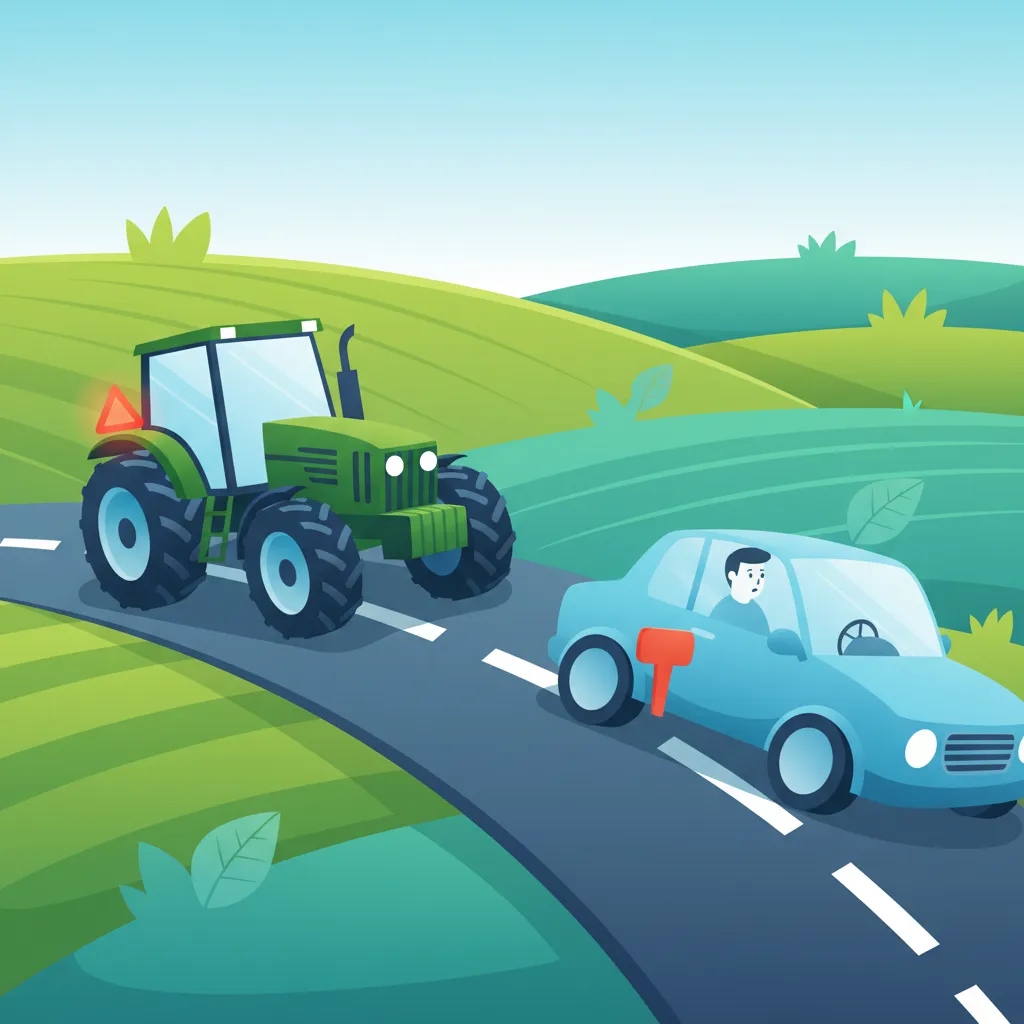
This lesson introduces hazard perception concepts specific to agricultural vehicles, teaching learners how to identify potential dangers such as unexpected farm equipment or changing road conditions. It outlines a systematic approach to visual scanning, risk evaluation, and timely decision-making to avoid accidents. The lesson provides guidelines for interpreting scenario simulations that mirror real-world rural road hazards.
This lesson focuses on the specific challenges of driving in rainy conditions. It explains the phenomenon of hydroplaning, where tires lose contact with the road surface, and how to prevent it by reducing speed. The importance of good tire condition, effective windscreen wipers, and extending following distances is also covered in detail.
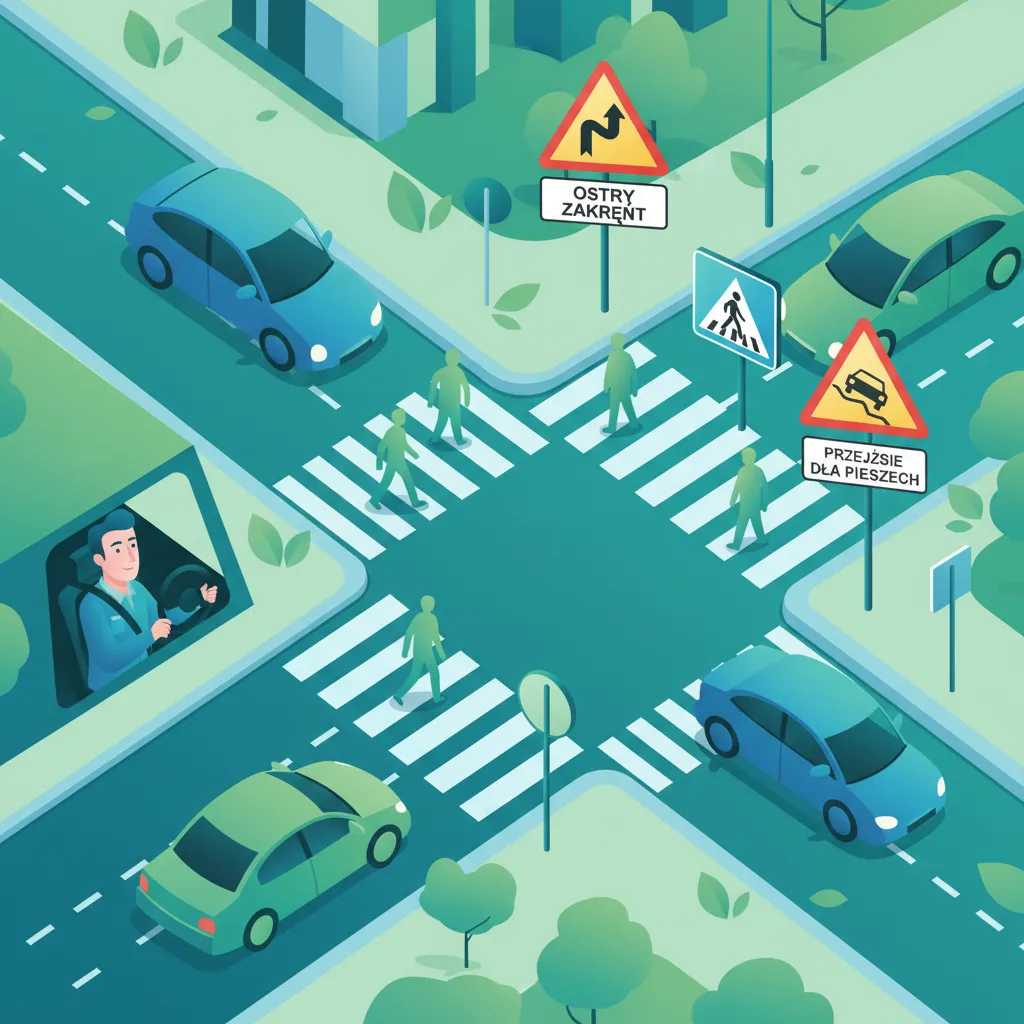
This lesson focuses on triangular warning signs, which are designed to alert drivers to upcoming hazards on the road. It covers the interpretation of various pictograms that indicate dangers like sharp turns, animal crossings, or road construction. Understanding these signs allows a driver to anticipate conditions and adjust their driving proactively.

This lesson introduces defensive driving strategies tailored for bus operation, emphasizing hazard perception and risk management. Learners will study techniques for continuous situational awareness and maintaining safe following distances for adequate reaction time. The content covers emergency maneuvers and interaction with vulnerable road users to reduce accident likelihood.
This lesson prepares drivers for the event of a vehicle breakdown on a motorway or expressway. It details the correct procedure: pulling over to the emergency lane, activating hazard lights, and placing the warning triangle at the legally required distance. The importance of wearing a reflective vest when outside the vehicle is also a key safety point.
This lesson addresses encounters with slow-moving vehicles, such as tractors, which are common on rural roads. It teaches drivers to be patient, maintain a safe following distance, and only overtake when it is absolutely safe and legal to do so. Recognizing the large size and limited maneuverability of such vehicles is crucial for avoiding accidents.

This lesson provides essential guidance for driving in fog, one of the most dangerous conditions. It instructs on the correct use of low-beam headlights and fog lights to maximize visibility without causing glare. The core advice is to significantly reduce speed and use the edge of the road or markings as a guide.
Understand specific Polish traffic regulations and essential safety maneuvers for operating agricultural vehicles in rural settings. This lesson details speed limits, right-of-way at field entrances, and proper handling for Category T drivers to ensure compliance and safety.
This lesson explains the scope of the Category T licence, distinguishing it from other categories and outlining the vehicles covered, such as agricultural and forestry vehicles. It details the legal basis for operating these vehicles on public roads, including specific provisions in the Prawo o ruchu drogowym. Learners will understand the regulatory environment defining where and how Category T vehicles may be driven within Poland.
This lesson explores the correct lane and road positioning for tractors, emphasizing the use of the right-hand lane or shoulder where appropriate. It clarifies how speed limits differ between road types and provides guidelines for adjusting speed based on vehicle load, road condition, and traffic density. Proper positioning improves safety for both the tractor driver and other road users sharing the same space.
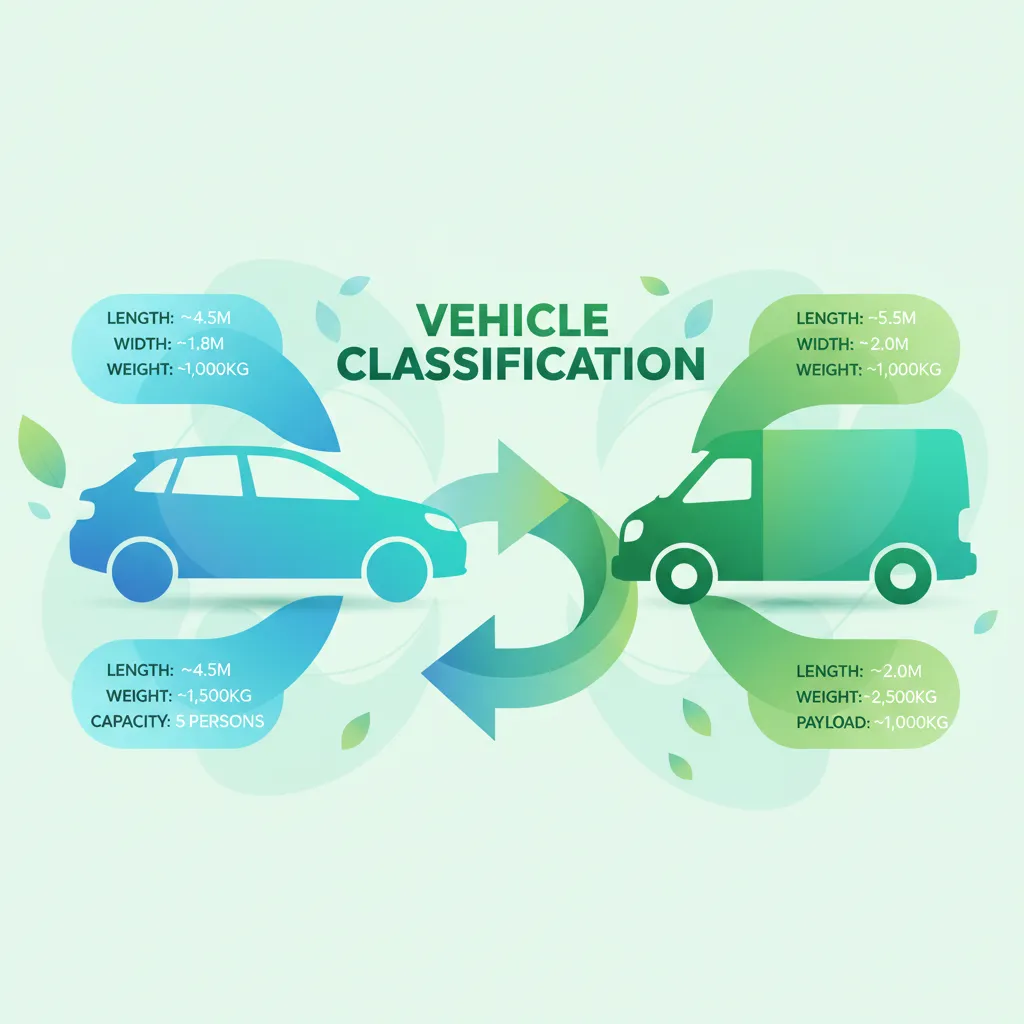
This lesson focuses on the precise classification of agricultural vehicles as defined by Polish law, differentiating between tractors, forestry machines, and trailers. It examines the legal parameters such as maximum permissible weight, width, height, and length that affect roadworthiness certifications. The lesson clarifies terminology used in official documents, ensuring learners can correctly identify the vehicles they are permitted to operate.

This lesson examines the signs that convey dimensional and weight restrictions, which are vital for safe tractor and trailer operation. It outlines how to read width, height, and weight limit signs and the legal implications of exceeding these limits. The lesson provides guidance on planning loads to comply with bridge and road classification restrictions found across Polish rural networks.
This lesson addresses encounters with slow-moving vehicles, such as tractors, which are common on rural roads. It teaches drivers to be patient, maintain a safe following distance, and only overtake when it is absolutely safe and legal to do so. Recognizing the large size and limited maneuverability of such vehicles is crucial for avoiding accidents.
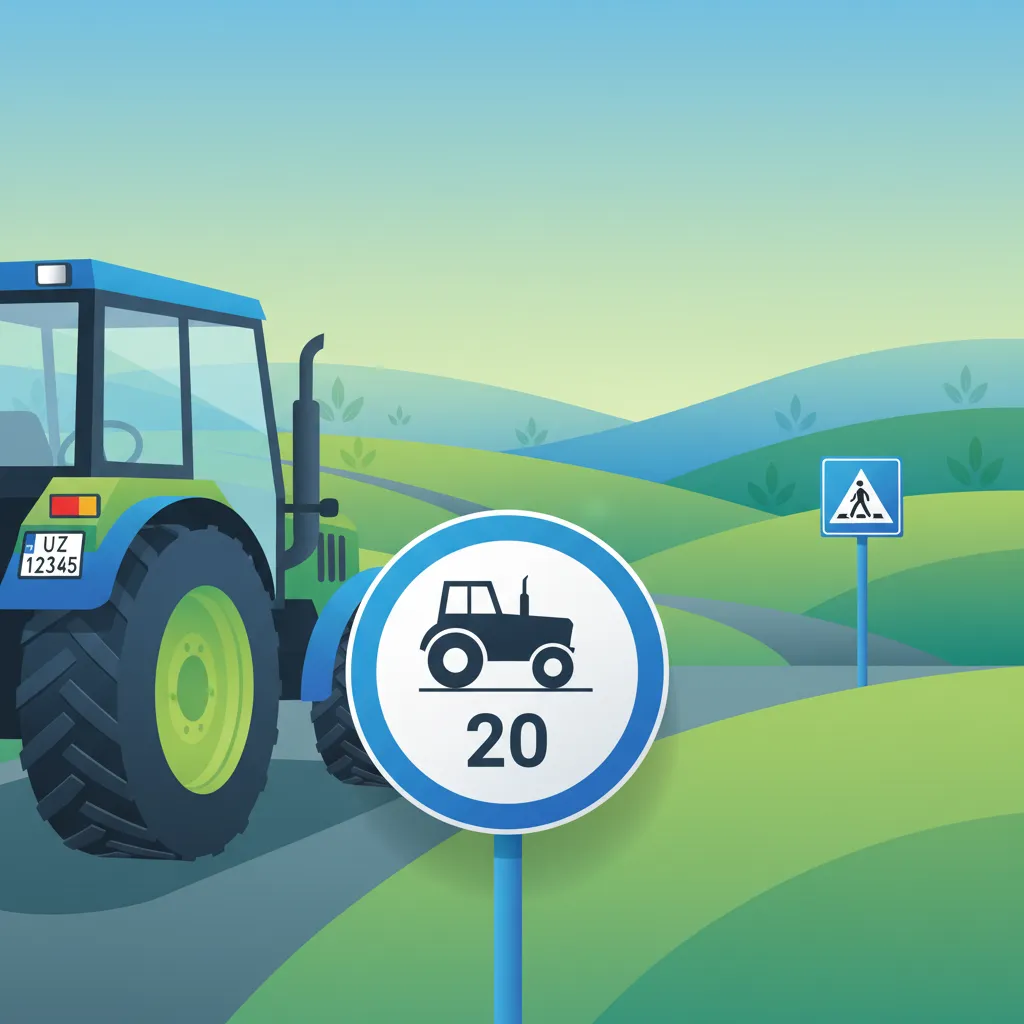
This lesson reviews the core set of regulatory and warning signs that all road users must obey, emphasizing those that affect agricultural tractors such as speed limits, stop, and give-way signs. It clarifies the colour and shape conventions used in Polish signage, enabling drivers to quickly recognize and react to sign information. The lesson also addresses the placement of signs in rural environments where visibility may be compromised.
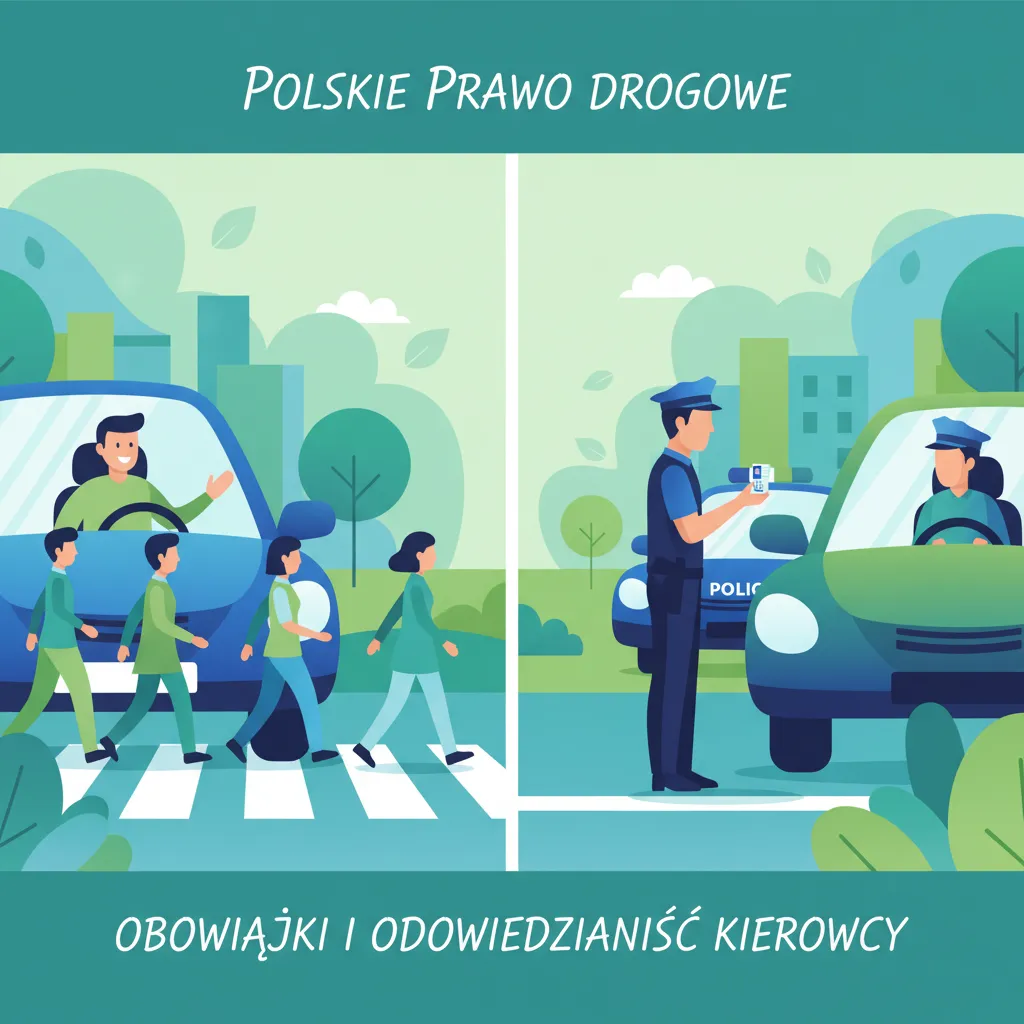
This lesson outlines the legal responsibilities of tractor drivers as stipulated by Polish traffic law, emphasizing the duty to comply with all rules of the road. It discusses the liability framework for accidents involving agricultural vehicles, including the need for appropriate insurance and potential penalties. The lesson also explains the importance of maintaining accurate documentation, such as registration papers and a driver’s licence.
This lesson focuses on the specific hazards introduced by seasonal weather, such as mud, snow, ice, fog, and heavy rain. It explains how these conditions affect traction, braking, and driver visibility, and provides guidance on adjusting speed and using appropriate tires. The lesson also covers the proper use of lights and reflectors to improve visibility in low-light conditions.
This lesson introduces hazard perception concepts specific to agricultural vehicles, teaching learners how to identify potential dangers such as unexpected farm equipment or changing road conditions. It outlines a systematic approach to visual scanning, risk evaluation, and timely decision-making to avoid accidents. The lesson provides guidelines for interpreting scenario simulations that mirror real-world rural road hazards.

This lesson covers the fundamental procedures for starting and stopping a tractor, with emphasis on selecting the appropriate gear and clutch engagement for smooth motion. It explains how to manage traction on soft fields, loose gravel, and wet paved roads, and how to calculate safe stopping distances. The content also discusses hill starts and the prevention of wheel slip during acceleration and deceleration.
Find clear answers to common questions learners have about Defensive Driving in Rural Settings. Learn how the lesson is structured, which driving theory objectives it supports, and how it fits into the overall learning path of units and curriculum progression in Poland. These explanations help you understand key concepts, lesson flow, and exam focused study goals.
Beyond general traffic, Category T drivers frequently encounter mud/debris on roads from fields, slow-moving farm machinery, animals, unmarked field entrances, and other vehicles overtaking impatiently. Poor visibility due to dust or topography is also common.
For agricultural vehicles, defensive driving means anticipating others' frustration or misjudgment of speed. It involves using appropriate warning signals, staying well to the right, and being prepared for sharp turns into fields. It also means actively scanning for impatient drivers and potential blind spots.
Agricultural vehicles often have longer braking distances, especially with trailers or heavy loads. Early brake application is crucial for safety, allowing more time to react to unexpected hazards like turning farm equipment or sudden stops, and signaling your intentions clearly to traffic behind you.
Maintain your speed and lane position, signal clearly if you intend to turn, and do not make sudden moves. If safe, gently ease to the right to provide more space, but only if it doesn't put you or others at risk. Never swerve or brake abruptly in response to an aggressive overtaking attempt.
When entering a public road from a field, Category T drivers must yield to all traffic on the main road. When exiting, ensure the path is clear and use mirrors and head checks extensively. Signal intentions early and clearly, being aware that other drivers might not anticipate a slow vehicle emerging from a field.
Build custom practice sessions tailored precisely to your needs. Focus on areas requiring improvement, review specific Polish road signs, or master complex traffic rules to ensure full preparation for your official driving license exam.