
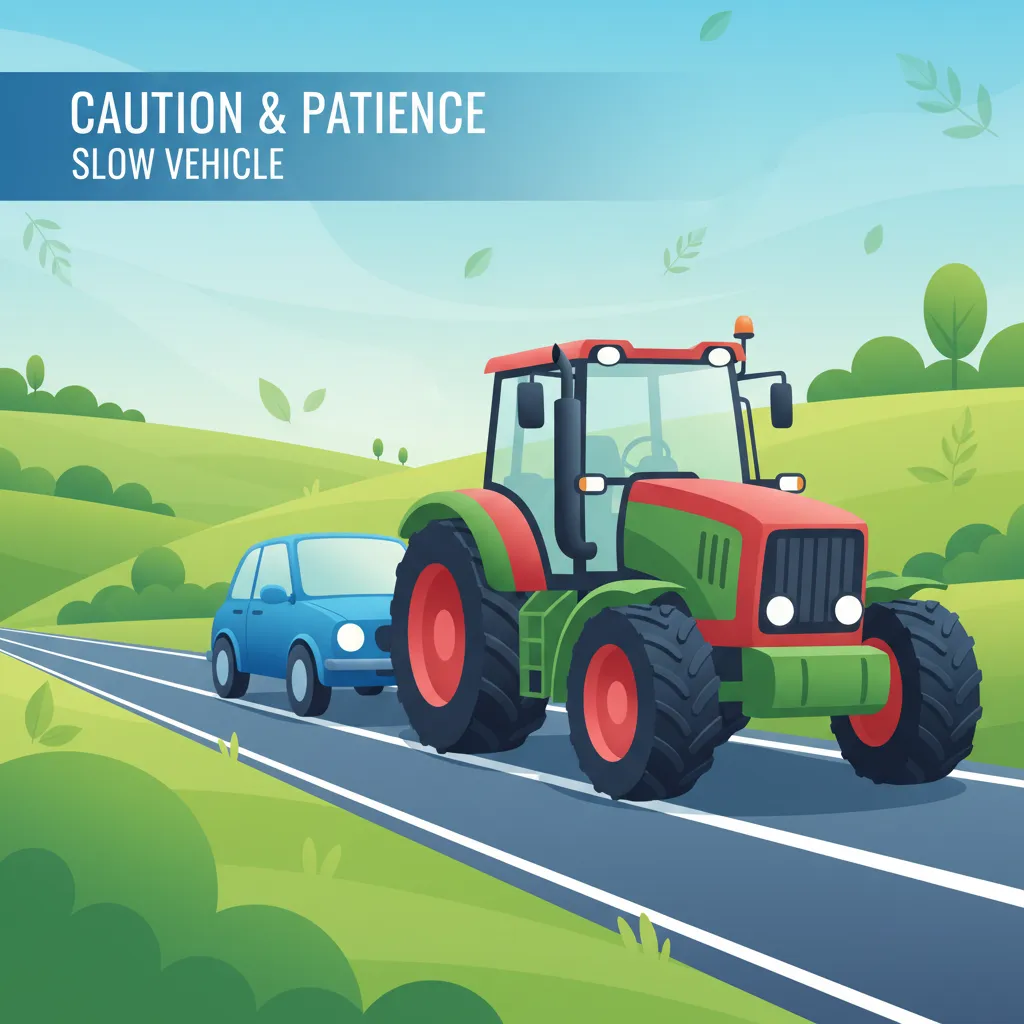
On Polish rural roads, you'll frequently encounter slow-moving vehicles like tractors. This lesson focuses on how to safely navigate these encounters, ensuring you understand when and how to overtake or wait, crucial knowledge for both your Category B theory exam and everyday driving.
Lesson content overview
Rural roads in Poland present a unique set of challenges and require specific driving skills due to the diverse mix of vehicles sharing the same routes. Among these, agricultural vehicles and other slow-moving traffic (SMVs) are prominent. Encountering tractors, combine harvesters, or road maintenance machinery is a common occurrence, especially outside urban areas. This lesson provides essential knowledge and practical guidance for safely interacting with these vehicles, ensuring compliance with Polish traffic law, and minimizing accident risks.
The presence of slow-moving vehicles significantly alters traffic flow and necessitates careful adaptation from other drivers. Unlike passenger cars, agricultural machinery often has large dimensions, limited acceleration, reduced maneuverability, and extended braking distances. Misjudging their capabilities, or failing to anticipate their movements, is a leading cause of collisions on country roads. By understanding the characteristics and legal requirements surrounding these vehicles, drivers can enhance road safety for themselves, their passengers, and agricultural operators. This knowledge builds upon foundational driving principles such as right-of-way, speed management, and safe overtaking, specifically tailoring them to the rural environment.
Patience is key on rural roads. Rushing to overtake a slow-moving vehicle can lead to dangerous situations. Always prioritize safety over speed.
To effectively share the road with slow-moving traffic, it is essential to first identify them and understand their specific characteristics.
In Poland, a Slow-Moving Vehicle (SMV) refers to any vehicle whose construction limits its maximum speed to 40 km/h. While this definition encompasses various types of machinery, it most commonly applies to agricultural vehicles. These vehicles are required to display a specific sign to alert other road users to their reduced speed.
A key visual identifier for an SMV is the "slow traffic" sign.
This sign, a white triangle with a red border, is universally recognized as a warning of a vehicle operating at significantly lower speeds than typical traffic flow. When you see this sign, you should immediately adjust your expectations regarding the vehicle's speed and maneuverability. Although the sign itself refers to a vehicle whose maximum speed is 25 km/h, the broader category of slow-moving agricultural vehicles can reach up to 40 km/h. Regardless, the presence of this sign mandates increased caution.
You will encounter several types of SMVs, primarily agricultural machinery:
Each of these vehicles presents unique challenges due to their size, weight, and operational characteristics, requiring drivers to exercise extra caution and apply specific safety principles.
Interacting safely with SMVs requires a shift in driving approach. The following principles are fundamental to preventing accidents.
One of the most critical safety principles is to maintain an adequate following distance. Because SMVs, especially when heavily loaded or pulling implements, have longer braking distances than passenger cars, you need more time to react and stop safely.
The Polish Road Traffic Act (Ustawa o ruchu drogowym) mandates a specific minimum following distance:
This distance allows you sufficient time for perception, reaction, and braking, particularly given the unpredictability of rural road surfaces and the potential for sudden slowdowns from heavy machinery. Failing to maintain this distance is a common violation that significantly increases the risk of a rear-end collision.
Do not assume the standard '2-second rule' is sufficient when following SMVs. Their size, weight, and often lower grip due to specialized tires mean they require much longer to stop. Always prioritize the mandated 150-metre gap on rural single carriageways.
When approaching an SMV, you must adjust your own speed significantly. Rapidly closing in on a slow vehicle creates a dangerous speed differential, forcing sudden braking or impulsive overtaking maneuvers.
Appropriate speed adaptation prevents dangerous situations and gives you time to plan your next move safely and legally.
Agricultural machinery, by its nature, has significant limitations in terms of maneuverability and driver visibility.
When you are near an SMV, always assume the driver has limited visibility of your vehicle. Give them ample space, especially when approaching from behind or attempting to pass. Be aware that wide implements may swing out unexpectedly, even if the main vehicle body seems clear.
Overtaking an SMV requires careful planning and execution to be performed safely and legally. It is one of the riskiest maneuvers on rural roads.
Before initiating an overtaking maneuver, you must confirm that conditions permit it. Overtaking is only safe and legal when:
Never overtake if there's any doubt about safety, visibility, or legality. It's always better to wait for a clear and safe opportunity, even if it means slowing down considerably.
A systematic approach to overtaking ensures safety and compliance with the law:
Observation and Assessment: Look far ahead to assess the road conditions, check for oncoming traffic, evaluate the SMV's speed and any attached implements, and confirm road markings allow overtaking. Use your mirrors to check for vehicles behind you that might also be preparing to overtake.
Signal Your Intention: Activate your left turn indicator well in advance to signal your intention to move into the left lane. This alerts both the SMV driver (if they can see it) and any following traffic.
Increase Speed and Move to the Left: When it is safe, clear, and legal, gently accelerate while moving into the left lane. Ensure you maintain a safe lateral clearance from the SMV. Do not "cut off" the SMV by staying too close.
Pass with Sufficient Clearance: Continue to accelerate safely past the SMV. Maintain a generous lateral distance, remembering that agricultural implements can extend wide. Always assume the SMV driver might make an unexpected movement.
Signal Right and Return to Lane: Once you can see the entire front of the overtaken SMV in your rear-view mirror, signal your intention to return to the right lane.
Return to Original Lane: Gently steer back into your original lane, ensuring you do not cut off the SMV. Cancel your indicator.
Polish traffic law (Prawo o ruchu drogowym) has strict rules regarding overtaking:
Adhering to specific Polish traffic regulations is paramount when sharing the road with slow-moving vehicles.
As discussed, any vehicle that, by its construction, cannot exceed a speed of 40 km/h and operates on public roads must display the "slow traffic" sign (D.2a). This regulation is enforced to clearly communicate the vehicle's limited speed to other road users, allowing them to adjust their driving accordingly. A driver of an SMV failing to display this sign on a public road can face fines.
Hazard warning lights (światła awaryjne) serve as a crucial signal for abnormal vehicle operation. For SMVs, their use is specific:
Always assume that if a slow-moving vehicle has its hazard lights on, it signifies a potential hazard or extremely low speed, demanding your immediate attention and speed reduction.
While general right-of-way rules apply, there are nuances when agricultural vehicles are involved, particularly at intersections. Due to their size and limited maneuverability, agricultural vehicles often need more space and time to complete turns.
Ustawa o ruchu drogowym) dictates that other drivers should yield to an agricultural vehicle that is signalling a turn, especially a left turn, as it may need to swing wide or occupy more of the road to complete the maneuver. Anticipate their movements and be prepared to stop and give way.Ignoring the rules specific to SMVs can lead to serious consequences:
Driving around SMVs requires an even greater degree of adaptability, especially when external conditions are less than ideal.
Weather significantly impacts visibility and road surface grip for all vehicles, but especially for heavy, slow-moving machinery.
Driving at night introduces additional challenges:
The type of road also influences how you interact with SMVs:
On many rural roads, vulnerable road users such as cyclists and pedestrians may share the same space as agricultural vehicles.
Understanding the scientific and psychological reasons behind these regulations reinforces their importance for road safety.
The primary reason for the 150-metre following distance is rooted in physics:
Drivers often make assumptions that can be dangerous around SMVs:
These insights highlight that the rules are not arbitrary but are designed to counteract inherent physical and psychological challenges of mixed traffic on rural roads.
This lesson covers the essential rules for sharing Polish rural roads with slow-moving agricultural vehicles. Key learning points include the mandatory 150-metre following distance on single carriageways, the significance of sign D.2a, and the extensive blind spots and limited maneuverability of machinery like tractors and combine harvesters. Safe overtaking requires legal road markings, sufficient sight distance, no oncoming traffic, and adherence to speed limits—never overtake on the right on single carriageways. Understanding when hazard lights must be used (poor visibility or hazardous positions) versus normal slow driving helps drivers anticipate SMV behavior and respond appropriately, reducing the risk of rear-end collisions and dangerous passing maneuvers.
A short set of high-value points that capture the most important learning from this lesson.
Slow-moving vehicles (SMVs) in Poland are those limited to 40 km/h by construction, and must display the D.2a sign (red-bordered white triangle)
A minimum following distance of 150 metres is mandated when following SMVs on rural single carriageways
Agricultural vehicles have extensive blind spots and limited maneuverability, requiring extra space and patience from other drivers
Overtaking SMVs is only legal when road markings permit it, sight distance is sufficient, no oncoming traffic exists, and speed limits are not exceeded
Hazard lights on an SMV signal increased danger or significantly reduced speed, requiring immediate attention from following drivers
Explore all units and lessons included in this driving theory course.
The D.2a sign indicates a vehicle that cannot exceed 25 km/h, but the broader SMV category includes vehicles up to 40 km/h
On single carriageways outside built-up areas, the maximum speed limit for passenger cars is 90 km/h—never exceed it even when overtaking
Overtaking on the right is generally prohibited on Polish single carriageways regardless of vehicle type
Agricultural vehicles may swing wide during turns and occupy more than one lane due to their turning radius
When an SMV uses hazard lights under normal conditions, it indicates a potential hazard requiring speed reduction
Assuming the standard 2-second following rule applies to SMVs, when the legal requirement is 150 metres on rural roads
Attempting to overtake across solid lines or at intersections, pedestrian crossings, or sharp bends where visibility is limited
Underestimating the width of agricultural implements (ploughs, sprayer booms, cultivators) that extend beyond the main vehicle body
Expecting SMV drivers to see approaching traffic in their mirrors, when large blind spots may prevent this
Exceeding the speed limit to complete an overtake, which remains illegal even if the SMV is very slow
Lesson content overview
A short set of high-value points that capture the most important learning from this lesson.
Slow-moving vehicles (SMVs) in Poland are those limited to 40 km/h by construction, and must display the D.2a sign (red-bordered white triangle)
A minimum following distance of 150 metres is mandated when following SMVs on rural single carriageways
Agricultural vehicles have extensive blind spots and limited maneuverability, requiring extra space and patience from other drivers
Overtaking SMVs is only legal when road markings permit it, sight distance is sufficient, no oncoming traffic exists, and speed limits are not exceeded
Hazard lights on an SMV signal increased danger or significantly reduced speed, requiring immediate attention from following drivers
Explore all units and lessons included in this driving theory course.
The D.2a sign indicates a vehicle that cannot exceed 25 km/h, but the broader SMV category includes vehicles up to 40 km/h
On single carriageways outside built-up areas, the maximum speed limit for passenger cars is 90 km/h—never exceed it even when overtaking
Overtaking on the right is generally prohibited on Polish single carriageways regardless of vehicle type
Agricultural vehicles may swing wide during turns and occupy more than one lane due to their turning radius
When an SMV uses hazard lights under normal conditions, it indicates a potential hazard requiring speed reduction
Assuming the standard 2-second following rule applies to SMVs, when the legal requirement is 150 metres on rural roads
Attempting to overtake across solid lines or at intersections, pedestrian crossings, or sharp bends where visibility is limited
Underestimating the width of agricultural implements (ploughs, sprayer booms, cultivators) that extend beyond the main vehicle body
Expecting SMV drivers to see approaching traffic in their mirrors, when large blind spots may prevent this
Exceeding the speed limit to complete an overtake, which remains illegal even if the SMV is very slow
Explore search topics learners often look for when studying Agricultural Vehicles and Slow-Moving Traffic. These topics reflect common questions about road rules, driving situations, safety guidance, and lesson level theory preparation for learners in Poland.
Browse additional driving theory lessons that cover connected traffic rules, road signs, and common driving situations related to this topic. Improve your understanding of how different rules interact across everyday traffic scenarios.
Understand the specific rules and challenges for overtaking and interacting with agricultural and other slow-moving vehicles. Learn about their maneuverability limits and required following distances on Polish country roads to ensure safe travel.
This lesson introduces defensive driving principles for rural settings, teaching learners how to continually scan the environment and anticipate potential hazards. It discusses the unique challenges posed by slow-moving agricultural traffic, field entrances, and unpredictable farm equipment maneuvers. The lesson emphasizes proactive decision-making and early brake application to avoid collisions in mixed traffic.
In this lesson, learners explore riding on rural and countryside roads, where road markings may be sparse and surface conditions varied. The content covers safe overtaking in single-lane sections, interaction with agricultural vehicles and animals, and the handling of gravel or uneven surfaces. Learners will also study the importance of anticipating curves and adjusting speed to light conditions, equipping them with the skills needed for safe countryside travel.
This lesson examines real-world case studies of harvest traffic, where multiple tractors and trailers share limited road space during peak agricultural periods. Learners explore strategies for coordinating speed, maintaining safe distances, and using signaling to communicate intentions. The content also addresses the challenges of field access points and the need for cooperation with other drivers.

This lesson examines how a tractor driver should interact with a variety of road users, focusing on right-of-way rules at intersections and with cars, trucks, cyclists, and pedestrians. It discusses safe overtaking practices, appropriate signaling to communicate intentions, and the importance of checking blind spots. The lesson highlights the need for heightened caution near schools, villages, and areas with high pedestrian activity.
This lesson explores the correct lane and road positioning for tractors, emphasizing the use of the right-hand lane or shoulder where appropriate. It clarifies how speed limits differ between road types and provides guidelines for adjusting speed based on vehicle load, road condition, and traffic density. Proper positioning improves safety for both the tractor driver and other road users sharing the same space.
This lesson details the legal framework for overtaking in Poland. It explains how to interpret road markings, such as solid and double solid lines, and prohibition signs that forbid passing. The content emphasizes the critical need for sufficient sight distance and a clear path before initiating an overtaking maneuver to ensure safety.

This lesson explores the unique characteristics of driving on rural roads. It highlights potential hazards such as sharp, unbanked curves, poor road surfaces, and limited visibility due to hills and vegetation. The content teaches drivers to anticipate these conditions and adjust their speed and position to navigate safely.
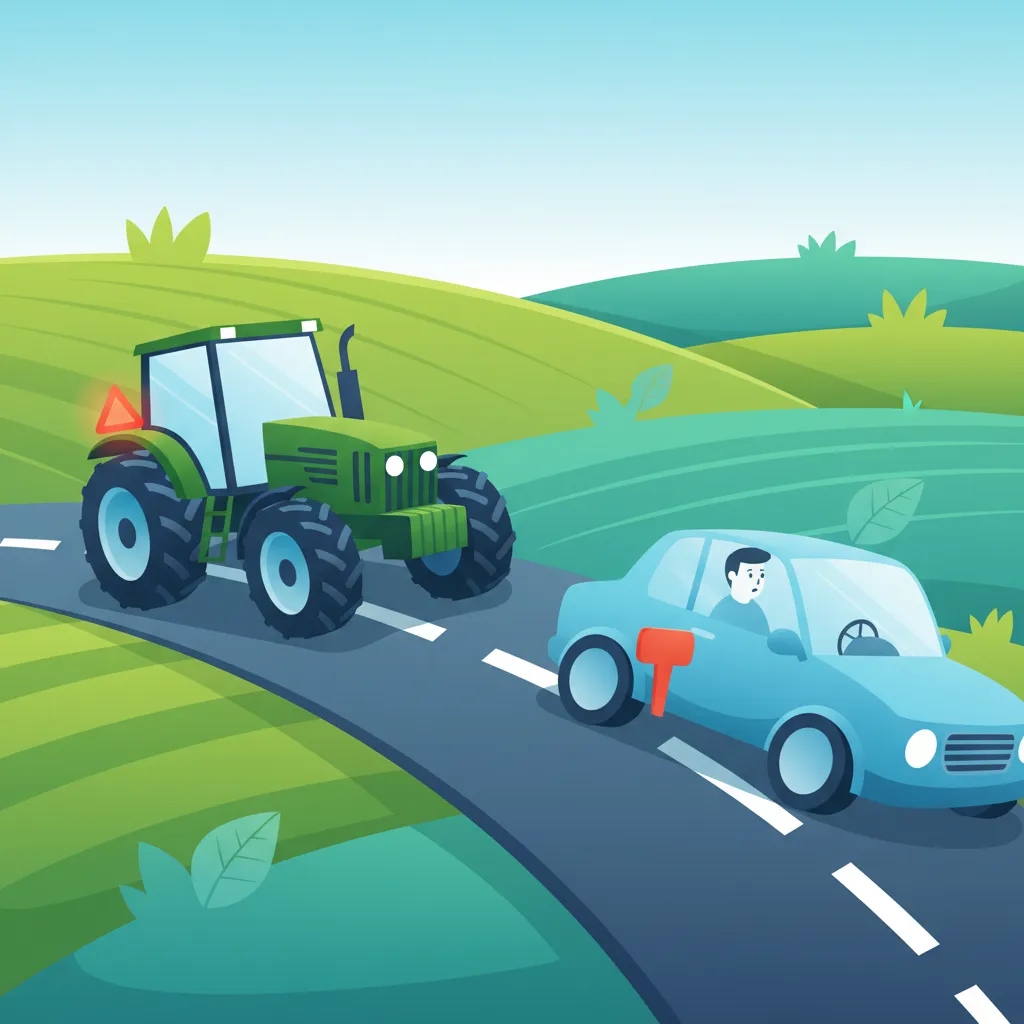
This lesson introduces hazard perception concepts specific to agricultural vehicles, teaching learners how to identify potential dangers such as unexpected farm equipment or changing road conditions. It outlines a systematic approach to visual scanning, risk evaluation, and timely decision-making to avoid accidents. The lesson provides guidelines for interpreting scenario simulations that mirror real-world rural road hazards.

This lesson focuses on reversing and maneuvering techniques required when operating a tractor with a trailer, particularly in confined farmyards or on narrow rural roads. It outlines the use of mirrors to monitor trailer swing and suggests best practices for using spotters to improve safety. The lesson also covers planning reversal paths and executing wide-angle turns without compromising load stability.
In this lesson, learners examine defensive overtaking practices, focusing on when and how to safely pass other road users. The content covers speed differential calculations, appropriate passing distances, and the importance of maintaining clear visibility during overtaking. Learners will also study the impact of road curvature, traffic flow, and lane selection on overtaking safety, allowing them to minimize risks associated with passing maneuvers.
Master the legal requirements for slow-moving vehicles in Poland, including signage and hazard light use. Learn how to improve visibility and anticipate hazards when encountering tractors and other machinery, especially in adverse weather or at night.
This lesson provides essential guidance for driving in fog, one of the most dangerous conditions. It instructs on the correct use of low-beam headlights and fog lights to maximize visibility without causing glare. The core advice is to significantly reduce speed and use the edge of the road or markings as a guide.

This lesson teaches the crucial concept that drivers must always adapt their speed to the current conditions. It explains how factors like rain, fog, ice, heavy traffic, and poor visibility reduce safety margins and require a lower speed than the posted limit. This principle of defensive driving is essential for preventing accidents in challenging situations.

This lesson addresses the challenges of driving after dark. It covers the correct use of high and low beam headlights to see and be seen, and techniques to avoid being dazzled by oncoming traffic. The content also touches on the increased risk of fatigue and reduced ability to judge speed and distance at night.
This lesson addresses environmental factors that impact rider visibility, such as low light, night conditions, fog, and glare from headlights. Learners will explore strategies for riding safely in reduced visibility, including the use of reflective gear, proper headlamp settings, and appropriate eye protection. The content also covers hazard detection techniques in adverse weather and how to adjust speed to maintain safety, enhancing rider safety across all conditions.
This lesson explores the unique characteristics of driving on rural roads. It highlights potential hazards such as sharp, unbanked curves, poor road surfaces, and limited visibility due to hills and vegetation. The content teaches drivers to anticipate these conditions and adjust their speed and position to navigate safely.
This lesson details the legal framework for overtaking in Poland. It explains how to interpret road markings, such as solid and double solid lines, and prohibition signs that forbid passing. The content emphasizes the critical need for sufficient sight distance and a clear path before initiating an overtaking maneuver to ensure safety.
This lesson details the specific driving adjustments needed for adverse weather. It focuses on how rain, snow, and ice affect vehicle dynamics and driver perception. Learners will study techniques to prevent hydroplaning, use winter tires effectively, and increase following distances on slippery surfaces while using safety systems like fog lights.
This lesson focuses on the specific challenges of driving in rainy conditions. It explains the phenomenon of hydroplaning, where tires lose contact with the road surface, and how to prevent it by reducing speed. The importance of good tire condition, effective windscreen wipers, and extending following distances is also covered in detail.

This lesson focuses on the specific hazards introduced by seasonal weather, such as mud, snow, ice, fog, and heavy rain. It explains how these conditions affect traction, braking, and driver visibility, and provides guidance on adjusting speed and using appropriate tires. The lesson also covers the proper use of lights and reflectors to improve visibility in low-light conditions.

This lesson defines what constitutes a 'built-up area' in Poland, marked by specific informational signs. It explains the default speed limit of 50 km/h that applies within these zones unless otherwise indicated. The content highlights the need for increased vigilance due to higher traffic density and the frequent presence of pedestrians.
Find clear answers to common questions learners have about Agricultural Vehicles and Slow-Moving Traffic. Learn how the lesson is structured, which driving theory objectives it supports, and how it fits into the overall learning path of units and curriculum progression in Poland. These explanations help you understand key concepts, lesson flow, and exam focused study goals.
In Poland, you must only overtake agricultural vehicles when it is safe and legal to do so. This means having clear visibility of the road ahead, sufficient space, and not exceeding speed limits. Always ensure you maintain a safe distance and use your indicators correctly. Be aware that tractors can be large and may suddenly turn or slow down.
Patience is key. Maintain a safe following distance and avoid aggressive driving. Look for safe opportunities to overtake only when the road ahead is clear and it's permitted. If overtaking is not possible, wait for a designated passing place or a clear stretch of road.
While specific rules may vary slightly, the general principle for all slow-moving vehicles, including agricultural machinery, bicycles, and horse-drawn carts, is to approach with caution, maintain a safe distance, and overtake only when safe and legal. The key is recognizing their slow speed and potential for unexpected maneuvers.
The Polish driving theory exam for Category B includes questions designed to test your understanding of rural driving scenarios. You'll encounter questions about safe overtaking, maintaining distances, and recognizing hazards related to agricultural vehicles and slow traffic. Understanding these rules is crucial for passing.
If a slow-moving vehicle, especially a large tractor, is signaling a turn (often by its driver pointing), do not attempt to overtake. They may require a wider turning path than anticipated. It's safest to wait until they have completed their maneuver or are safely off the road.
Build custom practice sessions tailored precisely to your needs. Focus on areas requiring improvement, review specific Polish road signs, or master complex traffic rules to ensure full preparation for your official driving license exam.