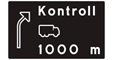
The P7 'Advance Information: Control Ahead' sign serves as a crucial heads-up that a control or inspection point is approaching. This sign is not the control itself but a preparatory warning, with the distance to the checkpoint tailored to local conditions. When you see this sign, prepare to adjust your speed and be attentive to further instructions regarding entry into the control area or potential lane changes.
This P7 sign, 'Advance Information: Control Ahead', is crucial for understanding upcoming traffic checkpoints in Sweden. Familiarise yourself with its warning to ensure readiness for potential instructions and prepare for your theory test revision on road sign interpretation.
This sign is used to warn drivers in advance that a control area is coming up, helping them prepare to slow down and follow directions. It is not the entry command itself, but an early notice that a checkpoint is ahead. The distance shown is selected based on the conditions at the location, such as speed limits, road layout, and visibility. Drivers should remain alert for the actual control instruction and for any lane changes or reduced speed requirements.
This provides advance notice that a control or inspection point is ahead. The stated distance is adapted to local conditions.
Get clear, practical answers to the most common questions about the P7 - Advance Information: Control Ahead road sign. Learn how the sign works, what rules it represents, and how it affects real driving situations. This FAQ strengthens your understanding and supports accurate decision making for the Swedish driving theory exam in Sweden.
The P7 sign is a warning that a control or inspection point, such as a police check, is ahead. It gives you advance notice to prepare to slow down and follow any subsequent directions from officials or other signs.
When you see the P7 sign, you should immediately start preparing for a control ahead. This means increasing your awareness, anticipating a need to reduce speed, and being ready to follow instructions for entering the control area or for lane management.
No, the distance indicated on the P7 sign is adjusted to suit the specific location and conditions, such as the road layout and speed limits. It's designed to give you adequate time to prepare without causing unnecessary disruption.
A common mistake is assuming the P7 sign requires immediate action like stopping or slowing down drastically. It's an advance warning, so while you should prepare, the primary action is to remain alert and ready for the actual control instructions that will follow.
Not necessarily. The P7 sign is an advance warning of a control area. Whether you are stopped, waved through, or directed to a specific lane depends on the nature of the control and the instructions given at the checkpoint itself.
A clear reference image of the P7 - Advance Information: Control Ahead road sign used in Sweden.
The P7 - Advance Information: Control Ahead road sign may also be known by these alternative names or terms.
The P7 - Advance Information: Control Ahead road sign is part of the Signals by Police Officer (P) category, which groups together signs with similar rules and functions.
Reviewing related road signs like this 'Advance Information: Control Ahead' sign helps solidify your understanding and prevent common mistakes. Effective traffic sign comparison is key to mastering recognition for your theory test revision.

Stop Your Vehicle Immediately If an Officer is Facing You or Your Rear

What to do when a police vehicle signals you to follow and stop.

P11: Pull Over and Stop for Police Vehicle Instructions

You must stop when the police officer's palm faces you.

Understand the P3 'Stop' Sign with a Police Lantern

Understand the Police 'Proceed' Signal (P4) and How to React Safely

P5: Slow Down When You See the Officer Facing You

P6 Control Sign: You Must Enter the Inspection Area
Connect visual signage with essential Swedish traffic rules by exploring our curated set of practice questions and detailed road safety explanations. These resources reinforce your ability to interpret complex road situations according to Transportstyrelsen standards.
Discover what Swedish traffic law requires of you if you witness or come across a traffic accident. This guide explains how to stop safely, offer appropriate assistance using the L-ABC method, and what to report to emergency services. Knowing these procedures is vital for both your safety and legal compliance in Sweden.
Being prepared for an accident is a critical component of safe driving and a core topic in the Swedish driving theory exam. You will learn the correct protocol for securing a scene, providing accurate information to SOS operators, and identifying specialized risks such as vehicles transporting hazardous substances. Mastery of these steps helps you fulfill your legal obligations and act with confidence during emergencies.
Master Emotional Control for Safer Driving and a Confident Exam Pass.
Master the hazards of slush and melting snow for a safer drive and a successful exam.
This warning sign indicates a danger ahead that cannot be adequately described by any other standard warning sign. It serves as a general alert to increase your vigilance and prepare to adjust your driving. The specific hazard is often clarified with an additional plate or nearby information, and it may be temporary or location-specific. Reduce speed, scan the road environment carefully, and be prepared for unexpected conditions such as unusual road layouts, temporary hazards, or local risks. Treat this sign as a prompt to drive defensively until the hazard is clearly passed.
This warning sign indicates a location where the roadway ends directly at water, such as a quay, ferry ramp area, or waterfront access point. The hazard is that drivers may misjudge the road’s end, especially in darkness, fog, or glare, and enter the water. Reduce speed and follow any lane markings, barriers, and local instructions carefully. Be cautious of pedestrians, cyclists, and vehicles maneuvering for loading or turning. In icy conditions, stopping distance and traction may be severely reduced near the water’s edge.
After reviewing this complete list of Swedish road signs, deepen your understanding by exploring signs by category or practicing with simulated test questions. Solidify your recognition skills and ensure you are fully prepared for every aspect of the official driving theory exam.
All Swedish Road Signs List