
Welcome to the unit on Iceland's traffic law hierarchy for Category AM mopeds. This lesson clarifies how national laws, road codes, and local regulations interact, ensuring you understand which rules take precedence. Mastering this hierarchy is key to interpreting Icelandic traffic legislation correctly and confidently for your theory exam.
Lesson content overview
Navigating the roads safely and legally in Iceland requires a clear understanding of its traffic laws. For those operating Category AM mopeds, this involves not only knowing specific rules but also comprehending how different layers of law interact and take precedence. Iceland's traffic legislation is structured as a hierarchy, a tiered system designed to provide a comprehensive and consistent framework for all road users.
This lesson will delve into the structure of Icelandic traffic regulations, explaining how national statutes, detailed road codes, and local municipal ordinances fit together. By understanding this hierarchy, you, as an AM moped rider, will be able to correctly interpret and apply the relevant legal provisions in any driving situation, ensuring compliance, enhancing safety, and confidently navigating Iceland's unique driving environment. This knowledge is crucial for avoiding infractions and contributing to a safer road system for everyone.
Iceland's legal framework for road traffic is organized into distinct layers, each with specific authority and scope. This tiered structure ensures that while national laws provide a universal foundation, there is also flexibility for more detailed regulations and local adaptations.
At the pinnacle of the Icelandic traffic law hierarchy are the national statutes, enacted by the Althingi, Iceland's parliament. These laws form the overarching legal framework that governs all road users and vehicles, including Category AM mopeds. The most significant of these is the Traffic Law Act No. 62/1999 (Lög um umferð), often simply referred to as the Road Traffic Act. This foundational act and its subsequent amendments set the broad principles and legal boundaries for traffic.
The Traffic Law Act includes general provisions that define key terms, outline the scope of the law, and establish the fundamental duties and responsibilities of all road users. It also categorizes offences, detailing criminal penalties, administrative fines, and the points system for various violations. For Category AM riders, this means the national statutes dictate core requirements such as the mandatory minimum age for obtaining a license, the necessity of vehicle insurance and registration, and universal speed limits that apply across the country unless specifically altered by a lower-tier regulation.
It is a common misunderstanding to believe that a local rule can somehow supersede or allow for a direct contradiction of a national statute. For example, the national speed limit on urban roads is generally 50 km/h. A local ordinance can lower this limit to 30 km/h in a school zone, but it can never legally raise it to 60 km/h, as that would directly conflict with the higher-level national law.
Directly subordinate to the national statutes, yet still highly authoritative, is the Road Code (Umferðarlög or Traffic Regulations). While often referred to by the same name as the main Traffic Law Act, the Road Code typically comprises the detailed technical regulations and specific operational rules that flesh out the broader principles established by the national parliament. These regulations are usually issued by the Ministry of Transport or other delegated national authorities.
The Road Code provides the concrete instructions and practical guidelines that riders follow on a daily basis. It covers intricate aspects such as:
For example, the requirement to use low-beam headlights when visibility drops below 150 meters is detailed in the Road Code. Similarly, the obligation to stop for pedestrians at a zebra crossing is a core Road Code rule. While the Road Code prescribes these actions, it’s important to remember that the penalties for non-compliance (such as fines or points) are typically defined in the higher-level national Traffic Law Act.
At the lowest tier of the hierarchy are local municipal ordinances. These are regulations enacted by individual municipalities across Iceland, such as Reykjavík, Akureyri, or Ísafjörður. Municipalities are granted delegated authority by the national parliament to issue these specific rules to address local road safety needs and specific environmental conditions.
Local ordinances serve to adjust or supplement national and Road Code rules to specific local contexts. They are always subordinate to higher authority, meaning they cannot contradict or undermine national statutes or the Road Code. Their primary function is to fine-tune traffic management for particular areas. Examples include:
A practical example is a residential street in a city like Reykjavík that has a municipal sign indicating a 30 km/h speed limit. While the national urban limit might be 50 km/h, the local ordinance allows the municipality to impose a lower, more restrictive, and enforceable limit to enhance safety for local residents and children. It is crucial for moped riders to be vigilant for these local signs, as ignoring them is a violation.
Understanding the hierarchy involves grasping several fundamental legal principles that dictate how rules are applied and interpreted. These principles ensure consistency, fairness, and effective governance of road traffic throughout Iceland.
The principle of legal supremacy establishes that higher-level statutes, such as the Icelandic Traffic Law Act, always override lower-level regulations, like municipal ordinances. This ensures uniformity across the country and prevents conflicting rules that could lead to confusion or legal disputes. For moped riders, this means you must first identify the highest applicable law before considering any local variations. If a municipal rule appears to contradict a national law, the national law will always take precedence, rendering the contradictory municipal rule invalid.
Delegated authority refers to the power granted by the national parliament to ministries (e.g., the Ministry of Transport) and local municipalities to issue specific regulations. This allows for necessary adaptation to local conditions (such as unique terrain, weather, or population density) while maintaining adherence to national consistency. Municipalities, for instance, can set speed limits for specific zones, but these limits must not conflict with or exceed national maximums for that road type. This balance between national framework and local flexibility is key to effective traffic management.
When the wording of a lower-level rule is unclear or ambiguous, interpretive hierarchy comes into play. This principle guides how such provisions are clarified, typically by referring to the purpose and intent of the higher-level statutes. This process guarantees that interpretations remain consistent with the overarching legislative intent. For example, if a local ordinance uses a term like "motor vehicle" without defining it, its meaning would be interpreted in line with the definition provided in the national Traffic Law Act, which often explicitly includes mopeds (Category AM) unless specifically exempted. Both purposive interpretation (looking at the underlying goal of the rule) and literal interpretation (applying the plain meaning of words when clear) are used.
The legal principle of retroactive non-application dictates that new laws generally do not apply to actions taken before their effective date, unless explicitly stated otherwise. This protects riders from being penalized for conduct that was legal at the time it occurred. While riders must stay informed about legislative updates, they are not retroactively held accountable for changes. This principle ensures fairness and predictability in the legal system.
Specific regulations are particularly pertinent to Category AM moped riders, reflecting the unique characteristics and safety considerations of these vehicles.
National statutes lay down the fundamental requirements for anyone operating a moped in Iceland:
The Road Code provides detailed rules that directly impact the daily operation and safety of mopeds:
Local municipal ordinances play a vital role in adjusting national rules to specific urban and residential contexts. A common example is the imposition of reduced speed limits in school zones. While the national urban limit might be 50 km/h, a municipality can legally enforce a 30 km/h limit (or even lower) within designated school zone boundaries. These local signs must always be obeyed, as they take precedence over the general national limit by imposing a more restrictive, local requirement. Ignoring such signs is a violation and endangers vulnerable road users, especially children.
Even with clear rules, moped riders can sometimes fall into common traps due to misunderstandings of the legal hierarchy. Being aware of these can prevent fines and accidents.
A frequent mistake is misreading local speed limits. For instance, assuming the national 50 km/h urban limit applies when entering a residential area clearly marked with a municipal 30 km/h sign. The lower municipal limit is valid and takes precedence in that specific zone. Failure to observe it can lead to fines and, more importantly, poses a significant danger to local residents, particularly children, who expect slower traffic.
Another issue is confusing vehicle classification. Some riders might operate a scooter or moped with an engine capacity greater than 50 cc or capable of exceeding 45 km/h, mistakenly believing it falls under Category AM. Vehicles exceeding these specifications typically require a different license category (e.g., A1, A2, or A) and different registration/insurance rules. Operating an incorrectly classified vehicle is a serious violation of registration and licensing laws.
Ignoring temporary ordinances can also lead to issues. Riding through a construction zone where temporary speed limits or detour signs are posted, assuming the standard limits apply, is dangerous and illegal. Temporary measures, often implemented by local authorities under delegated powers, take precedence over standard rules for the duration of the works. Adhering to these signs is crucial for your safety and the safety of construction workers.
Assuming national law allows night riding without lights or driving with lights off when ambient light seems sufficient is a dangerous misinterpretation. The Road Code explicitly mandates headlight usage in low visibility conditions (e.g., fog, heavy rain) regardless of daylight. Ignoring these requirements severely reduces your visibility to others and increases the risk of a collision.
Traffic laws are not always static; they often include conditional logic that requires riders to adjust their behavior based on prevailing circumstances. Understanding these variations, which are rooted in the legal hierarchy, is vital for safe and compliant riding.
Iceland's dynamic weather demands constant adaptation:
The type of road you are on will influence the rules that apply:
The condition of your moped also impacts operational rules:
A deep understanding of the traffic law hierarchy is more than just academic; it has direct and profound implications for a moped rider's safety and legal standing.
By correctly identifying which layer of law applies (national statute, Road Code, or local ordinance), you can avoid conflicting interpretations and ensure legal compliance. This directly translates to avoiding fines, penalty points, or even license suspension, all of which can result from unknowingly violating traffic rules. Proper application of the hierarchy means you are better equipped to pass inspections and handle interactions with law enforcement.
The tiered system is designed with safety in mind. Understanding why certain rules exist—like lower municipal speed limits in school zones—reinforces the importance of those rules and leads to safer riding practices. Observing these limits significantly reduces the risk of accidents, especially those involving children. When all riders adhere to the appropriate rules, the overall road environment becomes more predictable and safer for everyone.
Knowledge of the traffic law hierarchy forms a critical foundation for more complex riding scenarios. As you progress in your learning, you will apply this understanding to determine which priority rule applies at an intersection, how to correctly navigate roundabouts, or how specific regulations change when riding in adverse weather conditions. This lesson, therefore, directly builds upon previous modules (such as "Legal Framework for Category AM") and prepares you for future lessons on "Priority Rules, Intersections, Crossings & Roundabouts" and "Riding in Icelandic Weather, Darkness, Gravel & Slippery Conditions."
To further solidify your understanding of Iceland's traffic law hierarchy, here are some key terms:
This lesson explains how Iceland's traffic law hierarchy operates for Category AM moped riders, structured in three tiers: national statutes (Traffic Law Act No. 62/1999), the detailed Road Code (Umferðarlög), and local municipal ordinances. Understanding this hierarchy is essential for correctly applying the right rule in any situation, whether interpreting ambiguous local signs or determining BAC limits. Key regulations specific to AM riders include a maximum speed of 45 km/h, mandatory helmets, BAC limit of 0.02%, and headlight requirements when visibility falls below 150 meters. The lesson emphasizes that local rules can only add restrictions, never contradict national law, and introduces core legal principles including legal supremacy, delegated authority, and interpretive hierarchy that guide how Icelandic traffic regulations are applied and enforced.
A short set of high-value points that capture the most important learning from this lesson.
Iceland's traffic law hierarchy flows from National Statutes (Traffic Law Act No. 62/1999) at the top, through the Road Code (Umferðarlög) with detailed operational rules, down to local municipal ordinances with delegated authority.
National laws always take precedence—local ordinances can only impose more restrictive rules, never less (e.g., a municipality can lower an urban speed limit to 30 km/h but cannot raise it above the national 50 km/h).
Category AM mopeds are legally limited to 45 km/h maximum speed regardless of posted limits, even on motorways where cars may travel at 90 km/h.
Headlight use is mandatory whenever visibility drops below 150 meters, regardless of daylight conditions, under the Road Code's specific operational rules.
When interpreting ambiguous regulations, apply the purpose and intent of higher-level statutes using purposive or literal interpretation methods.
Explore all units and lessons included in this driving theory course.
The hierarchy order for applying traffic rules: National Statutes > Road Code > Local Municipal Ordinances.
For Category AM riders: minimum age 15, helmet mandatory, BAC limit 0.02%, vehicle must be registered with Samgöngustofa, maximum design speed 45 km/h.
Local speed limit signs (e.g., 30 km/h in school zones) always take precedence over the general national urban limit of 50 km/h when posted.
Penalties and point deductions are defined in the national Traffic Law Act, while the Road Code prescribes the specific behaviors required.
Temporary traffic measures (construction zones, detours) issued under delegated authority take precedence over standard rules for their duration.
Assuming the national 50 km/h urban speed limit applies when a municipal 30 km/h sign is clearly posted—the lower local limit is valid and enforceable.
Operating a moped that exceeds 50 cc engine capacity or 45 km/h design speed while believing it falls under Category AM, requiring a different license class.
Believing headlights are optional in daytime conditions—Road Code mandates them when visibility drops below 150 meters due to fog, heavy rain, or snow.
Ignoring temporary traffic control measures in construction zones, assuming standard speed limits still apply.
Failing to stop for pedestrians at zebra crossings, a strict Road Code requirement with penalties defined in national law.
Lesson content overview
A short set of high-value points that capture the most important learning from this lesson.
Iceland's traffic law hierarchy flows from National Statutes (Traffic Law Act No. 62/1999) at the top, through the Road Code (Umferðarlög) with detailed operational rules, down to local municipal ordinances with delegated authority.
National laws always take precedence—local ordinances can only impose more restrictive rules, never less (e.g., a municipality can lower an urban speed limit to 30 km/h but cannot raise it above the national 50 km/h).
Category AM mopeds are legally limited to 45 km/h maximum speed regardless of posted limits, even on motorways where cars may travel at 90 km/h.
Headlight use is mandatory whenever visibility drops below 150 meters, regardless of daylight conditions, under the Road Code's specific operational rules.
When interpreting ambiguous regulations, apply the purpose and intent of higher-level statutes using purposive or literal interpretation methods.
Explore all units and lessons included in this driving theory course.
The hierarchy order for applying traffic rules: National Statutes > Road Code > Local Municipal Ordinances.
For Category AM riders: minimum age 15, helmet mandatory, BAC limit 0.02%, vehicle must be registered with Samgöngustofa, maximum design speed 45 km/h.
Local speed limit signs (e.g., 30 km/h in school zones) always take precedence over the general national urban limit of 50 km/h when posted.
Penalties and point deductions are defined in the national Traffic Law Act, while the Road Code prescribes the specific behaviors required.
Temporary traffic measures (construction zones, detours) issued under delegated authority take precedence over standard rules for their duration.
Assuming the national 50 km/h urban speed limit applies when a municipal 30 km/h sign is clearly posted—the lower local limit is valid and enforceable.
Operating a moped that exceeds 50 cc engine capacity or 45 km/h design speed while believing it falls under Category AM, requiring a different license class.
Believing headlights are optional in daytime conditions—Road Code mandates them when visibility drops below 150 meters due to fog, heavy rain, or snow.
Ignoring temporary traffic control measures in construction zones, assuming standard speed limits still apply.
Failing to stop for pedestrians at zebra crossings, a strict Road Code requirement with penalties defined in national law.
Explore search topics learners often look for when studying Understanding Traffic Law Hierarchy in Iceland. These topics reflect common questions about road rules, driving situations, safety guidance, and lesson level theory preparation for learners in Iceland.
Browse additional driving theory lessons that cover connected traffic rules, road signs, and common driving situations related to this topic. Improve your understanding of how different rules interact across everyday traffic scenarios.
Learn how national traffic laws, the Icelandic Road Code, and local municipal ordinances interact. This lesson clarifies the legal structure and rules that apply to Category AM moped riders across Iceland.

This lesson dissects the three-color traffic light system, detailing the meaning of red, amber, and green signals, including flashing lights and directional arrows. It explains how signal timing impacts moped riders and the legal requirement to obey all signals at intersections. Proper interpretation is crucial for navigating signalized junctions safely and avoiding conflicts with other traffic.

This lesson examines regulatory signs that impose legal obligations, focusing on those most relevant to moped riders like speed limits and mandatory direction signs. Learners will understand how sign shapes and colors convey specific commands or prohibitions. Attention is given to signs with vehicle-specific restrictions, ensuring riders know when rules apply directly to them.

This lesson examines the precise legal definition of a Category AM moped under Icelandic traffic law, focusing on technical parameters like engine capacity and power-to-weight ratios. It explains the criteria that classify a vehicle for an AM license, ensuring riders can verify their vehicle's compliance. Understanding these statutory definitions is crucial for legal operation on public roads and avoiding penalties.
This lesson covers the extensive obligations that come with riding a moped, emphasizing the duty of care to other road users. It details specific legal requirements, such as mandatory helmet use, adherence to speed limits, and correct signaling protocols. Understanding these responsibilities helps riders grasp the consequences of non-compliance and fosters a culture of safety on the road.

This lesson covers the statutory speed limits applicable to Category AM vehicles in various environments, from urban centers to rural roads. It emphasizes the critical importance of adapting speed to conditions such as rain, wind, or poor visibility. Riders will learn practical techniques for managing acceleration and maintaining a safe, legal speed at all times.

This lesson provides an overview of the legal penalties for traffic violations and outlines the correct procedures to follow after an accident. It covers how to secure an accident scene, contact emergency services using 112, and provide basic first aid. Riders will also learn about their legal obligations for reporting incidents and the initial steps for making an insurance claim.

This lesson covers the strict rules governing pedestrian crossings and school zones, where riders have a heightened duty of care. It details the obligation to yield to pedestrians, recognize school zone signage, and reduce speed significantly. Riders learn to be extra vigilant for the unpredictable movements of children and other vulnerable road users in these sensitive areas.

This lesson focuses on interpreting road surface markings, including solid and broken lines that govern lane changes and positioning. Learners will understand the rules associated with turning arrows, pedestrian crossings, and markings for dedicated lanes. Correctly reading these markings is essential for maintaining proper lane discipline and navigating complex road layouts safely.
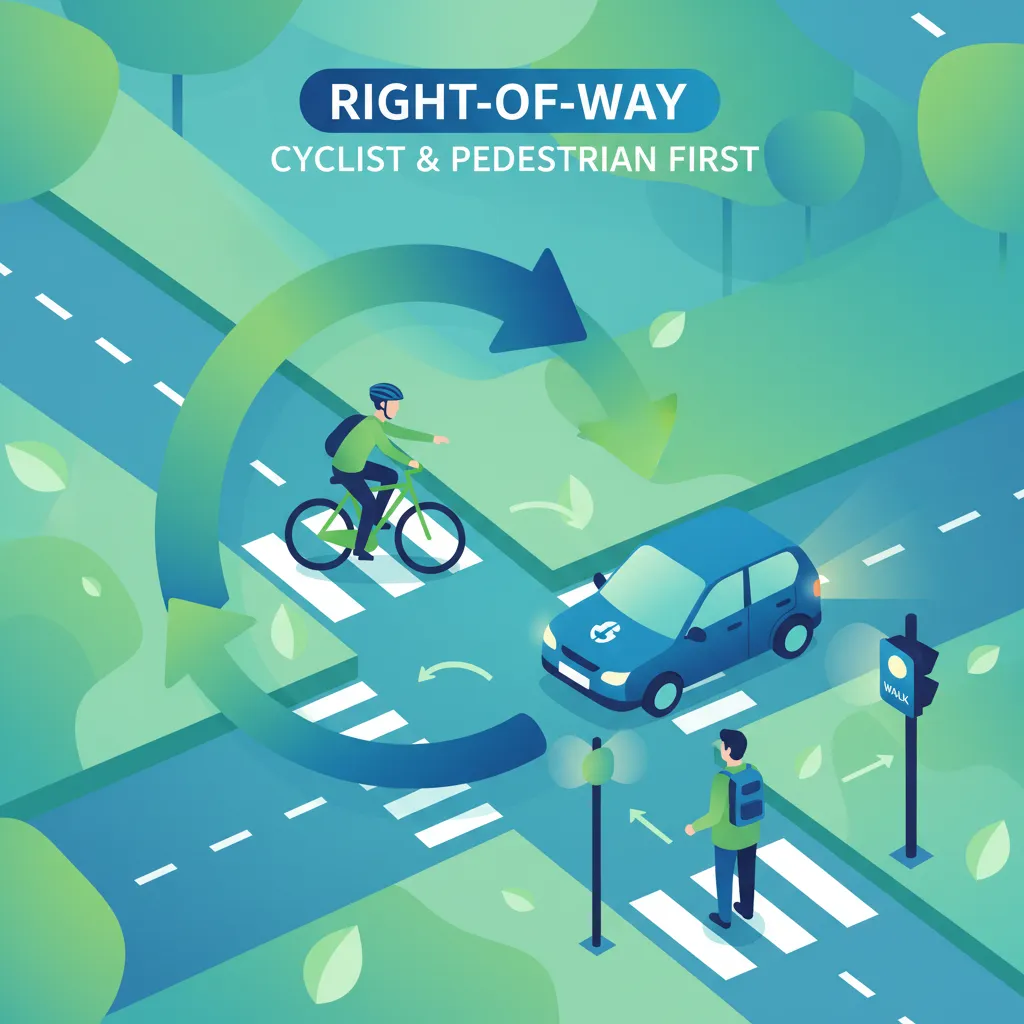
This lesson examines the legal framework defining right-of-way, distinguishing between priority and secondary roads, and detailing yielding responsibilities. It teaches riders how to assess intersections and approach safely based on Icelandic traffic law. Understanding these principles is critical for preventing collisions and ensuring smooth traffic flow at all types of junctions.

This lesson outlines the eligibility criteria for a Category AM license, including minimum age, residency, and health requirements. It details the application process with the Icelandic Transport Authority, covering the necessary documentation and examination stages. Learners will understand the complete pathway from application to receiving a full license, ensuring they are prepared for each step.
Identify and understand common mistakes and violations related to traffic law hierarchy, speed limits, and ordinances for AM moped riders in Iceland. Avoid penalties by clarifying these potential issues.
This lesson dissects the three-color traffic light system, detailing the meaning of red, amber, and green signals, including flashing lights and directional arrows. It explains how signal timing impacts moped riders and the legal requirement to obey all signals at intersections. Proper interpretation is crucial for navigating signalized junctions safely and avoiding conflicts with other traffic.
This lesson focuses on interpreting road surface markings, including solid and broken lines that govern lane changes and positioning. Learners will understand the rules associated with turning arrows, pedestrian crossings, and markings for dedicated lanes. Correctly reading these markings is essential for maintaining proper lane discipline and navigating complex road layouts safely.
This lesson familiarizes learners with signs that warn of upcoming hazards, such as sharp curves, slippery surfaces, or animal crossings. It emphasizes the importance of early hazard recognition and response, which is especially critical for vulnerable moped riders. Understanding these signs allows riders to anticipate road conditions and adjust their riding strategy accordingly for increased safety.
This lesson examines regulatory signs that impose legal obligations, focusing on those most relevant to moped riders like speed limits and mandatory direction signs. Learners will understand how sign shapes and colors convey specific commands or prohibitions. Attention is given to signs with vehicle-specific restrictions, ensuring riders know when rules apply directly to them.
This lesson provides an overview of the legal penalties for traffic violations and outlines the correct procedures to follow after an accident. It covers how to secure an accident scene, contact emergency services using 112, and provide basic first aid. Riders will also learn about their legal obligations for reporting incidents and the initial steps for making an insurance claim.
This lesson covers the strict rules governing pedestrian crossings and school zones, where riders have a heightened duty of care. It details the obligation to yield to pedestrians, recognize school zone signage, and reduce speed significantly. Riders learn to be extra vigilant for the unpredictable movements of children and other vulnerable road users in these sensitive areas.

This lesson explores the conduct required at uncontrolled crossings where the right-hand rule typically applies. It emphasizes the need to reduce speed, be prepared to stop, and establish clear communication with other road users. Riders will learn to assess the situation carefully and proceed only when it is confirmed to be safe, a critical skill for rural and residential areas.
This lesson covers the extensive obligations that come with riding a moped, emphasizing the duty of care to other road users. It details specific legal requirements, such as mandatory helmet use, adherence to speed limits, and correct signaling protocols. Understanding these responsibilities helps riders grasp the consequences of non-compliance and fosters a culture of safety on the road.
This lesson examines the legal framework defining right-of-way, distinguishing between priority and secondary roads, and detailing yielding responsibilities. It teaches riders how to assess intersections and approach safely based on Icelandic traffic law. Understanding these principles is critical for preventing collisions and ensuring smooth traffic flow at all types of junctions.

This lesson outlines the regulations governing pedestrian crossings, including zebra crossings, pedestrian traffic lights, and the driver’s obligations to yield. Learners will study how to identify crosswalk markings, interpret pedestrian signal phases, and understand the enhanced caution required in school zones and areas with high foot traffic. The content also emphasizes the need for drivers to anticipate vulnerable pedestrians and provide additional yielding in low-visibility conditions.
Find clear answers to common questions learners have about Understanding Traffic Law Hierarchy in Iceland. Learn how the lesson is structured, which driving theory objectives it supports, and how it fits into the overall learning path of units and curriculum progression in Iceland. These explanations help you understand key concepts, lesson flow, and exam focused study goals.
The primary source of traffic law in Iceland is national legislation, such as the Road Traffic Act (Umferðarlög). These overarching laws set the fundamental rules for all road users, including moped riders. Local regulations or specific road signs may provide further details or impose additional restrictions, but they must always be consistent with national statutes.
Local traffic rules, often implemented through specific signage or municipal ordinances, supplement national laws. For example, a local speed limit sign might impose a lower speed than the general national limit for that road type. However, local rules cannot contradict or override national traffic statutes; they always operate within the framework set by national law.
In the Icelandic legal system, national traffic laws always take precedence over local rules or interpretations. If you encounter a situation where a local measure appears to conflict with a national statute, you must adhere to the national law. This ensures a consistent and authoritative application of traffic regulations across the country for all vehicle categories, including mopeds.
The Icelandic AM license theory exam often includes questions that test your understanding of how different traffic rules are applied. Knowing the hierarchy helps you correctly interpret scenarios, distinguish between general and specific rules, and apply the most appropriate regulation, leading to more accurate answers on your exam.
The fundamental hierarchy of traffic law is the same for all vehicle categories in Iceland, including mopeds (Category AM) and cars. National laws form the basis, supplemented by specific regulations and signage. The main difference lies in the specific rules and restrictions that apply to mopeds, such as speed limits or permitted road types, which are defined within this legal hierarchy.
Utilize our advanced practice set search to pinpoint the exact Icelandic driving theory topics you need to review. Filter by subject, difficulty, or question type to create a highly effective study plan and ensure you are fully prepared for your official driving licence test in Iceland.