
This lesson covers the critical rules regarding pedestrian crossings, known in Austria as Schutzweg. You will learn the exact legal obligations for drivers when pedestrians approach or use these crossings, ensuring you are fully prepared for both the theory exam and real-world urban driving.

Lesson content overview
Understanding the rules governing pedestrian crossings is paramount for all drivers in Austria. This lesson, part of the Austrian Driving License B Theory Course, delves into the specific regulations, particularly focusing on the marked zebra crossings known as Schutzweg. These crossings are designed to provide a safe passage for pedestrians, and the law places a strict obligation on drivers to ensure their safety. Mastering these rules is not just about legal compliance; it's about fostering a safe driving culture and preventing accidents involving vulnerable road users.
In Austria, pedestrian crossings are governed by precise regulations under the Straßenverkehrsordnung (StVO). Among these, the Schutzweg holds a special status due to its strict priority rules. Drivers must understand the legal framework and practical implications of these crossings to navigate them safely and correctly.
A Schutzweg is a marked pedestrian crossing, typically identified by alternating white and black stripes (a zebra crossing) across the road surface. Crucially, a Schutzweg is also accompanied by a specific traffic sign.
This sign, depicting a pedestrian crossing, confirms the designation of the area as a Schutzweg. The combination of the road markings and the sign signifies that pedestrians using this crossing have absolute priority. This designation is critical because it removes any ambiguity about who has the right-of-way, placing the full responsibility for yielding on the driver. Its significance lies in enhancing pedestrian safety by providing clear, predictable crossing opportunities, especially in urban and residential areas.
The core principle at any marked Schutzweg is absolute pedestrian priority (absoluter Vorrang). This means that if a pedestrian is on the Schutzweg, or clearly intending to step onto it, drivers must yield completely. This is not merely a suggestion to slow down; it's a legal obligation to come to a full stop and allow the pedestrian to cross without any interference or feeling rushed.
This principle is fundamental to Austrian traffic law and is rooted in the recognition of pedestrians as vulnerable road users. It ensures that pedestrians can cross safely, confidently, and without having to second-guess a driver's intentions. Failing to respect this absolute priority is a serious traffic violation and a significant cause of accidents involving pedestrians.
To ensure safety and comply with the StVO, drivers must adhere to several specific rules when approaching and navigating pedestrian crossings, particularly Schutzwege. These rules dictate appropriate speed, stopping procedures, and behavior around traffic signals.
When approaching any pedestrian crossing where yielding is required, drivers must stop at the designated stop line (Stopp-Linie). This is a solid white line painted across the lane, preceding the zebra stripes of the Schutzweg. The purpose of the stop line is to clearly delineate the safe stopping point. By stopping before this line, drivers ensure that the crossing area itself remains clear and unobstructed, allowing pedestrians ample space to cross safely without having to walk around stationary vehicles.
Failing to stop before the stop line can result in obstructing the pedestrian's path, creating a hazardous situation, and is considered a violation. It is essential to ensure that the entire vehicle is behind the stop line before proceeding, once the crossing is clear.
Some pedestrian crossings, especially at busy intersections, are equipped with traffic lights for both vehicles and pedestrians. At these signal-controlled Schutzwege, the traffic lights dictate the right-of-way.
It is a common misunderstanding that if there are no pedestrians immediately present, a driver can proceed through a red vehicular light when the pedestrian signal is green. This is incorrect. Drivers must always respect the traffic light phases. A green pedestrian signal legally obliges vehicles to stop, even if no pedestrian has yet stepped onto the crossing. This prevents last-minute conflicts and provides a predictable flow for all road users.
A critical aspect of safe driving at pedestrian crossings is the proactive adjustment of speed and maintaining high vigilance. Drivers must always approach a Schutzweg with a reduced speed, ensuring they can stop safely and completely before the stop line if a pedestrian appears. This requirement is paramount, especially when visibility is limited due to weather conditions, time of day, or other obstructions.
Visibility plays a significant role. Under adverse conditions such as heavy rain, fog, snowfall, or at night, pedestrians can be much harder to spot. In these scenarios, drivers must reduce their speed even further to extend their reaction time and stopping distance. The goal is to be able to stop within the distance you can clearly see, even if a pedestrian emerges unexpectedly from behind an obstruction or into low light. Maintaining an appropriate approach speed directly contributes to preventing collisions and upholding pedestrian safety.
The legal requirements for pedestrian crossings and Schutzweg in Austria are explicitly detailed in the Straßenverkehrsordnung (StVO). Adherence to these specific paragraphs is mandatory for all drivers.
The core of pedestrian priority at Schutzweg crossings is enshrined in the following sections of the StVO:
These regulations ensure that the responsibility for safety unequivocally rests with the driver when interacting with pedestrians at these designated crossings.
For signal-controlled crossings, § 61 Abs. 1 StVO governs the behavior of all road users. This article stipulates that vehicles must stop before a red light or a green pedestrian signal. This means that even if the vehicular traffic light is not red, but the pedestrian green light is active, drivers are legally required to stop before the stop line. This prevents conflicts at busy intersections where traffic flows are regulated by lights, reinforcing the principle of orderly and safe passage for pedestrians.
Beyond the specific rules for crossings, general principles of safe driving also apply, reinforcing the need for caution:
Despite clear regulations, violations at pedestrian crossings are unfortunately common, leading to dangerous situations and potential legal consequences. Understanding these pitfalls can help drivers practice safer habits.
Many violations stem from an incomplete understanding or disregard for the absolute priority rule:
Other violations occur in more specific contexts:
Safe driving at pedestrian crossings requires not only knowing the rules but also adapting behavior to various real-world conditions. Environmental factors, vehicle characteristics, and the nature of road users all influence how a driver should approach a Schutzweg.
To fully grasp the regulations discussed, it's helpful to be familiar with the key terms used in Austrian traffic law regarding pedestrian crossings.
Mastering the regulations for pedestrian crossings, particularly the Schutzweg, is a cornerstone of safe driving in Austria. The concept of absolute pedestrian priority is not merely a guideline but a strict legal requirement designed to protect the most vulnerable road users. Drivers must internalize the obligation to stop fully at the stop line, yield to pedestrians on or intending to use a Schutzweg, and respect traffic light signals, including the pedestrian green light.
Beyond strict adherence to the rules, a proactive and defensive driving mindset is crucial. This involves adjusting speed for visibility and road conditions, anticipating the unexpected actions of pedestrians, and showing patience and consideration for all road users, especially children, the elderly, and those with disabilities. By consistently applying these principles, drivers contribute significantly to reducing accident risks, ensuring legal compliance, and fostering a safer, more harmonious traffic environment on Austrian roads.
This lesson covers the Austrian regulations for pedestrian crossings (Schutzweg), emphasizing the principle of absolute pedestrian priority under StVO. Drivers must fully stop at the stop line before marked crossings when pedestrians are present or intend to cross, and at signal-controlled crossings, vehicles must stop whenever the pedestrian signal is green. Key legal references include § 66 Abs. 2 StVO for absolute priority and § 61 Abs. 1 StVO for traffic light compliance. Drivers should approach crossings at reduced speeds, adjust for weather and visibility conditions, and allow extra time for vulnerable road users to cross completely.
A short set of high-value points that capture the most important learning from this lesson.
A Schutzweg is a marked pedestrian crossing (zebra pattern) accompanied by sign B22, where pedestrians have absolute priority under Austrian law.
Drivers must come to a complete stop at the stop line (Stopp-Linie) when pedestrians are on or clearly intending to step onto the crossing.
At signal-controlled crossings, vehicles must stop when the pedestrian signal is green, regardless of whether pedestrians are physically present.
Approach every Schutzweg with reduced speed sufficient to stop safely before the stop line if a pedestrian appears.
Legal responsibility for yielding at Schutzwege rests entirely with drivers under § 66 Abs. 2 StVO.
Explore all units and lessons included in this driving theory course.
Absolute pedestrian priority (Absoluter Vorrang) means no vehicle may proceed until pedestrians have fully cleared the crossing area.
A green pedestrian signal legally obliges vehicles to stop even if no pedestrian is currently on the crossing.
Stop line (Stopp-Linie) position is mandatory—creeping past it blocks the pedestrian path and is a violation.
Reduced visibility (night, rain, fog, snow) requires earlier and greater speed reduction due to extended stopping distances.
Vulnerable pedestrians (children, elderly, disabled) may need extra crossing time—patience is required.
Only slowing down instead of making a full, discernible stop before the stop line.
Proceeding when the pedestrian signal is green simply because no pedestrian is currently on the crossing.
Creeping past the stop line while waiting to turn, blocking the crossing area for pedestrians.
Moving forward as soon as a pedestrian steps off the stripes without ensuring they have fully cleared the crossing and curb.
Approaching at speeds that prevent safe stopping if a pedestrian suddenly appears, especially in poor visibility.
Lesson content overview
A short set of high-value points that capture the most important learning from this lesson.
A Schutzweg is a marked pedestrian crossing (zebra pattern) accompanied by sign B22, where pedestrians have absolute priority under Austrian law.
Drivers must come to a complete stop at the stop line (Stopp-Linie) when pedestrians are on or clearly intending to step onto the crossing.
At signal-controlled crossings, vehicles must stop when the pedestrian signal is green, regardless of whether pedestrians are physically present.
Approach every Schutzweg with reduced speed sufficient to stop safely before the stop line if a pedestrian appears.
Legal responsibility for yielding at Schutzwege rests entirely with drivers under § 66 Abs. 2 StVO.
Explore all units and lessons included in this driving theory course.
Absolute pedestrian priority (Absoluter Vorrang) means no vehicle may proceed until pedestrians have fully cleared the crossing area.
A green pedestrian signal legally obliges vehicles to stop even if no pedestrian is currently on the crossing.
Stop line (Stopp-Linie) position is mandatory—creeping past it blocks the pedestrian path and is a violation.
Reduced visibility (night, rain, fog, snow) requires earlier and greater speed reduction due to extended stopping distances.
Vulnerable pedestrians (children, elderly, disabled) may need extra crossing time—patience is required.
Only slowing down instead of making a full, discernible stop before the stop line.
Proceeding when the pedestrian signal is green simply because no pedestrian is currently on the crossing.
Creeping past the stop line while waiting to turn, blocking the crossing area for pedestrians.
Moving forward as soon as a pedestrian steps off the stripes without ensuring they have fully cleared the crossing and curb.
Approaching at speeds that prevent safe stopping if a pedestrian suddenly appears, especially in poor visibility.
Explore search topics learners often look for when studying Pedestrian Crossings and Schutzweg Regulations. These topics reflect common questions about road rules, driving situations, safety guidance, and lesson level theory preparation for learners in Austria.
Browse additional driving theory lessons that cover connected traffic rules, road signs, and common driving situations related to this topic. Improve your understanding of how different rules interact across everyday traffic scenarios.
Learn the specific legal regulations for Austrian pedestrian crossings, focusing on Schutzweg rules. Understand driver responsibilities, absolute pedestrian priority, and safe interaction at zebra crossings and signal-controlled areas.

Pedestrians have absolute priority on marked crossings in Austria, and a bus driver must always be ready to give way. This lesson covers the rules for approaching and stopping for pedestrians, and highlights the risk of pedestrians being hidden by the vehicle's structure. It also stresses the danger of passengers crossing the road after alighting from your bus.
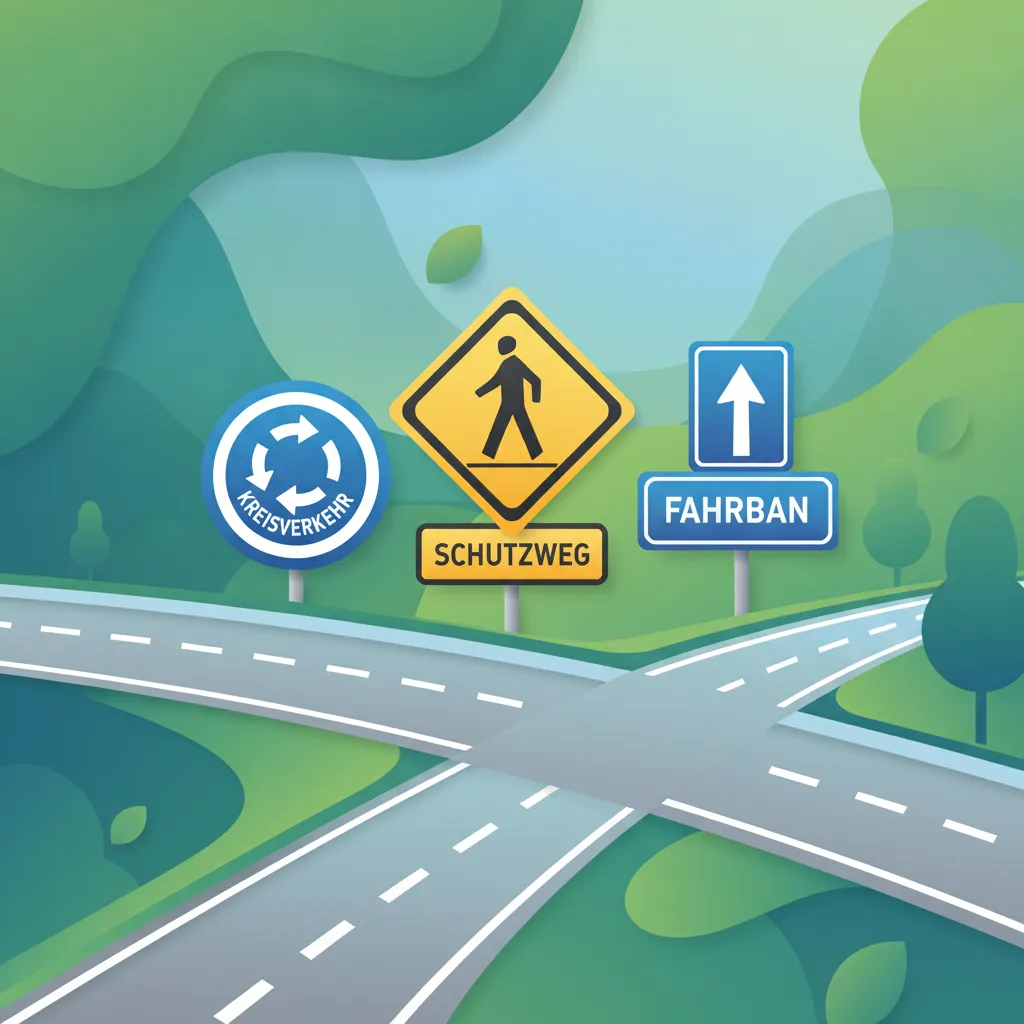
This lesson covers the specific regulations associated with special Austrian road signs and areas. It details the rules for 'Schutzweg' (protected pedestrian crossings), 'Kreisverkehr' (roundabouts), and the distinction between 'Fahrbahn' (road) and 'Fahrstreifen' (lane). Understanding these specific contexts is essential for safe navigation in urban and suburban environments.

This lesson provides a comprehensive explanation of Austria's right-of-way laws, which are fundamental to intersection safety. It covers the meaning of different priority signs and clarifies the 'Rechts vor Links' (priority to the right) rule that applies at unmarked junctions. A clear understanding of these rules is essential to prevent conflicts and collisions in urban and rural settings.
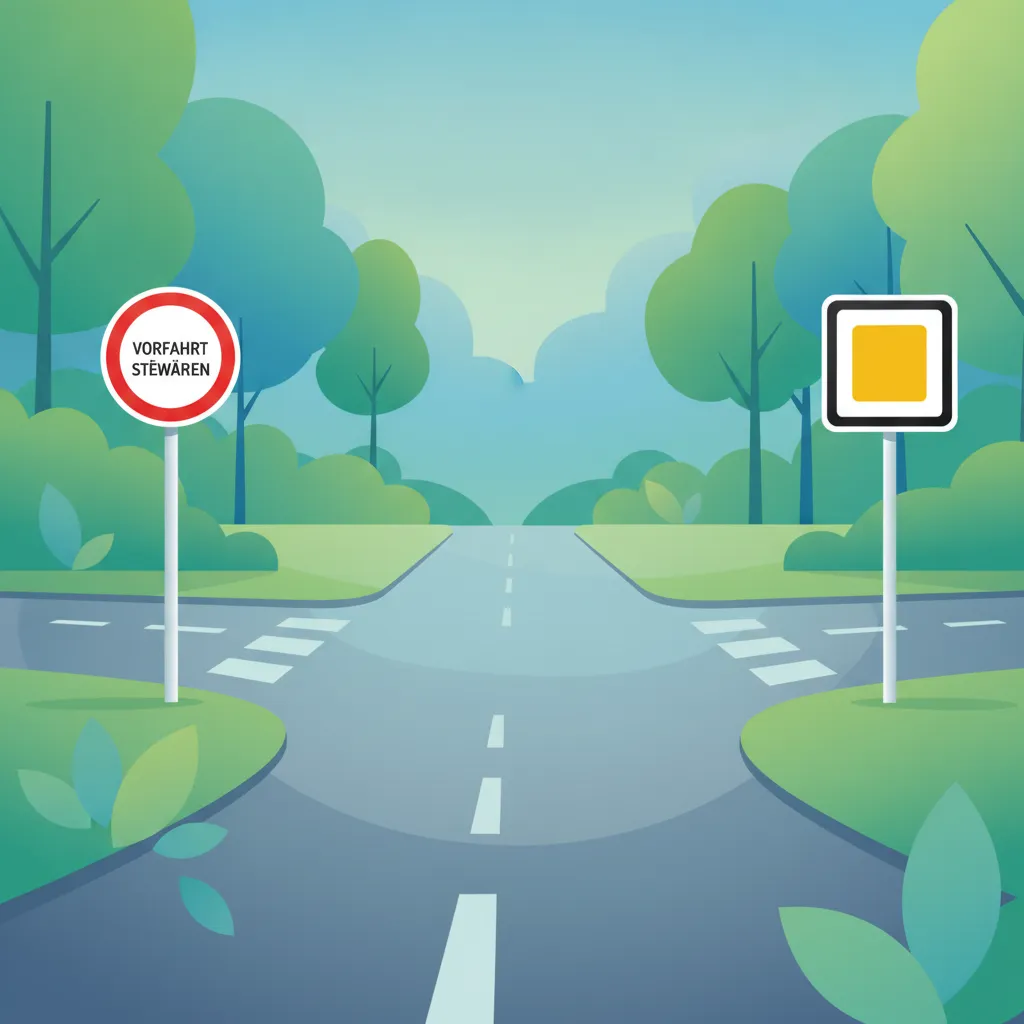
This lesson explains the fundamental concepts of priority that govern traffic at Austrian junctions. It differentiates between having priority ('Vorfahrt') and the duty to yield ('Nachrang'), detailing the signs that establish these rules. Correct application of these principles is critical for preventing collisions at intersections and roundabouts.
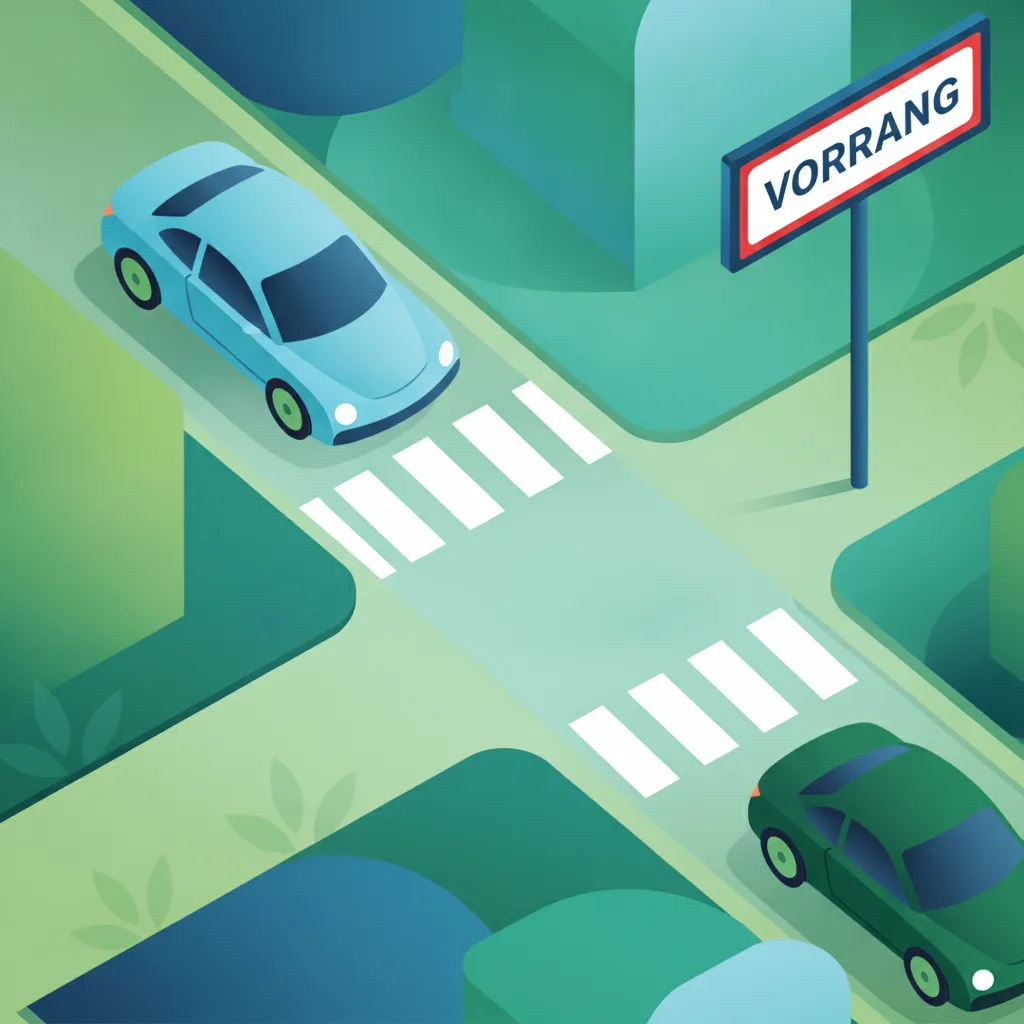
This lesson provides a detailed analysis of the core Austrian traffic rules that govern priority at junctions and in traffic. It focuses on the principles of Vorrang (having priority), Nachrang (yielding), and the Rechtsregel (default right-of-way from the right). Learners will understand the hierarchy of these rules and their application at various types of intersections, from unmarked junctions to those controlled by priority road signs, ensuring correct and safe decision-making.
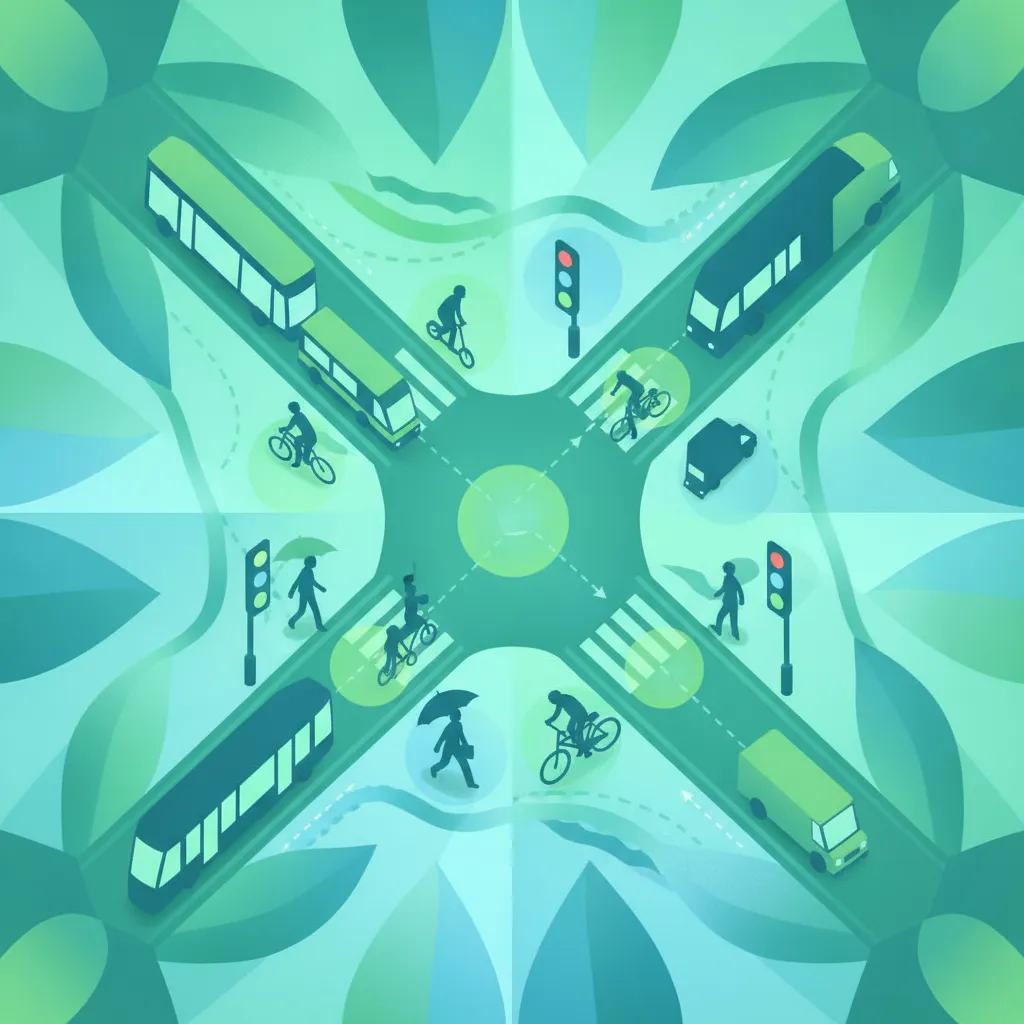
This lesson examines various common intersection layouts, including T-intersections, four-way junctions, and complex multi-lane crossings. It explains how right-of-way is determined in each scenario, whether through traffic signals, stop or yield signs, or the default right-hand rule. Understanding how to identify conflict points and apply the correct priority rule is essential for preventing collisions and ensuring smooth traffic movement.

This lesson addresses the unique challenges and priority rules that apply when interacting with public transport and cyclists at intersections. It clarifies the specific right-of-way regulations for trams, which often have priority over other traffic, and the procedures for navigating around bus stops. The content also covers how to safely manage crossings with dedicated bicycle lanes, ensuring the protection of all road users.

This lesson explains the core principles of Vorrang (having priority) and Nachrang (the obligation to yield) which form the basis of the Austrian traffic hierarchy. Learners will understand how priority roads are designated by signs and how drivers on secondary roads must yield right-of-way. The content clarifies the legal foundation for these rules under the Austrian road traffic act (StVO), providing a clear framework for decision-making at intersections.

This lesson teaches a safe and systematic process for approaching and crossing intersections. It covers how to correctly assess priority based on signs and general rules, adjust speed appropriately, and perform thorough visual checks. Emphasis is placed on anticipating the actions of other road users to prevent conflicts at junctions.
This lesson details the specific regulations and best practices for driving in areas with high pedestrian activity, such as bus stops and school zones. It explains the driver's obligation to stop for school buses with flashing lights and to yield to public buses pulling out from a stop. The content emphasizes the requirement to significantly reduce speed in marked school zones to ensure the safety of children.
Explore how to safely navigate pedestrian crossings in Austria, with a special focus on interacting with vulnerable road users like children and the elderly. Understand how weather and visibility impact these interactions.
Pedestrians have absolute priority on marked crossings in Austria, and a bus driver must always be ready to give way. This lesson covers the rules for approaching and stopping for pedestrians, and highlights the risk of pedestrians being hidden by the vehicle's structure. It also stresses the danger of passengers crossing the road after alighting from your bus.

This lesson provides advanced strategies for proactively managing interactions with vulnerable road users to prevent conflicts before they arise. It teaches drivers to predict the likely behavior of pedestrians, cyclists, and e-scooter riders, especially at intersections and in congested areas. Key techniques include maintaining larger safety distances, covering the brake, and making eye contact to ensure mutual awareness and avoid accidents.

This lesson focuses on the critical skill of sharing the road safely with vulnerable users, such as pedestrians, cyclists, and e-scooter riders. It details the legally required distance buffers for overtaking and emphasizes heightened awareness in sensitive areas like school zones and designated pedestrian crossings. The content provides guidelines for interacting with bicycle lanes and shared spaces to foster a protective and respectful driving attitude towards those most at risk.
This lesson teaches a safe and systematic process for approaching and crossing intersections. It covers how to correctly assess priority based on signs and general rules, adjust speed appropriately, and perform thorough visual checks. Emphasis is placed on anticipating the actions of other road users to prevent conflicts at junctions.

This lesson teaches drivers how to safely coexist with cyclists and pedestrians, who are prevalent in urban areas. It covers the rules for dedicated bike lanes (Radweg), the importance of yielding to pedestrians in designated zones, and the need for extra caution when turning or opening car doors. Maintaining safe overtaking distances and anticipating the movements of these vulnerable road users are key themes for preventing accidents.

This lesson reinforces the critical importance of protecting vulnerable road users in dense urban settings. It teaches drivers to be hyper-aware of pedestrians and cyclists, especially near intersections and crosswalks. Key techniques include reducing speed, making eye contact to confirm intentions, and giving ample space.
This lesson covers the specific regulations associated with special Austrian road signs and areas. It details the rules for 'Schutzweg' (protected pedestrian crossings), 'Kreisverkehr' (roundabouts), and the distinction between 'Fahrbahn' (road) and 'Fahrstreifen' (lane). Understanding these specific contexts is essential for safe navigation in urban and suburban environments.

This lesson teaches a safe, methodical process for navigating intersections. It stresses the importance of proper lane positioning on approach, comprehensive visual scans for cross-traffic, pedestrians, and cyclists, and clear communication of intent. Special attention is given to the increased risks associated with left turns across oncoming traffic.
This lesson addresses the unique challenges and priority rules that apply when interacting with public transport and cyclists at intersections. It clarifies the specific right-of-way regulations for trams, which often have priority over other traffic, and the procedures for navigating around bus stops. The content also covers how to safely manage crossings with dedicated bicycle lanes, ensuring the protection of all road users.

This lesson addresses the specific challenges of interacting with larger vehicles like buses and trams in an urban environment. It explains how to signal intentions clearly and predictably to avoid conflicts in shared spaces. Key topics include safely crossing tram tracks and maintaining awareness around public transport stops.
Find clear answers to common questions learners have about Pedestrian Crossings and Schutzweg Regulations. Learn how the lesson is structured, which driving theory objectives it supports, and how it fits into the overall learning path of units and curriculum progression in Austria. These explanations help you understand key concepts, lesson flow, and exam focused study goals.
You must stop if it is clear that the pedestrian intends to use the crossing. You do not need to stop for pedestrians who are only walking along the pavement or standing well back without indicating an intent to cross.
Overtaking is strictly prohibited at a Schutzweg. Furthermore, you must not overtake vehicles that have stopped to allow pedestrians to cross, as this creates a severe danger and is a common failure point in exams.
Yes. If traffic lights are operational at a pedestrian crossing, they take precedence over the standard Schutzweg priority rules. You must obey the light signals, though you must still exercise caution for any pedestrians already on the crossing.
No, parking and stopping are strictly prohibited on a Schutzweg and within a distance of 5 meters immediately before it to ensure maximum visibility for both drivers and pedestrians.
Refine your study plan by searching for specific Austrian driving theory practice sets. Pinpoint questions related to particular road rules, signs, or challenge levels, and begin practicing immediately to reinforce your knowledge and excel in your official exam with confidence. Get started with focused revision today.