
This lesson focuses on the critical safety skills needed to navigate tram tracks and public transport areas as an AM license holder. By understanding how to approach these complex urban zones, you will improve your road safety and confidence for both the official exam and real-world riding.
Lesson content overview
For riders of mopeds and small scooters in Austria, understanding how to safely interact with tram tracks and public transport vehicles is crucial for urban riding. This lesson of the Austrian AM Driving Theory course focuses on specific hazards and regulations to ensure your safety and contribute to smooth traffic flow. Trams, being electric rail vehicles, present unique challenges due to their fixed routes, limited maneuverability, and the inherent slipperiness of their metal tracks. Additionally, navigating around bus and tram stops requires heightened awareness of passenger movements and the specific priority rules that apply to public transport.
Tram tracks are an integral part of many Austrian cities, enabling efficient public transport. However, for two-wheeled vehicles like mopeds and scooters, they represent a distinct and often underestimated hazard. Their presence necessitates a different approach to riding, requiring riders to adapt their speed, angle of approach, and overall road position.
The most immediate danger posed by tram tracks is their inherently low-friction surface. Steel rails offer significantly less grip than asphalt, particularly when wet, icy, or covered with leaves, oil, or gravel. This reduced friction means that your tires have less traction, increasing the risk of a slip or skid.
When your tires are parallel to the tracks, even momentarily, they can easily get caught in the groove or slide along the smooth metal. This effect is amplified when braking or turning directly on the tracks. Furthermore, the small contact patch of moped and scooter tires makes them more susceptible to these low-friction conditions compared to cars with wider tires.
A sudden loss of grip on tram tracks can quickly lead to a loss of balance, especially for moped and scooter riders who rely heavily on dynamic balance for control. If a wheel slips sideways, it can cause the vehicle to wobble or even fall. This is particularly dangerous in mixed traffic, where an unexpected loss of control can lead to collisions with other vehicles or obstacles. The design of moped and scooter tires, while optimized for urban roads, is not designed to provide significant lateral grip on a steel rail. Therefore, conscious effort is required to minimize exposure to the slippery surface.
In Austria, public transport, particularly trams, holds a special status in road traffic law. These regulations are designed to ensure the punctuality of public services and the safety of their many passengers. For moped and scooter riders, understanding and consistently applying these priority rules is non-negotiable.
The Austrian Road Traffic Act (Straßenverkehrsordnung – StVO) § 40 establishes that trams have absolute priority over all other road users, unless explicitly indicated otherwise by road signs or traffic signals. This fundamental rule simplifies right-of-way decisions, but it places a significant responsibility on all other drivers to be constantly aware of tram movements.
Definition: Tram Priority Tram priority refers to the legal precedence given to trams over all other road users, ensuring their unimpeded movement and schedule adherence.
This means that even if you have a green light or are on a priority road, you must yield to an approaching tram if it is entering an intersection. Trams cannot swerve or stop as quickly as other vehicles, making their priority essential for preventing accidents. Riders must be prepared to stop and wait whenever a tram is approaching a crossing or intersection, giving it the necessary space and time to pass.
Trams use specific signals to communicate their intentions, which all road users must recognize and obey.
Dedicated traffic lights for trams (red/green, or white bar indications) and audible warnings (bell or horn) indicating tram movement or intent to stop.
The application of tram priority varies slightly depending on whether an intersection is controlled by signals or not:
Successfully and safely crossing tram tracks on a moped or scooter requires specific techniques to maintain stability and grip. The goal is to minimize the time your tires spend on the slippery metal rails and to maximize the effective contact patch.
To reduce the risk of slipping, riders must cross tram tracks at a specific angle. The recommended minimum angle is 30 degrees to the direction of the rail, but an angle of 45 degrees is considered ideal when feasible. Crossing at a shallow angle (e.g., almost parallel to the rails) significantly increases the chance of a wheel slipping sideways and causing a loss of balance. A perpendicular (90-degree) crossing, while seeming direct, can cause the tire to become momentarily lodged in the groove, especially if the track is uneven, leading to a sudden jarring or loss of control. The optimal angle allows the tire tread to "bite" across the rail, providing more stability.
Before you reach the tram tracks, you must adjust your speed and road position.
Assess the situation: Look far ahead for tram tracks, especially at intersections. Identify the direction of the rails and any associated signals.
Reduce speed: Slow down significantly before reaching the tracks. This gives you more time to react and maneuver, and reduces the impact of any loss of grip.
Adjust your approach: Position your moped or scooter to allow for a crossing angle of 30-45 degrees. This might mean making a slight curve in your path before the tracks.
Maintain a steady throttle: Cross the tracks with a steady, light throttle. Avoid sudden braking, acceleration, or sharp turns while your wheels are on the rails.
Keep your gaze up: Look beyond the tracks to where you want to go, helping to maintain balance and direction.
Beware of multiple tracks: If there are multiple sets of tracks close together, treat each one with the same caution and angle.
Never attempt to stop, brake sharply, or accelerate aggressively while your wheels are directly on tram tracks, especially in wet conditions. This is a primary cause of slips and falls.
This practice aligns with StVO § 6, which mandates drivers to adapt their speed and vehicle position to prevailing road conditions, including slippery surfaces.
Tram and bus stops are areas of high activity where multiple road users — vehicles, pedestrians, and public transport passengers — converge. Navigating these zones safely requires heightened caution and adherence to specific rules.
Public transport stops can be configured in various ways:
At both types of stops, anticipate unpredictable movements from passengers, who may alight and immediately cross the road, often without looking for approaching traffic. Your primary responsibility is to ensure the safety of these vulnerable road users.
When a bus or tram stops to allow passengers to board or alight, StVO § 46 dictates specific obligations for other drivers:
Beyond the general priority rules, several specific sections of the Austrian StVO govern how moped and scooter riders must behave around tram tracks and public transport. Familiarity with these regulations is essential for safe and legal riding.
Understanding the rules is the first step; applying them correctly in dynamic traffic situations is the next. Many accidents involving mopeds/scooters and trams or public transport occur due to common misconceptions or unsafe practices.
Safe interaction with tram tracks and public transport is not static; it requires dynamic adaptation based on various environmental and operational factors.
The rules and recommendations for interacting with tram tracks and public transport are not arbitrary. They are rooted in fundamental principles of physics, human behavior, and the legal framework designed to promote safety and efficiency in urban environments.
The core reason for specific crossing techniques is the difference in the coefficient of friction between rubber tires on asphalt versus rubber tires on steel rails. Steel on rubber has a much lower coefficient of friction. When a wheel is steered at an angle relative to its direction of travel (slip angle), it generates lateral force. On a high-friction surface like asphalt, this force allows turning. On a low-friction surface like steel, too much lateral force (caused by a shallow crossing angle) quickly exceeds the available grip, leading to a slide. Reducing speed and crossing at a wider angle minimizes the lateral force component, allowing the tire to maintain crucial forward grip.
The absolute priority granted to trams and the specific regulations around public transport stops serve several vital purposes:
This lesson covers essential safety techniques for moped riders navigating tram tracks in Austrian urban environments, emphasizing the physics of low rail friction and the critical 30-45 degree crossing angle. Austrian traffic law grants trams absolute priority under StVO § 40, requiring riders to yield at all intersections regardless of their own traffic signals. Key procedures include reducing speed before tracks, maintaining steady throttle during crossing, and never stopping on rails. The lesson also addresses safe conduct near public transport stops under StVO § 46, where riders must maintain safe distances from boarding passengers. Weather conditions significantly affect grip on steel rails, with wet or icy surfaces demanding even greater caution and slower speeds.
A short set of high-value points that capture the most important learning from this lesson.
Tram tracks are inherently slippery due to low friction between steel rails and rubber tires, requiring special riding techniques
Trams have absolute priority under Austrian StVO § 40, meaning you must always yield to them regardless of your traffic light
Cross tram tracks at a minimum 30-degree angle (ideally 45 degrees) to maintain tire grip and prevent slipping
Never stop directly on tram tracks; always stop before the crossing line as trams cannot swerve to avoid you
Public transport stops require heightened awareness of passengers boarding and alighting who may cross unpredictably
Explore all units and lessons included in this driving theory course.
Optimal crossing angle is 30-45 degrees perpendicular to rails to maximize lateral tire grip on the low-friction steel surface
Tram-specific traffic signals (white bar/dot) take precedence over general vehicle traffic lights when both show green
Treat a tram's audible warning (bell or horn) as an urgent signal to be aware and yield immediately
StVO § 18 prohibits stopping on or too close to tram tracks; always leave clear passage for approaching trams
Wet conditions drastically reduce grip on rails, requiring further speed reduction and precise angle maintenance
Crossing tram tracks at a shallow angle or nearly perpendicular, which causes wheels to slip sideways on the low-friction steel surface
Assuming green vehicle traffic lights override tram priority, leading to dangerous intersections with approaching trams
Stopping with wheels positioned directly on the rails, creating an immovable obstacle that trams cannot avoid
Overtaking stopped buses or trams too closely without reducing speed, endangering passengers entering or exiting
Accelerating to beat an approaching tram, which is extremely dangerous due to the tram's long braking distance and fixed route
Lesson content overview
A short set of high-value points that capture the most important learning from this lesson.
Tram tracks are inherently slippery due to low friction between steel rails and rubber tires, requiring special riding techniques
Trams have absolute priority under Austrian StVO § 40, meaning you must always yield to them regardless of your traffic light
Cross tram tracks at a minimum 30-degree angle (ideally 45 degrees) to maintain tire grip and prevent slipping
Never stop directly on tram tracks; always stop before the crossing line as trams cannot swerve to avoid you
Public transport stops require heightened awareness of passengers boarding and alighting who may cross unpredictably
Explore all units and lessons included in this driving theory course.
Optimal crossing angle is 30-45 degrees perpendicular to rails to maximize lateral tire grip on the low-friction steel surface
Tram-specific traffic signals (white bar/dot) take precedence over general vehicle traffic lights when both show green
Treat a tram's audible warning (bell or horn) as an urgent signal to be aware and yield immediately
StVO § 18 prohibits stopping on or too close to tram tracks; always leave clear passage for approaching trams
Wet conditions drastically reduce grip on rails, requiring further speed reduction and precise angle maintenance
Crossing tram tracks at a shallow angle or nearly perpendicular, which causes wheels to slip sideways on the low-friction steel surface
Assuming green vehicle traffic lights override tram priority, leading to dangerous intersections with approaching trams
Stopping with wheels positioned directly on the rails, creating an immovable obstacle that trams cannot avoid
Overtaking stopped buses or trams too closely without reducing speed, endangering passengers entering or exiting
Accelerating to beat an approaching tram, which is extremely dangerous due to the tram's long braking distance and fixed route
Explore search topics learners often look for when studying Tram Tracks and Intersections with Public Transport. These topics reflect common questions about road rules, driving situations, safety guidance, and lesson level theory preparation for learners in Austria.
Browse additional driving theory lessons that cover connected traffic rules, road signs, and common driving situations related to this topic. Improve your understanding of how different rules interact across everyday traffic scenarios.
Explore the specific dangers and legal requirements when riding mopeds near buses and trams in Austria. This lesson covers priority rules, safe distances, and common hazards at public transport stops, crucial for AM license theory.

This lesson addresses the specific challenges of interacting with larger vehicles like buses and trams in an urban environment. It explains how to signal intentions clearly and predictably to avoid conflicts in shared spaces. Key topics include safely crossing tram tracks and maintaining awareness around public transport stops.
This lesson details the specific regulations and best practices for driving in areas with high pedestrian activity, such as bus stops and school zones. It explains the driver's obligation to stop for school buses with flashing lights and to yield to public buses pulling out from a stop. The content emphasizes the requirement to significantly reduce speed in marked school zones to ensure the safety of children.
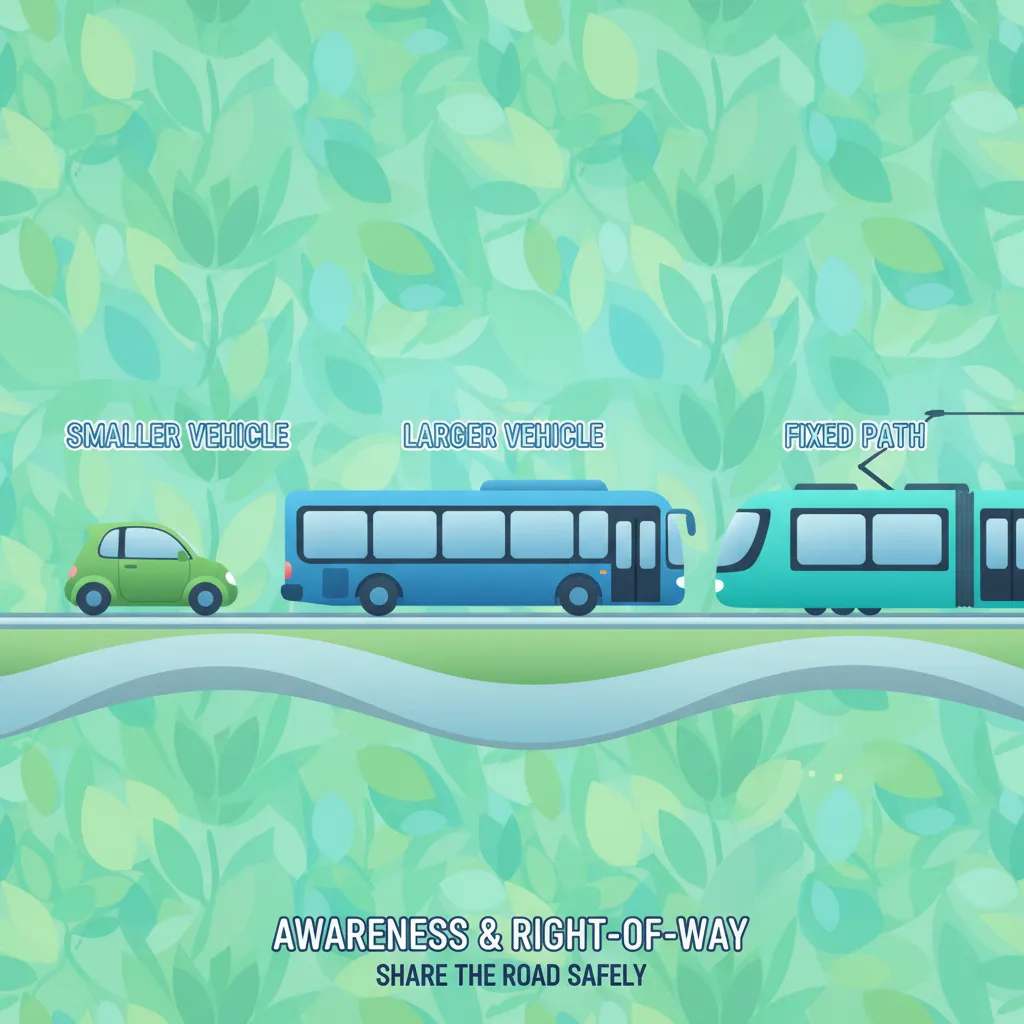
This lesson provides specific guidance for sharing the road with different types of vehicles in Austria. It covers the dangers of large vehicle blind spots, the rules for navigating near buses and dedicated tram tracks, and common conflict points at intersections. Understanding the behavior and limitations of other vehicles is key to safely navigating complex urban environments.

Transporting children carries the highest level of responsibility. This lesson covers the specific Austrian rules for school buses, including the use of warning signs and lights. It focuses on developing a mindset of extreme caution, anticipating that children may run into the road unexpectedly, and managing the chaotic traffic environment often found around schools during drop-off and pick-up times.
This lesson focuses on the unique challenges presented by tram systems in Austrian cities. It teaches riders how to cross tracks at a safe angle to avoid tyres getting caught, especially in wet conditions, and explains the absolute priority trams have in most situations. Awareness around tram stops and bus lanes is also covered to ensure safe coexistence with public transport.
This lesson introduces the proactive mindset of defensive driving, which focuses on anticipating potential hazards rather than just reacting to them. It teaches techniques for systematic risk assessment, including scanning the road ahead, checking mirrors frequently, and being aware of the potential actions of other road users. By adopting these safe habits, drivers can create a buffer of safety around their vehicle and significantly reduce the likelihood of being involved in an accident.

Driving in tourist hotspots in cities like Salzburg or alpine resorts requires extra patience and vigilance. This lesson explores common unpredictable behaviours, such as pedestrians stepping into the road to take photos or groups of tourists being unaware of traffic. It teaches drivers to slow down, be prepared for anything, and use communication tools like the horn sparingly and appropriately.

Rural Austrian roads present unique challenges, including lack of markings, tight spaces, and slow-moving agricultural vehicles. This lesson teaches how to read the road ahead, anticipate hazards around blind bends, and use passing places effectively when meeting other large vehicles. It emphasizes adjusting speed to suit the limited visibility and variable road conditions.

Cities like Vienna and Graz have extensive tram networks that require special attention from bus drivers. This lesson covers the rules of priority concerning trams, the dangers of crossing tracks, and the specific hazards at shared stops where passengers cross traffic lanes. It emphasizes the need for extreme caution and clear communication with other road users in these complex environments.

This lesson provides a clear overview of the legal penalties for traffic violations in Austria. It details the system of fines, demerit points, and the conditions that can lead to license suspension or revocation. Understanding these consequences reinforces the importance of lawful and responsible riding.
Master the physics and techniques for crossing tram tracks safely, focusing on angle, speed, and grip. This theory lesson addresses the unique challenges and legal nuances of navigating slippery tram rails in Austrian urban environments.
This lesson focuses on the unique challenges presented by tram systems in Austrian cities. It teaches riders how to cross tracks at a safe angle to avoid tyres getting caught, especially in wet conditions, and explains the absolute priority trams have in most situations. Awareness around tram stops and bus lanes is also covered to ensure safe coexistence with public transport.
This lesson addresses the specific challenges of interacting with larger vehicles like buses and trams in an urban environment. It explains how to signal intentions clearly and predictably to avoid conflicts in shared spaces. Key topics include safely crossing tram tracks and maintaining awareness around public transport stops.
This lesson provides specific guidance for sharing the road with different types of vehicles in Austria. It covers the dangers of large vehicle blind spots, the rules for navigating near buses and dedicated tram tracks, and common conflict points at intersections. Understanding the behavior and limitations of other vehicles is key to safely navigating complex urban environments.

This lesson teaches a safe and systematic process for approaching and crossing intersections. It covers how to correctly assess priority based on signs and general rules, adjust speed appropriately, and perform thorough visual checks. Emphasis is placed on anticipating the actions of other road users to prevent conflicts at junctions.

This lesson provides guidance on selecting the appropriate road position to maximize visibility and safety. It covers strategies for riding in different parts of a lane based on traffic, road conditions, and potential hazards like parked cars. The goal is to establish a defensive position that allows for adequate reaction time and makes the rider predictable to others.

This lesson focuses on the specific regulations and safety protocols for driving near trams (Straßenbahn) in Austrian cities. It clarifies the priority rules, which almost always favor the tram, and explains how to safely share lanes or cross tram tracks. The content provides critical guidance on how to behave at tram stops, ensuring the safety of boarding and alighting passengers is always the primary concern.
Cities like Vienna and Graz have extensive tram networks that require special attention from bus drivers. This lesson covers the rules of priority concerning trams, the dangers of crossing tracks, and the specific hazards at shared stops where passengers cross traffic lanes. It emphasizes the need for extreme caution and clear communication with other road users in these complex environments.

This lesson focuses on the rider's primary responsibility: ensuring they are visible and their actions are predictable to other road users. It explains effective strategies such as using proper lighting, wearing reflective clothing, and adopting a safe road position. The content also emphasizes how clear signaling and anticipating the actions of others can significantly reduce the risk of collisions.

This lesson explores the strict regulations governing pedestrian crossings in Austria, particularly marked zebra crossings known as Schutzweg. It emphasizes the absolute priority of pedestrians on these crossings and the driver's legal obligation to stop and allow them to cross safely. The content covers how to approach these areas with caution, the importance of visibility, and the rules at crossings controlled by traffic lights.

This lesson focuses on identifying and mitigating common hazards in dense urban settings. It explains how to maintain a safe distance from parked cars to avoid opening doors and how to navigate narrow streets. Additionally, it covers the special rules and heightened awareness required when riding in or near pedestrian zones and school areas.
Find clear answers to common questions learners have about Tram Tracks and Intersections with Public Transport. Learn how the lesson is structured, which driving theory objectives it supports, and how it fits into the overall learning path of units and curriculum progression in Austria. These explanations help you understand key concepts, lesson flow, and exam focused study goals.
Crossing at a shallow angle can cause your tires to get stuck in the groove or lose grip, especially in wet conditions. Always aim to cross as close to a 90-degree angle as possible to maintain stability and prevent sliding.
Always look for the designated boarding areas. In Austria, if passengers are boarding or alighting and there is no safety island, you must stop behind the vehicle and wait for passengers to reach the pavement safely.
Yes, look for warning signs indicating tram traffic. These alert you to the presence of rails. Remember that trams generally have right-of-way unless specific traffic signs or signals dictate otherwise.
The exam often features interactive scenarios showing tram intersections. You will be tested on your ability to identify the correct path of travel, your spatial awareness, and your knowledge of when you are required to yield to public transport.
Refine your study plan by searching for specific Austrian driving theory practice sets. Pinpoint questions related to particular road rules, signs, or challenge levels, and begin practicing immediately to reinforce your knowledge and excel in your official exam with confidence. Get started with focused revision today.