
Understanding how to interpret dynamic motorway signage is a critical skill for any driver in Belgium. This guide clarifies the legal weight of variable speed limits and lane indicators, ensuring you know how to react correctly to real-time instructions from regional traffic management centers like the Verkeerscentrum or Brussels Mobility.
Article content overview
Understanding the network of variable message signs (VMS) on Belgian motorways is a vital skill for both passing your theory exam and ensuring your safety on the road. These overhead gantries are not merely advisory; they are critical traffic management tools used by the Flemish Agency for Roads and Traffic (AWV) via the Verkeerscentrum, and by Brussels Mobility through the MOBIRIS network. Whether you are driving on the R1 in Antwerp or the E411 near Brussels, the instructions displayed on these boards are legally binding and form an essential part of the Belgian Highway Code.
In the Belgian traffic system, a dynamic speed limit displayed on an overhead gantry has the same legal status as a permanent fixed speed limit sign. The moment a speed limit—such as 90 km/h or 70 km/h—appears on the display, it immediately governs your maximum permissible speed. You are expected to adjust your speed progressively as you approach these signs, ensuring that you are already compliant by the time you pass beneath the gantry.
Failure to adhere to these dynamic limits is a common cause of traffic fines. Many Belgian motorway sections are equipped with trajectcontrole (average speed enforcement), which is integrated with the motorway management system. When a reduced speed limit is active due to congestion or weather, the enforcement system automatically adjusts its threshold to match the displayed sign. Do not assume that the standard 120 km/h limit applies simply because the overhead gantry is part of a complex system; if a lower speed is shown, that is the law you must follow.
Never assume a speed limit on a gantry is merely advisory. In Belgium, if a speed limit is shown in a red-bordered circle, it is a mandatory restriction. Ignoring it risks heavy fines and will almost certainly lead to a failure in a practical driving evaluation.
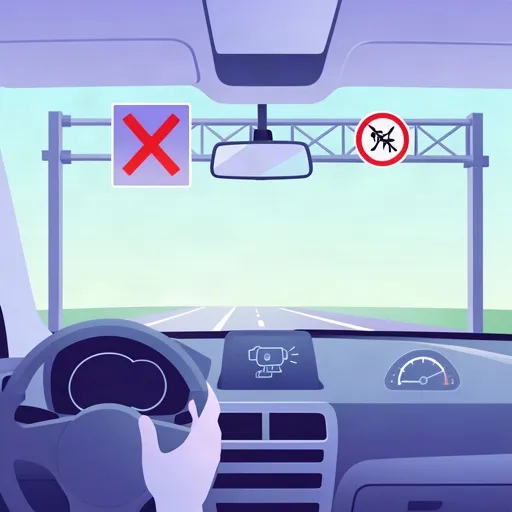
One of the most critical aspects of motorway driving in Belgium is the correct interpretation of lane status indicators. If you see a red cross (X) displayed above a specific lane, it means that lane is closed to traffic ahead, often due to an accident, a breakdown, or emergency roadworks. You must vacate that lane as soon as it is safe to do so. Driving past a red X sign is considered a serious traffic violation and poses an extreme danger to maintenance crews or stranded motorists waiting in the closed lane.
The management centers use these signals to create "safety corridors" or to divert traffic before a major blockage. If you see an X, do not wait until the last second to merge; early, orderly merging facilitates smoother traffic flow and prevents the "accordion effect" that often leads to rear-end collisions during traffic jams.
| Signal Type | Meaning for the Driver |
|---|---|
| Dynamic Speed Sign | Mandatory speed limit; supersedes general limits. |
| Red X above lane | Lane is closed; must vacate immediately. |
| Text Messages | Provides situational awareness (e.g., File, Travaux). |
| Warning Symbols | Alerts you to upcoming hazards like ice or fog. |
Beyond speed and lane control, VMS boards provide essential real-time information using standard terminology. You will frequently see warnings such as "FILE" (traffic jam), "ACCIDENT", or "TRAVAUX" (roadworks). These messages are designed to give you sufficient time to increase your following distance and prepare for sudden deceleration.
When you see a warning for congestion (FILE), the best defensive driving strategy is to turn on your hazard lights briefly to alert drivers behind you that you are approaching the tail end of a queue. This small action is a standard convention in Belgium that significantly reduces the risk of secondary collisions. Always keep your eyes on the road ahead and the gantry signs, as the situation can change rapidly due to the input from the regional traffic management centers.
The enforcement of these rules is strictly handled by the authorities across the three regions of Belgium. Because these signs are updated in real-time, they reflect the current safety requirements of that specific stretch of road. Whether you are driving in Flanders, Wallonia, or the Brussels-Capital Region, the requirement to obey the signs is uniform.
For the theory exam, remember that you are expected to respect the signage exactly as it appears. If you encounter a situation where a gantry sign contradicts a general rule (like the standard motorway speed limit), the sign on the gantry takes priority. This is a fundamental principle of the Belgian Highway Code: specific temporary instructions provided by signs or signals always override general traffic regulations.
Variable message signs on Belgian motorways are legally mandatory tools managed by regional traffic centres such as the Verkeerscentrum and MOBIRIS, displaying enforceable dynamic speed limits and lane closure signals. A red X above a lane means that lane is closed and must be vacated immediately; dynamic speed limits override the standard 120 km/h when displayed. Trajectcontrole average speed enforcement integrates with these signs, automatically adjusting thresholds to match current displayed limits. Early, orderly merging when a lane is closing prevents the accordion effect that leads to secondary collisions. For the theory exam, remember that specific temporary gantry instructions always take priority over general traffic regulations in the Belgian Highway Code.
A short set of high-value points that capture the most important ideas from this article.
Variable speed limits displayed on VMS gantries are legally mandatory and hold the same weight as fixed signs
A red X above a lane signals immediate closure requiring you to vacate as soon as safely possible
Trajectcontrole systems are integrated with dynamic signs and automatically adjust enforcement thresholds to match displayed limits
Gantry signs override general traffic rules whenever they are actively displayed
Real-time alerts like FILE, ACCIDENT, or TRAVAUX require proactive defensive adjustments such as increasing following distance
Dynamic speed limits with a red-bordered circle are mandatory restrictions, not advisory suggestions
Red X violations are serious traffic offences and extremely dangerous to anyone in the closed lane
Merge early when lane closure is indicated to prevent the accordion effect that causes rear-end collisions
The moment a speed limit appears on the display, it governs your maximum permissible speed
Specific temporary signs always take priority over general traffic regulations under Belgian Highway Code rules
Assuming that variable speed limits are merely advisory rather than legally binding instructions
Waiting until the last second to merge when a red X is displayed, creating sudden lane changes and safety risks
Believing the standard 120 km/h motorway limit still applies when a lower dynamic limit is shown
Failing to activate hazard lights briefly when approaching the tail of a FILE (traffic jam) to warn following drivers
Ignoring text messages on VMS that provide context for speed restrictions or upcoming hazards
Article content overview
A short set of high-value points that capture the most important ideas from this article.
Variable speed limits displayed on VMS gantries are legally mandatory and hold the same weight as fixed signs
A red X above a lane signals immediate closure requiring you to vacate as soon as safely possible
Trajectcontrole systems are integrated with dynamic signs and automatically adjust enforcement thresholds to match displayed limits
Gantry signs override general traffic rules whenever they are actively displayed
Real-time alerts like FILE, ACCIDENT, or TRAVAUX require proactive defensive adjustments such as increasing following distance
Dynamic speed limits with a red-bordered circle are mandatory restrictions, not advisory suggestions
Red X violations are serious traffic offences and extremely dangerous to anyone in the closed lane
Merge early when lane closure is indicated to prevent the accordion effect that causes rear-end collisions
The moment a speed limit appears on the display, it governs your maximum permissible speed
Specific temporary signs always take priority over general traffic regulations under Belgian Highway Code rules
Assuming that variable speed limits are merely advisory rather than legally binding instructions
Waiting until the last second to merge when a red X is displayed, creating sudden lane changes and safety risks
Believing the standard 120 km/h motorway limit still applies when a lower dynamic limit is shown
Failing to activate hazard lights briefly when approaching the tail of a FILE (traffic jam) to warn following drivers
Ignoring text messages on VMS that provide context for speed restrictions or upcoming hazards
Explore related topics, search based questions, and concepts that learners often look up when studying Belgian Motorway VMS Rules. These themes reflect real search intent and help you understand how this topic connects to wider driving theory knowledge in Belgium.
Find clear and practical answers to common questions learners often have about Belgian Motorway VMS Rules. This section helps explain difficult points, remove confusion, and reinforce the key driving theory concepts that matter for learners in Belgium.
Yes. Dynamic speed limits displayed on variable message signs are legally binding exactly like fixed speed limit signs. They are actively monitored by trajectcontrole systems, and failing to comply is a punishable offence.
A red X indicates that the lane is closed to traffic. You must vacate the lane immediately and safely merge into an open lane. Driving in a lane marked with a red X is a serious violation of the Belgian Highway Code.
Your obligation to comply with a speed limit shown on a VMS begins the moment it comes into your view. You should adjust your speed progressively to adhere to the new limit as you approach and pass the gantry.
Yes. Regional traffic centers manage the network. In Flanders, it is the Verkeerscentrum, and in the Brussels-Capital Region, it is managed by Brussels Mobility (Mobiris). They use these signs to communicate incidents such as accidents, congestion, or roadworks.
Continue your learning journey by exploring related articles and guides on specific Belgian traffic situations, advanced road signs, or vehicle safety topics. Use our search to pinpoint what you need to review next, deepening your understanding for your driving license theory exam.