
Understanding the transition from urban environments to rural, non-built-up roads is critical for both the Belgian theory exam and your safety on the road. This article explains the legal requirements, regional speed limit variations, and the specific defensive driving behaviors necessary to navigate rural environments effectively.
Article content overview
Driving in Belgium involves frequent transitions between dense urban environments and open rural landscapes. For learner drivers, understanding the distinction between built-up areas and the zones that lie beyond them is essential not only for passing the theory exam but for maintaining safety on the road. In the Belgian Highway Code, "outside built-up areas" (hors agglomération) refers to all public roads that are not classified as urban zones, each governed by specific speed limits and traffic rules that differ significantly from city driving.
The most reliable way to identify your legal status on the road is by observing F1 and F3 traffic signs. These signs act as the legal border markers for built-up areas. When you pass an F1 sign, you enter a built-up area where the speed limit is typically 50 km/h, unless indicated otherwise. Conversely, when you encounter an F3 sign, you are leaving the built-up area and entering a zone where different speed regulations apply.
Understanding these signs is a common focus in the Belgian theory exam. It is vital to remember that once you pass the F3 sign, you must immediately adjust your speed to the regional limit, as urban-specific rules—such as those regarding priority or parking—change significantly in rural settings.
One of the most complex aspects for learners is the regionalization of speed limits. Since 2015, speed regulations outside of motorways have diverged between Flanders, Wallonia, and the Brussels-Capital Region. Failing to account for these regional differences is a frequent cause of errors in both theory and practice.
| Region | Standard Speed Limit (Outside Built-up) | Key Consideration |
|---|---|---|
| Flanders | 70 km/h | Often lower on secondary roads; pay attention to local signage. |
| Wallonia | 90 km/h | General standard, though local signs (C43) may override this. |
| Brussels | 30 km/h | Almost entirely a 30 km/h zone; non-urban stretches are rare and strictly signed. |
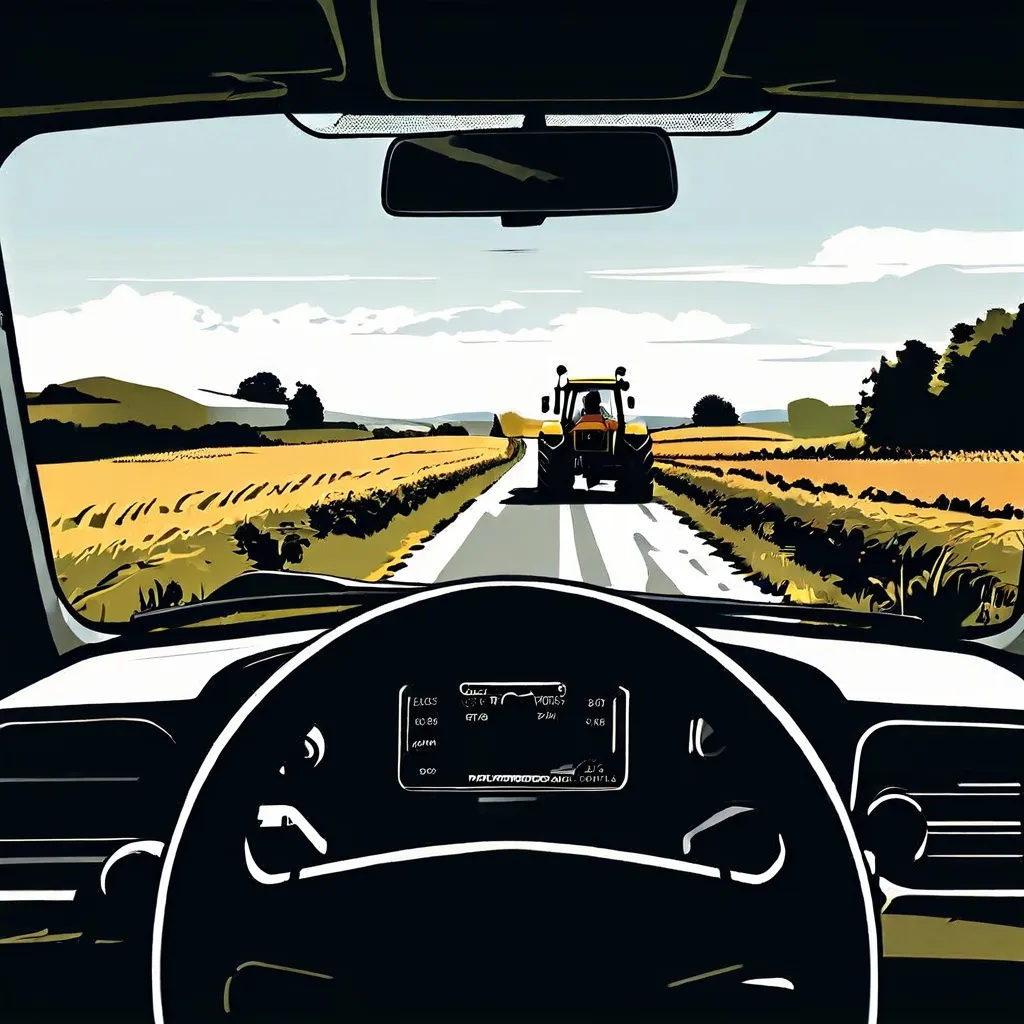
Driving outside built-up areas introduces unique challenges that are not typically encountered in city centers. You will often share the road with heavy agricultural machinery, slow-moving tractors, or livestock. Because these vehicles are significantly wider and slower than passenger cars, you must be prepared to adjust your speed well in advance and only overtake when you have full visibility and sufficient space.
Additionally, rural roads often feature less predictable surfaces, including mud tracked onto the road by farm vehicles or loose gravel near road shoulders. Vulnerable road users, such as cyclists and pedestrians, are also present, often in areas lacking dedicated infrastructure like sidewalks or cycle paths. Defensive driving requires you to constantly scan the horizon, anticipate potential hazards, and recognize that the maximum legal speed is not a target—it is an upper limit that must be reduced if conditions are poor.
Visibility is a major factor in rural safety. On winding roads or during twilight hours, your ability to see and be seen is critical. Statistics from road safety reports indicate that a significant percentage of drivers admit to speeding for the given conditions, such as dense fog or heavy traffic. To succeed in your theory exam and become a safe driver, you must prioritize "safe speed" over "legal speed."
This article explains how to identify transitions between urban and rural zones using F1 and F3 traffic signs, which serve as legal border markers in Belgium. The speed limits outside built-up areas vary significantly by region, with Flanders at 70 km/h, Wallonia at 90 km/h, and Brussels at 30 km/h, though local C43 signs can override these defaults. Rural driving introduces hazards such as agricultural machinery, variable road surfaces, and vulnerable road users that require defensive driving and constant hazard perception. The key principle emphasized is that drivers should prioritize safe speed over legal speed, adjusting their velocity based on actual road and weather conditions rather than simply following the maximum permitted limit.
A short set of high-value points that capture the most important ideas from this article.
F1 signs mark the beginning of a built-up area where the speed limit is generally 50 km/h; F3 signs mark the end, transitioning you to regional rural speed limits
Speed limits outside built-up areas differ by region: Flanders at 70 km/h, Wallonia at 90 km/h, and Brussels at 30 km/h
A posted C43 circular speed limit sign always overrides the general regional speed limit regardless of which region you are in
Rural roads present unique hazards including agricultural machinery, unpredictable road surfaces, and vulnerable road users like cyclists
Safe speed means adjusting your velocity to conditions such as weather, visibility, and traffic density, not just following the legal maximum
F1 = entering built-up area (50 km/h applies), F3 = leaving built-up area (regional limits apply immediately)
Regional base limits: Flanders 70 km/h, Wallonia 90 km/h, Brussels 30 km/h for non-urban roads
C43 signs always take priority over regional defaults - scan for these when entering rural zones
Agricultural vehicles are wider and slower than cars; adjust speed and only overtake with full visibility and space
The maximum legal speed is an upper limit, not a target, especially on winding roads or in poor conditions
Applying the wrong regional speed limit when traveling between Flanders, Wallonia, and Brussels without checking local signs
Ignoring C43 speed limit signs and continuing at the default regional limit
Treating the maximum legal speed as a target rather than an upper limit that must be reduced for conditions
Failing to increase following distance when entering rural roads due to higher speeds and potential debris
Not anticipating agricultural machinery or failing to adjust speed well in advance for slow-moving vehicles
Article content overview
A short set of high-value points that capture the most important ideas from this article.
F1 signs mark the beginning of a built-up area where the speed limit is generally 50 km/h; F3 signs mark the end, transitioning you to regional rural speed limits
Speed limits outside built-up areas differ by region: Flanders at 70 km/h, Wallonia at 90 km/h, and Brussels at 30 km/h
A posted C43 circular speed limit sign always overrides the general regional speed limit regardless of which region you are in
Rural roads present unique hazards including agricultural machinery, unpredictable road surfaces, and vulnerable road users like cyclists
Safe speed means adjusting your velocity to conditions such as weather, visibility, and traffic density, not just following the legal maximum
F1 = entering built-up area (50 km/h applies), F3 = leaving built-up area (regional limits apply immediately)
Regional base limits: Flanders 70 km/h, Wallonia 90 km/h, Brussels 30 km/h for non-urban roads
C43 signs always take priority over regional defaults - scan for these when entering rural zones
Agricultural vehicles are wider and slower than cars; adjust speed and only overtake with full visibility and space
The maximum legal speed is an upper limit, not a target, especially on winding roads or in poor conditions
Applying the wrong regional speed limit when traveling between Flanders, Wallonia, and Brussels without checking local signs
Ignoring C43 speed limit signs and continuing at the default regional limit
Treating the maximum legal speed as a target rather than an upper limit that must be reduced for conditions
Failing to increase following distance when entering rural roads due to higher speeds and potential debris
Not anticipating agricultural machinery or failing to adjust speed well in advance for slow-moving vehicles
Explore related topics, search based questions, and concepts that learners often look up when studying Rural Driving Rules in Belgium. These themes reflect real search intent and help you understand how this topic connects to wider driving theory knowledge in Belgium.
Find clear and practical answers to common questions learners often have about Rural Driving Rules in Belgium. This section helps explain difficult points, remove confusion, and reinforce the key driving theory concepts that matter for learners in Belgium.
The F1 sign marks the beginning of a built-up area, while the F3 sign indicates the end of a built-up area, marking the transition to rural driving rules.
Speed limits outside built-up areas are regionalized. Flanders generally sets a limit of 70 km/h on these roads, while the default limit in Wallonia is 90 km/h, though local signage can always override these defaults.
No, Belgian law requires you to always adapt your speed to road conditions, traffic density, visibility, and the presence of vulnerable road users, regardless of the maximum legal speed limit.
Rural roads often present hazards such as agricultural machinery, mud on the road, narrow lanes, blind curves, and the presence of cyclists and pedestrians who may lack proper infrastructure.
Continue your learning journey by exploring related articles and guides on specific Belgian traffic situations, advanced road signs, or vehicle safety topics. Use our search to pinpoint what you need to review next, deepening your understanding for your driving license theory exam.