
Driving in Belgium requires constant adaptation to wet conditions, from handling the slippery 'first-rain' oil effect in cities to managing visibility in dense morning fog. This guide clarifies your legal responsibilities under the Belgian Highway Code, specifically regarding speed adjustment and light usage. By mastering these concepts, you will be prepared to handle unpredictable weather while meeting the high standards required for your theory exam.
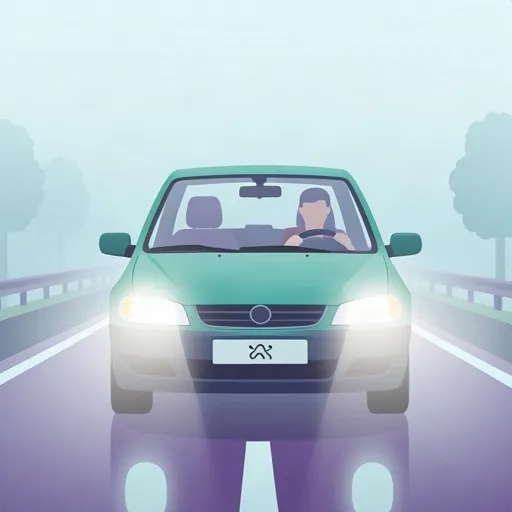
Article content overview
Navigating Belgian roads requires more than just mechanical skill; it demands a deep understanding of how weather conditions transform the driving environment. Given that Belgium experiences precipitation on approximately 200 days per year, wet weather is a constant factor rather than an occasional challenge. Whether you are traversing the misty hills of the Ardennes, negotiating the busy streets of Brussels, or driving through the Meuse valley, your ability to adapt to rain and fog is a fundamental competency required for your theory exam and your lifelong safety as a driver.
One of the most frequent hazards in Belgian urban environments is the "first rain" effect. After a dry period, road surfaces—particularly in cities—accumulate layers of dust, rubber particles, and petroleum residue. When light rain begins to fall, these substances emulsify into a thin, highly slippery film that drastically reduces tire-road friction. Drivers must exercise extreme caution during the first few minutes of a downpour, as the risk of losing control during braking or cornering is at its highest.
On motorways, the risk shifts toward aquaplaning. Even with adequate drainage, pooling can occur in areas where road surface rutting, or spurrillen, has developed over time. Aquaplaning occurs when your tires lose contact with the asphalt, floating on a layer of water. If you feel your steering suddenly become light and unresponsive, it is crucial to remain calm. Do not slam on the brakes or make sharp steering inputs, as this will lead to a total loss of traction. Instead, release the accelerator, keep the steering wheel straight, and allow the engine to provide natural braking until you feel the tires regain contact with the road.
The Belgian Highway Code sets strict rules for when and how to use vehicle lighting. Misunderstanding these rules is a common trap in the theory exam. The primary objective of these regulations is to ensure you remain visible without dazzling other road users, which is why the use of fog lights is specifically regulated.
According to the Belgian Highway Code, front fog lights may be used only during conditions of fog, snow, or heavy rain that reduce visibility to less than 200 metres. Rear fog lights must be used in the same conditions. Crucially, these lights are prohibited when visibility is sufficient, as they create an intense glare that blinds drivers behind you or approaching you.
It is important to remember that heavy rain is not explicitly defined by a specific millimetre measurement in the Code, but the standard practice is to adopt the "100-metre/200-metre" visibility threshold. If you can see clearly beyond 200 metres, you must deactivate your fog lights. Failure to adhere to these lighting protocols is not only a safety risk but can also result in fines during police checks.
In the context of the Belgian theory test, speed adaptation is governed by the principle of driving at a speed that allows you to stop within the distance you can clearly see. This means that if visibility is limited by dense fog in the Meuse valley or heavy downpours, your maximum allowable speed must decrease significantly, even if the posted limit is higher.
| Condition | Hazard Level | Recommended Adaptation |
|---|---|---|
| Light Rain | Moderate | Increase following distance to at least 2 seconds. |
| Heavy Rain | High | Use dipped headlights; reduce speed; watch for pooling. |
| Dense Fog | Very High | Use fog lights; reduce speed to match visible distance. |
| Snow/Ice | Critical | Extreme caution; avoid unnecessary travel; expect lower friction. |
Common theory exam trap: Many candidates mistakenly believe they should use full-beam headlights in fog. This is incorrect. High beams will reflect off the water droplets, creating a "white wall" effect that makes visibility even worse. Always use dipped headlights (or fog lights where appropriate) in these conditions.
When answering questions about weather-related hazards, always prioritize safety and the correct usage of vehicle technology. Pay close attention to questions about "stopping distance," which increases significantly on wet pavement—often doubling compared to dry conditions. By mastering these rules now, you will not only pass the theory exam but also develop the defensive driving habits required for the unique challenges of the Belgian road network.
This article covers essential Belgian regulations for driving in adverse weather, focusing on three core areas: the hidden danger of urban 'first rain' oil slicks, motorway aquaplaning and correct recovery technique, and the legal requirements for fog light usage under the 200-metre visibility threshold. It emphasizes that speed must always be adapted to what you can see, and that stopping distances roughly double on wet surfaces. A key exam trap highlighted is the misconception about using high-beam headlights in fog. The content is directly relevant to Belgian theory test questions on weather-related hazards and lighting regulations.
A short set of high-value points that capture the most important ideas from this article.
The 'first rain' effect creates a highly slippery oil film on urban roads after dry periods, making the first minutes of rainfall particularly dangerous
During aquaplaning, release the accelerator and keep steering straight to allow tires to regain road contact—never brake sharply or make sudden steering inputs
Front and rear fog lights may only be used when visibility drops below 200 metres due to fog, snow, or heavy rain
Your speed must always allow you to stop safely within the distance you can clearly see ahead, regardless of posted speed limits
Stopping distances on wet roads can roughly double compared to dry conditions, requiring significantly greater following gaps
Fog light rule: 200 metres visibility threshold—deactivate fog lights when you can see beyond 200 metres to avoid blinding other drivers
Aquaplaning response: ease off accelerator, straight steering, let engine braking slow you down naturally
First rain hazard: increase caution during the initial minutes of rainfall in urban areas when oil and rubber residue mix with water
Speed adaptation principle: drive at a speed that allows you to stop within your visible stopping distance
High beams in fog create a dangerous 'white wall' effect—always use dipped headlights or fog lights instead
Using full-beam headlights in fog, which reflects off water droplets and worsens visibility instead of improving it
Leaving fog lights on when visibility exceeds 200 metres, blinding drivers behind you and leading to fines
Slamming on the brakes during aquaplaning, which causes total loss of traction and control
Assuming posted speed limits are safe regardless of current weather conditions and visibility
Underestimating stopping distance increases on wet roads and maintaining inadequate following distances
Article content overview
A short set of high-value points that capture the most important ideas from this article.
The 'first rain' effect creates a highly slippery oil film on urban roads after dry periods, making the first minutes of rainfall particularly dangerous
During aquaplaning, release the accelerator and keep steering straight to allow tires to regain road contact—never brake sharply or make sudden steering inputs
Front and rear fog lights may only be used when visibility drops below 200 metres due to fog, snow, or heavy rain
Your speed must always allow you to stop safely within the distance you can clearly see ahead, regardless of posted speed limits
Stopping distances on wet roads can roughly double compared to dry conditions, requiring significantly greater following gaps
Fog light rule: 200 metres visibility threshold—deactivate fog lights when you can see beyond 200 metres to avoid blinding other drivers
Aquaplaning response: ease off accelerator, straight steering, let engine braking slow you down naturally
First rain hazard: increase caution during the initial minutes of rainfall in urban areas when oil and rubber residue mix with water
Speed adaptation principle: drive at a speed that allows you to stop within your visible stopping distance
High beams in fog create a dangerous 'white wall' effect—always use dipped headlights or fog lights instead
Using full-beam headlights in fog, which reflects off water droplets and worsens visibility instead of improving it
Leaving fog lights on when visibility exceeds 200 metres, blinding drivers behind you and leading to fines
Slamming on the brakes during aquaplaning, which causes total loss of traction and control
Assuming posted speed limits are safe regardless of current weather conditions and visibility
Underestimating stopping distance increases on wet roads and maintaining inadequate following distances
Explore related topics, search based questions, and concepts that learners often look up when studying Rain and Fog Driving Rules. These themes reflect real search intent and help you understand how this topic connects to wider driving theory knowledge in Belgium.
Find clear and practical answers to common questions learners often have about Rain and Fog Driving Rules. This section helps explain difficult points, remove confusion, and reinforce the key driving theory concepts that matter for learners in Belgium.
You may only use front and rear fog lights when visibility is reduced to less than 200 meters due to fog, snow, or heavy rain. Using them in clear conditions is prohibited because they can blind other drivers.
Urban roads accumulate oil and rubber residue during dry spells. When it first rains, this residue emulsifies, creating a slippery film that significantly reduces tire grip before the road is washed clean.
The cardinal rule is that you must always be able to stop your vehicle within the distance you can clearly see ahead. If visibility drops, you must reduce your speed accordingly.
Stay calm and avoid sudden braking or steering, which can cause you to lose total control. Gradually lift your foot off the accelerator and let engine braking slow the car until the tires regain traction with the road surface.
Continue your learning journey by exploring related articles and guides on specific Belgian traffic situations, advanced road signs, or vehicle safety topics. Use our search to pinpoint what you need to review next, deepening your understanding for your driving license theory exam.